Extra Practice Material GCSE Polish: Is It Worth It?
Extra practice material GCSE polish: learn what to ask your teacher for, how to show effort and how to turn targeted questions into exam marks.
A difficult mock paper can create two opposite thoughts. The first is useful: I need more practice. The second is less helpful: If I ask for more work, will my teacher think I have ignored everything already given to me?
When students search for extra practice material GCSE polish, they are usually looking for that final layer of GCSE maths preparation: targeted questions that turn uncertain methods into dependable ones. Yes, it is worth asking your teacher. The key is to show what you have attempted, identify the exact gap and request a manageable resource rather than simply asking for “more worksheets”.
That approach does not suggest a lack of effort. It demonstrates ownership of your revision.
The short answer: ask, but ask specifically
A teacher can help you choose material that matches your exam board, foundation or higher tier, and present level. That matters because an impressive-looking pile of questions is not automatically useful.
Before starting the conversation, prepare this short checklist:
- Confirm your exam board: Edexcel, AQA, OCR or Eduqas.
- Confirm whether you are taking foundation or higher tier.
- Identify between 111 and 333 precise topics.
- Bring evidence of what you have already attempted.
- Explain whether you need to learn, practise or test the skill.
- Ask for material with answers, a mark scheme or feedback where possible.
- Agree when you will complete it.
You can begin that process independently through the free GCSE maths revision hub, where MathsGenie organises lessons, exam questions and papers by board and topic.
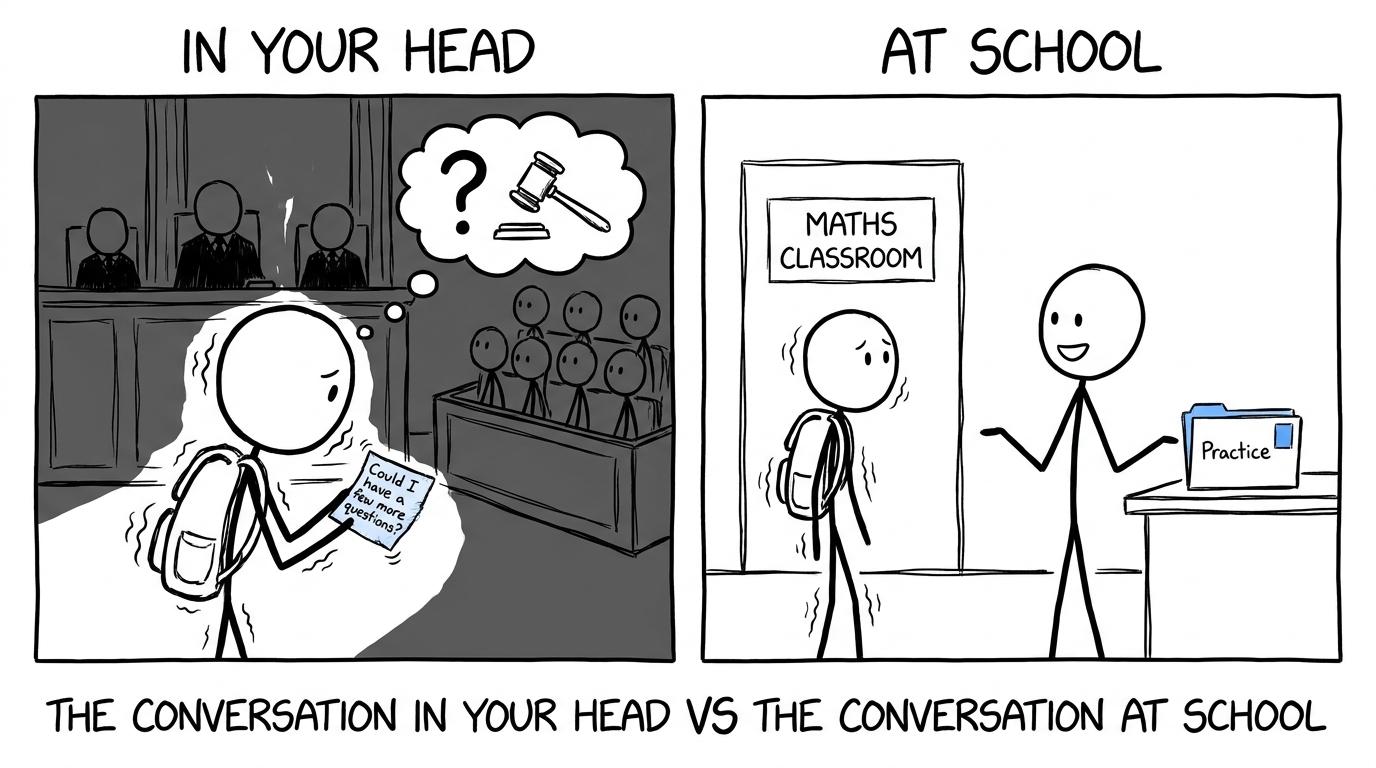 A student imagines a dramatic confrontation before making a simple request for practice questions
Why extra material can improve GCSE maths revision
Current GCSE maths specifications assess more than the ability to repeat a familiar calculation. Across exam boards, the assessment objectives cover using standard techniques, mathematical reasoning and solving problems. Foundation and higher papers therefore include routine skills alongside questions that require interpretation, communication and decisions about which method to use.
This is why one worksheet may not be enough. You may be able to solve equations when the instruction says “solve”, yet hesitate when an equation is hidden inside a worded problem. The underlying maths is similar, but the demand is different.
Extra practice is most valuable when it serves one of three purposes.
Building fluency
Fluency practice helps when you understand a method but still perform it slowly or make frequent accuracy errors. Short sets of related questions can make the sequence of steps more reliable.
Meeting varied question styles
Exam questions do not always present a topic in its most recognisable form. Mixed and unfamiliar questions make you decide what information matters and which method applies. That supports the reasoning and problem-solving demands found in GCSE specifications.
Testing performance under pressure
A topic can feel secure with notes open and become less secure in a timed paper. Mini tests and paper sections reveal whether you can retrieve the method without prompts. MathsGenie’s GCSE twenty-minute revision routine offers a practical way to combine recall, questions and marking on busy school days.
How to ask without sounding as though you are not trying
The tone of your request matters less than its evidence. Teachers generally do not need a polished speech. They need enough information to recommend the right next step.
A strong request has four parts:
- what you have completed;
- what went wrong;
- what you think you need;
- what you will do with the material.
You could say:
I completed the questions from this week and marked them. I am still losing marks when the topic appears in a longer problem, although I can do the basic questions. Could you recommend a short set of exam-style questions for my tier? I will complete them before Friday and bring back the questions I cannot resolve.
This wording quietly answers the teacher’s likely concerns. You have tried. You have marked your work. You have diagnosed a specific weakness. You are requesting a focused amount and committing to use it.
If speaking after a lesson feels uncomfortable, ask whether you can send the same information through your school’s normal communication system. Keep it concise and use the channel your teacher expects.
Show your teacher useful evidence
“Algebra is bad” is difficult to act on. “I can expand single brackets, but I lose the negative sign when expanding and simplifying” gives your teacher a clear target.
Useful evidence might include:
- a marked class worksheet;
- a mock paper with repeated errors highlighted;
- a list of questions you could not start;
- an error log containing one sentence per mistake;
- your scores from two attempts at the same topic;
- a note showing whether the difficulty was knowledge, accuracy or timing.
Marking is essential here. An unmarked worksheet proves completion, but it does not reveal what needs to change. The guide to using GCSE mark schemes explains how to distinguish method errors, accuracy slips and incomplete communication.
You do not need to produce a complicated revision spreadsheet. A page divided into “topic”, “mistake” and “next action” is enough. The purpose is diagnosis, not administration.
Ask for the right kind of extra practice
The phrase “extra material” can mean several different things. Ask for the format that matches your problem.
Topic questions
Choose these when a particular method is insecure. Ask for questions at the correct tier and, if possible, a gradual increase in difficulty.
Mixed questions
Use mixed practice when you know individual methods but struggle to select the correct one. This prevents the worksheet heading from giving away the technique.
Mini tests
A short test is useful when you need retrieval and timing practice without completing a full paper. It can also show whether last week’s revision has remained secure.
Past papers
Past papers provide realistic wording, marks and paper structure. They are most useful after you have repaired the main topic gaps. Students taking Pearson can use the Edexcel GCSE maths past papers with mark schemes and available solutions.
Predicted or practice papers
Predicted papers can provide fresh exam-style practice, but they cannot guarantee what will appear in the real examination. Treat them as unseen practice rather than forecasts. They should complement official past papers and specification-based topic revision, not replace them.
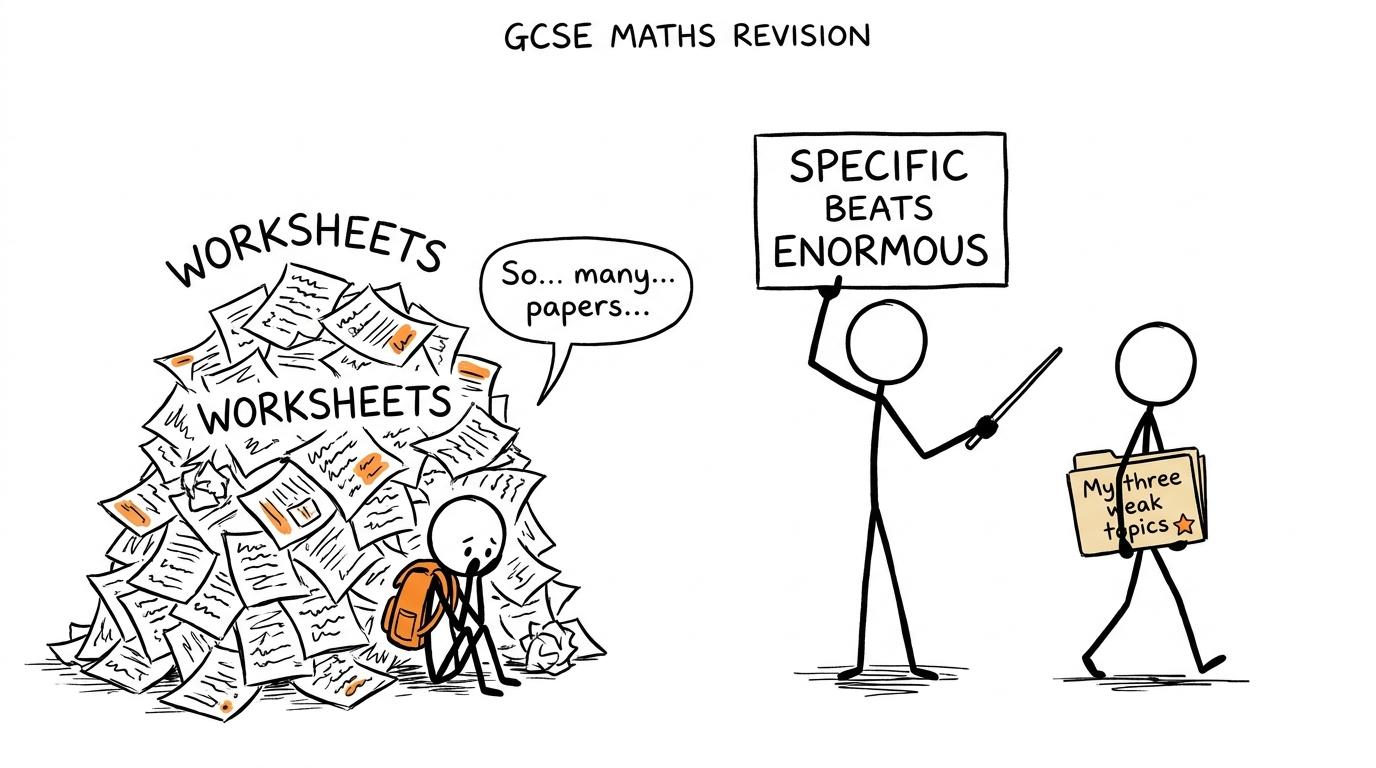 One student is buried under worksheets while another carries a targeted folder
Match the material to your board and tier
GCSE maths content has substantial common ground, but paper structures and presentation can differ between Edexcel, AQA, OCR and Eduqas. Even the location of the non-calculator paper is not identical across every board. Always confirm your board, tier and current specification before requesting or downloading papers.
Foundation questions are designed around the foundation content and available grade range, while higher papers contain additional material and greater mathematical demand. A higher-tier worksheet is not automatically better. If it is too far beyond your current course, it can consume time without repairing the skill costing you marks.
A useful question is:
Is this material suitable for my exam board and tier, and is it the right difficulty for what I need to improve next?
Your teacher can answer that more reliably when you bring marked evidence. You can then organise the recommendation within a realistic GCSE maths revision timetable, rather than adding it to an undefined pile for “later”.
Turn new questions into better marks
Receiving a worksheet is not the finish line. It is the beginning of a feedback loop:
- attempt the questions without immediately checking notes;
- mark the work carefully;
- locate the first incorrect step;
- write a brief correction rule;
- retry the question without copying;
- complete a similar question;
- revisit the skill on another day.
This turns quantity into learning. Doing 303030 questions while repeating the same misunderstanding is less useful than doing 888, correcting them properly and returning to the topic later.
Spacing also matters. A method that works immediately after a lesson may depend on short-term familiarity. Revisiting it after a gap tests whether you can retrieve it independently. The plan for stopping GCSE maths content from fading shows how lessons, retrieval and exam questions can fit into repeated revision cycles.
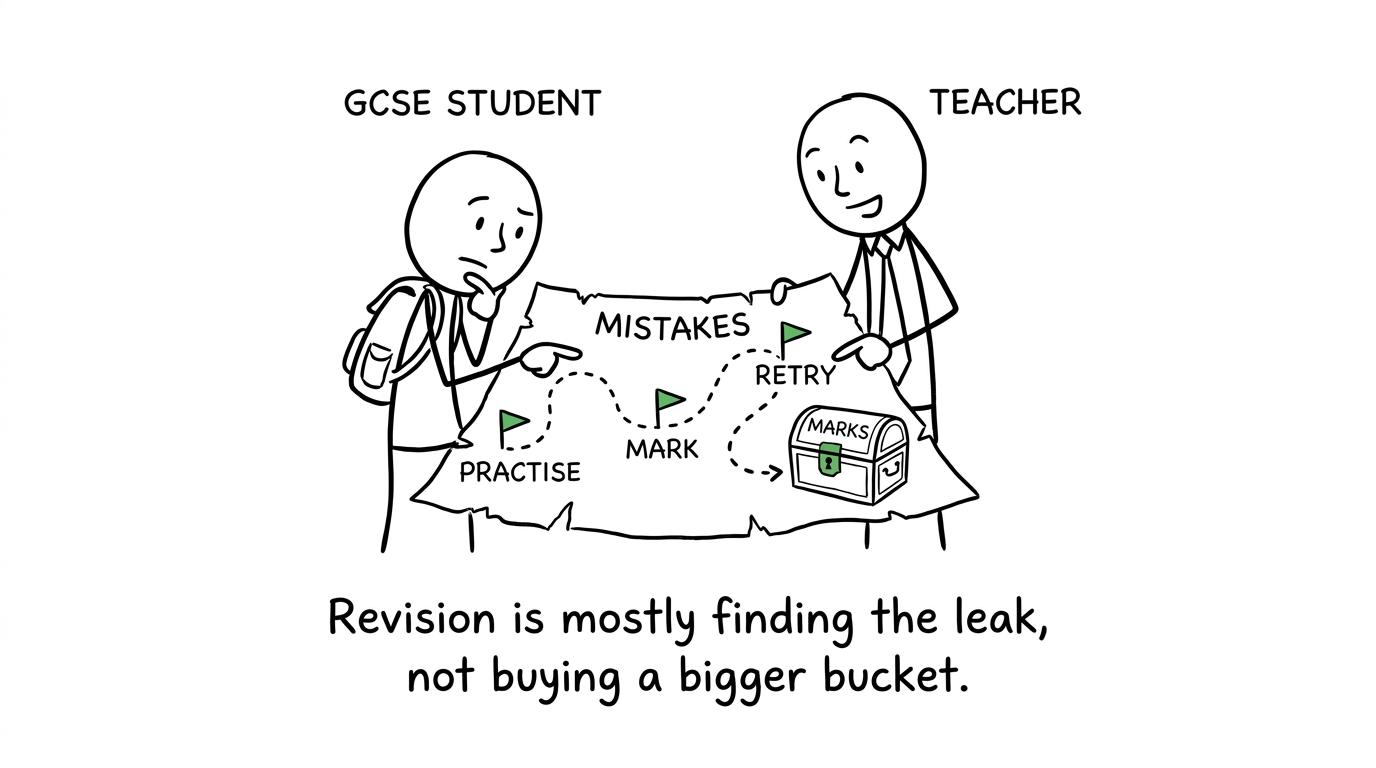 A teacher and student follow a mistake map towards recovered marks
What to do if your teacher cannot provide more
A teacher may be unable to create or print additional material immediately. That does not mean the request was unreasonable. Ask for direction instead:
- Which topic should I prioritise?
- Which existing worksheet should I repeat without notes?
- Which past-paper questions match this weakness?
- Should I focus on fluency or longer problems?
- Can I bring one completed set back for feedback?
Then use MathsGenie to follow that recommendation. Start with a revision lesson, move to practice questions, mark your answers and finish with a mini test or paper section. Near the examination, the GCSE maths exam-week checklist can help you keep this work proportionate and calm.
Common mistakes when requesting more material
Asking for everything
A request for “all the higher worksheets” feels ambitious but creates no priority. Ask for one topic or one manageable set first.
Hiding what you have not completed
If you still have unfinished material, say so honestly. Ask whether you should finish it before moving on. More paper is not the solution when the real obstacle is time or uncertainty about the first question.
Requesting questions without answers or feedback
Practice needs correction. Whenever possible, ask whether a mark scheme, answers, video solution or later feedback is available.
Choosing material because it looks difficult
Difficulty is not the same as relevance. The best question is often the one that exposes the exact step you repeatedly miss.
Completing work but never returning to mistakes
A crossed answer contains useful information. Correct it, retry it and schedule another attempt. Otherwise, the worksheet records the weakness without changing it.
Make the conversation your next revision step
Asking for extra practice is not an admission that you have failed to try. Done well, it shows that you have moved beyond vague worry and found a precise problem to solve.
Bring one marked piece of work. Name one weakness. Ask for one appropriate set. Agree when you will complete it. That is enough.
Then make MathsGenie your free revision base. Use the GCSE maths revision resources to learn through revision lessons, build fluency with practice questions, check progress with mini tests and prepare under pressure with past papers and predicted papers. Mark your attempts, use video solutions where available and take your specific unanswered questions back to your teacher.
The aim is not to collect more material. It is to make each new question tell you what to do next.