Evening Classes GCSE English Language: Worth It?
Evening classes GCSE English Language guide: compare adult courses with self-study, including costs, time, feedback, funding and the best choice.
For many adults, the hardest part of returning to GCSE English is not analysing a text or planning an article. It is opening the front door after work and finding enough energy to begin. That is why evening classes GCSE English Language courses can be worth it: they provide structure, specialist feedback and a recognised exam-entry route. But they are not automatically better than self-study.
The practical answer is simple. Choose an evening class if you need regular deadlines, feedback on writing, access to the spoken language assessment or help arranging the exams. Choose self-study if your foundations are secure, you can mark your progress honestly and you already have an exam centre. Before paying, check whether you qualify for a funded course; many eligible adults in England can study GCSE English Language without tuition fees.
The quick decision checklist
An adult evening course is more likely to be worthwhile if:
- you do not already hold GCSE English at grade 444 or above;
- writing is difficult to assess without a teacher;
- you need external accountability to stay consistent;
- you want a centre to manage exam entry and the spoken language endorsement;
- the timetable fits your work and caring responsibilities;
- the full cost, including travel and materials, is affordable or funded.
Self-study may be the better route if:
- you can already work close to your target grade;
- you understand your exam board's papers and assessment objectives;
- you can obtain useful feedback from a teacher or tutor when needed;
- fixed weekly attendance would cause more stress than structure;
- you have confirmed where and when you can sit the qualification.
The choice is not really between being taught and learning alone. It is between two systems. The better system is the one you can keep following when motivation becomes ordinary.
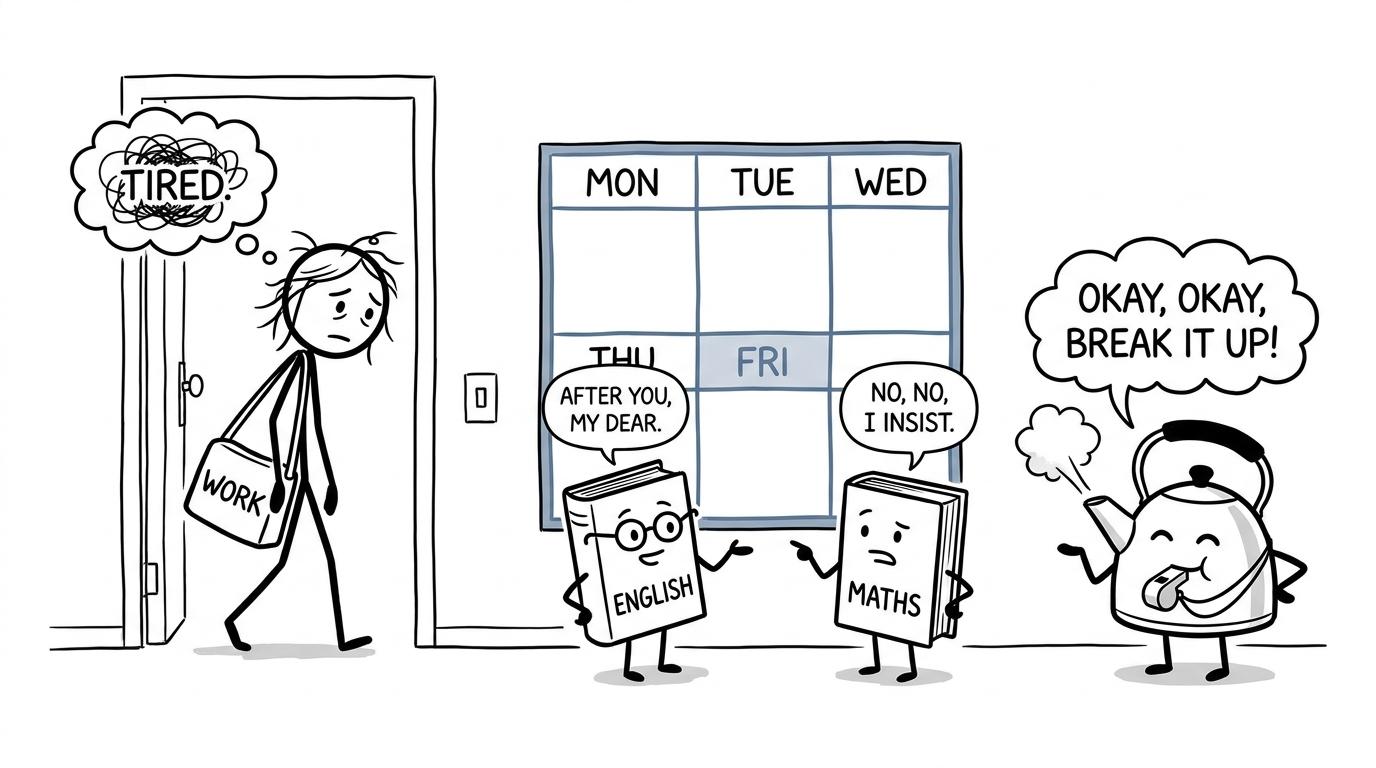 An adult learner balancing English, maths and an evening calendar
What adult GCSE English evening classes involve
Most adult courses run across an academic year and combine weekly teaching with independent work. Current college listings commonly advertise one evening lesson each week, often lasting around three hours, although formats vary by provider. Some colleges also expect several hours of independent practice between sessions.
Admission is not always automatic. A provider may use an initial assessment or interview to decide whether GCSE is the right level. If your current reading and writing skills need more development, it may recommend Functional Skills English or another stepping-stone qualification first. That is not a lesser judgement. A one-year GCSE course moves quickly, so starting at an appropriate level protects both your time and confidence.
GCSE English Language is assessed according to the specification offered by the centre, which could be AQA, Edexcel, OCR or Eduqas. Paper structures and question styles differ, so ask which exam board you will follow before enrolling. The qualification also includes a compulsory spoken language endorsement. It is reported separately as Pass, Merit, Distinction or Not Classified and does not contribute to the main GCSE grade.
That detail matters for private candidates. A course does more than explain reading and writing: it may provide the centre-based arrangements needed to complete the endorsement and sit the written papers.
What you are really paying for
The obvious product is tuition. The more valuable product is often reduced uncertainty.
A good course tells you what to do next, when to submit it and why an answer has not yet reached the required standard. English writing is particularly difficult to self-mark because recognising a strong paragraph is not the same as diagnosing your own paragraph. A teacher can identify whether the underlying problem is selection of evidence, explanation, organisation, vocabulary, sentence control or accuracy.
You may also gain:
- a sequence built around one exam-board specification;
- regular reading and writing tasks;
- feedback connected to assessment objectives;
- timed practice under controlled conditions;
- classmates who make attendance feel normal;
- support with entry, exam dates and administrative requirements.
This is similar to effective maths revision. A resource becomes useful when it closes the loop between learning, practice and correction. Maths students can build that loop through the free GCSE Maths revision hub, where revision lessons lead into questions, mark schemes and paper practice. In English, a well-run class provides the human feedback that is harder to reproduce with an answer sheet.
Are evening classes free for adults?
They can be, but eligibility must be checked with the provider.
Under England's adult funding rules for the 202520252025 to 202620262026 funding year, eligible adults aged 191919 or over can receive full funding for GCSE English or maths up to Level 222 if they have not previously attained GCSE grade 444 or above, subject to residency and other funding conditions. Devolved authorities can administer adult funding locally, so the precise process may depend on where you live.
Do not assume that every advertised course is free. Some providers publish a full fee for learners who are ineligible for public funding, already hold the relevant qualification or do not meet residency rules. There may also be smaller costs for materials, books, travel, parking or childcare.
Ask the college for a written breakdown covering:
- tuition and examination fees;
- eligibility evidence;
- materials or registration charges;
- resit arrangements;
- financial support for travel or childcare;
- the refund policy if your circumstances change.
A course that costs nothing in tuition still carries a time cost. Equally, a paid course may be poor value if feedback is rare or the class format does not suit you.
Evening class versus self-study
| Consideration | Evening class | Self-study |
|---|---|---|
| Structure | Fixed lessons and deadlines | Fully flexible |
| Feedback | Regular teacher feedback may be included | Must be arranged independently |
| Exam administration | Often managed by the provider | You must find and confirm a centre |
| Spoken language endorsement | Usually arranged through the centre | Must be discussed with the exam centre |
| Direct cost | May be funded or fee-paying | Resources may be inexpensive, but centre fees can apply |
| Time commitment | Travel plus fixed attendance | Can fit around work and family |
| Best suited to | Learners needing guidance and accountability | Independent learners with secure foundations |
Self-study looks cheaper because the visible price is lower. Yet hidden tasks remain: choosing the correct specification, locating suitable papers, securing an exam entry and obtaining informed feedback. If those tasks repeatedly delay progress, the saving is mostly theoretical.
An evening course has a different risk. You can attend every week without doing enough independent practice. Presence is not the same as preparation.
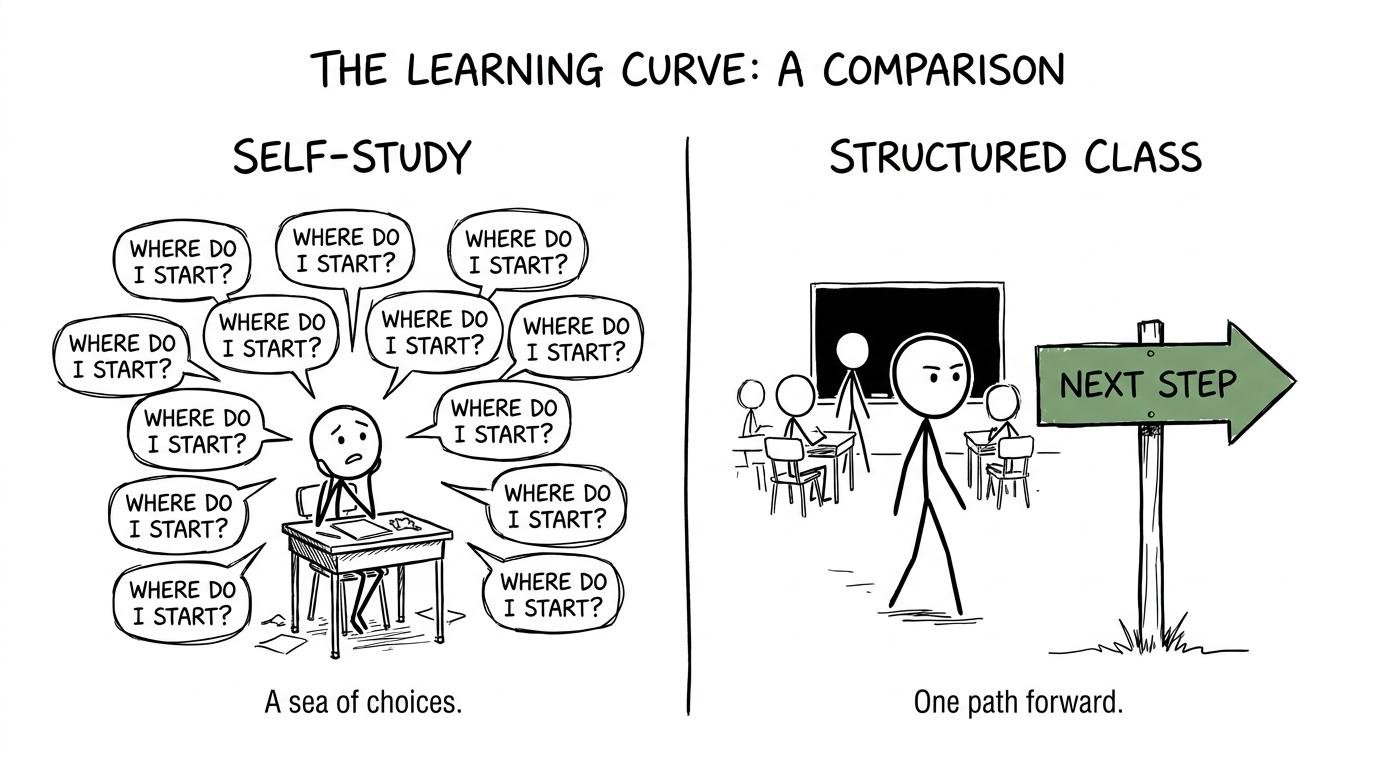 A humorous comparison between scattered self-study and a structured class
When self-study is genuinely enough
Self-study can work well when you treat it as a planned course rather than a collection of videos and worksheets. Confirm your exam board first, download its current specification and build practice around the actual papers you will sit.
A sensible weekly system includes:
- one focused reading session;
- one planned writing task;
- one timed paper section;
- careful review of errors;
- periodic feedback from someone who understands GCSE assessment.
The same principle can protect your maths preparation if you are taking both subjects. Start by checking the GCSE maths topics for each exam board and tier, then use a realistic GCSE maths revision timetable. A plan should remove decisions, not fill every free hour.
If exams are approaching, the one-month GCSE maths revision plan shows how to diagnose weak areas, practise actively and build towards timed work. The subject is different, but the revision logic carries across: attempt, receive feedback, correct and repeat.
How to judge a course before enrolling
A course title tells you very little about the experience inside the classroom. Contact the provider and ask specific questions.
Check the teaching and feedback
Find out how often you will complete full reading and writing tasks, how quickly work is returned and whether feedback explains your next action. Ask about class size and whether lessons are face-to-face, online or blended.
Confirm the qualification arrangements
Ask which exam board is used, whether the provider enters learners for the exams, where papers are sat and how the spoken language endorsement is completed. Confirm the attendance expectations and all compulsory exam dates before committing.
Test the timetable honestly
Imagine a cold weekday evening after a demanding day. Can you still reach the class reliably? If not, ask about online attendance, alternative sessions or recorded support. Optimistic calendars are easy to create. Repeatable calendars are valuable.
For maths, apply the same realism. Short Edexcel GCSE Maths mini tests can fit around a busy evening more easily than an unplanned three-hour session. When you are ready for longer work, use GCSE past-paper guidance to phase timed practice sensibly.
Balancing GCSE English with maths revision
Adults retaking English frequently need maths too, while school-age learners may be preparing for both subjects simultaneously. The danger is allowing whichever subject feels easier to consume all available time.
Give each subject a defined role. English needs sustained reading, drafting and feedback. Maths needs active question practice, visible working and correction. Keep sessions short enough to repeat, and protect at least one evening without revision.
For maths, follow the best order for learning GCSE topics rather than jumping randomly between difficult questions. Once methods are secure, move into past papers, mark schemes and GCSE predicted papers. Predicted papers should sharpen preparation near the exam; they should not replace broad specification coverage.
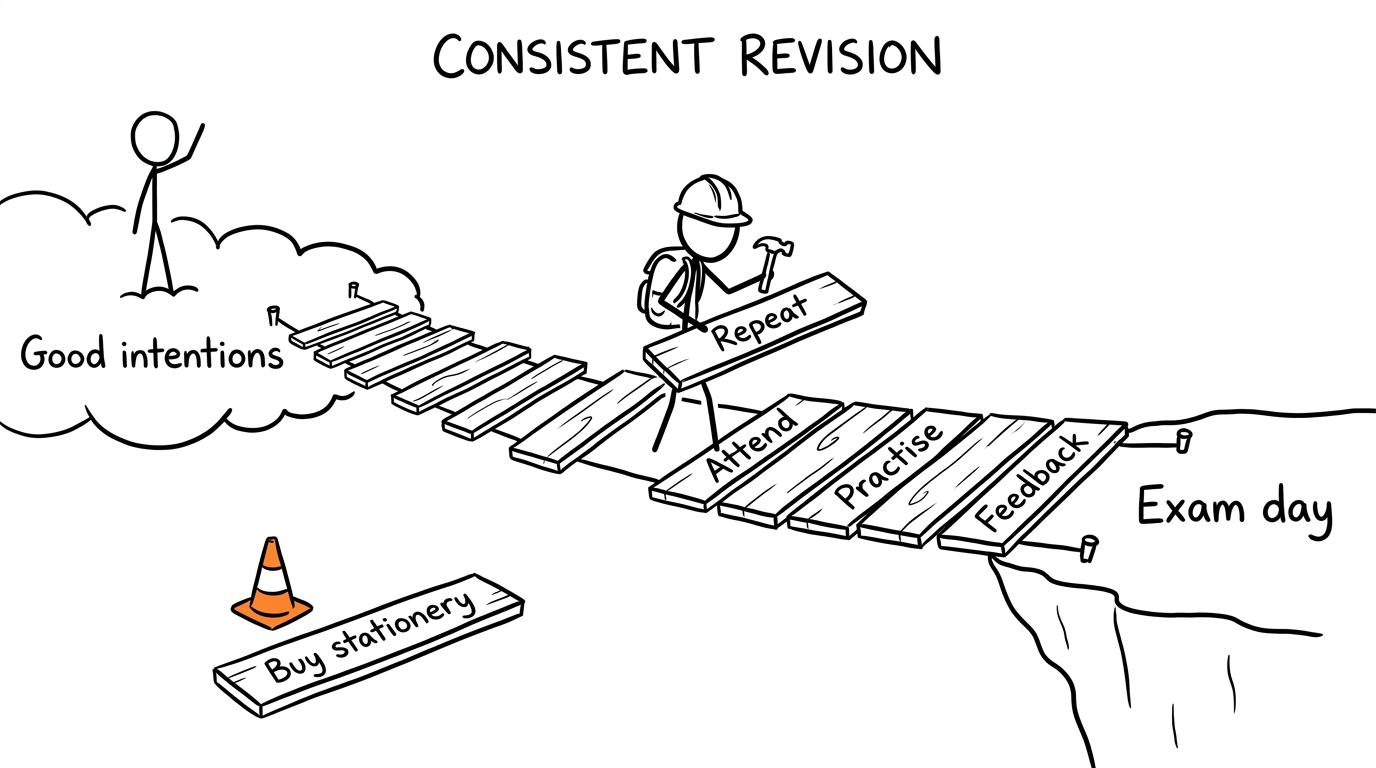 A learner building a bridge from good intentions to exam day
Common mistakes when choosing an evening course
Enrolling before checking funding. Eligibility is individual and regional administration can vary. Ask the provider rather than relying on an old course listing.
Ignoring the exam board. AQA, Edexcel, OCR and Eduqas do not use identical paper structures. Your preparation must match the specification taught.
Assuming attendance replaces independent work. Weekly teaching creates direction, but reading and writing improve through practice between lessons.
Choosing GCSE when another level is more appropriate. An initial assessment may reveal that Functional Skills or a preparatory course is the stronger first step.
Forgetting exam-centre arrangements during self-study. Finding resources is not the same as securing an entry. Confirm written exams and the spoken language endorsement early.
Building an impossible timetable. A plan that ignores work, travel, family and maths revision will eventually break. Leave catch-up space and schedule fewer sessions than you can sustain.
So, are evening classes actually worth it?
Yes, when they solve a problem you cannot solve reliably alone. If you need feedback, structure, exam administration and a weekly commitment, a suitable adult evening course can be excellent value, particularly when you qualify for full funding. If you are already close to your target, have access to informed feedback and can organise the assessment independently, self-study may be more efficient.
Do not judge the decision by the number of classroom hours. Judge it by whether the course creates regular, corrected practice and leads to a valid exam entry.
While your college or chosen provider supports English, let MathsGenie organise the maths side of your week. Use the free revision lessons, practice questions and mini tests to repair weak topics, then move into past papers, mark schemes, video solutions and predicted papers. Start at the MathsGenie GCSE Maths revision hub, choose your board and tier, and make the next session small enough to begin tonight.