Evening Classes GCSE Art and Design: Worth It?
Evening classes GCSE Art and Design compared with self-study: weigh tuition, feedback, studio access, hidden costs and pressure on maths revision.
The difficult part is rarely deciding whether you enjoy art. It is deciding whether enjoyment justifies another fixed commitment after work, family responsibilities and GCSE maths revision have already claimed their share of the week.
For most adult learners, evening classes GCSE Art and Design are worth it when they provide three things that are difficult to reproduce alone: regular expert feedback, access to suitable facilities and a centre that can manage assessment and exam-board requirements. Self-study can cost less and offer more freedom, but GCSE Art and Design is portfolio-led. That makes reliable guidance and access to an approved assessment centre unusually important.
The real question is not simply, “Could I learn to draw by myself?” You probably could. It is whether self-study can take you efficiently from personal practice to a correctly assessed GCSE while leaving enough energy for your other qualifications.
The quick verdict
Evening classes are usually the stronger choice if you:
- want a recognised GCSE rather than art lessons for enjoyment;
- need deadlines and accountability to keep a portfolio moving;
- value feedback on how your work meets the assessment objectives;
- need access to specialist materials, software or studio equipment;
- are also taking GCSE maths and need a predictable timetable;
- have found a provider offering the correct subject title and exam board.
Self-study may be better if you:
- already understand portfolio development and visual annotation;
- have suitable materials and workspace at home;
- can find a centre willing to enter, assess and authenticate your work;
- prefer flexible hours because shifts or caring duties change each week;
- want to develop artistic skills without necessarily sitting the GCSE.
Before paying anything, confirm the complete cost, course timetable, awarding body, assessment arrangements and expectations for work outside lessons.
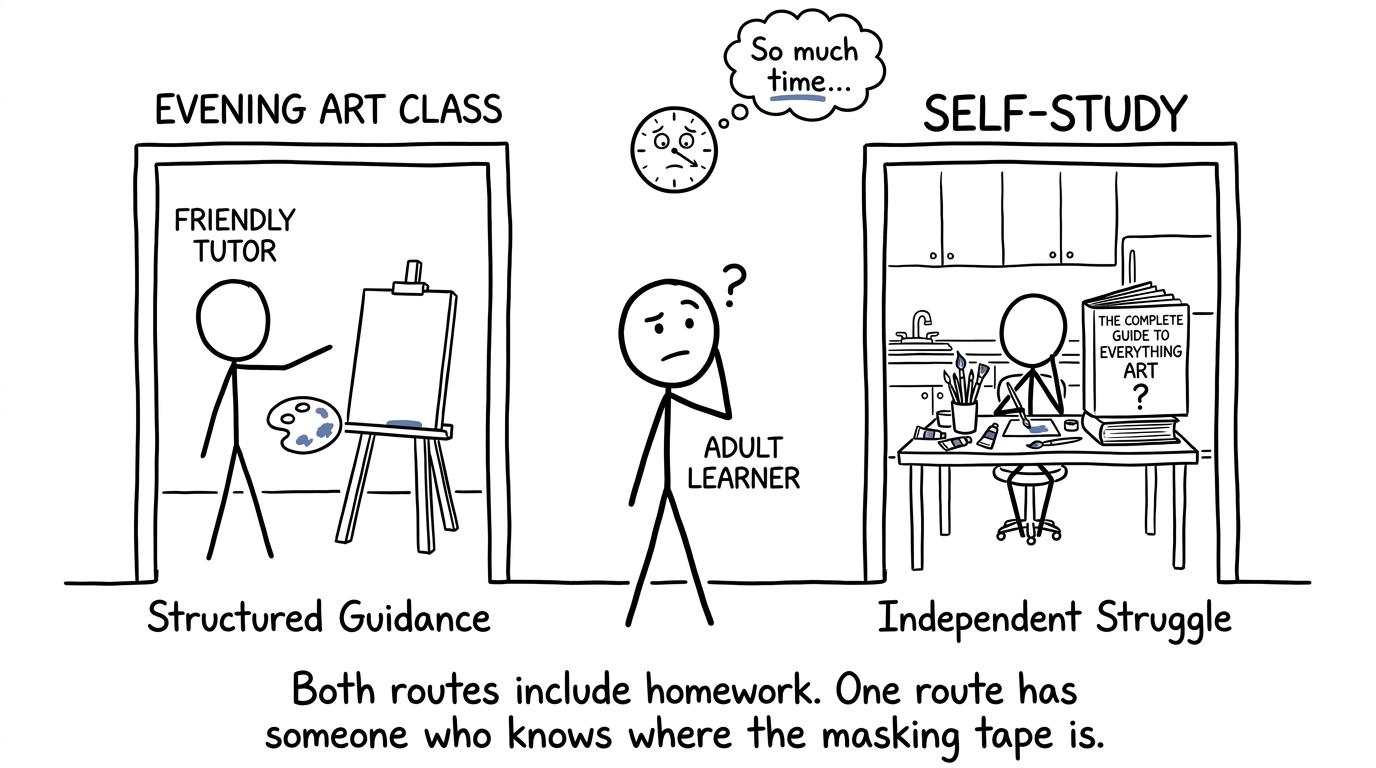 An adult learner choosing between an evening art class and self-study
What GCSE Art and Design actually requires
A GCSE art course is not assessed only on the quality of a final painting, photograph or design. The creative journey matters.
Across GCSE specifications, students are expected to develop ideas through research, experiment with materials and processes, record observations, refine their intentions and present a personal response. The four assessment objectives cover broadly the same skills across exam boards, although providers must follow the detailed specification they have chosen.
For example, current AQA and Pearson Edexcel specifications divide assessment between a portfolio worth 60%60\%60% and an externally set assignment worth 40%40\%40%. Each of the four assessment objectives contributes 25%25\%25% overall. Both specifications include a supervised period of 101010 hours for the final response to the externally set assignment.
Eduqas follows the same broad 60%60\%60% portfolio and 40%40\%40% externally set structure. Exact administrative rules, titles and submission arrangements can differ, so ask whether the course uses AQA, Edexcel, OCR or Eduqas and read that specification rather than assuming every course operates identically.
This structure explains why self-study is more complicated than watching tutorials and producing finished pieces. Your work must show development, not just arrival. A beautiful final outcome cannot automatically compensate for weak investigation, limited experimentation or missing evidence of refinement.
What an evening class is really buying you
The obvious purchase is teaching time. The more valuable purchase may be fewer wrong turns.
Feedback linked to assessment
A useful tutor does not merely say that a piece “looks good”. They can identify which assessment objective is underdeveloped and suggest what evidence is missing. Perhaps your experiments are varied but poorly explained. Perhaps your artist research is descriptive rather than connected to your own decisions.
That feedback shortens the distance between effort and marks. Without it, an independent learner can spend many hours making more work when the portfolio actually needs better selection, reflection or development.
Structure and momentum
A weekly lesson creates a deadline that self-study does not naturally provide. One unfinished page becomes visible next Thursday. That small pressure is often helpful, particularly when a qualification stretches across many months.
Structure also protects your maths. If art can expand into every free evening, it often will. A fixed class and a defined homework block make it easier to reserve separate sessions for the MathsGenie GCSE maths revision hub, where you can choose resources for your board and tier.
Materials and specialist facilities
Depending on the course title, a provider may offer studio space, printing equipment, photography facilities, textiles tools, specialist software or materials that would be expensive to obtain individually. Availability varies significantly, so never treat “materials included” as a promise unless it appears in the course information.
Ask which consumables are supplied, what must be purchased and whether facilities are available outside the scheduled lesson. A low tuition fee can become less attractive once materials, printing, travel and examination charges are added.
A route through formal assessment
This is the practical advantage many people miss. GCSE Art and Design includes internally assessed work that is externally moderated, alongside an externally set assignment completed under controlled conditions. The centre must also manage authentication, security and exam-board administration.
An independent learner therefore needs more than artistic knowledge. They need an approved centre willing and able to handle the qualification. Before choosing self-study, obtain written confirmation about entry, assessment, supervision and fees. Do not assume a local centre accepts private candidates for a portfolio-based subject simply because it accepts private entries for written examinations.
When self-study is genuinely the better option
Classes are not automatically good value. A poorly organised course can combine the cost of formal tuition with the confusion of learning alone.
Self-study may be sensible for an experienced artist who already understands how to document research, experimentation and refinement. It can also suit someone whose work pattern makes regular attendance unrealistic. The freedom to work early in the morning, at weekends or around shifts has real value.
It is most convincing when the administrative route has already been secured. If a centre confirms that it will accept your entry and clearly explains how work will be assessed and authenticated, you can compare options on equal terms.
Self-study is less convincing when the plan is simply to make artwork first and solve the assessment arrangements later. Portfolio decisions made near the deadline are difficult to reverse. The final collection must evidence a process that took place over time.
How to compare the true time and cost
Tuition is only one part of the calculation. A more honest comparison is:
total cost=course fee+materials+travel+assessment fees+lost time\text{total cost}=\text{course fee}+\text{materials}+\text{travel}+\text{assessment fees}+\text{lost time}total cost=course fee+materials+travel+assessment fees+lost timeFor self-study, include materials, software, equipment, private-candidate charges and any separate tuition you may eventually need. For evening classes, include travel time and the work expected between lessons.
Then consider weekly capacity:
available revision time=free time−art lessons−art homework−essential rest\text{available revision time}=\text{free time}-\text{art lessons}-\text{art homework}-\text{essential rest}available revision time=free time−art lessons−art homework−essential restThis is not a worked financial calculation because the numbers differ by provider and learner. It is a reminder to count the whole commitment. An evening labelled as a two-hour class may occupy much more of the night once travel, preparation and follow-up work are included.
Funding also requires careful checking. In England, current adult-skills rules provide specific legal entitlements for eligible adults studying English and maths up to Level 222. GCSE Art and Design does not receive the same universal entitlement merely because it is a GCSE. Other funding may depend on age, prior attainment, earnings, location and provider. Arrangements elsewhere in the UK differ, so ask the college for an individual fee assessment rather than relying on a general advertisement.
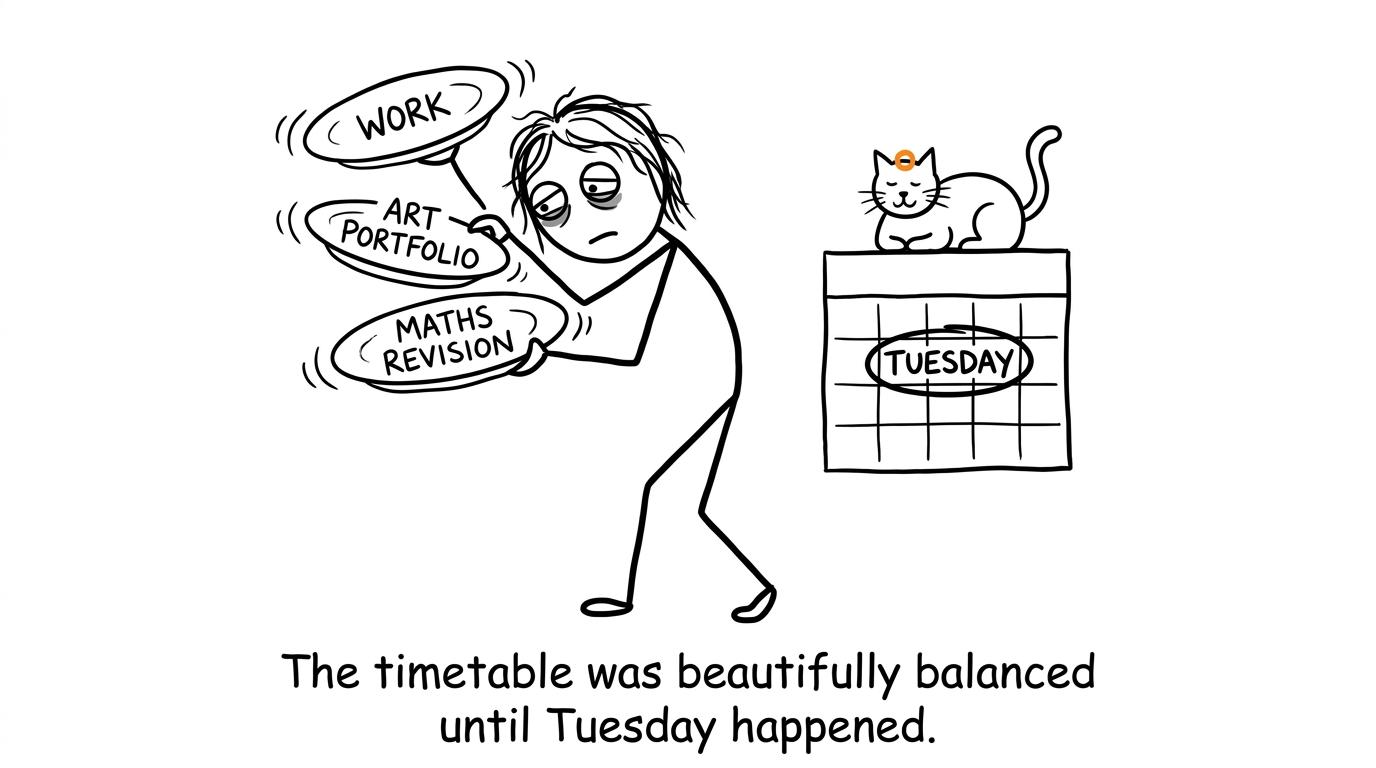 A learner balancing work, an art portfolio and maths revision
Protecting GCSE maths revision alongside art
Creative work can be absorbing. Maths improves through a different rhythm: short, repeated contact with questions, followed by careful correction. If you are resitting GCSE maths alongside art, neither subject should be allowed to consume every available hour.
Start with a realistic weekly pattern. The GCSE maths revision timetable guide can help you build sessions around work and evening classes. Keep at least two short topic sessions for maths and add timed paper practice when exams approach.
A reliable maths cycle is:
- learn or review one method;
- answer focused practice questions;
- mark the work immediately;
- record the reason for each lost mark;
- return to the same skill later;
- progress to timed exam papers.
If a full paper feels too large after an evening class, use a mini test or a shorter block of questions. The one-month GCSE maths revision plan shows how smaller sessions can still build towards exam readiness.
Official past papers should remain the foundation of exam practice. The guide to when to start GCSE maths past papers explains how to move from topic work to timed papers gradually. Edexcel learners can also use Edexcel GCSE Maths predicted papers for fresh practice after weaknesses have been identified.
The goal is not to create a heroic timetable. It is to create one you can repeat on an ordinary, tiring week.
Questions to ask an evening-class provider
A short conversation before enrolment can prevent an expensive misunderstanding. Ask:
- Is this a full GCSE qualification or a general art course using “GCSE level” informally?
- Which exam board and subject title will I enter?
- Does the fee include registration, moderation and examination costs?
- Which materials and facilities are included?
- How much independent work is expected each week?
- How are portfolios stored, authenticated and assessed?
- What happens if I miss a session because of work or illness?
- Can I see the current specification and course calendar?
- Is financial support available based on my circumstances?
Clear answers are a positive sign. Vague promises about completing the portfolio quickly are not.
Common mistakes when choosing between classes and self-study
Comparing tuition fees rather than total costs
The cheapest advertised option may require substantial spending on materials, travel or assessment. Request a complete list before enrolling.
Assuming talent is enough
GCSE Art and Design rewards a documented creative process across the assessment objectives. Technical confidence helps, but it does not remove the need for investigation, experimentation, recording and refinement.
Leaving the private-candidate search until later
Finding a centre for a written examination can be difficult. Finding one for a qualification involving portfolios, internal marking and moderation may be harder. Confirm arrangements first.
Underestimating work outside class
An evening lesson is not the entire course commitment. Portfolio development continues between sessions. Ask for a realistic weekly expectation and test it against work, family and maths revision.
Sacrificing all maths practice near the art deadline
Long gaps make mathematical methods feel unfamiliar. Maintain a small minimum session, even during intensive portfolio weeks. If you are preparing for a resit, the GCSE maths resit revision plan can help turn lost marks into a focused list of topics.
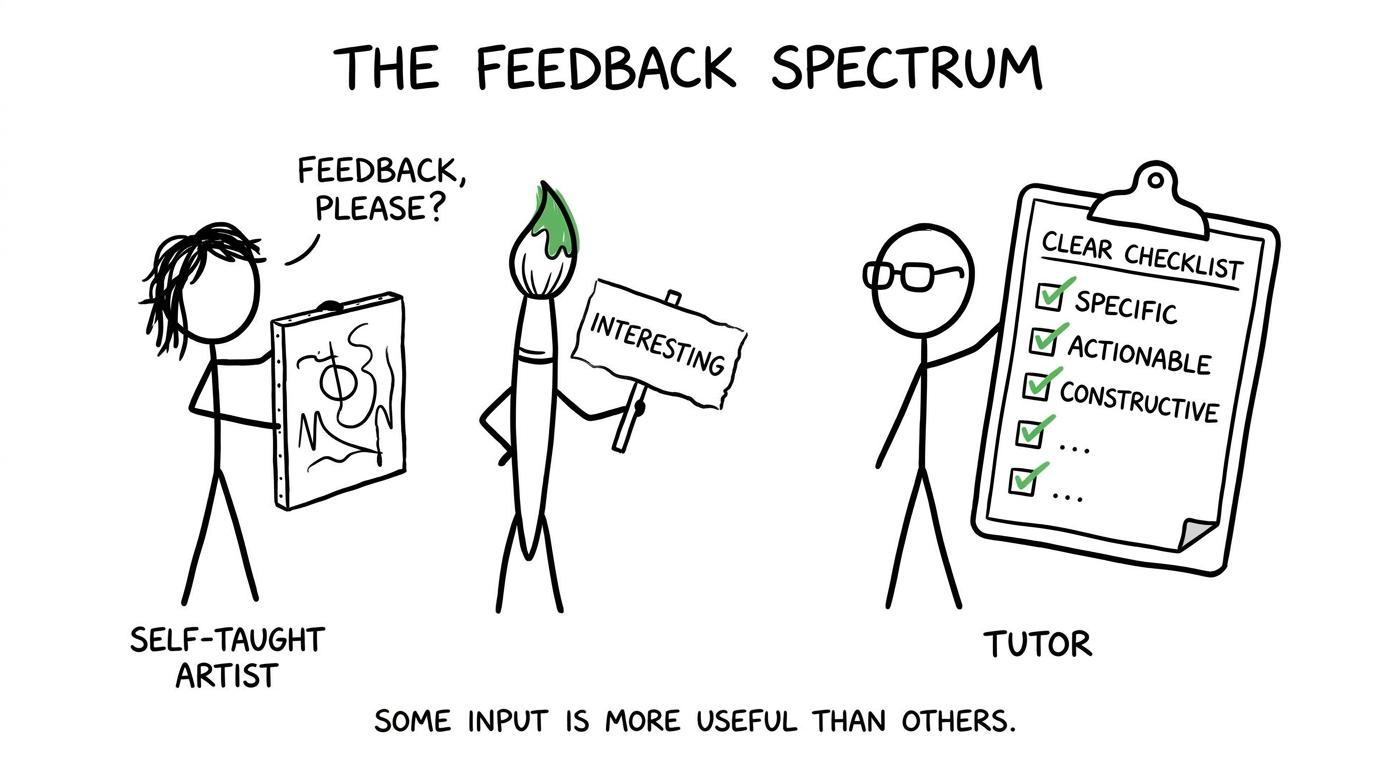 A paintbrush offering vague feedback while a tutor holds a useful checklist
So, are evening classes worth it?
For many adult learners seeking the actual qualification, yes, provided the course includes informed teaching, suitable facilities and a secure route through assessment. Those benefits address the hardest parts of GCSE Art and Design to reproduce alone.
Self-study remains a valid choice when flexibility matters more than weekly structure and the learner already has the skills, facilities and confirmed assessment arrangements. It is also ideal when the aim is creative development rather than a formal GCSE.
Make the decision with the specification, full cost and weekly workload in front of you. Then protect the rest of your education. If GCSE maths is part of your plan, use MathsGenie’s guide to efficient Edexcel revision or begin at the main GCSE hub. Free revision lessons, practice questions, mini tests, past papers, predicted papers, mark schemes and video solutions give you a clear route from one weak topic to the next mark.