Edexcel English Language Paper 1 Resit Guide
Edexcel English Language Paper 1 guide for resit students, covering current 1EN0 question marks, timings, reading methods and imaginative writing.
Resitting English Language can feel strange. You know the exam hall, but the result still seems to depend on an unpredictable extract and writing prompt.
The useful truth is that Edexcel English Language Paper 1 has a predictable structure. Pearson's GCSE English Language specification, code 1EN0, sets a paper lasting 111 hour 454545 minutes and worth 646464 marks. Section A tests reading through an unseen nineteenth-century fiction extract. Section B asks you to complete one imaginative writing task.
Your main job is to understand what each question rewards, allocate your time deliberately and practise producing evidence under timed conditions.
Paper 1 overview
The official title of 1EN0 Paper 1 is Fiction and Imaginative Writing. It contributes 40%40\%40% of the GCSE qualification.
| Part | Task | Marks | Suggested time |
|---|---|---|---|
| Initial reading | Read and annotate the fiction extract | 000 | 101010 minutes |
| Question 1 | Retrieve one detail | 111 | 222 minutes |
| Question 2 | Retrieve two details | 222 | 333 minutes |
| Question 3 | Analyse language and structure | 666 | 121212 minutes |
| Question 4 | Evaluate the extract critically | 151515 | 282828 minutes |
| Reading check | Improve or complete responses | 000 | 555 minutes |
| Section B | Plan, write and check one imaginative response | 404040 | 454545 minutes |
Pearson advises spending about one hour on Section A and 454545 minutes on Section B. The individual timings above are practical suggestions within that division, not Pearson rules. Adjust them if needed, but protect the writing time.
Your checklist: follow line references, keep retrieval brief, analyse language and structure, evaluate clearly and check your writing.
How to read the nineteenth-century extract
Section A uses an unseen extract of nineteenth-century prose fiction, normally around 650650650 words. Every answer must come from the material printed in front of you.
Begin by establishing the situation: who is present, where the scene takes place, what changes and which feeling or conflict becomes important. Mark shifts in place, time, focus, pace or mood. These structural movements support Question 3; your sense of the extract's overall success supports Question 4.
Use surrounding sentences and characters' actions to infer unfamiliar vocabulary. You are assessed on reading, not prior knowledge of the novel.
Question 1: retrieve one detail
Question 1 is worth 111 mark and directs you to specific lines. It usually asks you to identify one word, phrase or detail showing something about the scene or a character.
Copy a precise answer from the stated lines. No analysis is required. If asked for a phrase, provide a phrase. Lengthy explanations take time away from questions with larger rewards.
Aim to finish in about 222 minutes.
Question 2: retrieve two details
Question 2 is worth 222 marks. Pearson identifies a section of the extract, and you normally need two relevant details.
Select two distinct answers and present them as separate bullet points or short sentences. Avoid giving several uncertain alternatives, which can obscure your intended answers.
Aim for about 333 minutes. Both opening questions test accurate retrieval rather than essay writing.
Question 3: analyse language and structure
Question 3 is worth 666 marks and assesses how the writer uses language and structure to achieve effects and influence readers. Keep your response within the specified lines.
A strong paragraph connects four things:
- a relevant quotation;
- a language or structural choice;
- the effect created within the scene;
- the reader's developing impression.
Language might include verbs, imagery, contrasts, dialogue or sentence patterns. Structure concerns how information is arranged: shifts in focus, changes of pace, the order of revelations or the position of a short sentence.
Both matter. Responses considering only language or only structure are limited to the bottom level of the mark scheme. You do not need an equal split, but you need meaningful discussion of each.
Spend roughly 121212 minutes here. Two developed analytical paragraphs can be more effective than a page of feature spotting.
Question 4: evaluate the writer's success
Question 4 is the largest reading question at 151515 marks. You receive a statement or focus and evaluate how successfully the writer achieves a particular effect.
Evaluation means making a judgement. Explain how effectively a choice shapes the reader's view and why. Words such as convincingly and particularly successfully help only when supported by evidence.
Use the whole extract unless directed otherwise. Select evidence from different stages so that your answer follows the scene's development. A reliable structure is:
- state a clear judgement about the writing;
- embed a short quotation;
- analyse the choice and its effect;
- explain why it supports your judgement;
- consider how the effect develops elsewhere.
Question 4 assesses critical evaluation under Assessment Objective 4. The mark scheme rewards a sustained, supported interpretation of how successfully the text works.
Allow about 282828 minutes for several developed points without borrowing time from Section B.
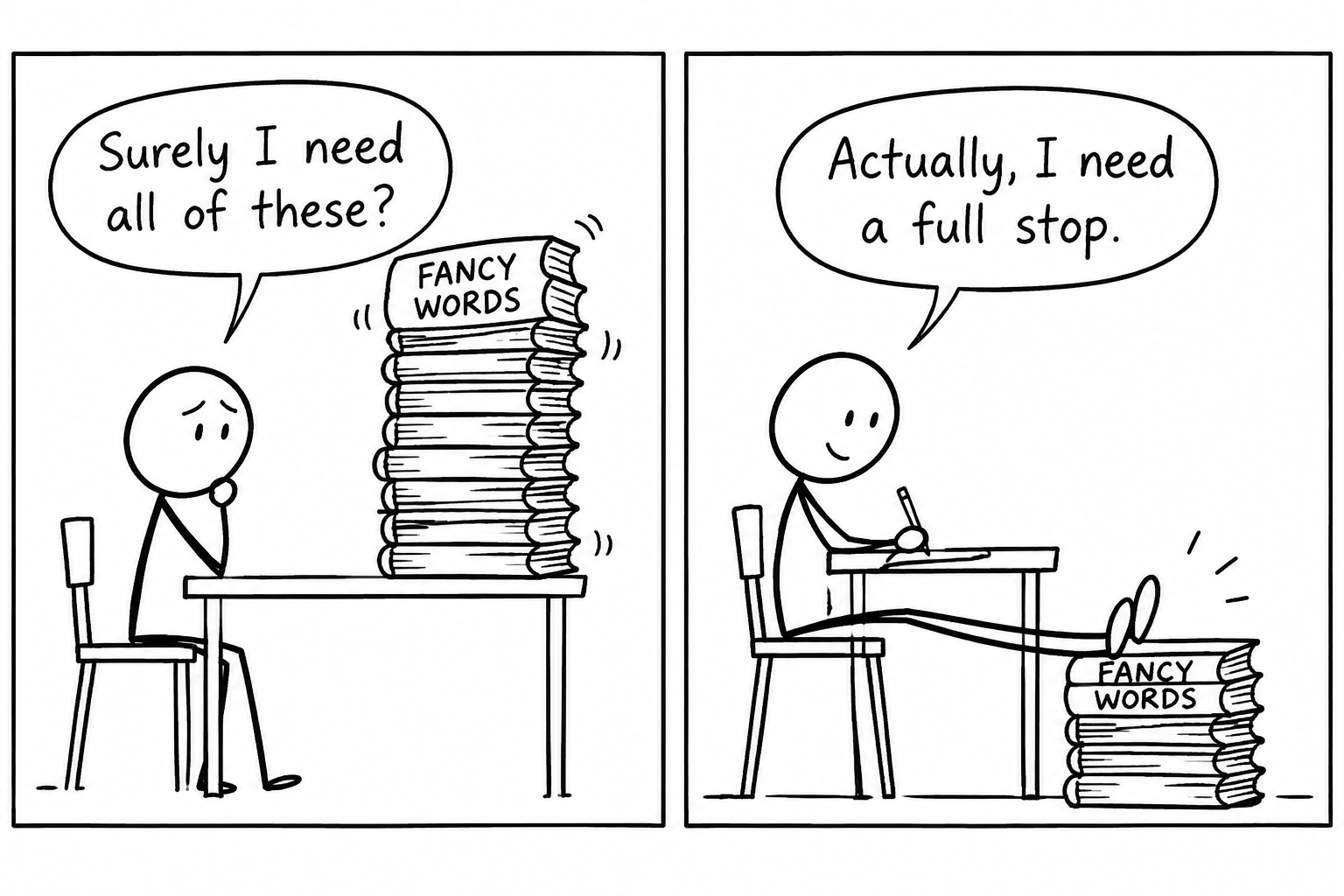 XKCD-style comic showing a student discovering that controlled punctuation matters more than a tower of fancy words
Section B: imaginative writing
Section B is worth 404040 marks, making it the most valuable part of the Edexcel fiction paper. Choose one of two imaginative writing tasks. Read both first and select the prompt that suggests a manageable sequence of events, clear atmosphere and convincing ending.
The marks are divided between:
- 242424 marks for communication and organisation under Assessment Objective 5;
- 161616 marks for vocabulary, sentence structure, spelling and punctuation under Assessment Objective 6.
A complicated plot cannot compensate for unclear paragraphs and uncontrolled sentences. Equally, accurate punctuation alone will not create a compelling response.
Use the first 555 minutes to plan the viewpoint, setting, central change and ending. A focused event is easier to control than a story spanning years, numerous locations and many characters.
Spend around 353535 minutes writing and the final 555 minutes checking sentence boundaries, paragraphing, tense, repetition, spelling and dialogue punctuation.
Building a manageable imaginative response
Imaginative writing does not require an extraordinary idea. The examiner can reward a simple situation shaped deliberately.
Think in terms of movement:
- establish a place and mood;
- introduce a change, discovery or problem;
- slow down at the most important moment;
- finish with a consequence or altered perspective.
Vary sentence lengths purposefully. A short sentence can mark a realisation; a longer one can gather descriptive detail. Paragraph changes can signal a new speaker, focus, place, time or stage of the experience.
Choose precise vocabulary you can use accurately. A simpler, well-chosen word serves your writing better than an impressive word used incorrectly.
Common mistakes on 1EN0 Paper 1
Ignoring the line references
The first three questions identify the relevant lines. Evidence from elsewhere may not answer the task, however perceptive your comment appears.
Treating Question 3 as language-only analysis
The assessment requires language and structure. Annotate at least one structural development before writing.
Forgetting to evaluate in Question 4
Analysis explains an effect. Evaluation judges how successfully it fulfils the question's focus. Make judgements throughout, not only in your conclusion.
Writing both Section B answers
Choose one task. Two incomplete pieces leave insufficient time to demonstrate organisation and technical accuracy.
Spending too long on the opening
An elaborate opening can consume half your time. Keep the story manageable and move towards its central moment.
Neglecting proofreading
Section B awards 161616 marks for technical accuracy. Checking full stops, capitals, spelling and tense can protect marks.
Turn mark schemes into next steps
A mark scheme is most useful after you have attempted a question without help. Mark your response in a different colour, then identify the highest level whose description is consistently supported by your work. Do not award a level because one sentence sounds sophisticated; look for quality sustained across the answer.
For Question 3, check that you discussed both language and structure, used precise evidence and explained effects rather than merely naming techniques. For Question 4, underline every evaluative judgement and circle the evidence supporting it. If either set of markings looks sparse, the next practice task has revealed itself.
For Section B, separate content from accuracy. First review communication and organisation: viewpoint, paragraph sequence, atmosphere and ending. Then make a second pass for sentence control, punctuation, spelling and vocabulary. This prevents an interesting idea from hiding technical weaknesses.
Keep a brief error log with three columns: the issue, an example from your answer and the action for next time. Actions should be specific, such as including one structural shift in Question 3 or reserving the final 555 minutes for proofreading. Repeating a whole paper without diagnosing the previous attempt feels productive, but targeted practice usually gives you a clearer route forward.
A practical resit revision routine
Revision should reproduce exam decisions. Complete the first three reading questions in one session, practise a timed Question 4 in another, then plan several writing prompts.
Once each part feels familiar, complete the full paper in 111 hour 454545 minutes. Use the mark scheme to identify whether your weakness was retrieval, analysis, evaluation, organisation or accuracy. Give your next session that specific focus.
Organise sessions with the free MathsGenie revision planner, and review your wider workload through MathsGenie's progress tools. For a shorter run-up, use the GCSE English Language last-minute revision plan. The English Language and Literature half-term revision guide can help when you have longer.
A resit offers a chance to make the paper less mysterious. Learn the marks, protect the timings and practise one skill at a time. Start with the free MathsGenie revision resources, build a realistic weekly plan and use marked practice to turn familiarity into control.