GCSE English Language and Literature Half-Term Revision
GCSE English Language and Literature half-term revision made manageable: build a realistic plan, practise actively and protect time for a proper break.
Half-term revision often begins with an ambitious timetable and ends with a familiar question: where did the week go? The answer is rarely laziness. Usually, the plan was too vague, too large or too exhausting to begin.
Effective GCSE English Language and Literature half-term revision does not require surrendering the whole break. Choose a small number of specific outcomes, complete one or two focused sessions on revision days, and leave genuine space for rest. For Language, practise reading and writing under controlled timings. For Literature, retrieve quotations, revisit themes and plan responses. The aim is evidence of progress, not hours spent near a book.
Your half-term revision checklist
Before creating a colour-coded masterpiece, decide what you want to have finished by the end of the break.
- Check your exam board and the exact texts, papers and question types you study.
- Identify two or three weaknesses rather than revising everything equally.
- Give each session one visible outcome.
- Combine memory retrieval, planning and timed writing.
- Mark or review every completed task.
- Keep several blocks of the holiday completely free.
- Include maths and other subjects without allowing the timetable to take over.
The last point matters. English may be the focus, but GCSE revision is a portfolio problem: every subject competes for the same finite supply of attention. MathsGenie's free GCSE maths revision lessons can make the maths part of your plan more precise, leaving less time lost to deciding what to revise.
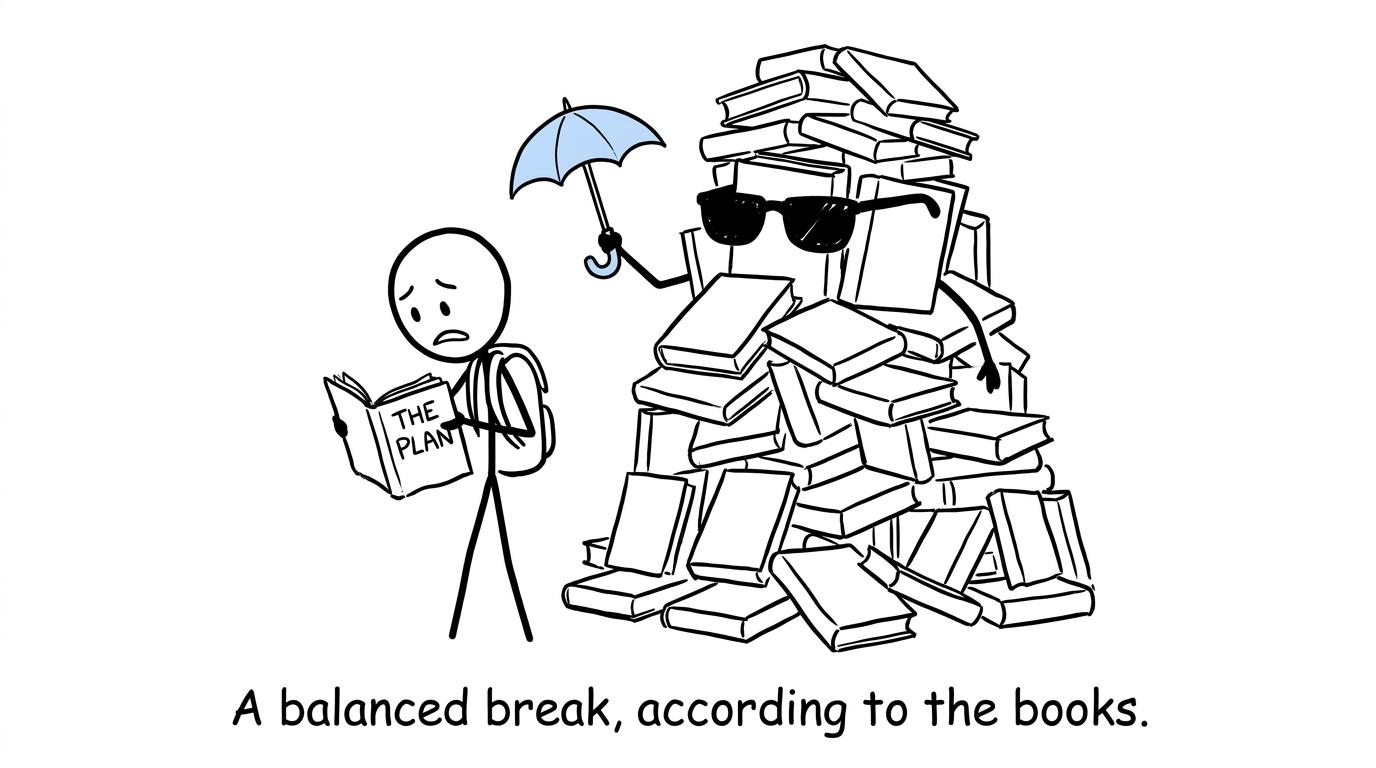 A student discovers that the revision books have planned their own holiday
Start with outcomes, not hours
“Revise English for two hours” sounds responsible, but it contains no definition of success. You could reread a novel, rearrange your notes and watch several videos without testing whether you can produce an exam response.
A useful session ends with something you can inspect. For example:
- a plan for one Literature question;
- a quotation retrieval sheet completed from memory;
- one Language question answered under a time limit;
- an opening and ending for a creative writing task;
- one paragraph improved after comparison with a mark scheme;
- a list of three recurring errors and how to correct them.
This shift is small but powerful. Time is an input. A completed response, accurate recall or corrected mistake is an outcome.
Choose priorities using evidence
Begin with your latest mock, class assessment or teacher feedback. Look beyond the grade and find the pattern underneath it. Perhaps you understand the Literature text but do not analyse the writer's methods closely enough. Perhaps your Language answers begin strongly but become rushed. Perhaps you know quotations when you see them but cannot retrieve them independently.
Turn that evidence into a short priority list. If everything is labelled urgent, nothing is genuinely prioritised.
Also check the specification and materials supplied by your school. AQA, Edexcel, OCR and Eduqas do not use identical papers, wording, set texts or assessment arrangements. Advice that ignores your exam board can make you practise the wrong format. Confirm the texts you study, the structure of each paper, the permitted materials and the expectations attached to each question.
Build a plan that leaves room for half-term
A workable timetable is modest. It accepts that concentration has limits and that family plans, sleep and unstructured time are part of a holiday rather than obstacles to it.
Try dividing the break into three types of day:
- Focused days: one English session and one session for another subject.
- Light days: a short retrieval task, reading or error review.
- Free days: no scheduled revision.
Place the most demanding work earlier in the day if that is when you concentrate best. If evenings suit you better, use them. The right timetable is not the one that looks most impressive; it is the one you are likely to follow.
Give each block a starting instruction. “Open the practice paper and answer the specified reading question” creates less friction than “do English”. Prepare the text, question and stationery before the session begins. A clear first action removes the tiny decisions that often become twenty minutes of avoidance.
For maths, use a defined resource instead of writing “maths revision” across an empty box. A paper from the GCSE maths past papers collection, followed by its mark scheme, gives the session a beginning, an end and a source of feedback. MathsGenie's predicted GCSE maths papers can also support exam-style practice when used alongside past papers and topic revision.
Revise GCSE English Language actively
English Language is not best revised by memorising model answers. The extracts and tasks require you to apply reading and writing skills to the material in front of you. Revision should therefore involve making decisions, producing responses and evaluating them.
Separate reading skills from writing skills
For reading, practise locating evidence, making inferences, analysing methods and organising comparisons where your paper requires them. Do not merely highlight an extract. Decide what each selected detail shows and why the writer may have used it.
For writing, rotate through planning, openings, paragraph control, vocabulary choices, sentence crafting, punctuation and endings. You do not need to complete a full response every time. A focused session on planning several prompts can improve flexibility, while a separate timed response tests whether those choices survive exam pressure.
Use mark schemes without copying their language
A mark scheme is a description of what is rewarded, not a script to reproduce. After answering a question, identify where your work provides evidence, explanation and analysis. Then find the weakest part and revise it.
This review stage is where much of the learning happens. Writing another answer immediately may simply repeat the same habit. Correcting one paragraph forces you to notice the difference between what you intended and what reached the page.
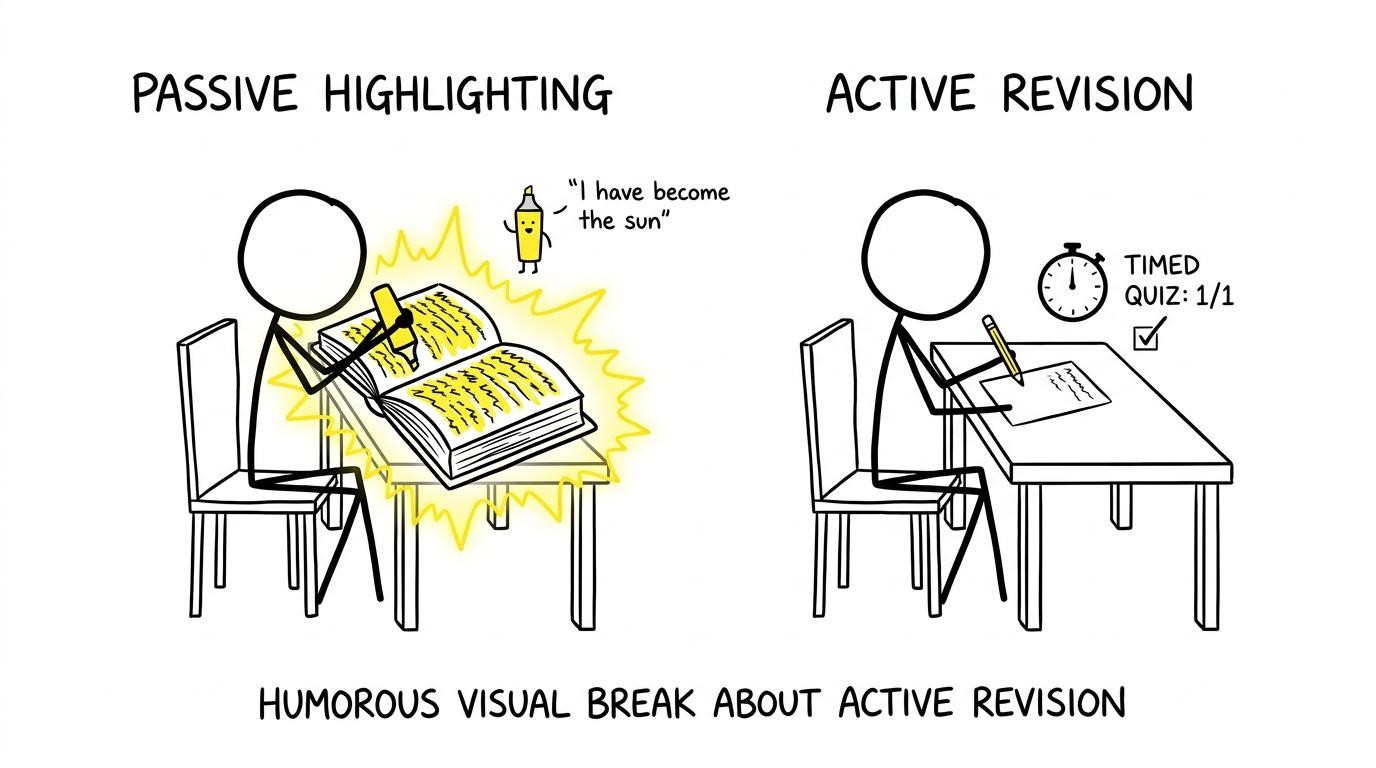 One student highlights everything while another completes a focused task
Revise GCSE English Literature without rereading everything
Rereading can rebuild familiarity, but familiarity is not the same as recall. In the exam, you need to retrieve relevant knowledge and shape it around the question.
Organise Literature revision around connections:
- character and theme;
- quotation and interpretation;
- method and effect;
- moment in the text and wider development;
- context and the specific argument it helps explain.
Retrieve quotations before checking the text. Keep the selection small and versatile, prioritising quotations that support several themes or reveal a character at an important stage. Accuracy matters, but so does knowing what you can say about the language, structure or dramatic method.
Then practise essay planning. A useful plan should contain a clear argument, a logical sequence of ideas and carefully chosen evidence. It should not become a miniature essay that consumes the entire session.
Context also needs control. Relevant context can sharpen an interpretation; detached historical facts usually cannot. Connect contextual knowledge directly to the writer's choices, ideas or audience rather than adding it because you remember it.
Make English and maths revision work together
Students preparing for maths exams have a particular balancing problem. Maths benefits from regular problem-solving, while English often requires longer reading and writing tasks. Treating both subjects identically can create an awkward plan.
A better approach is to pair different demands. A sustained English response might sit beside a shorter maths topic session. A timed maths paper might be paired with Literature quotation retrieval rather than another full paper.
Use your errors to choose the next maths task. The topic list on the MathsGenie GCSE revision page is arranged by grade, with videos and exam-style questions that help turn a broad weakness into a specific session. If you are also looking ahead beyond GCSE, the free A Level maths revision resources show how later topics build on secure foundations.
Do not measure English progress by pages written and maths progress by questions attempted. In both subjects, improvement comes from feedback. Mark the work, diagnose the error and return to it later.
Protect the break without feeling guilty
Rest is not a reward that becomes available only when every topic is secure. That moment may never arrive. It needs to be placed in the plan from the beginning.
Set a stopping time for each session. When it arrives, write down the next action so that restarting will be easy, then stop. Extending every task teaches your timetable that its boundaries are optional.
Keep free days genuinely free. A day spent half-revising and half-feeling guilty is neither restorative nor productive. Half-term can support exam preparation while still containing sleep, exercise, friends, family and ordinary boredom.
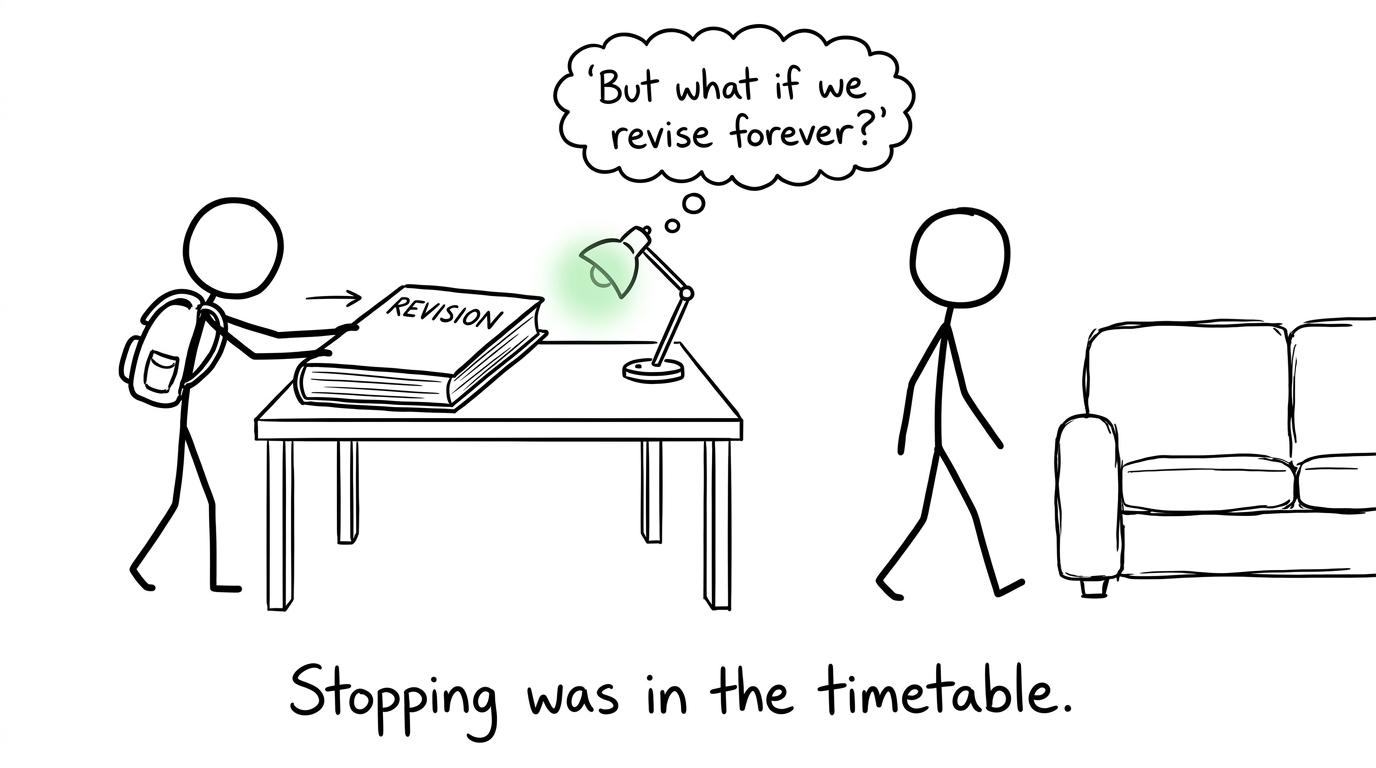 A student follows the timetable's radical instruction to stop revising
Common half-term revision mistakes
Planning every minute
A timetable without spare capacity collapses when one task takes longer than expected. Leave gaps and limit the number of essential outcomes.
Revising only comfortable material
Familiar tasks feel productive because they are easier to complete. Use assessments and teacher feedback to include weaknesses, while retaining some secure topics to build fluency and confidence.
Highlighting instead of retrieving
Highlighting can identify important material, but it does not prove that you can recall or use it. Close the book, retrieve the idea, then check the result.
Writing without reviewing
Completing an answer is only half the process. Use the relevant mark scheme, teacher guidance or model material to identify one improvement you can apply next time.
Completing full papers too early or too often
Full papers are valuable diagnostic tools, but they are demanding. Alternate them with targeted question practice, planning and correction. For maths, the GCSE exam paper archive includes mark schemes that make careful review possible.
Sacrificing the entire holiday
An extreme plan often produces avoidance rather than extra learning. A smaller plan completed calmly is more valuable than a vast plan repeatedly postponed.
Finish half-term with a useful reset
On the final revision day, do not try to rescue every unfinished task. Review what you completed, record the weaknesses that remain and choose the first task for the following week.
Good GCSE English Language and Literature half-term revision should leave you with clearer knowledge, several pieces of reviewed practice and a more accurate sense of what to do next. It should not leave you exhausted before school restarts.
Keep the plan specific. Practise actively. Correct what you produce. Then stop when you said you would.
For the maths side of your timetable, make MathsGenie your next step. Use the free revision lessons, videos, practice questions, mini tests, past papers, predicted papers and mark schemes to replace vague intentions with work you can complete and improve.