Drop GCSE German Mid-Year? A Clear Decision Guide
Drop GCSE German mid-year? Judge the workload, check school and sixth-form consequences, and protect your GCSE maths revision plan with confidence.

The thought often arrives after a difficult mock: German feels unmanageable, maths needs more attention, and the calendar seems to be moving faster than you are. If you are wondering whether to drop GCSE German, the short answer is this: it may be sensible if sustained, well-supported effort is producing little progress and the subject is seriously harming your wider GCSE preparation. But one bad result, a stressful speaking lesson or a crowded week is not enough evidence on its own.
Dropping a GCSE mid-year is also not a decision you can normally make alone. Your school controls its curriculum and exam entries, while withdrawal arrangements and deadlines vary by exam board and exam series. Speak to your German teacher, head of year, exams officer and parent or carer before changing anything.
Your decision checklist
Before asking to leave the course, establish five things:
- whether the problem is a temporary dip or a persistent pattern
- what support you have already tried
- how much German is affecting maths, English and science
- whether your school will permit a mid-year change
- whether German matters for your sixth-form or career plans
The important distinction is between discomfort and genuine overload. GCSE subjects are meant to become difficult. Difficulty alone is not proof that you are in the wrong course.
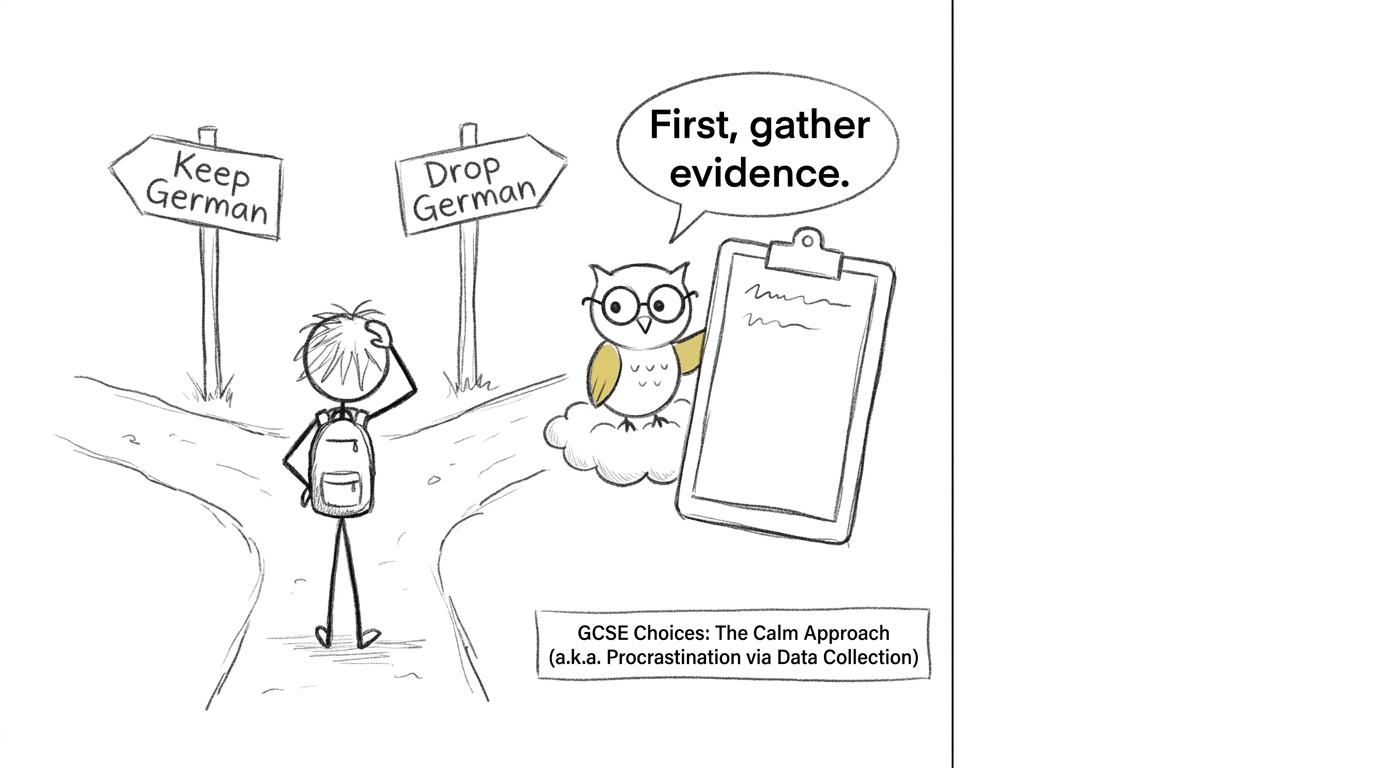 A student gathering evidence before choosing whether to continue GCSE German
How to tell if you are actually in over your head
Feeling behind is common. Being unable to recover despite appropriate support is different. Look for a pattern across several weeks rather than relying on your mood after one lesson.
Your results remain far below your target
Review recent assessments in listening, speaking, reading and writing. Current GCSE German courses assess a combination of these language skills, although the precise paper structure depends on your specification and examination year.
A low mock grade does not settle the question. Ask what caused it:
- Was vocabulary recall the main problem?
- Did you misunderstand the question format?
- Did anxiety disrupt the speaking assessment?
- Were your answers too short to access the available marks?
- Had absence or illness interrupted the course?
These are often fixable problems. More serious evidence would be consistently weak performance across several skill areas, even after regular attendance, focused practice and teacher feedback.
German consumes a disproportionate amount of revision time
Record your revision for two ordinary weeks. Do not estimate from memory. Write down the time spent and what you completed.
Suppose German repeatedly takes whole evenings while essential maths topics remain untouched. That is worth discussing. However, simply disliking vocabulary practice does not mean it is taking too long. Compare completed work, not just how tiring each subject feels.
Maths is a compulsory GCSE and commonly appears in sixth-form entry requirements, so protecting it matters. Use the GCSE maths revision hub to identify whether you genuinely have a large maths gap or are reacting to one disappointing paper.
Support has not changed the pattern
Before concluding that German is beyond you, try a defined support period. That might include:
- attending intervention or lunchtime support
- asking for precise feedback on one weak skill
- practising vocabulary in short, frequent sessions
- completing missed classwork
- using your exam board's specification and school resources
- arranging support for anxiety, dyslexia or another identified need
Set a review date with your teacher. The question is not whether your grade transforms immediately. It is whether attendance, confidence, recall and assessment performance begin moving in the right direction.
Your wellbeing is being affected persistently
Normal exam nerves come and go. Persistent sleep problems, panic, avoidance or distress deserve attention regardless of which subject appears to trigger them. Speak to a trusted adult and your school's pastoral or safeguarding team.
Dropping German may remove one pressure, but it will not automatically resolve anxiety caused by perfectionism, exam fear or an overloaded timetable. Support the underlying problem as well as reviewing the subject choice.
What dropping GCSE German does affect
The exact consequences depend on your school, location, exam board and post-161616 plans. Ask for the answer in writing where possible.
Your number and range of GCSE qualifications
If you withdraw without replacing German, you will normally finish with one fewer GCSE qualification. This can matter because some sixth forms and colleges ask for a minimum number of GCSEs at specified grades.
Requirements vary considerably. Some providers focus on English language and maths plus a total number of passes; selective providers may calculate a broader GCSE score. Check the published entry rules for every sixth form or college you are considering rather than relying on a friend's application experience.
The English Baccalaureate subject combination
In England, a modern foreign language is part of the English Baccalaureate, usually called the EBacc, alongside English, maths, sciences, history or geography. The EBacc is a school performance measure and subject combination, not a separate qualification or certificate.
Dropping German may therefore mean that you no longer complete the full EBacc combination. Your school may have its own policy because subject entries contribute to its curriculum and performance measures. Ask what this means in your particular case rather than assuming it prevents sixth-form or university entry.
The option of studying German at A Level
If you may want to take A Level German, dropping the GCSE could close or complicate that route. Sixth forms commonly set a subject-specific GCSE German requirement, often alongside their general entry criteria, but the required grade varies by provider.
Occasionally a sixth form may assess a fluent speaker without the GCSE, but that is a local exception rather than something to assume. Check directly with the provider before withdrawing.
Your school's exam administration
Schools and colleges act as examination centres. They submit entries and handle amendments or withdrawals according to awarding-body deadlines. The practical position may differ depending on whether you ask in autumn, after entries have been submitted or close to the examinations.
A student or parent can request a withdrawal, but the school will normally make the final curriculum and entry decision. There may also be administrative or fee implications for the centre after certain deadlines. Your exams officer can give the current answer for your board and examination series.
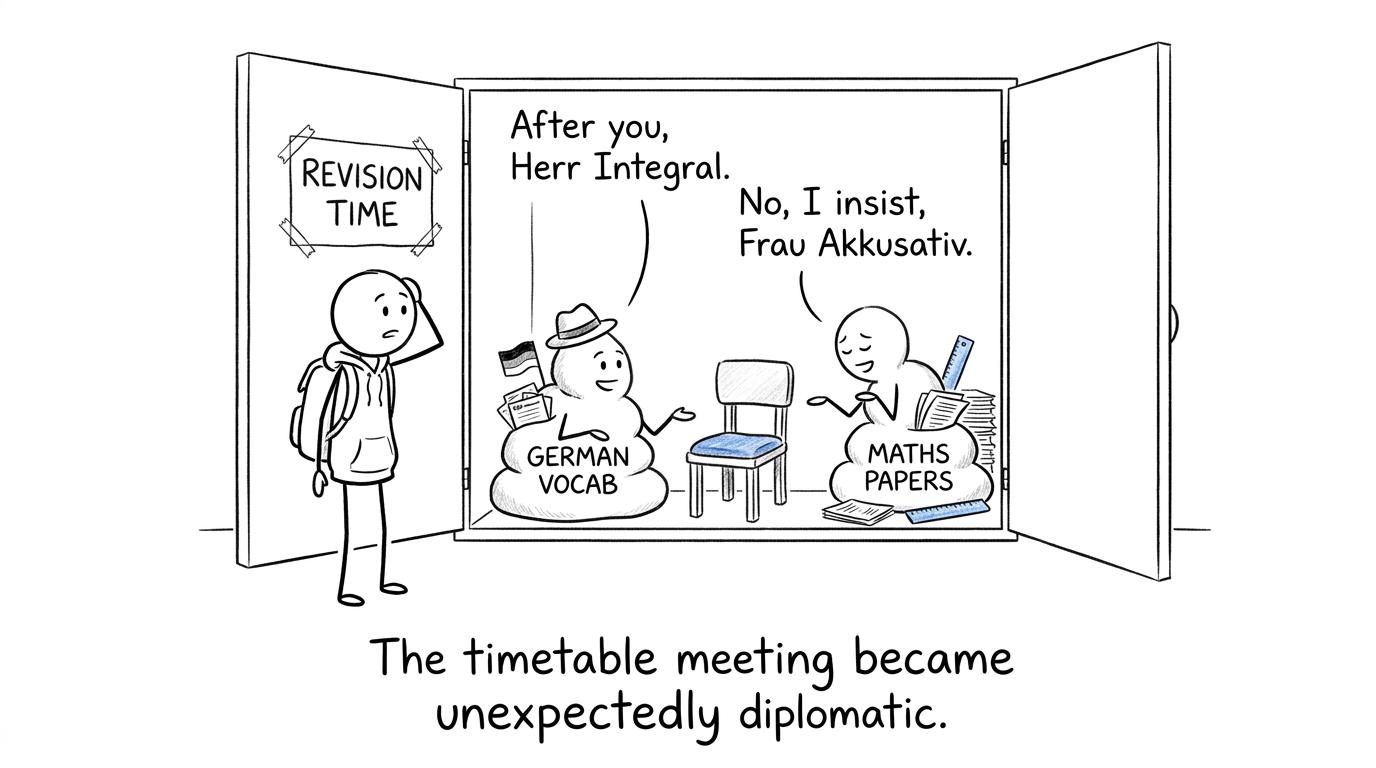 German vocabulary cards and maths papers negotiate over limited revision time
What dropping German does not automatically affect
Dropping one optional subject does not erase marks already earned elsewhere. It does not directly change your GCSE maths tier, maths grade or English and science entries.
It also does not automatically:
- stop you entering sixth form or college
- prevent you applying to university later
- make your remaining GCSE grades rise
- create extra supervised maths lessons
- remove the need for a balanced revision plan
That last point is easily missed. Free periods do not become useful revision by themselves. If German leaves your timetable, ask exactly where you will go, who will supervise you and what work you will complete.
MathsGenie's best order for learning GCSE maths topics can turn that time into a sequence rather than a vague promise to “do more maths”. For busy days, the GCSE twenty-minute maths routine gives you a small, repeatable structure.
Build evidence before making the decision
Treat the decision like a diagnosis, not an escape route.
Gather the right information
Bring these items to a meeting with your teacher or head of year:
- recent German assessment results by skill
- your target grade and current working grade
- attendance and missed-work information
- a two-week revision record
- evidence of intervention or extra practice
- entry requirements for your preferred sixth forms
- a proposed plan for any time released
Then ask direct questions: Is a pass still realistic? Which skill is limiting the grade? What support remains available? Has the exam entry been made? Would withdrawal affect the school's options policy? What happens during German lessons afterwards?
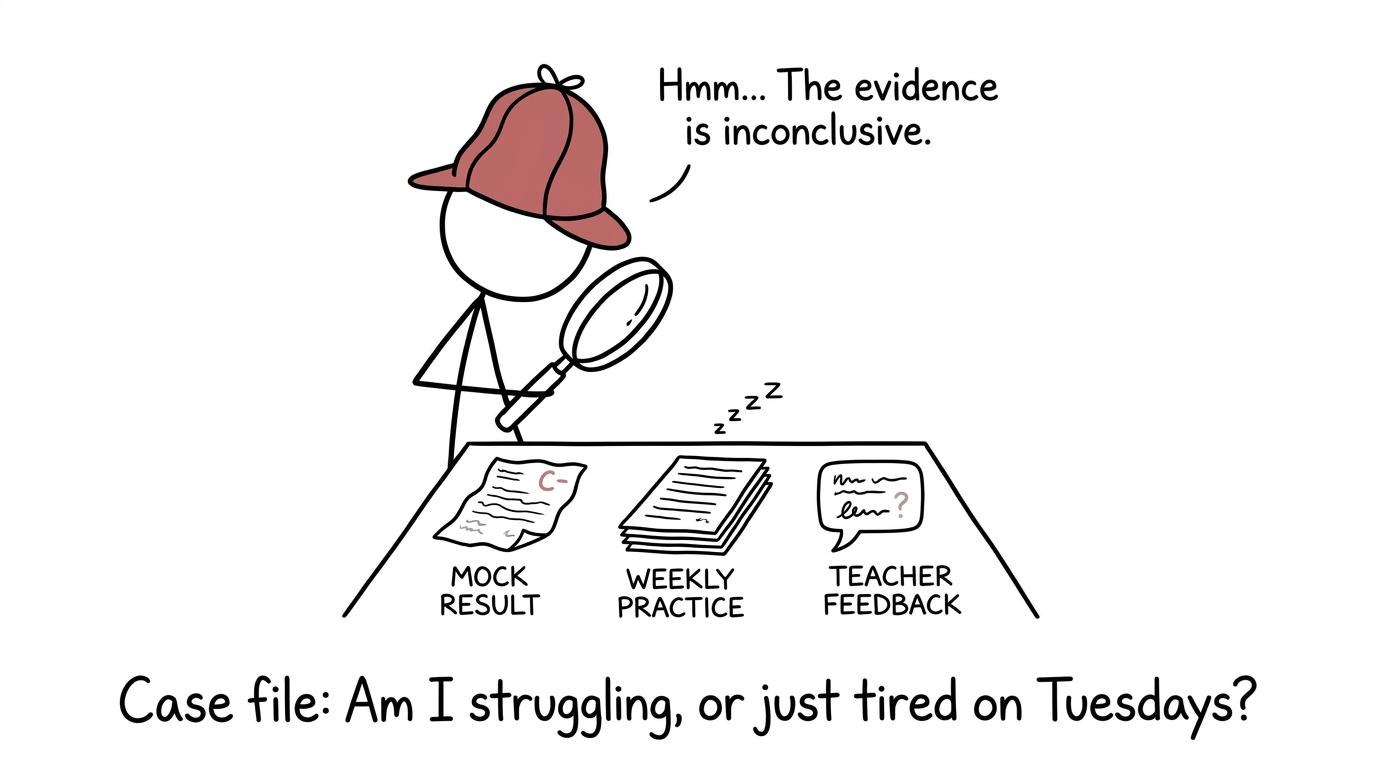 A revision detective investigates mock results, practice and teacher feedback
Test a short recovery plan
Unless your wellbeing requires an urgent change, agree a short trial before deciding. Make the tasks specific: vocabulary retrieval, one listening activity, one speaking practice and teacher feedback on a written response.
At the same time, diagnose your maths needs with mixed questions and mark schemes. The MathsGenie active-recall guide explains how to turn passive notes into retrieval practice. If examinations are approaching, use the one-month GCSE maths revision plan to organise weak topics, mini tests and timed papers.
The result of the trial should tell you something useful. Improvement may justify continuing. No movement despite attendance, support and appropriate practice may strengthen the case for withdrawal.
Common mistakes when considering whether to drop GCSE German
Deciding immediately after one bad mock
Mocks are evidence, not verdicts. Review the component marks and teacher feedback before making a permanent choice.
Assuming the freed time will fix maths
More time helps only when it has a job. Decide which topics, practice questions and papers will fill each session. Start from MathsGenie's free revision resources and record the marks you lose by topic.
Ignoring sixth-form requirements
Do not assume every provider has identical rules. Check general entry requirements and the requirements for each A Level you may choose, especially German.
Treating embarrassment as a reason to continue
Staying solely because you fear what classmates will think is not a sound academic reason. Equally, leaving because friends dislike the subject is not evidence that it is wrong for you.
Stopping attendance before a decision is approved
Continue attending lessons and completing work until your school formally confirms a change. Unauthorised absence can create a second problem without resolving the first.
Make the choice that protects the whole GCSE picture
The best decision is rarely “drop the hardest subject” or “never give up”. It is the decision supported by results, teacher judgement, wellbeing evidence, school policy and future entry requirements.
If you continue German, do so with a narrower recovery plan. If your school approves withdrawal, give every released session a purpose. Use MathsGenie revision lessons to rebuild weak methods, practice questions and mini tests to check recall, then past papers and predicted papers to practise switching between topics. Mark schemes and video solutions should decide what you revise next.
You are not trying to create an easier timetable. You are trying to create one that gives your effort somewhere useful to go.