Do GCSE Arabic Class Sets Matter?
GCSE Arabic class sets matter less than tier choice and practice. Learn what affects grades, when to discuss moving set, and how to revise effectively.
A set label can feel like a prediction. If you are placed in a lower GCSE Arabic class, it is easy to imagine that somebody has already decided your final grade. If you are in the highest set, it can feel as though success is guaranteed.
Neither conclusion is reliable. If you are asking whether GCSE Arabic class sets matter, the short answer is this: your class can influence the pace, support and material you receive, but it does not directly determine your result. Your exam tier, quality of teaching, access to the full curriculum and consistent practice matter more.
Effort matters too, but not as a vague instruction to “work harder”. Effective effort means practising the four assessed skills, responding to feedback and using evidence from assessments to close specific gaps.
The quick answer
Keep these distinctions clear:
- Your set is an internal school grouping. It does not appear on your certificate.
- Your tier is an examination entry. For Pearson Edexcel GCSE Arabic, students take either foundation or higher tier across the qualification.
- Foundation tier offers grades 111 to 555. Higher tier offers grades 444 to 999, with a possible grade 333 for a mark narrowly below the grade 444 boundary.
- Your teacher and classroom experience matter, especially if a group receives different content, expectations or support.
- Your independent practice matters more than the name of the room because the examiner marks what you listen to, say, read and write.
- Set placement should not be treated as permanent. If your assessment evidence improves, ask what your school requires for a move or higher-tier entry.
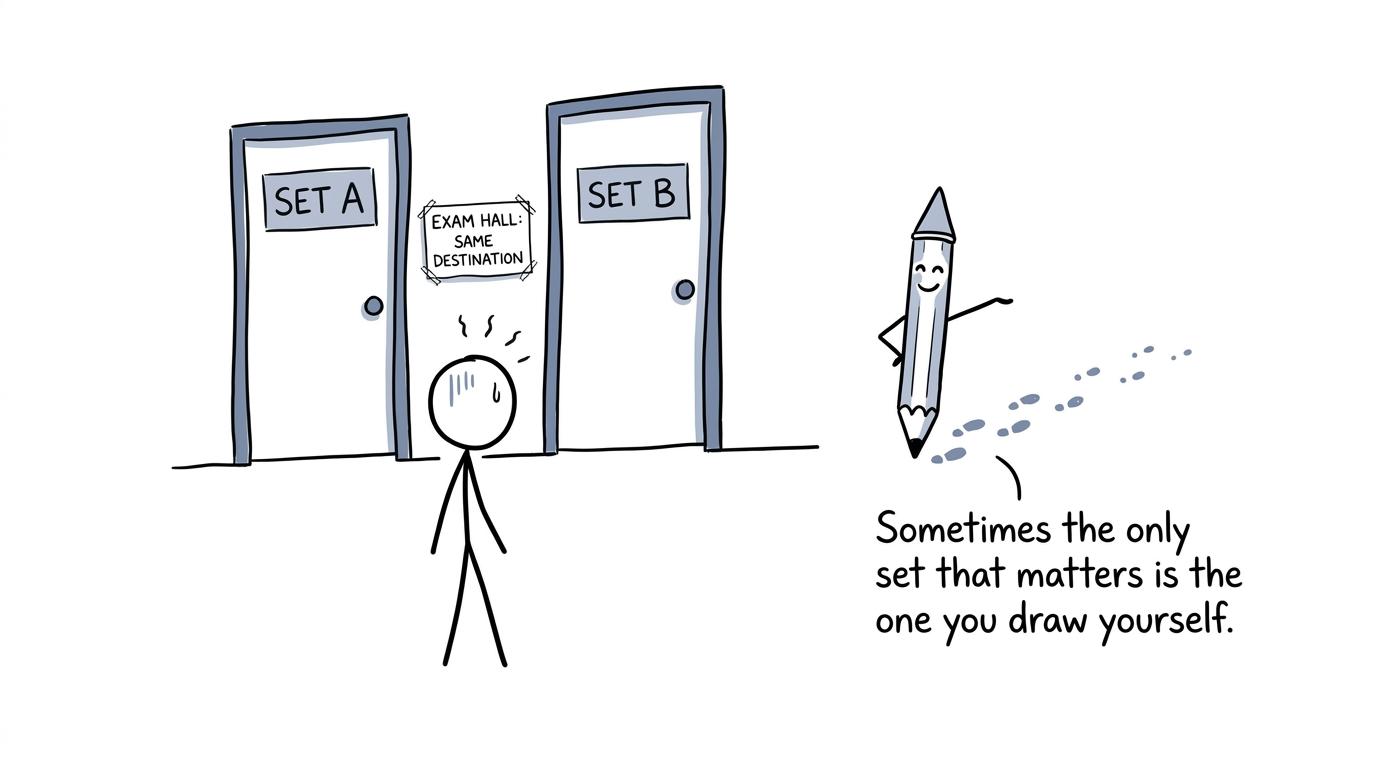 A student discovers that different classroom doors can lead towards the same exam hall
A class set and an exam tier are not the same thing
This is the most important point in the discussion.
Schools can organise Arabic teaching in whatever way works for their timetable and pupils. One school might use numbered sets. Another might have one mixed-attainment class. Some students may prepare for GCSE Arabic through supplementary teaching or as an additional language qualification.
These arrangements are not exam grades. Pearson does not award extra marks for being in Set 111, and an examiner does not know which class you attended.
Tier entry is different. Under the current Pearson Edexcel GCSE Arabic specification, listening, speaking, reading and writing are externally assessed. Each contributes 25%25\%25% of the qualification, and a student must be entered for one tier across all four papers. Dictionaries are not permitted in the assessments.
That creates a practical limit. A student entered for foundation tier cannot receive a grade above 555, regardless of set. A student aiming for grades 666 to 999 therefore needs higher-tier entry as well as the language knowledge required to succeed on those papers.
You can view recent outcomes through the Edexcel GCSE Arabic grade boundaries, but remember that boundaries change between exam series. They describe how marks were converted into grades in a particular year; they are not permanent revision targets.
How your set can affect your GCSE Arabic outcome
A set does not print a grade onto your certificate, but it can shape the conditions in which you prepare. That is why the honest answer is more nuanced than “sets never matter”.
Pace and level of classroom work
A higher set may move more quickly, use less English in lessons or encounter longer, less predictable language earlier. A lower set may spend more time consolidating vocabulary, sentence structures and core grammar.
Neither pace is automatically better. Fast teaching is not useful if gaps remain hidden. Slower teaching can be valuable when it produces secure understanding, but it becomes a problem if pupils who are ready for higher-tier material never receive it.
Ask a concrete question: Am I learning and practising the content needed for the tier and grade I am targeting? That is more useful than comparing set numbers.
Teacher expectations and feedback
Expectations can influence the difficulty of tasks offered and the detail of feedback. A productive classroom should still stretch every pupil, explain how to improve and provide a route towards more demanding work.
If feedback only says “add detail”, ask what that means for the relevant assessment. You might need a wider range of vocabulary, more accurate grammar, clearer pronunciation or a better-developed response. Specific feedback creates a specific next action.
The pupils around you
Classmates can affect concentration, confidence and how much Arabic is spoken during lessons. Yet this effect is not fixed. A quiet, purposeful lower set may provide better learning conditions than a distracted higher set.
The wider evidence on setting and streaming is cautious rather than dramatic. The Education Endowment Foundation reported in 202520252025 that setting and streaming produced, on average, similar progress to mixed-attainment teaching. It found small differences for lower- and higher-attaining pupils, but rated the evidence as very limited. That does not prove what will happen in one Arabic department. It does show why a set label should not be mistaken for destiny.
Does it ultimately come down to effort?
Effort is essential, but “effort” needs a definition.
A student can spend a long evening copying vocabulary and still struggle to retrieve it in a listening paper. Another can revise for less time but repeatedly recall words, speak aloud, answer unfamiliar questions and correct errors. The second approach is usually more useful because it resembles the performance the exam requires.
Effective GCSE Arabic effort includes:
- retrieving vocabulary without looking at notes;
- hearing Arabic spoken at an appropriate pace;
- giving unrehearsed spoken responses rather than memorising one script;
- reading for overall meaning before focusing on unfamiliar words;
- writing under time limits;
- checking recurring errors in grammar, spelling and sentence construction;
- returning to weak material after a delay.
Effort is not the only factor. Prior exposure to Arabic, teaching quality, attendance, confidence, time and access to feedback can all affect progress. You should not blame yourself for every difficulty. The useful question is which factor you can act on next.
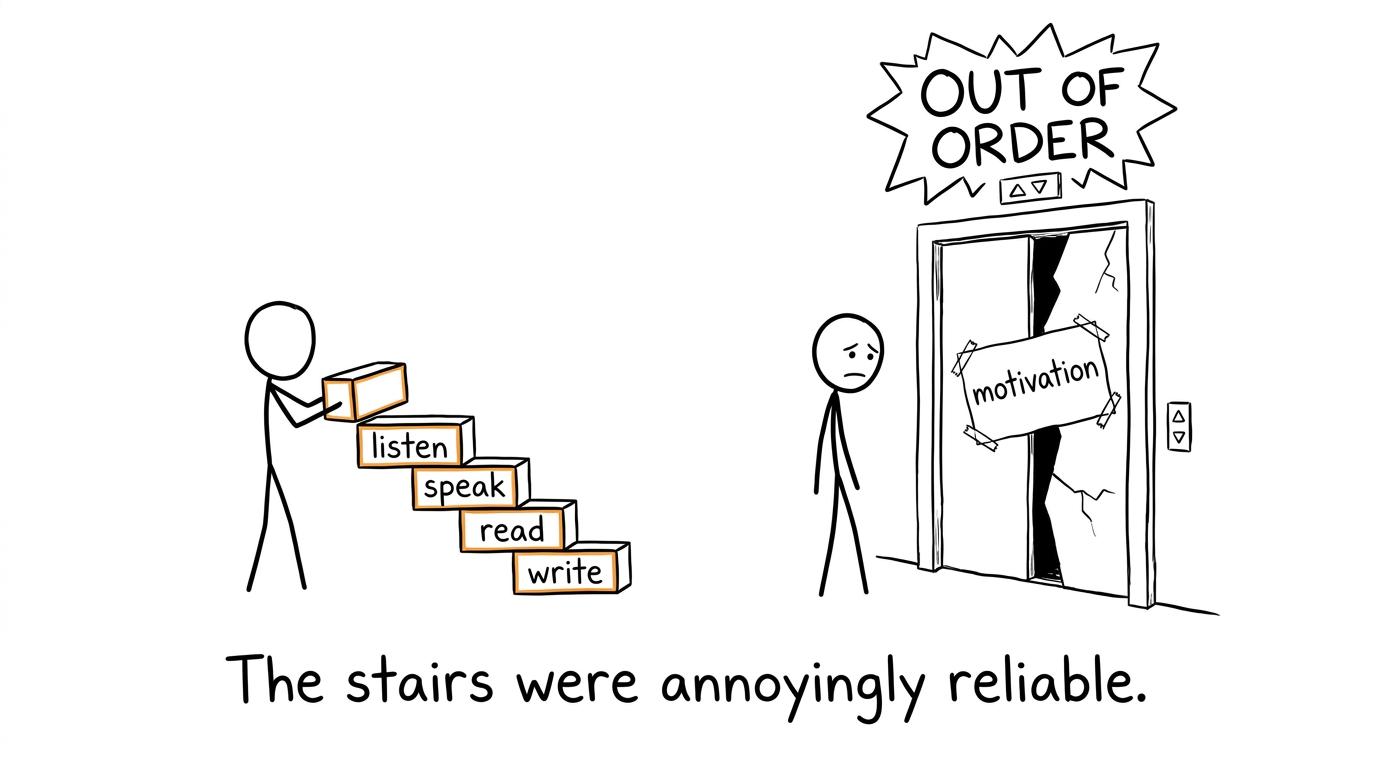 A student chooses the reliable revision stairs instead of waiting for the motivation lift
A revision plan that works in any set
The safest strategy is to build evidence of your current performance. You need to know what you can do independently, not simply how your class is described.
Audit the four skills separately
Do not reduce Arabic to one judgement such as “I am bad at languages”. Rate your listening, speaking, reading and writing separately using recent assessments and teacher feedback.
For each skill, record:
- the task or topic;
- the marks available and marks earned;
- why marks were lost;
- the action needed;
- the date you will try a similar task again.
This mirrors the diagnostic approach in MathsGenie’s guide to finding your weakest GCSE topics. Although MathsGenie specialises in maths, the underlying revision principle transfers well: evidence first, targeted practice second, re-testing third.
Build a repeatable weekly rhythm
A sensible week should touch all four skills rather than allowing comfortable activities to crowd out difficult ones. Keep sessions focused enough to sustain.
Vocabulary retrieval can support every paper, but it should feed into communication. After recalling vocabulary, use it in a spoken response, a short piece of writing or an interpretation task. Revisit it later rather than assuming one successful session means it has been learnt permanently.
Maths students can use the same spaced routine through MathsGenie’s guide to stopping forgotten GCSE content. Coordinating your subjects around one revision rhythm reduces the number of decisions you have to make each evening.
Practise under assessment conditions
Eventually, revision must become performance. Complete tasks without a dictionary, follow the correct timing and practise responding when the exact question is unfamiliar.
Mark what can be marked accurately and take speaking or extended writing to your teacher for feedback. Keep an error log. The purpose is not to collect disappointing scores; it is to prevent the same lost marks from returning.
MathsGenie uses this same progression across its free GCSE maths revision hub: revision lessons establish understanding, practice questions develop fluency, and papers test whether knowledge survives under pressure.
When should you ask about changing set or tier?
Ask early enough for the conversation to affect your preparation. Do not wait until final entries or speaking assessments are close.
A useful conversation is based on evidence rather than status. Bring recent assessment results, examples of improved work and a clear target grade. Then ask:
- Which tier am I currently expected to enter?
- Is our class covering the full content for that tier?
- Which skill is preventing me from moving set or entering higher tier?
- What assessment evidence would show that I am ready?
- When will the decision be reviewed?
If you are aiming above grade 555, clarify higher-tier entry directly. Equally, foundation tier can be a sensible choice when it gives a pupil the strongest realistic route to grades 111 to 555. Tier decisions should reflect evidence, not embarrassment or classroom prestige.
Common mistakes when thinking about Arabic sets
Assuming the top set guarantees a high grade
A demanding class provides an opportunity, not an outcome. Weak retrieval, limited speaking practice or unfinished papers can still hold back a student in the highest set.
Treating a lower set as a permanent ceiling
Current placement reflects a school decision made using information available at a particular time. It is not an examiner’s verdict. Ask for measurable improvement criteria and keep producing evidence.
Confusing foundation teaching with low expectations
Foundation tier is designed around a particular grade range. It should still involve accurate language, careful preparation and meaningful challenge.
Revising only vocabulary lists
Vocabulary is necessary but not sufficient. GCSE Arabic assesses whether you can understand and communicate through four different skills. Retrieval must lead into listening, speaking, reading and writing.
Comparing raw marks from different years
Grade boundaries can change. Use past boundaries for context, then focus on improving the quality and consistency of your responses rather than treating one historical mark as guaranteed.
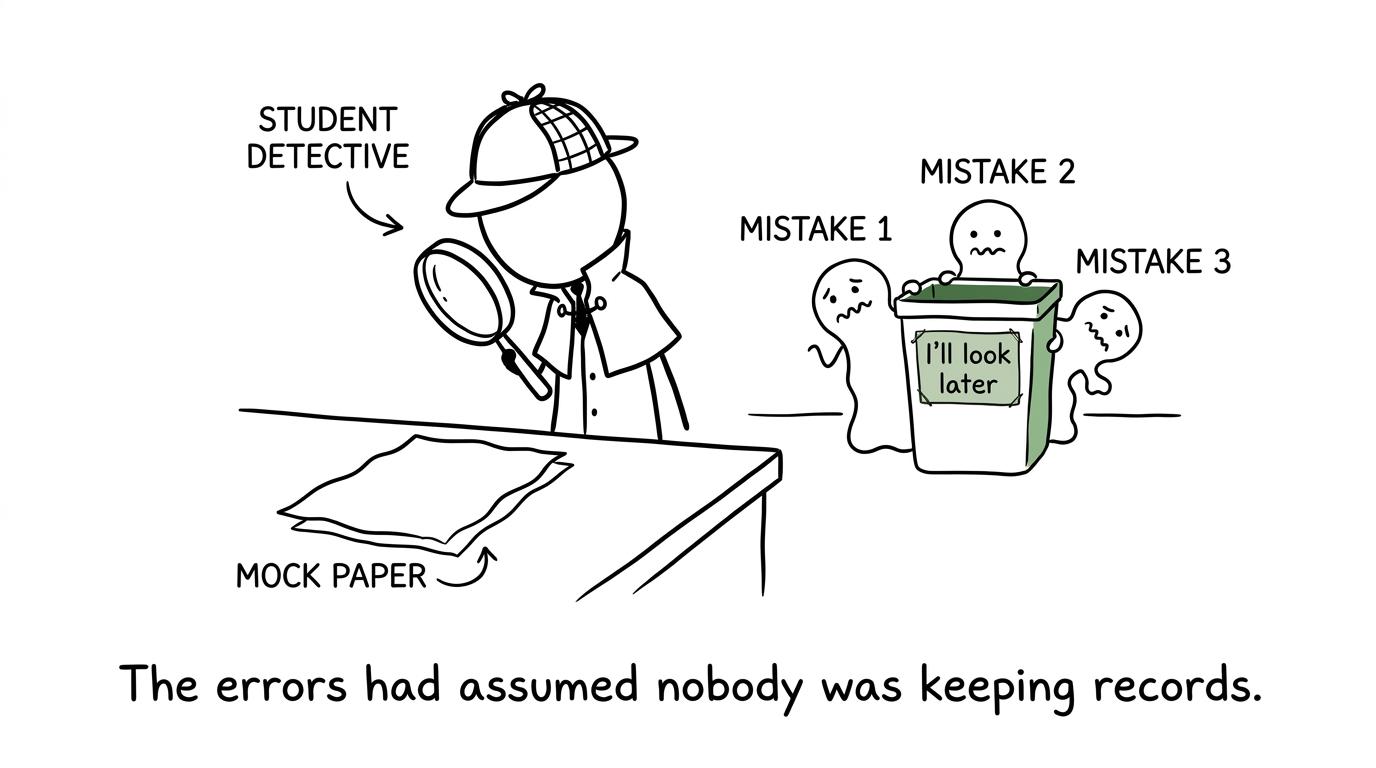 A student detective catches revision errors before they can hide
Your class is a condition, not a conclusion
Your GCSE Arabic set can affect your daily experience. It may change the pace, challenge, feedback and peers around you. But the set name itself earns no marks. The decisive questions are whether you receive the right content, whether your tier matches your goal and whether your practice improves what you can independently understand and communicate.
Build a record of your weak areas. Practise all four skills. Ask direct questions about tier entry. Then let repeated evidence, rather than a classroom label, describe your progress.
For your maths exams, apply the same disciplined process with MathsGenie. Start from the GCSE maths revision hub, diagnose gaps with GCSE mini tests, and develop exam stamina using Edexcel predicted papers. You can also use the one-month GCSE maths revision plan to organise revision lessons, practice questions, mark schemes, past papers and video solutions into a manageable routine.
A set tells you where you are taught today. Consistent, well-directed practice gives you the best chance of changing what happens on exam day.