

Do Documentaries Help GCSE Astronomy Revision?
Documentaries help GCSE Astronomy when paired with recall and exam practice. Learn what to watch, what to avoid and how to turn viewing into marks.
It is easy to finish a space documentary feeling as though you have revised. Black holes make sense. The scale of the Universe feels vivid. You can recognise the names of telescopes, planets and stellar processes. Then you open an exam question and discover that recognition is not quite the same as recall.
So, do documentaries help GCSE Astronomy? Yes, but mainly as a tool for building context, curiosity and conceptual understanding. They are much less effective when they replace specification-based revision, mathematical practice and exam questions. The best approach is to watch selectively, retrieve what you learnt without the screen, and then test whether you can use it.
That distinction matters because GCSE Astronomy does not only reward interesting knowledge about space. It assesses precise scientific explanations, calculations, graphs, data analysis and observational skills.
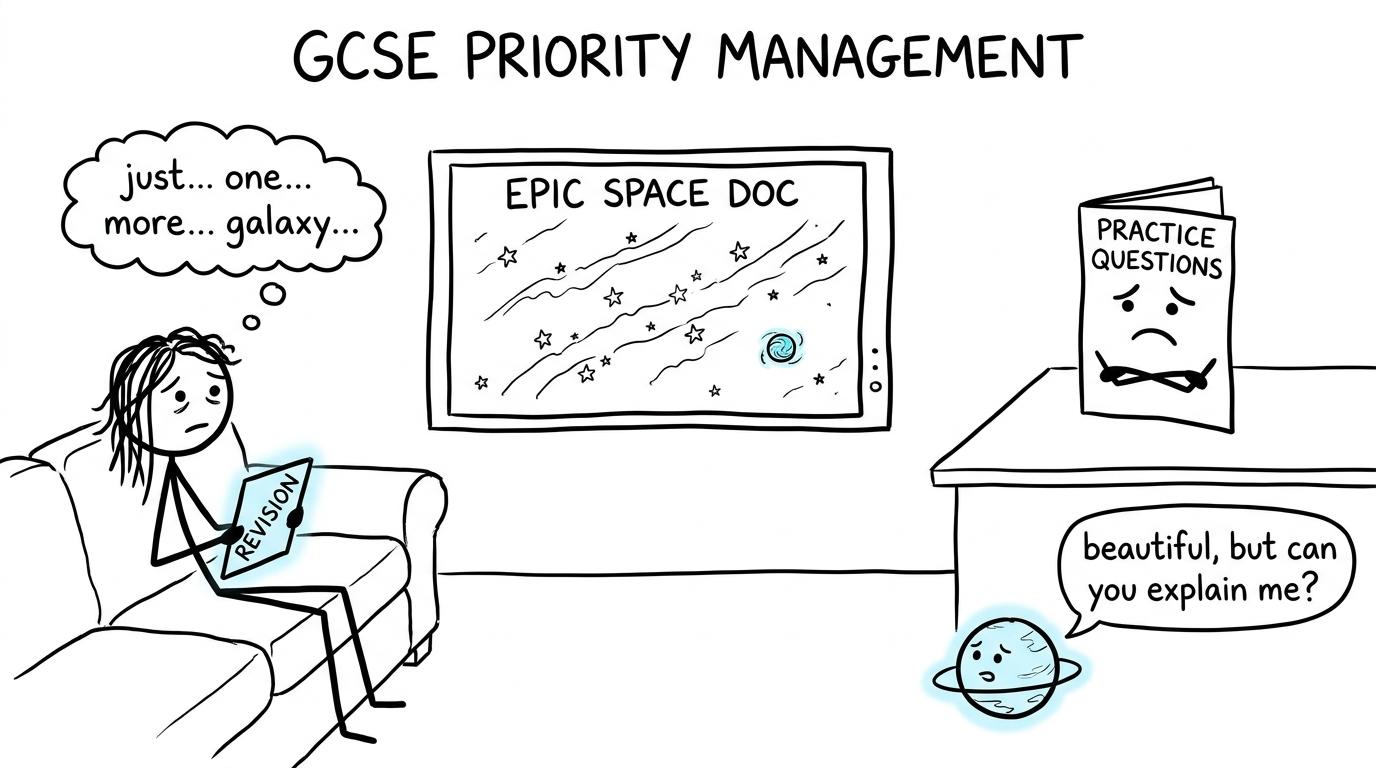 A student discovers that an enjoyable space documentary is not quite the same as answering questions
The short answer: useful, but not sufficient
A documentary can make an unfamiliar idea easier to picture. It may help you understand the scale of the Solar System, remember how stars evolve or see why atmospheric conditions affect observations. Reading around the subject can do something similar.
However, neither activity automatically prepares you to:
- recall a definition without prompts;
- use the terminology expected by the specification;
- select and rearrange an equation;
- interpret unfamiliar data;
- evaluate an observational method;
- structure an extended response; or
- complete a calculation accurately under time pressure.
A sensible checklist is therefore:
- Watch for understanding, not to cover the whole course.
- Check the specification so you know what is examinable.
- Close the screen and retrieve the main ideas from memory.
- Practise the connected maths rather than merely noticing it.
- Answer exam questions and check the mark scheme.
- Treat extra reading as enrichment, not as a replacement for core revision.
The documentary opens the door. Active practice is what takes you through it.
What GCSE Astronomy actually assesses
GCSE Astronomy in England is offered through Pearson Edexcel. It is a grades 999-111 qualification with two written papers: Naked-eye Astronomy and Telescopic Astronomy. Each paper lasts 111 hour 454545 minutes, is worth 100100100 marks and contributes 50%50\%50% of the qualification.
The papers include multiple-choice, short-answer, calculation, graphical and extended open-response questions. Students must also undertake observational work, and knowledge of observational techniques is assessed in the written examinations.
Most importantly for a MathsGenie reader, official subject requirements state that mathematical skills must account for at least 20%20\%20% of the total marks. Those skills include:
- standard form and orders of magnitude;
- ratios, fractions and inverse-square relationships;
- logarithms to base 101010;
- significant figures and specialist units;
- substitution and rearrangement of formulae;
- plotting and interpreting graphs;
- gradients and intercepts;
- angular measurement; and
- geometry and trigonometry.
This is why watching an excellent explanation of stellar distances may improve understanding without securing the calculation marks attached to that topic. You still need to handle quantities such as astronomical units, light years and parsecs, and to present numerical answers with suitable units and precision.
MathsGenie's GCSE maths revision hub provides free revision lessons, question banks, worksheets, videos and solutions for the underlying skills. Although GCSE Astronomy follows the Edexcel Astronomy specification, your GCSE Maths course may be with Edexcel, AQA, OCR or Eduqas, so choose resources that match your maths exam board and tier where relevant.
Where documentaries genuinely help
They give isolated facts a structure
A list of facts about planets or stellar evolution can feel like a collection of separate objects. A well-made documentary may show how those ideas connect: observations produce evidence, evidence supports a model, and new instruments allow that model to be tested more closely.
That larger structure can make later specification revision more meaningful. When you encounter a term in your notes, you have somewhere to place it.
They make scale and motion easier to imagine
Astronomy contains distances, timescales and movements far beyond everyday experience. Visual explanations can support an initial understanding of rotation, orbit, apparent motion and the relative scale of astronomical objects.
But visual intuition must eventually become mathematical control. Very large and very small quantities are commonly represented using standard form:
a×10n,1≤a<10a \times 10^n, \qquad 1 \leq a < 10a×10n,1≤a<10If a programme displays a vast distance on screen, pause and ask what the exponent tells you about its order of magnitude. Then strengthen the skill using MathsGenie's standard form revision resources.
They can make technical vocabulary memorable
Images and narrative can help terms such as redshift, nebula, exoplanet or electromagnetic radiation feel less abstract. That familiarity is useful, particularly at the beginning of a topic.
Yet an examination usually requires more than recognition. You may need to define the idea, explain its significance, apply it to data or compare it with another concept. After viewing, try to write a precise explanation without replaying the programme.
They can sustain curiosity
Enjoyment is not the same as revision, but it is not worthless. Curiosity can make you more willing to return to a difficult topic and ask better questions about it. The official GCSE subject content explicitly aims to develop an informed interest in astronomical investigations, discoveries and space exploration.
The key is honesty. If you watched because it was enjoyable, that is a perfectly good use of time. Just do not automatically count every minute as exam preparation.
Why passive watching can create false confidence
A documentary supplies images, narration and a carefully organised sequence. Those cues make ideas feel familiar. In the examination, the cues disappear.
Research on learning consistently supports retrieval practice: trying to recall information strengthens learning more reliably than simply seeing the material again. Classroom evidence is not identical for every subject or every complex task, so retrieval should not be treated as magic. Nevertheless, it gives students a practical principle: test what you can produce from memory, not what looks familiar on screen.
This gap is particularly important in maths. Watching someone discuss a relationship is different from deciding which quantities matter, choosing a formula and completing the calculation yourself. If formula manipulation is a weak point, use the changing the subject of a formula lesson and practice before attempting astronomy calculations.
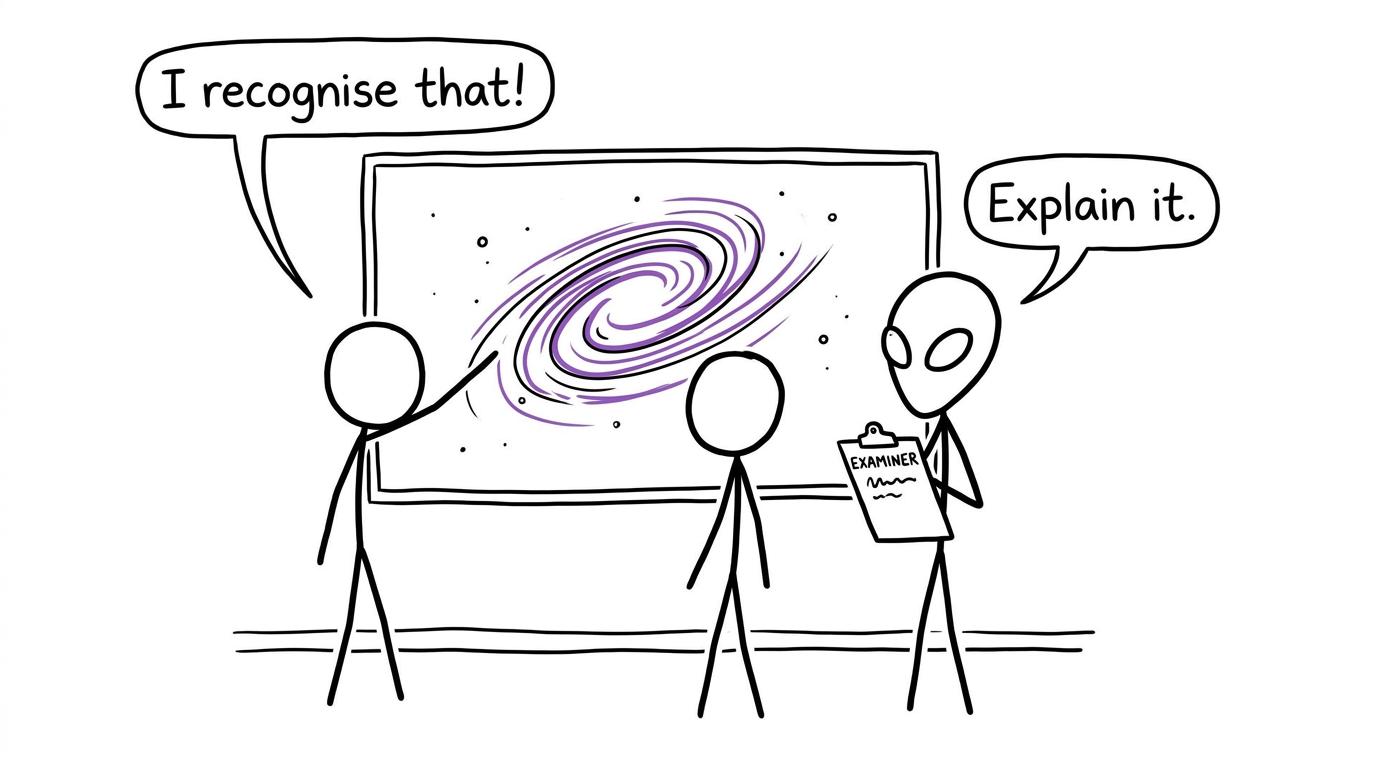 A humorous space examiner asks for explanation rather than recognition
How to turn a documentary into effective revision
Choose one specification idea before watching
Do not begin with the vague goal of “revising space”. Choose a narrower purpose, such as telescopes, lunar features, stellar evolution or evidence for the expanding Universe.
Check that the programme actually addresses your course. Documentaries are created for broad audiences, not for a particular mark scheme. They may simplify a model, spend a long time on non-examinable material or discuss discoveries made after an older programme was produced.
Use the watch, recall, check, practise cycle
A short cycle turns entertainment into something more academically useful:
- Watch: view a focused section without trying to transcribe everything.
- Recall: close the programme and write the main ideas from memory.
- Check: compare your account with your specification, class notes or textbook.
- Practise: answer questions that require you to explain, calculate or interpret.
Keep the recall stage brief and demanding. Useful prompts include:
- What were the three most important ideas?
- What evidence supported the explanation?
- Which technical terms would an examiner expect?
- What part could I not explain without looking?
- Which mathematical skill appeared?
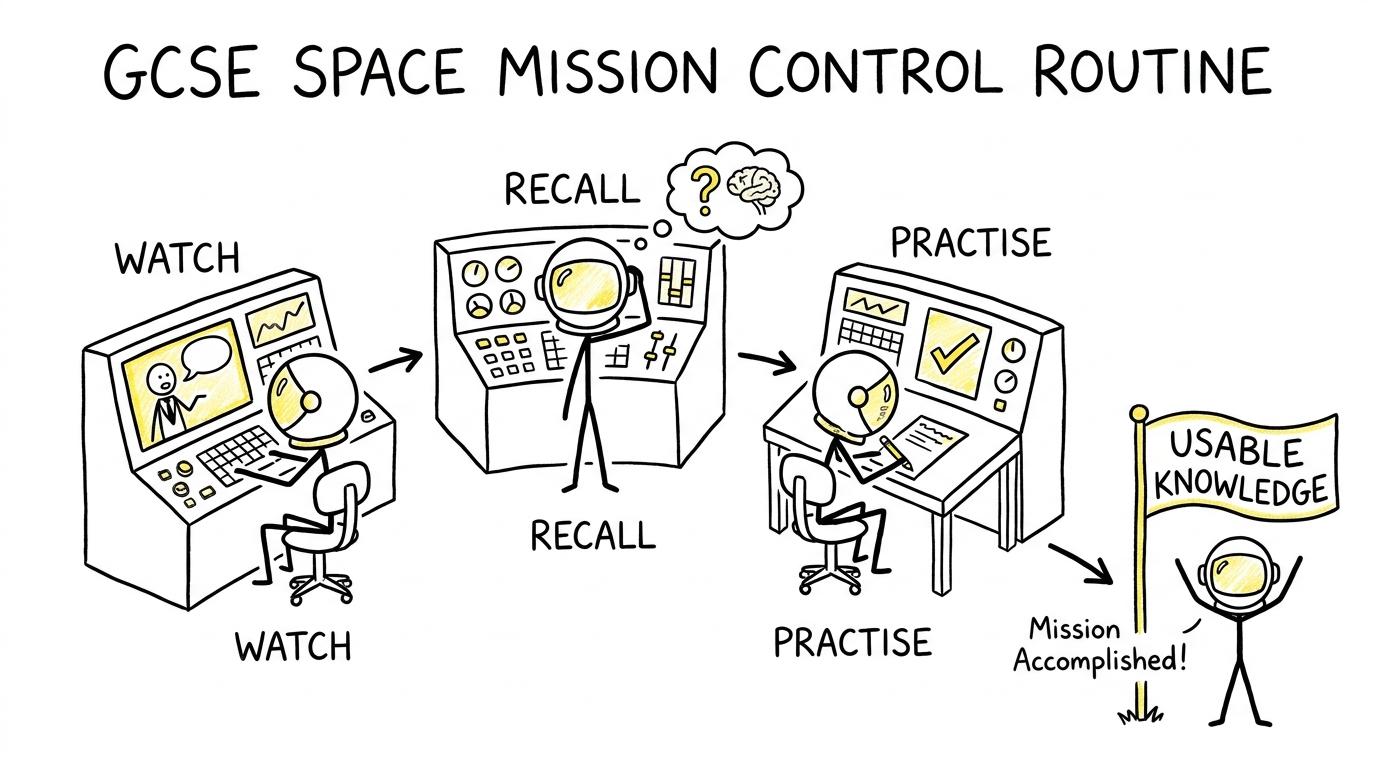 A student follows a watch, recall and practise space mission
Connect the programme to mathematical practice
When a documentary introduces a graph, angle, distance or physical relationship, identify the corresponding maths skill.
For example, astronomy can require students to move between graphical and numerical information, find a gradient or interpret changing quantities. MathsGenie's real-life and distance-time graphs resources can build confidence in extracting meaning from graphs, while the AQA bearings revision page supports angle and direction skills. Use the page matching your maths board when possible, but remember that the underlying mathematics remains transferable.
Do not invent extra calculations from every scene. The goal is to recognise an examinable skill and practise it deliberately.
Finish with questions and feedback
A revision activity becomes valuable when it changes what you can do next. After watching, complete a small set of questions and mark them carefully. If you cannot find GCSE Astronomy questions for that exact programme, use your teacher's materials or official Edexcel past-paper questions.
For the supporting maths, MathsGenie brings together topic questions, mark schemes and video solutions. Later in your revision, use GCSE predicted papers and board-specific past papers to test whether the mathematical skills remain secure in unfamiliar contexts. Predicted papers are practice tools, not promises about what will appear.
Does reading around GCSE Astronomy help more?
Reading around the subject has many of the same strengths and limitations as documentaries. It can deepen context, introduce current investigations and expose you to more precise vocabulary. Because you control the pace, reading also makes it easier to stop, question a claim and summarise a paragraph.
But extra reading can still become passive. Highlighting an elegant page about galaxies is not proof that you can answer a question about the evidence involved.
Use wider reading when it serves one of three purposes:
- clarifying a specification idea you do not understand;
- adding a memorable context to knowledge you must learn; or
- exploring astronomy because you genuinely enjoy it.
All three are worthwhile. Only the first two should automatically be counted as targeted revision, and both still need recall or question practice afterwards.
Common mistakes when using documentaries for revision
Counting viewing time instead of testing learning
Two hours watched is not the same as two hours learnt. Measure the session by what you can explain or answer afterwards.
Taking every statement as specification language
A narrator may use analogy, simplification or dramatic phrasing. Return to the current Edexcel specification and your approved course materials for the required depth and terminology.
Ignoring the maths
Astronomy is not a calculation-free subject. Standard form, formulae, graphs and angular measurements can all generate marks. Build these foundations through the MathsGenie GCSE learning journey, then apply them in astronomical contexts.
Making beautiful notes without retrieval
Detailed notes can feel productive because they leave visible evidence of effort. After writing them, close the page and reproduce the explanation from memory. The struggle is useful information: it reveals what is not secure yet.
Watching instead of addressing weak topics
Students naturally return to subjects they enjoy. If galaxies are fascinating but logarithms keep costing marks, another galaxy documentary may be avoidance disguised as revision. A realistic GCSE maths revision timetable can protect time for weaker skills while leaving room for wider exploration.
A balanced weekly approach
Documentaries work best as a small part of a broader plan. You might use one focused viewing session to introduce or consolidate a topic, then spend the rest of the week on specification notes, retrieval, calculations and exam questions.
Keep a simple record with four items: the topic, what you recalled, what you missed and what you will practise next. This turns curiosity into a decision rather than another page of notes.
As the examination approaches, shift more time towards timed questions and feedback. MathsGenie's guidance on when to start GCSE past papers explains why papers are most useful while there is still time to repair the weaknesses they reveal.
Enjoy the story, then practise the skill
Documentaries can help GCSE Astronomy. They can make the Universe feel coherent, give difficult ideas a visual shape and remind you why the subject interested you in the first place. Reading around the course can do the same.
But enjoyment and examination readiness are different outcomes. A strong revision session moves from interest to recall, and from recall to application. Watch the explanation. Close it. Reconstruct the idea. Then answer the question.
Use MathsGenie as the free maths base beneath your astronomy revision: revisit weak methods through revision lessons, build fluency with practice questions, check your work using mark schemes and video solutions, and test your progress with mini tests, past papers and predicted papers. The night sky can provide the wonder. Deliberate practice turns that wonder into marks.










