

Degree After A-Level Computer Science: Course Guide
Degree after A-Level Computer Science: compare UK courses, maths requirements, example entry grades and smart Results Day choices with confidence.
Results Day can make a carefully planned future feel surprisingly uncertain. Perhaps your grades differ from your predictions, or perhaps receiving them has made university feel real for the first time. If you are choosing a degree after A-Level Computer Science, the short answer is that your strongest options include computer science, software engineering, cyber security, data science, artificial intelligence and several joint degrees. The right choice depends less on the course title than on its modules, mathematical demands and entry requirements.
For students still taking GCSEs, this decision may seem distant. It is not. Your GCSE Maths result can influence sixth-form subject choices, while A-Level Mathematics is required by many mathematically demanding computer science courses.
Your university course checklist
Before accepting an offer or searching for an alternative, check:
- whether the degree requires A-Level Mathematics;
- whether your achieved grades meet the standard or contextual offer;
- which modules are compulsory in the first two years;
- how much programming, theory and mathematics the course contains;
- whether there is a placement year, year abroad or integrated master's option;
- how the course is assessed;
- whether the curriculum suits the work you may want to pursue.
Course requirements change between universities and admissions cycles. Always confirm them on the university's current course page rather than relying on an old prospectus or a general league table.
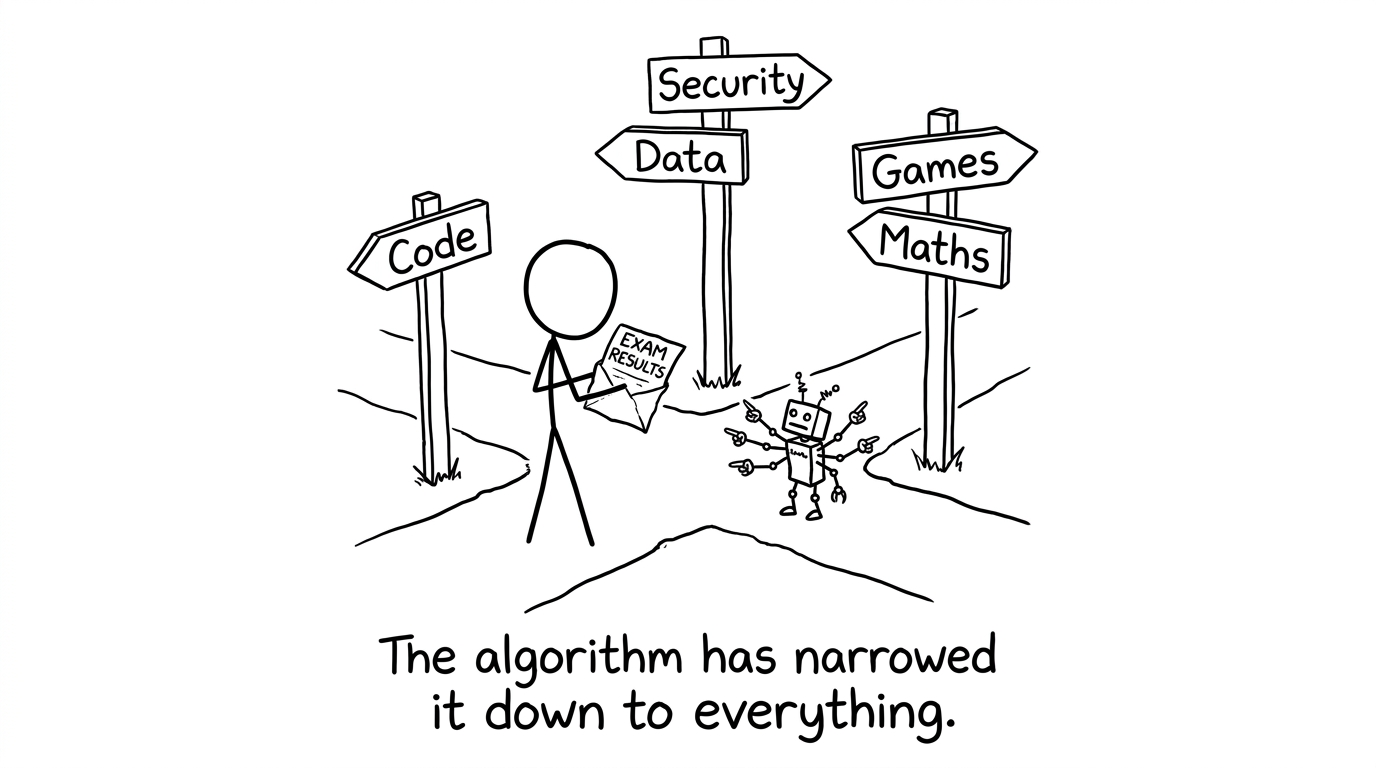 A student and robot facing too many degree-course signposts
Degree routes that build on A-Level Computer Science
Computer science
A broad computer science degree normally covers programming, algorithms, data structures, databases, computer architecture and software development. Many courses later offer optional modules in areas such as machine learning, graphics or security.
This route suits students who enjoy understanding why computational methods work, not merely using a particular programming language. Theoretical courses can involve substantial discrete mathematics, logic, probability and algebra.
Software engineering
Software engineering focuses more directly on designing, testing and maintaining larger software systems. Common themes include team development, requirements analysis, software architecture and project management.
Choose it if you enjoy programming but also want to understand how reliable software is built collaboratively. Compare the modules carefully: at some universities, computer science and software engineering share most of their first year.
Cyber security
Cyber security degrees may cover networks, operating systems, secure programming, cryptography, digital forensics and ethical security testing. They reward careful thinking because small assumptions can create large vulnerabilities.
Do not choose cyber security simply because the title sounds employable. Check the balance between technical computing, security policy and practical laboratory work.
Data science and artificial intelligence
Data science combines programming with statistics, probability and data analysis. Artificial intelligence courses may add machine learning, optimisation, robotics or natural-language processing.
These are usually among the more mathematical routes. A student who likes coding but strongly dislikes algebra and statistics should inspect the compulsory modules before applying. If you are considering A-Level Mathematics alongside Computer Science, explore how to choose your three A-Level subjects before finalising your combination.
Games, robotics and joint degrees
Games computing may include graphics, simulation, game engines and software design. Robotics often combines computing with electronics, mechanics and control. Joint degrees can connect computer science with mathematics, business, economics or a science.
Specialist titles can be attractive, but breadth has value. A broad first year may let you discover an area before committing to a narrow pathway.
Comparing courses and example entry grades
The following examples show how widely requirements can vary. They reflect published requirements found for recent entry cycles and are illustrations, not a complete application list.
| Example course | Published A-Level offer example | Important subject condition |
|---|---|---|
| UCL Computer Science BSc | A*A*A | A* in Mathematics or Further Mathematics |
| Queen Mary Computer Science BSc | AAA | Mathematics, Computer Science or Physics included |
| Exeter Computer Science BSc | AAA to AAB | Grade B in Mathematics |
| Sussex Computer Science BSc | ABB to BBB | GCSE Mathematics requirement applies |
The pattern matters more than the individual universities. Competitive theoretical courses often require A-Level Mathematics even when they do not require A-Level Computer Science. UCAS guidance also notes that relatively few computing courses specify Computer Science itself, while mathematically theoretical programmes are more likely to demand Mathematics.
That distinction is useful for GCSE students. A-Level Computer Science can develop programming and computational thinking, but A-Level Mathematics may keep more selective computer science routes open. Before choosing it, inspect the demands through Edexcel A-Level Maths revision resources, including algebra, calculus, statistics and mechanics.
 A student using a magnifying glass to compare university modules
What to do on Results Day
Start with facts, not the emotion of the first five minutes.
Check your results, your UCAS status and any messages from your firm and insurance universities. If your place is confirmed, you can still reread the course structure before making practical arrangements. If it is not confirmed, contact the university using its published admissions details and ask precise questions.
When considering Clearing, prepare a short comparison list. Record the course modules, entry conditions, location, accommodation position and placement options. Ask whether the course has spaces before making assumptions based on an older web page.
A slightly different course can be a sensible route, but it should still fit your interests. Software engineering is not automatically a substitute for computer science, and a foundation year is not a failure. It is an additional year designed to prepare students who do not yet meet the direct-entry requirements of a particular programme.
How maths preparation supports a computing degree
Computer science often turns uncertainty into a sequence of smaller problems. Maths revision develops the same habit: interpret the information, select a method, test it and correct mistakes.
If you are still at GCSE, use AQA GCSE Computer Science past papers alongside your maths preparation. If A-Level Mathematics is part of your route, combine topic revision with Edexcel A-Level Maths past papers, AQA A-Level past papers or MathsGenie's broader A-Level Maths revision collection.
The purpose is not to race ahead into university mathematics. It is to become secure with the algebra, functions, probability and logical reasoning already on your specification.
Common mistakes when choosing a degree
Choosing only by course title: Two identically named degrees can contain very different compulsory modules.
Assuming A-Level Computer Science replaces Mathematics: Some universities accept Computer Science as a relevant subject, but mathematically demanding courses may specifically require A-Level Mathematics.
Treating published grades as the whole offer: Subject grades, GCSE conditions, admissions tests and contextual criteria may also apply.
Ignoring assessment style: A course may rely on examinations, programming projects, group work or reports in different proportions.
Making a rushed Results Day decision: A vacancy is only useful if the course, costs and location remain workable.
Make the next decision from stronger foundations
Going from A-Level Computer Science to a degree is not one fixed path. The best course is the one whose content matches how you like to think, what you want to learn and the qualifications you actually hold.
Start by comparing modules and current entry requirements. Then strengthen the mathematics that keeps computing routes open. MathsGenie provides free revision lessons, practice questions, mini tests, past papers, predicted papers, mark schemes and video solutions for GCSE and A-Level Maths. Choose your next course carefully; then prepare for it one topic at a time.











