

Degree After A-Level Business: Courses to Consider
Degree after A-Level Business choices explained, from management and marketing to finance, with example entry grades and a practical decision checklist.

Results Day can make a carefully planned future feel strangely small: one screen, three grades and a decision about what happens next. If you are choosing a degree after A-Level Business, the short answer is that your strongest routes include business management, marketing, accounting and finance, economics, entrepreneurship, human resource management and international business.
Your Business A-Level gives you useful context, but it does not lock you into one course. The better question is not simply, “Which degree matches my subject?” It is, “Which kind of problem would I like to spend three years learning to solve?”
Your degree decision checklist
Before comparing university names, check five things:
- the modules you will actually study
- required A-Level and GCSE subjects
- typical and contextual offers
- the balance between essays, calculations and practical projects
- placement years, professional accreditation and graduate destinations
Entry requirements change between universities and application cycles. The examples below illustrate published requirements for 2026 entry, but you should always confirm the current course page before applying or entering Clearing.
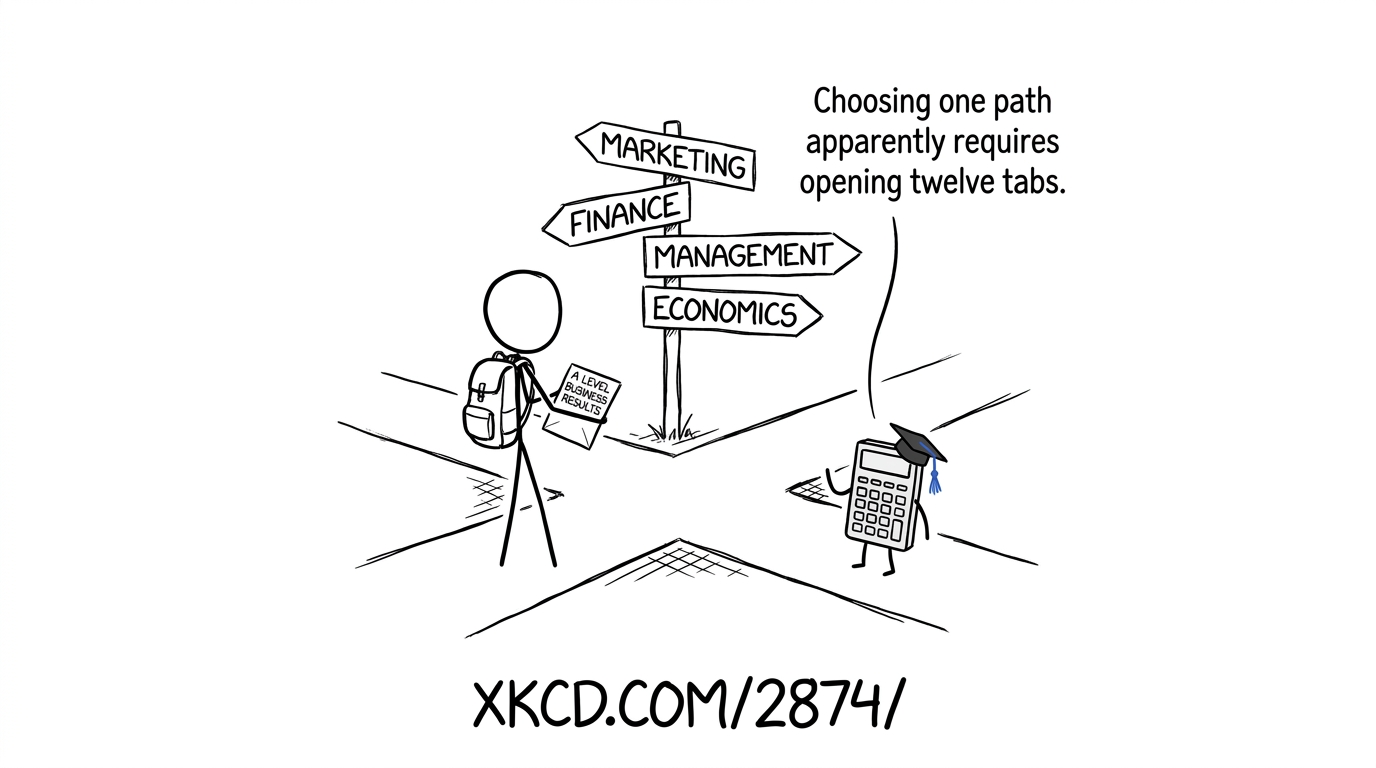 A student faces degree signposts while a calculator wears a graduation cap
University courses for Business A-Level students
Business management
Business management is the broadest continuation from A-Level Business. Typical modules cover strategy, operations, organisational behaviour, finance, marketing and data analysis. It suits students who enjoy seeing how the different parts of an organisation fit together.
Breadth is both its advantage and its risk. Read the module list carefully: two courses with almost identical titles may place very different weight on economics, mathematics or group projects.
As an indication of variation, Queen Mary University of London published a typical offer of AAA for its 2026 Business Management course, while contextual offers were lower. This is an example, not a national standard.
Marketing
Marketing degrees move beyond advertising. You may study consumer behaviour, market research, digital strategy, branding and analytics. This route suits students who enjoyed analysing why customers behave as they do and how businesses build demand.
Marketing still involves numbers. Surveys, conversion rates, budgets and market data all reward confidence with percentages and statistics. Leeds University Business School, for example, published an AAB offer for its 2026 Marketing degree, alongside GCSE English and maths requirements.
Accounting and finance
Accounting and finance is a more numerical A-Level Business to degree route. Courses can include financial reporting, management accounting, corporate finance, taxation and economics.
It may suit you if you prefer evidence and structured decisions to open-ended discussion. Some courses accept students without A-Level Maths, while more quantitative programmes require it or expect a strong GCSE Maths grade. Exeter’s Accounting and Business course published a typical AAB offer for 2026, including GCSE Maths at grade 5.
If this path interests you, strengthen the foundations through the free GCSE Maths revision hub. Percentages, ratio, graphs and interpreting data remain valuable long after the GCSE exam.
Economics and business economics
Economics asks wider questions about markets, incentives, government policy and the allocation of resources. Business economics applies similar thinking more directly to firms and commercial decisions.
The mathematical demand varies sharply. Leicester’s 2026 Business Economics course published an ABB offer and required GCSE Maths at grade 5. By contrast, highly quantitative economics courses may require A-Level Maths and considerably higher grades. Never assume that A-Level Business alone meets the subject requirements.
International business
International business combines management with global markets, cultures, trade and multinational strategy. Some courses offer language study, overseas study or an international placement.
This can be a good choice if the global strategy parts of Business interested you, but inspect the degree structure. “International” may mean specialist modules, a compulsory year abroad or simply a broader case-study focus.
Entrepreneurship and innovation
Entrepreneurship degrees explore how ideas become viable organisations. Modules may cover opportunity recognition, business models, finance, innovation and new venture development.
Do not choose this route because it sounds less academic. A credible course should still develop research, financial reasoning and critical evaluation. The aim is not merely to produce ideas; it is to test whether those ideas survive contact with evidence.
Human resource management
Human resource management focuses on recruitment, workplace behaviour, employment relationships, training and organisational culture. It may appeal if you enjoyed the people-focused parts of A-Level Business.
Look for opportunities to study employment law, analytics and organisational psychology. These give the degree more depth than a course built mainly around general management.
Example course and entry-grade comparison
| Course route | Example published 2026 offer | Check particularly carefully |
|---|---|---|
| Business Management | AAA at Queen Mary | Module breadth and assessment style |
| Marketing | AAB at Leeds | Research methods and analytics |
| Accounting and Business | AAB at Exeter | GCSE Maths requirement and accreditation |
| Business Economics | ABB at Leicester | Mathematical content |
| International Business, Finance and Economics | AAA at Manchester | GCSE numeracy requirements |
These grades are decision-support examples, not predictions of an offer. Contextual admissions, foundation years and course-specific conditions can create different routes. On Results Day, compare your confirmed place, any alternative offer and available Clearing options using current university information.
Why your GCSE Maths grade still matters
A university may consider your GCSE profile even when the headline offer lists only A-Level grades. Several current business-related courses specify GCSE Maths at grade 5 or 6, while more quantitative economics routes can demand A-Level Maths.
That makes GCSE revision part of a longer story. Students taking AQA can use the AQA GCSE Maths revision resources, while the main hub includes exam-board resources for Edexcel, OCR and Eduqas. Build knowledge with revision lessons and practice questions, then test it through mark schemes and past papers.
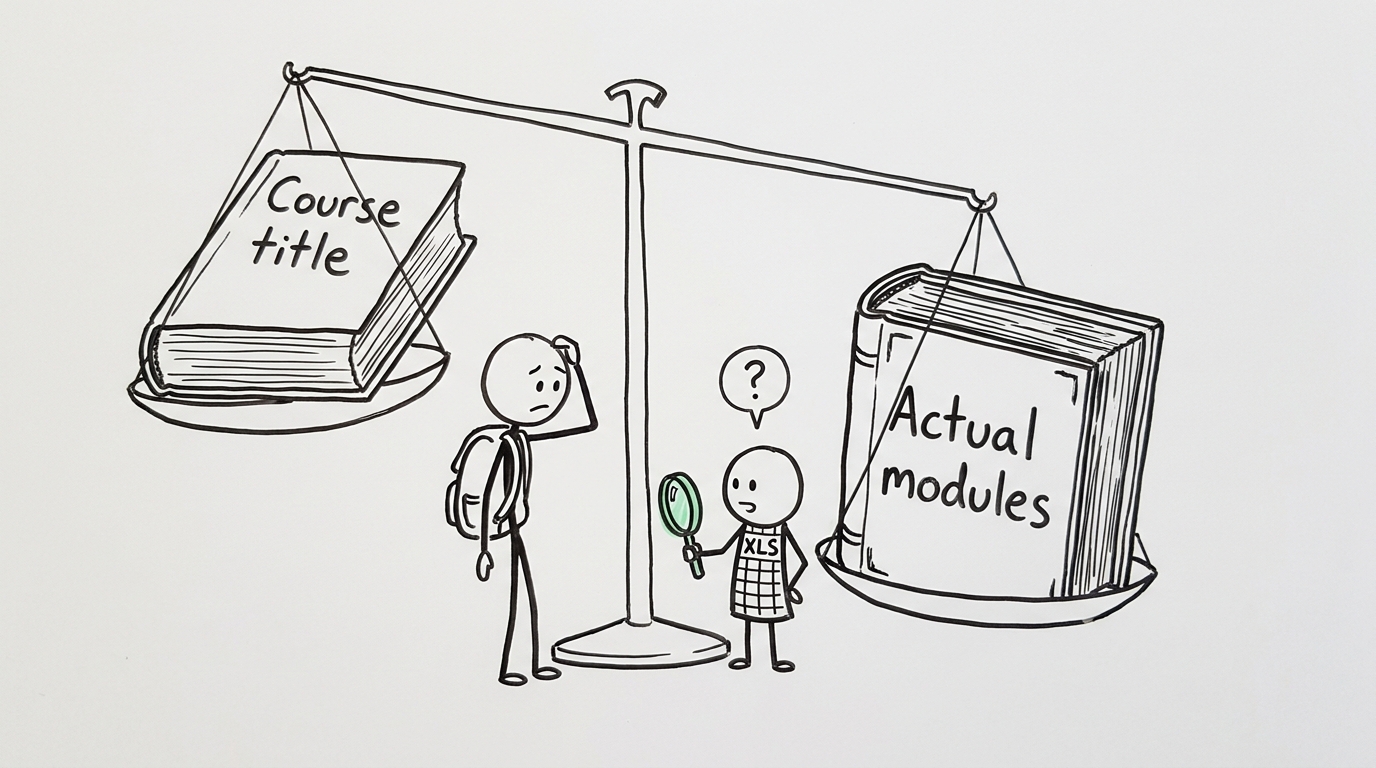 A student discovers that actual modules outweigh a course title
How to choose between similar degrees
Start with modules, not titles. Create a shortlist and compare compulsory first-year subjects, optional modules, assessment methods and placement opportunities. Then ask:
- Would I rather write strategic evaluations or analyse financial data?
- Do I want a broad course or early specialisation?
- Is a placement year worth an additional year of study?
- Does the course meet the entry conditions I actually hold?
- Can I explain why I want this course without repeating its title?
Also consider cost and funding using official information relevant to where you normally live. Eligibility and support differ across the UK, and foundation years may have separate fee arrangements.
Common mistakes when choosing a business degree
Choosing by title alone: “Business”, “management” and “enterprise” can hide very different modules.
Ignoring the maths requirement: A-Level Business does not replace A-Level Maths where a university explicitly requires Maths.
Treating published grades as permanent: Offers and subject conditions can change each year.
Assuming every finance course leads to the same exemptions: Check professional accreditation directly with the university and relevant professional body.
Looking only at league tables: Course structure, location, cost, support and placement access may matter more to your daily experience.
Turn today’s preparation into tomorrow’s options
Choosing a degree after A-Level Business is less about finding one perfect label and more about recognising the work you want to become good at. Compare modules, verify requirements and keep a broad route alongside more ambitious choices.
If you are still preparing for GCSEs, protect those future options now. Start at MathsGenie’s free revision homepage, organise topic practice with the GCSE revision resources, and use GCSE predicted papers alongside real past papers. For a more deliberate routine, follow the guide to revising GCSE Maths without wasting time and the plan for remembering GCSE Maths content.
Revision lessons, practice questions, mini tests, video solutions and mark schemes turn uncertainty into evidence. That is useful in an exam, and surprisingly useful when choosing what comes after it.










