

Degree After A-Level Biology: Courses to Consider
Degree after A-Level Biology: compare biology, biomedical science, ecology, zoology and medicine routes, entry grades, maths demands and next steps.
Results day can make a future that once felt distant suddenly feel very close. If you are deciding on a degree after A-Level Biology, the main routes include biological sciences, biomedical science, biochemistry, ecology, zoology, biotechnology and healthcare courses such as medicine. The right choice depends on what you enjoyed, your other A Levels, your achieved grades and the kind of work you want to do.
There is no universally best biology degree. A broad course preserves options; a specialist course commits earlier. Your task is not to predict your entire career. It is to choose a useful next step.
Your degree decision checklist
Before comparing course titles, ask:
- Did you prefer cells and genetics, human physiology, practical work or ecosystems?
- Do you want a broad scientific degree or a defined professional route?
- Which science subjects does the course require alongside Biology?
- Are your achieved grades within the standard or contextual offer range?
- How much statistics, chemistry and laboratory work appears in the modules?
- Is professional accreditation important for your intended career?
- Does the course offer placements, fieldwork or an integrated master’s year?
Entry requirements change between universities and application cycles. Treat the grades below as current examples, not promises, and check the provider’s course page before making a decision through your application or Clearing.
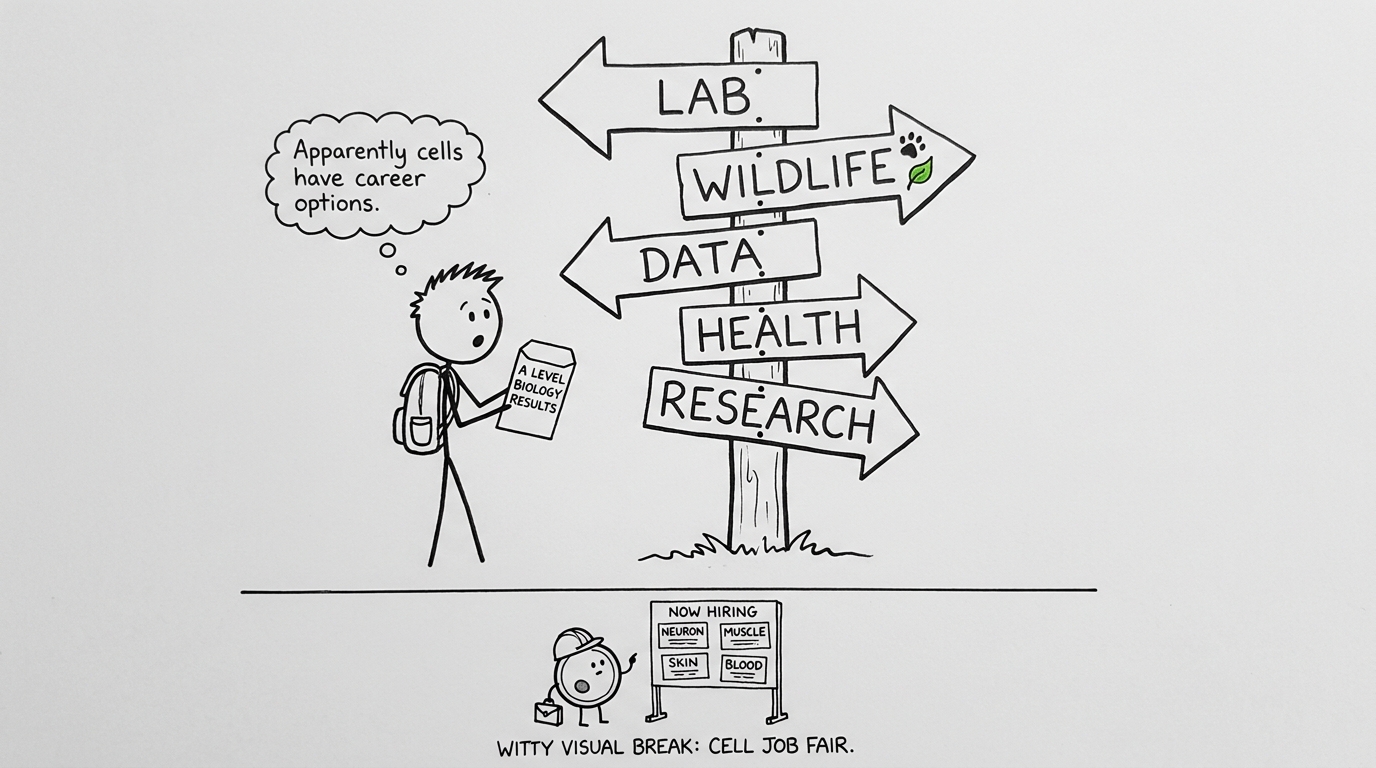 A student choosing between laboratory, wildlife, data, health and research degree routes
University courses for Biology A-Level students
Biological sciences or biology
A broad biological sciences degree is often the safest choice when you enjoy several branches of the subject. Typical modules may cover genetics, evolution, cell biology, physiology, ecology and molecular biology, with specialisation later.
Published examples for 2026 entry illustrate the variation. Leicester lists ABB, including two relevant sciences, while Manchester publishes AAA-AAB with requirements involving core sciences. Some universities also make contextual offers.
This route suits students who want flexibility before choosing between laboratory research, conservation, biotechnology, science communication or postgraduate study.
Biomedical science
Biomedical science concentrates on human disease, diagnostics, cells, infection and laboratory investigation. It is not the same course as medicine and does not qualify you as a doctor.
For students intending to work as registered biomedical scientists in the UK, course accreditation matters. NHS careers guidance advises checking for Institute of Biomedical Science accreditation; professional registration also requires the relevant practical competence route. Do not assume that every degree with “biomedical” in its title leads to the same professional outcome.
As an entry-grade example, Southampton publishes ABB for its biomedical sciences degree, including Biology or Chemistry and another science subject. Requirements elsewhere may be higher or lower.
Biochemistry, biotechnology and genetics
These courses sit where biology meets chemistry, technology and data. They can lead towards pharmaceutical research, molecular diagnostics, industrial biotechnology, genomics or further academic research.
Check Chemistry requirements carefully. Some courses require A-Level Chemistry, while others accept Biology with another science. Module lists are especially valuable here: two similarly named degrees may place very different emphasis on organic chemistry, programming or laboratory work.
Ecology, zoology and environmental biology
If fieldwork, biodiversity and interactions between organisms held your attention, consider ecology, zoology, marine biology or conservation.
Edinburgh’s published ecology requirements, for example, include Biology and Chemistry within an AAA-ABB range. Leicester’s zoology course lists ABB with two relevant sciences. These are examples rather than a national rule.
Look beyond appealing animal photographs. Compare the amount of fieldwork, ecological statistics, laboratory biology and independent research. A strong ecology degree is quantitative as well as observational.
Medicine and related healthcare courses
Medicine is a professional route with demanding academic and admissions requirements. UCL’s published 2026 standard offer is AAA, requiring Biology and Chemistry with either at A. Applicants must also take the UCAT in the application year. Other medical schools set different subject, GCSE and admissions-test conditions.
Medicine is therefore not simply “the degree for someone good at Biology”. It requires a sustained interest in patient care, communication, scientific reasoning and clinical responsibility. Other health-related possibilities include pharmacy, neuroscience, physiotherapy and healthcare science, each with distinct entry and professional requirements.
Example courses and entry grades
| Degree route | Published example | Questions to ask |
|---|---|---|
| Biological sciences | Leicester: ABB | Can you specialise after the first year? |
| Biology | Manchester: AAA-AAB | Which second science is required? |
| Biomedical sciences | Southampton: ABB | Is accreditation needed for your career plan? |
| Zoology | Leicester: ABB | How much fieldwork and statistics are included? |
| Ecology | Edinburgh: AAA-ABB | Are both Biology and Chemistry required? |
| Medicine | UCL: A*AA | Have you met the subject and admissions-test rules? |
Grades alone should not choose the course. Compare compulsory modules, assessment methods, placements, location and progression routes. A course whose content fits you is usually a better decision than one chosen only for its title.
How much maths is involved in a biology degree?
Modern biology uses data. You may meet percentages, logarithms, graphs, probability, statistical tests, rates of change and experimental uncertainty. Ecology can involve population modelling; genetics uses probability; biomedical research depends on interpreting evidence.
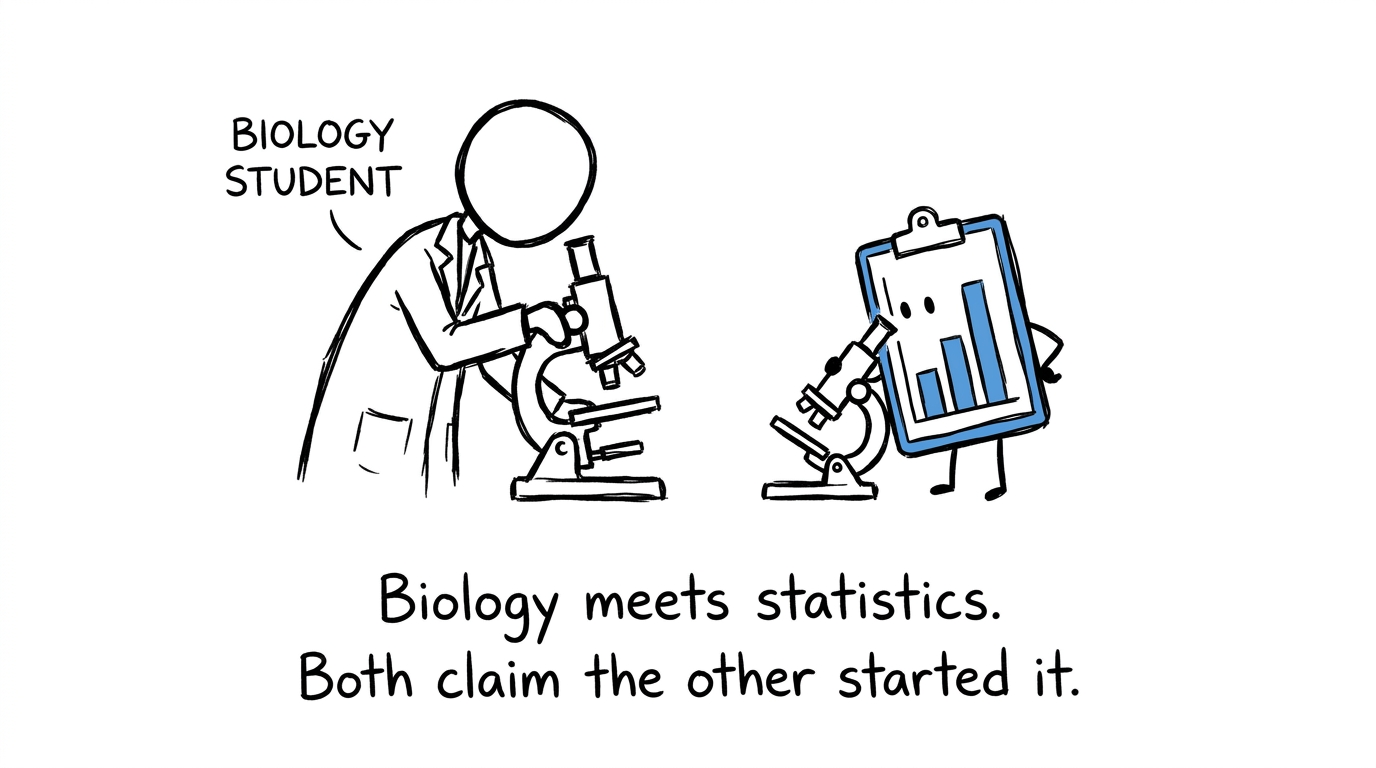 Biology and statistics examining each other through microscopes
For GCSE students considering A-Level Biology later, secure numeracy now. The GCSE maths revision hub covers all major exam boards, while the Edexcel GCSE Maths lessons include percentages, standard form, probability and statistics. These are not isolated exam topics. They become tools for handling biological evidence.
At A Level, stronger statistics can make the transition to university calmer. MathsGenie’s Edexcel A-Level Maths revision and Edexcel A-Level past papers provide structured practice where appropriate.
What to do if your results change the plan
First, compare achieved grades with every condition of your offer, including required subjects and practical endorsements. If a university has not confirmed your place, contact it using the details in your application rather than assuming the outcome.
Then consider nearby routes: a broader biology degree, a related course with different requirements, a foundation year or a planned reapplication. A lower result may change the route without removing the destination.
Keep decisions evidence-based. The same habit improves revision: identify the gap, practise it and test again. MathsGenie’s guide to finding your weakest GCSE topics explains that process clearly.
Common mistakes when choosing a biology degree
Choosing by course title alone. Read compulsory modules and assessment details.
Ignoring the second-subject requirement. Biology may be essential, but Chemistry, Maths or another science can also be required.
Treating sample grades as permanent. Offers can change by year and contextual eligibility.
Confusing biomedical science with medicine. They have different training routes and professional outcomes.
Underestimating maths and data. Strengthen graphs, probability and statistics rather than avoiding them.
Applying only to one type of route. A balanced shortlist can include ambitious, realistic and safer choices.
Choose the next step, not your whole life
Moving from A-Level Biology to a degree is less like selecting one permanent identity and more like choosing the next useful environment in which to learn. Start with the biology you genuinely enjoy, confirm the entry rules, and inspect what the course teaches after the first exciting paragraph.
While planning, keep your academic foundations moving. Use MathsGenie’s free AQA A-Level Biology revision hub and AQA Biology question bank, supported by revision lessons, practice questions and mark schemes. For maths preparation, combine topic work with GCSE predicted papers. A clear university decision begins with good information; a strong offer begins with the work you do now.










