

Colour Coding Notes GCSE English Language and Literature
Colour coding notes GCSE English Language and Literature: learn when colour supports recall, when it wastes time, and how to revise actively for exams.
A page can look impressive without teaching you very much. Neat headings, carefully ruled boxes and five shades of highlighter create a reassuring sense of progress. But when the book closes, can you retrieve the quotation, explain the writer’s method or plan a convincing response?
That is the real test of colour coding notes GCSE English Language and Literature students need to apply. Colour can help you organise information and direct attention, but it does not reliably create strong recall by itself. It works best as a small part of active revision, not as a replacement for self-testing, writing practice or feedback.
For students balancing English with GCSE maths, that distinction matters. Revision time is limited. Every technique has an opportunity cost.
The short answer: does colour-coding help?
Yes, sometimes. Research on colour and memory suggests that distinctive, consistently used colour can attract attention and provide retrieval cues. However, evidence specifically supporting decorative highlighting as a powerful revision method is limited and mixed. Re-reading and covering large sections of a page in colour can also produce false confidence because the material feels familiar.
A useful verdict is:
- Colour helps with organisation when each colour has a stable meaning.
- Colour may support recall when it acts as a cue and you subsequently test yourself.
- Colour wastes time when you continually rewrite or decorate notes.
- Active retrieval and exam practice matter more than the appearance of the page.
- The best system is simple enough to use consistently.
This reflects a broader principle of effective revision: looking at information is not the same as retrieving or applying it. MathsGenie’s guide to stopping GCSE maths content from being forgotten uses the same idea: learn, retrieve, practise and revisit.
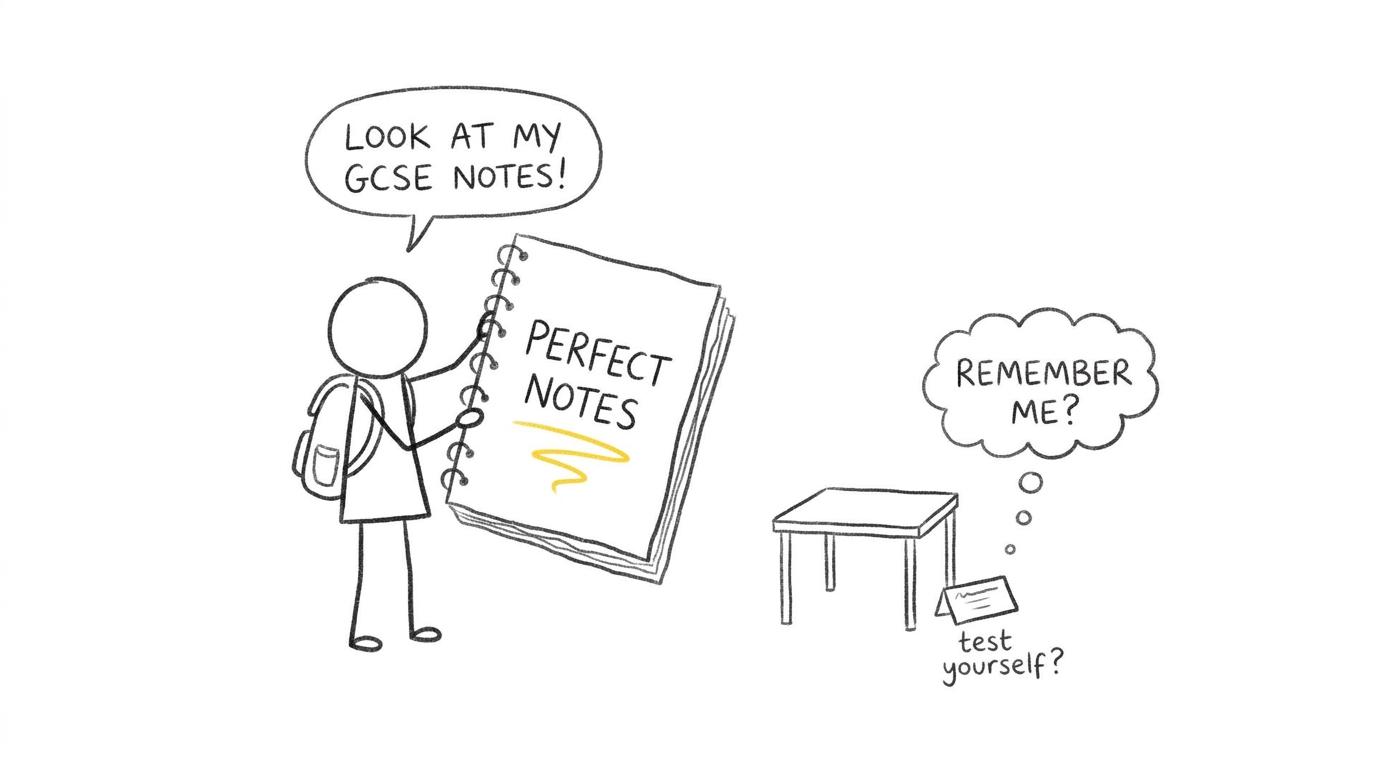 A student discovers that perfect rainbow notes cannot replace self-testing
Why colour can feel more effective than it is
Colour-coding is satisfying because its progress is visible. At the end of twenty minutes, the page has changed. Retrieval practice is less comfortable: you close the book, attempt to remember something and immediately discover gaps.
The uncomfortable task often tells you more.
Highlighting can improve selection if you must decide which phrase matters and why. Yet simply moving a highlighter across a sentence demands little retrieval. Familiarity then gets mistaken for knowledge. You recognise a quotation when you see it, but cannot produce or use it independently in an exam.
This is not an argument for dull notes. It is an argument for giving colour a specific job. Colour should help you find, classify or question information. It should not become the revision activity itself.
A practical colour system for GCSE English
Keep the key small. Three or four categories are normally enough; there is no evidence-based universal set of colours that every student must follow. What matters is that your meanings are clear, useful and consistent.
| Colour category | Possible purpose |
|---|---|
| One colour | Quotations or precise textual evidence |
| One colour | Language, form and structural methods |
| One colour | Themes, ideas or contextual connections |
| One colour | Mistakes, questions or content to retrieve again |
Students with colour-vision differences, visual stress or limited access to coloured materials can pair each category with a symbol, label or underline style. The system should remain understandable in black and white. Accessibility matters more than aesthetics.
For English Literature notes
English Literature assessment rewards more than remembered quotations. Across exam boards, students are expected to understand and respond to texts, support interpretations with textual references, analyse language, form and structure, and consider context where required. Exact paper structures and set texts vary between AQA, Edexcel, OCR and Eduqas, so check your own specification and teacher guidance.
Your colours should therefore separate different thinking jobs. A quotation colour identifies evidence; another identifies analysis; another might mark context that genuinely informs interpretation. This prevents a common problem: pages filled with quotations but little explanation of why they matter.
Do not turn every quotation into a rainbow. A short, flexible bank of evidence that you can analyse is more useful than a large collection you merely recognise.
For English Language notes
GCSE English Language is built around reading and writing skills rather than memorising set responses. National subject requirements include interpreting information, analysing language and structure, comparing perspectives, evaluating texts and writing effectively for audience and purpose. Written accuracy also contributes to assessment.
Colour is most useful for separating those functions. You might distinguish:
- the command word in a question;
- evidence selected from an extract;
- the writer’s method;
- your explanation of its effect;
- feedback about organisation or technical accuracy.
Be careful, though. The unseen texts in an English Language examination will not arrive already highlighted. You must eventually practise identifying important details without relying on your home colour system.
For a realistic plan around the examination itself, see the GCSE English Language exam-week checklist.
Turn coloured notes into active revision
Colour becomes more valuable when it leads directly to retrieval. The sequence matters.
Select before you colour
Read the material and decide what role each detail plays. Do not highlight on the first glance simply because a sentence sounds important. Selection is part of the thinking.
Close the notes
Use the coloured category as a prompt, then remove the answer from view. Recall the quotation, explain the technique, reconstruct a theme map or plan a paragraph from memory. If you cannot do it, the gap has become visible.
Check and correct
Compare your response with your notes, teacher feedback or an appropriate mark scheme. Mark missing knowledge in your designated correction colour, but write a specific action rather than colouring the whole section again.
Revisit after a gap
Return on another day and retrieve the same material without first re-reading it. The purpose is not to preserve the notebook. It is to make the knowledge usable when the notebook is absent.
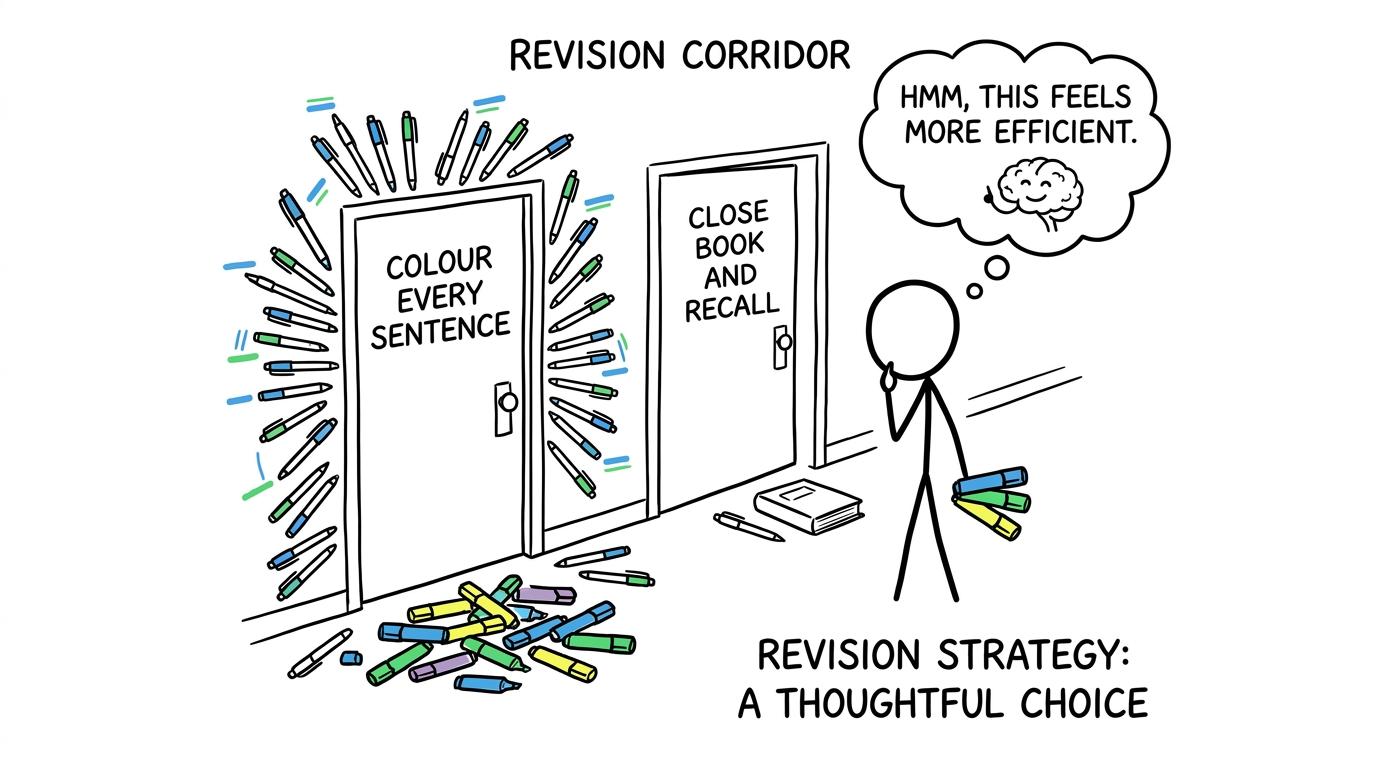 A student chooses closed-book recall while carrying only a few useful highlighters
How this applies when you are also revising maths
The underlying lesson transfers neatly to maths, although the categories change. A coloured formula sheet may help you navigate, but it cannot prove that you can select and apply a method under exam conditions.
For maths, the strongest evidence of learning is performance on unfamiliar questions. Use colour sparingly to classify an error: perhaps method, arithmetic, interpretation or exam technique, and then fix it through practice.
Start at the GCSE maths revision hub, where resources are organised for boards including Edexcel, AQA, OCR and Eduqas. Choose the correct foundation or higher tier, review a revision lesson, and complete questions without copying the method.
Then move through a feedback loop:
- attempt questions without notes;
- check the mark scheme or video solution;
- label the exact reason for each lost mark;
- revisit the relevant lesson or practice questions;
- retest the skill later.
Short GCSE maths mini tests make this easier when English revision is taking most of the evening. When you need realistic exam practice, use the MathsGenie past-paper library or, for Pearson students, the Edexcel GCSE maths past papers.
A coloured error log can support this process. But the improvement comes from correcting and retesting the mistake, not from assigning it a pleasing shade.
A revision routine that keeps colour in proportion
A sensible session has three stages:
- Organise briefly: add only the colours needed to identify categories or priorities.
- Retrieve actively: close the notes and recall, plan or answer from memory.
- Apply and review: complete an exam-style task, check feedback and schedule another attempt.
If colouring takes longer than retrieval and practice combined, the balance has probably shifted in the wrong direction. Use the MathsGenie revision planner to protect time for question practice across your subjects rather than allowing note production to expand indefinitely.
You can also use the diagnostic approach in finding your weakest GCSE topics. Let evidence from questions and marked work decide what receives attention. Feelings are useful, but results are clearer.
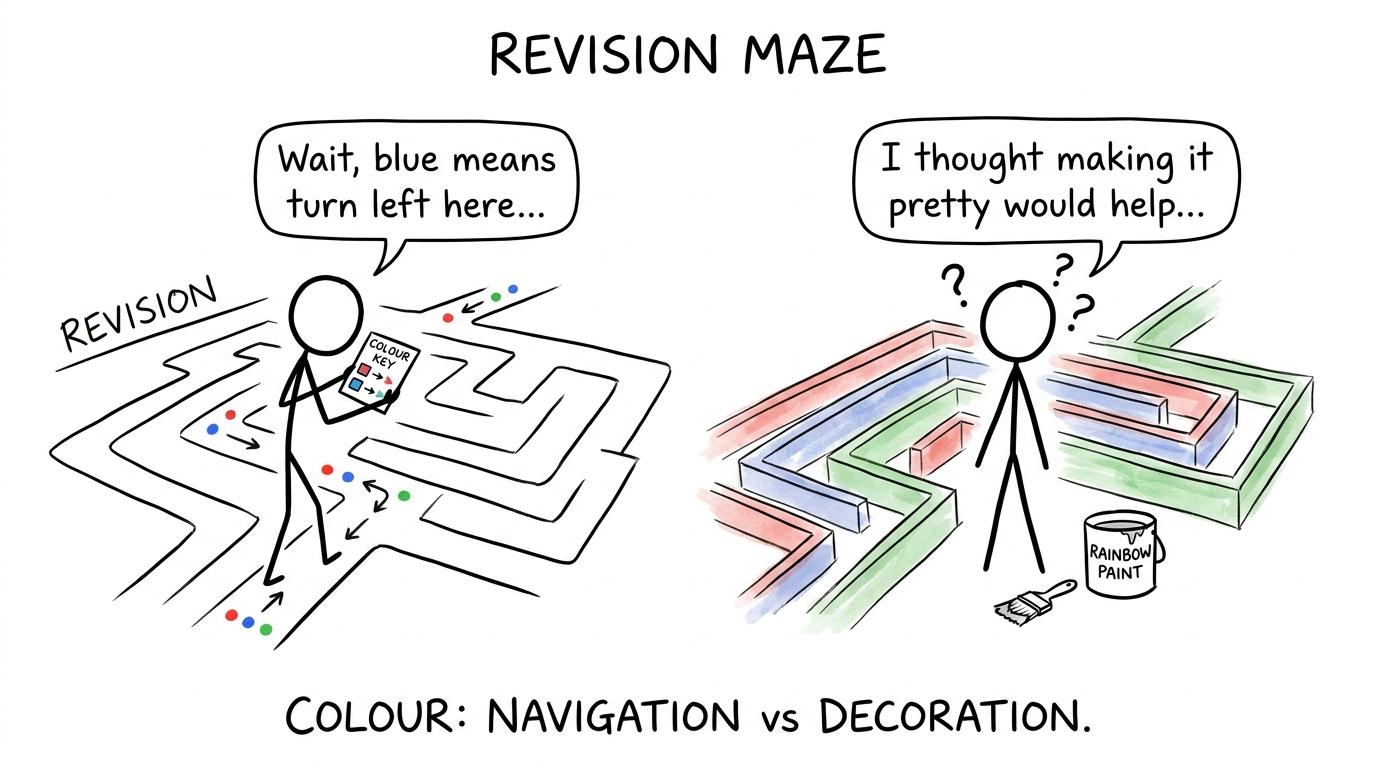 A simple colour key guides one student through revision while another gets lost in a rainbow maze
Common colour-coding mistakes
Using too many colours
An elaborate key creates extra decisions. If you regularly forget what a colour means, the system is no longer reducing effort. Simplify it.
Highlighting nearly everything
When every sentence is emphasised, nothing is prioritised. Highlight only information with a defined purpose.
Rewriting notes to make them prettier
Rewriting can occasionally help you condense or reorganise knowledge, but copying pages in new colours is usually a poor exchange for exam practice. Ask what the finished page will allow you to do.
Changing the key between topics
If blue represents quotations on one page and context on the next, it becomes a weak cue. Keep meanings consistent within the subject.
Never testing without colour
The exam will not reproduce your notebook. Gradually remove the visual support and practise with plain questions, unseen extracts and blank planning paper.
Ignoring feedback
Colour-coding content you already know may feel productive while avoiding weaknesses. Teacher comments, mark schemes and lost marks should decide your priorities.
Colour is a tool, not the learning
Colour-coding can make GCSE English Language and Literature notes easier to navigate. It may also provide useful attention and retrieval cues when categories remain consistent. But its value depends on what happens next.
Close the book. Retrieve the quotation. Explain the method. Plan the response. Complete the question. Check what the examiner rewards.
The same principle protects your maths revision. Use MathsGenie’s free revision lessons and practice questions to repair individual topics, mini tests to check recall, and past papers with mark schemes and video solutions to develop exam technique. Nearer the examinations, add predicted papers to your preparation rather than using them as a substitute for learning.
A colourful page can point you towards the work. Only practice can do the work for you.










