Best GCSE Subjects to Pair with ICT
GCSE subjects to pair with ICT: compare maths, business, science, geography and creative options, balance workload and choose a combination that fits.
Choosing GCSE options can feel like trying to predict a future you have not lived yet. One subject sounds useful. Another sounds impressive. A third is taught by your favourite teacher. Then somebody warns you that your combination will be "too much".
The best GCSE subjects to pair with ICT are usually maths, business or economics, geography, a creative design subject, and, where it is genuinely a separate course, computer science. But the right combination depends on what your school means by ICT, how each subject is assessed, and whether the total workload suits you.
The aim is not to assemble the most impressive-looking list. It is to choose a balanced set of subjects in which you can stay interested, manage the deadlines and earn strong grades.
Your quick subject-pairing checklist
Before comparing individual subjects, check these points:
- Find the exact qualification title and exam board for your ICT course.
- Separate compulsory subjects from genuine options.
- Look at the balance of written exams, practical work and non-exam assessment.
- Identify subjects you enjoy enough to practise when the work becomes difficult.
- Check whether a future sixth form, college course or apprenticeship has specific entry requirements.
- Ask teachers when major projects and internal deadlines normally fall.
- Keep breadth unless you already have a clear reason to specialise.
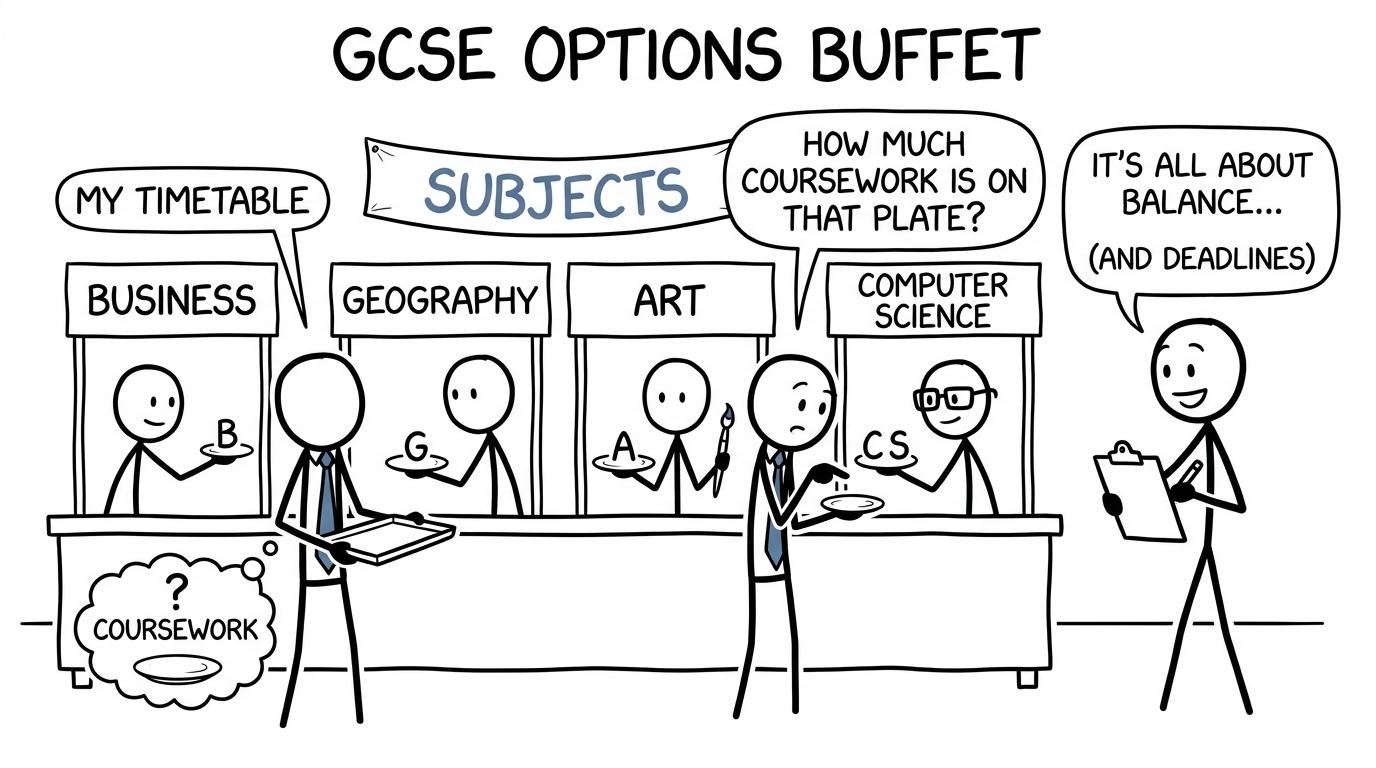 A student considers the workload at a GCSE options buffet
First, check what your school means by ICT
This small question prevents a surprisingly large amount of confusion.
The former GCSE ICT qualification was not reformed alongside the current grades 999 to 111 GCSEs in England. Schools may now use "ICT" informally to describe GCSE Computer Science, a vocational digital or information technology qualification, or a school-designed computing course. Arrangements can also differ across England, Wales and Northern Ireland.
These are not interchangeable. GCSE Computer Science includes areas such as algorithms, programming, data representation, computer systems, networks, cyber security and the social effects of digital technology. A vocational digital qualification may focus more heavily on applying software, planning digital products, data handling or project work.
Write down the qualification's full name, awarding organisation and assessment structure. Your options booklet should explain whether it is offered through AQA, OCR, Pearson Edexcel, Eduqas or another awarding organisation. If the title remains unclear, ask the subject teacher or examinations officer.
This matters when choosing a companion subject. Pairing business with an applied IT course may create useful context. Pairing computer science with the same course may create depth, but it could also duplicate some content or concentrate too much of your timetable in one area.
Maths is the strongest general partner
Maths is compulsory for most GCSE students rather than an optional extra, but it is still the most useful subject to develop alongside ICT or computing.
Computer science specifications require logical reasoning, problem-solving and computing-related mathematics. Binary representation, algorithms, variables, Boolean logic and data all reward a structured way of thinking. Applied ICT courses also benefit from confidence with percentages, graphs, spreadsheets, formulae and interpreting information.
The connection is not that every ICT lesson becomes a maths lesson. It is that both subjects reward precision. A program can fail because of one incorrect condition; a maths solution can lose marks because one step was not justified. In both cases, careful thinking matters.
Use the GCSE Maths revision hub to build the six main areas of number, algebra, ratio, geometry, probability and statistics. If you want a clear map before beginning, the GCSE Maths topics by exam board and tier guide explains the common content assessed by Edexcel, AQA, OCR and Eduqas.
Algebra and graphs are particularly valuable because they develop pattern recognition and the ability to express rules precisely. Statistics is equally relevant when technology is being used to collect, organise or communicate data. MathsGenie's GCSE Statistics revision resources can help you strengthen that side of the pairing.
Business or economics adds commercial context
Business is a sensible partner if you are interested in how organisations use technology. Digital communication, online services, data, automation and cyber security all affect business decisions. An applied ICT project can feel more meaningful when you understand the organisation or customer it is intended to serve.
Economics, where offered, develops a different but related perspective. It asks you to interpret evidence, understand incentives and explain the consequences of decisions. It may involve more extended written analysis than students expect, so inspect the specification rather than assuming it is simply "business with graphs".
Neither subject is automatically required for a future business course. Choose one because you find its questions interesting and its assessment style manageable, not because the title sounds employable.
Geography creates a useful data-and-world combination
Geography pairs naturally with ICT because modern geographical enquiry involves data, maps, models, research and communication. It also broadens your timetable beyond technology.
The strongest overlap is often in handling evidence. You may need to interpret a graph, compare patterns, question the reliability of data or present a conclusion clearly. Those habits also support GCSE Maths statistics and probability.
For AQA students who want to reinforce the underlying ideas, MathsGenie's GCSE probability revision provides lessons, questions and self-testing resources. Students following other boards should use the matching section of the main GCSE hub.
Geography still involves substantial subject knowledge and written explanations. It is a good pairing when you like both data and real-world issues, not merely because it uses computers occasionally.
Design, art and media subjects develop the creative side
Technology is not only about code. Digital products need clear layouts, accessible interfaces, purposeful visuals and an understanding of users. Art and design, graphic communication, design and technology, photography or media-related courses can therefore complement an ICT qualification.
This combination suits students who enjoy making and refining things. It can build both technical confidence and visual judgement.
The caution is workload. Creative and technical awards can contain sustained practical tasks or non-exam assessment, depending on the qualification. Choosing several project-heavy subjects may cause deadlines to gather in the same part of the year. That does not make the combination bad, but it makes organisation essential.
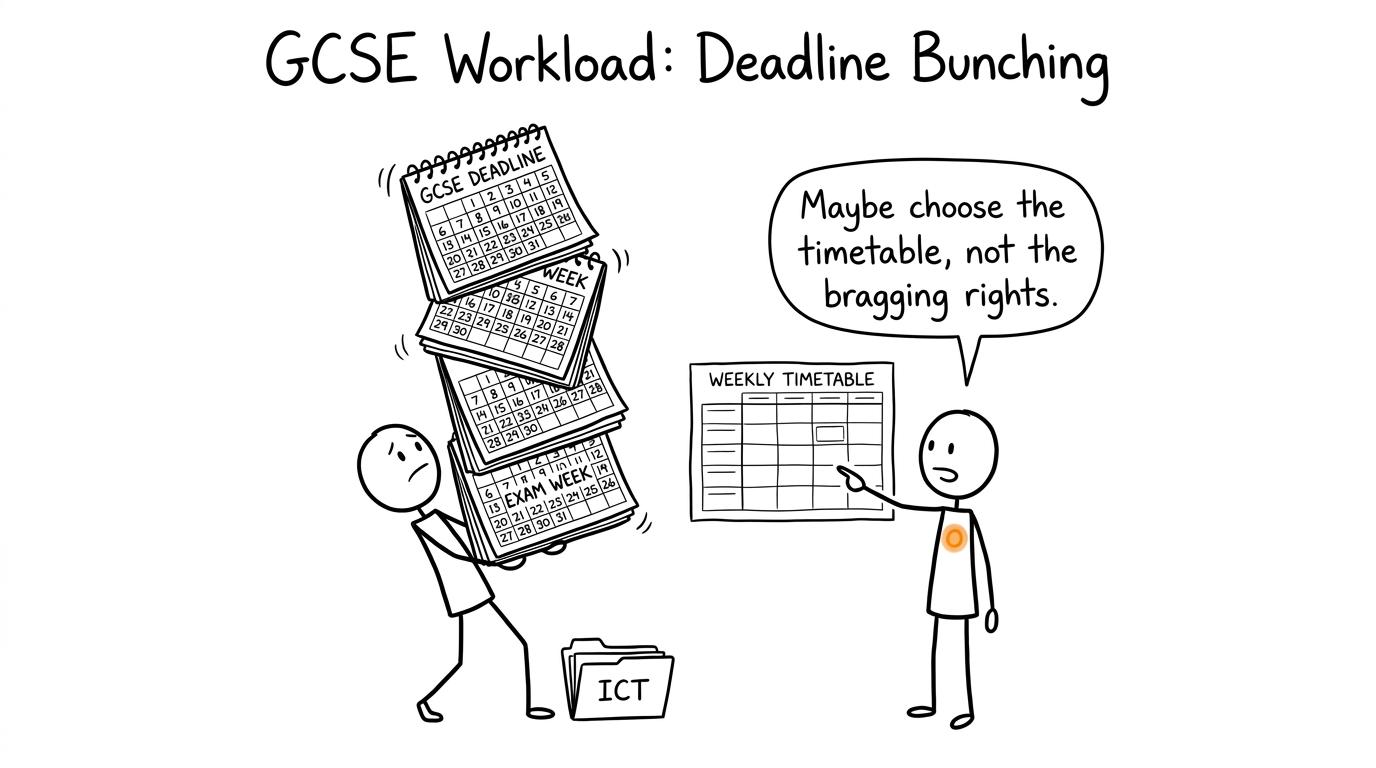 A tower of folders demonstrates why deadline balance matters
Science keeps technical routes open
Science and ICT form a strong general combination because both develop analysis, evidence-based reasoning and methodical problem-solving. Physics may feel especially connected through electronics, systems, measurement and modelling, while biology and chemistry increasingly depend on data and digital tools too.
Most students take combined science or separate sciences within their core programme, so your real decision may be whether to choose triple science. Triple science can be valuable if you enjoy science and may want to take science subjects at A Level. It also adds content and teaching time, so it should not be selected only because it appears prestigious.
Computer science can count within the science pillar of the English Baccalaureate, but the EBacc as a whole also includes English language and literature, maths, science, a language, and geography or history. It is a subject combination and school performance measure, not a separate qualification awarded to you.
Should you pair ICT with computer science?
Sometimes. Begin by checking whether your school is using "ICT" as shorthand for computer science. If it is, there is no second pairing to consider.
If your ICT course is an applied digital qualification and computer science is offered separately, taking both can make sense when you genuinely enjoy technology. One may emphasise digital products and practical application, while the other develops programming, algorithms and understanding of computer systems.
However, this pairing narrows your options. It may also give you two subjects with technical theory, lengthy problem-solving tasks or substantial revision demands. Ask three questions:
- How much content genuinely overlaps?
- How is each course assessed?
- What broader subject would you give up to take both?
Depth is useful when it is deliberate. Duplication is less useful when it happens because two course names sounded similar.
Which combinations can create unnecessary stress?
No combination is universally too difficult. Stress usually comes from a mismatch between the student, the assessment pattern and the available time.
Too many project-heavy courses
ICT alongside art, design and technology, photography and another vocational award may produce several long-running assignments. Students who enjoy project work can succeed with this combination, but clustered deadlines can make ordinary weeks feel deceptively calm and later weeks overwhelming.
Choosing every subject for prestige
Triple science, computer science, history and a language can be an excellent set for the right student. It can also create a dense mixture of content, problem-solving, vocabulary and extended writing. "Hard" is not a qualification category. A strong combination is one you can sustain.
Choosing only subjects that seem similar
ICT, computer science, business and media may look neatly connected, but a narrow selection can remove opportunities to discover other strengths. Breadth through geography, history, a language, science or a creative subject can be valuable.
Ignoring your assessment preferences
Some students prefer final examinations. Others are more comfortable developing practical work over time. Neither approach is easier in every circumstance. Read the current course information and consider how you actually work, rather than how you hope you might work two years from now.
Build a workload you can revise consistently
Imagine two timetables. The first looks impressive but depends on constant last-minute effort. The second contains subjects the student understands, enjoys and revises steadily. The second timetable usually has the stronger foundation.
A simple weekly plan should leave protected time for compulsory GCSE Maths. Start with the best order for learning GCSE Maths topics, then move from lessons to targeted questions and short tests. MathsGenie's GCSE 45-minute tests are useful when a full paper will not fit around project deadlines.
As exams approach, use GCSE predicted papers to practise timing and identify gaps. Predicted papers cannot tell you exactly what will appear. Their value is in revealing which methods still break down under exam conditions.
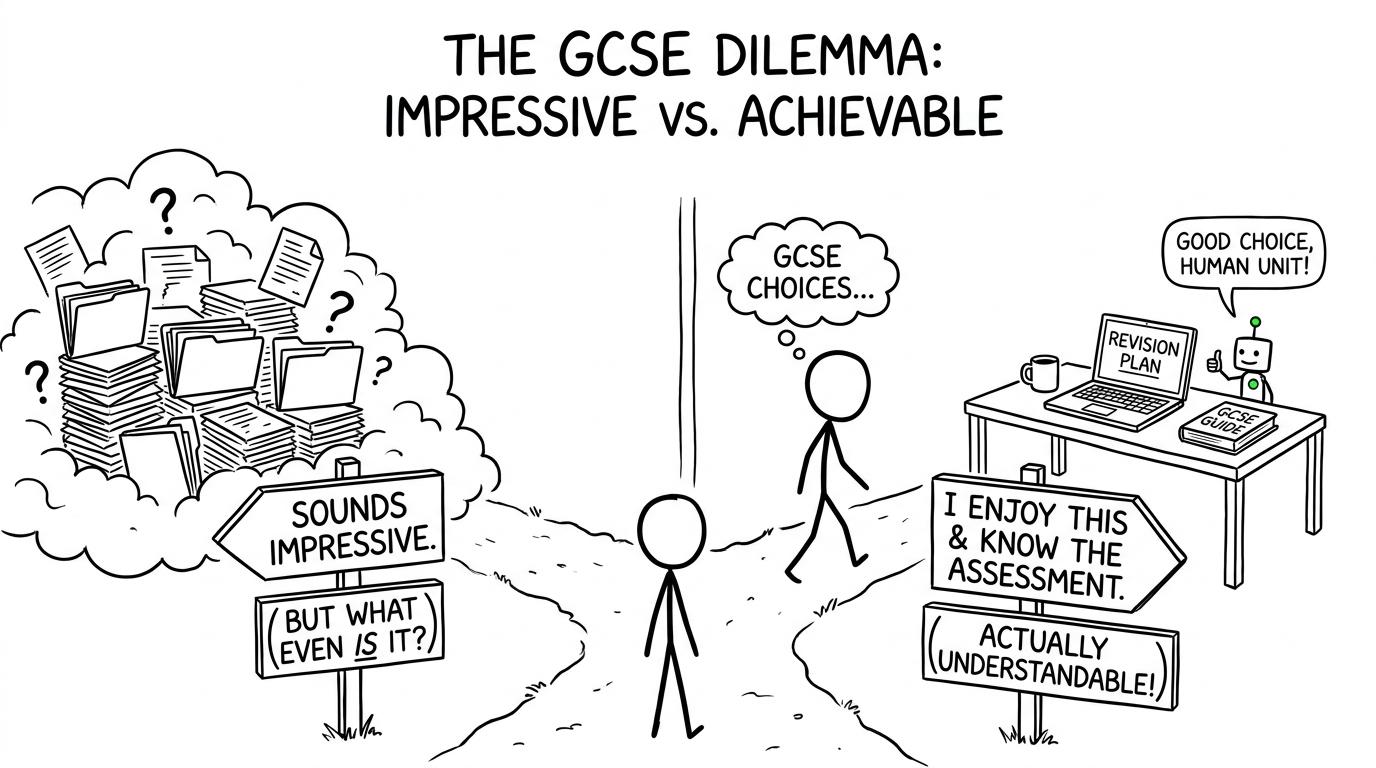 A student chooses a thoughtful GCSE path rather than an impressive-sounding one
Common mistakes when choosing subjects with ICT
Not checking the qualification title: "ICT" may refer to a very different course from the one you imagine.
Assuming related subjects will be easy together: overlap can help, but each specification still has its own knowledge and assessment demands.
Following friends: sharing a classroom is not guaranteed, and your interests may differ once the course becomes challenging.
Choosing around one teacher: staffing can change. Choose the subject and course, not only the person currently teaching it.
Forgetting compulsory workload: English, maths and science already require regular revision. Options must fit around them.
Treating predicted careers as fixed: many students change direction. Keep sensible breadth unless a published entry requirement gives you a clear reason not to.
Ignoring reserve choices: timetable clashes happen. Select reserves you would be genuinely willing to take.
Choose for fit, then revise with purpose
The best GCSE subjects to pair with ICT are not hidden in one perfect list. Maths develops logic and data confidence. Business adds commercial context. Geography connects technology with evidence and real places. Creative subjects strengthen design thinking. Science preserves technical breadth. Computer science can add depth when it is genuinely a separate qualification.
Your final decision should combine interest, assessment fit, workload and future flexibility. Ask for the exact specifications, compare deadlines and discuss the choice with teachers who know your current work.
Then give the subjects you choose a reliable revision system. Use MathsGenie as your free maths home base: begin with revision lessons, build fluency through practice questions and mini tests, and finish with past papers, predicted papers, mark schemes and video solutions. A sensible option list creates space. Consistent practice is what turns that space into grades.