Best GCSE Subjects to Pair with Arabic
GCSE subjects to pair with Arabic: choose balanced options that suit your strengths, protect maths revision time and avoid an overloaded timetable.
Choosing GCSE options can feel strangely permanent. A subject you select on an ordinary afternoon may shape hundreds of lessons, several exams and much of your Year 11 revision timetable. If you are looking for the best GCSE subjects to pair with Arabic, the short answer is this: choose a broad humanity such as geography or history, then add a subject whose workload and assessment style suit you. Maths, English and science will normally already sit within your core curriculum.
Arabic can provide the language element of a broad GCSE programme, including the English Baccalaureate combination in England when the qualification is eligible. But there is no universally perfect pairing. The sensible combination is the one that matches your ability, interests, school timetable and available revision time without turning every week into a deadline contest.
A quick GCSE options checklist
Before comparing individual subjects, ask:
- Does your school offer Arabic within its normal option blocks, or as an additional qualification?
- Which Arabic specification and exam board will you follow?
- Can you already read, write, listen and speak confidently in Modern Standard Arabic?
- Do you prefer essays, calculations, practical work, creative projects or a mixture?
- Which subjects might you want to continue at sixth form or college?
- How many assessments, projects and speaking commitments will overlap?
- Will the combination leave regular time for core maths, English and science revision?
Check your own options booklet carefully. Schools control their option blocks and may make additional subjects compulsory, so a combination available elsewhere may not fit your timetable.
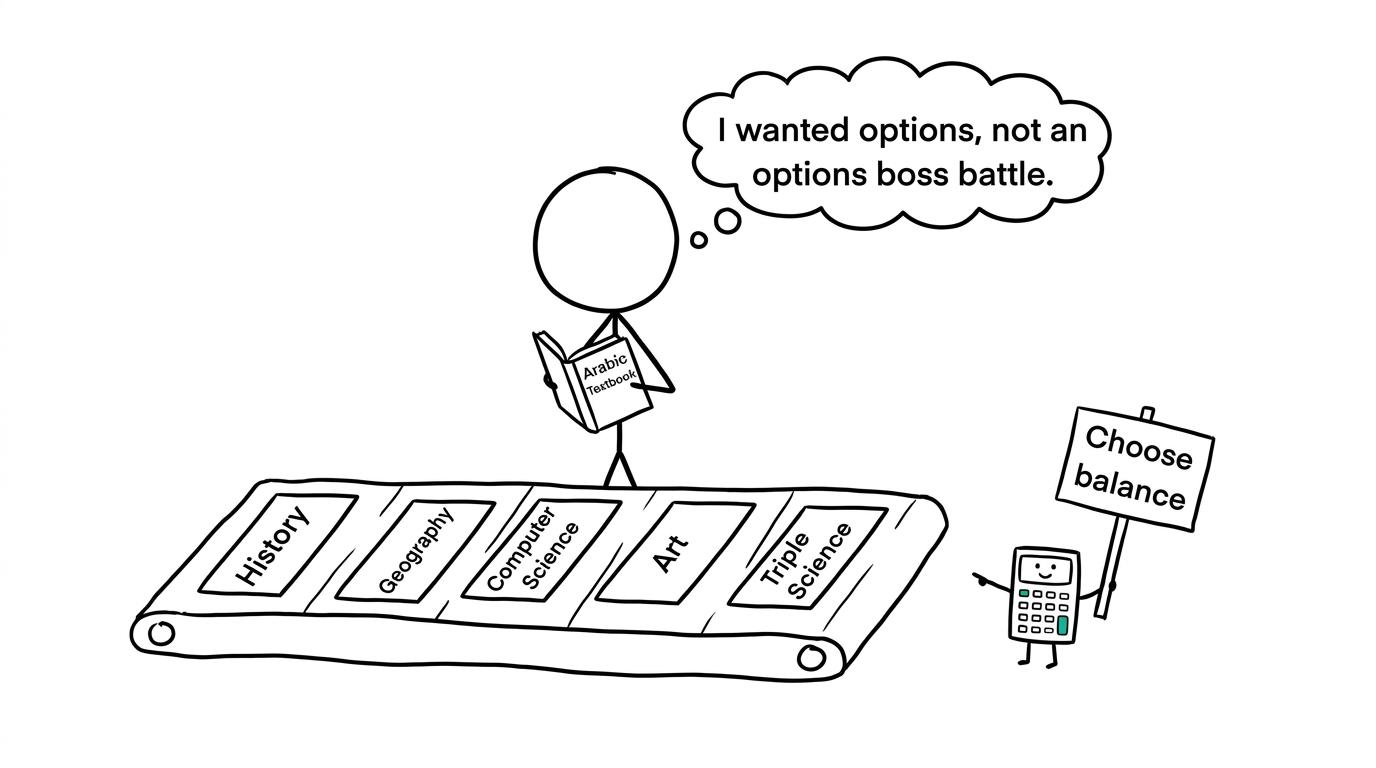 A student faces an options boss battle while a calculator recommends balance
What studying GCSE Arabic involves
The current Pearson Edexcel GCSE Arabic specification assesses four skills: listening, speaking, reading and writing. Each contributes equally to the qualification, and students enter either foundation or higher tier across all papers. The course uses standard Arabic, so everyday confidence in a regional dialect does not automatically remove the need for preparation.
That matters when choosing companion subjects. Arabic revision is not just vocabulary learning. You need repeated listening, accurate reading, planned writing and spoken practice. A student who speaks Arabic at home may find some elements familiar but still need to develop formal grammar, spelling, translation and exam technique.
Arabic can count as the language component of the EBacc in England. The wider EBacc subject combination includes English language and literature, maths, science, a language, and history or geography. The EBacc is a subject combination used as a performance measure, not a separate qualification that students receive.
The strongest GCSE subjects to pair with Arabic
Geography offers breadth and useful connections
Geography is often one of the most balanced choices alongside Arabic. It adds a humanity to your programme and can complete the history-or-geography part of the EBacc combination. Its study of places, populations, development, resources and environmental issues may also give useful context for understanding different regions of the Arabic-speaking world.
There is some numerical work in geography, including graphs, percentages, averages and data interpretation. That can reinforce skills from GCSE maths without making the two subjects identical. If data is a weak area, the GCSE maths revision hub lets you choose your exam board and work through relevant statistics and graph topics.
Geography still demands extended writing, case knowledge and fieldwork understanding. It is a good pairing if you enjoy explaining patterns and using evidence, not merely because it appears broad on an options form.
History suits strong readers and writers
History is another natural partner because it provides the humanity component of the EBacc combination. It develops source analysis, argument and extended writing, which can complement the communication skills developed through Arabic.
The caution is workload. Both subjects reward frequent retrieval rather than occasional cramming. History brings substantial content and structured essays, while Arabic requires continuing practice across four language skills. This can be an excellent combination for an organised student who enjoys reading and writing, but a tiring one for somebody who already finds long written responses slow.
Choose history because you are interested in the periods offered by your school. The exact topics differ by exam board and school, so the course title alone does not tell you what the next two years will contain.
Computer science can create a balanced contrast
Computer science may work well if you want a subject with a different rhythm. Arabic centres on communication; computer science emphasises algorithms, logical reasoning, programming and the operation of computer systems. The contrast can make a timetable feel more varied.
It also connects naturally with mathematical thinking, particularly decomposition, patterns and precise instructions. However, computer science is not an easy option for everyone. Programming requires persistence, and theoretical content still needs careful revision.
If algebraic reasoning is one of your weaker areas, first consult the GCSE maths topics by exam board and tier. That gives you a clearer view of the maths commitment you already have before adding another logic-heavy subject.
Business can connect language with practical contexts
Business may appeal to students interested in enterprise, international trade, marketing or finance. Arabic and business can form a coherent combination without forcing you into a narrow future career. Language skills support communication and cultural awareness, while business develops decision-making and interpretation of commercial information.
Expect calculations, written explanations and case-based questions. Being comfortable with percentages, ratios and graphs will help. Use MathsGenie's recommended order for learning GCSE maths if you need to rebuild number skills before tackling more applied questions.
A creative or practical subject may improve balance
Art, drama, music, design and technology, food preparation and nutrition, or GCSE PE can provide variety beside a language and the academic core. This is particularly valuable if you enjoy producing, performing or designing rather than spending every lesson on written analysis.
Yet “creative” does not mean “light”. Art and design courses may involve substantial portfolios; drama and music can include rehearsals or performance preparation; design subjects can bring projects and technical knowledge. Ask teachers when major deadlines normally fall and how much independent work is expected.
A creative subject makes sense when you genuinely enjoy its day-to-day work. It adds unnecessary stress when it is selected only because it sounds like a break from exams.
Combinations that can become unnecessarily stressful
No subject combination is automatically wrong. Stress usually comes from a mismatch between the student and the assessment pattern.
Too many content-heavy writing subjects
Arabic, history, religious studies and another essay-heavy option may suit a fast, confident writer. For someone who needs a long time to plan each response, the same combination can create a revision backlog. Count the kinds of tasks involved, not just the number of GCSEs.
Arabic plus another language without a clear reason
Two languages can be a strong choice for an enthusiastic linguist. They also mean two sets of vocabulary, grammar, listening and speaking practice. Choose a second language if you enjoy it and have the necessary foundation, not because two related subjects appear automatically easier than two different ones.
Several portfolio or performance subjects together
Combining art, music, drama or design subjects may produce overlapping projects, rehearsals and submission deadlines. That can reduce the time available for maths practice precisely when mock examinations begin to expose weak topics.
Separate sciences with every demanding extra option
Separate sciences can be appropriate for students who enjoy science and may continue it after GCSE. But adding Arabic, a content-heavy humanity and a major portfolio subject creates a broad commitment. The issue is not academic ambition. It is whether your weekly timetable can support the required practice consistently.
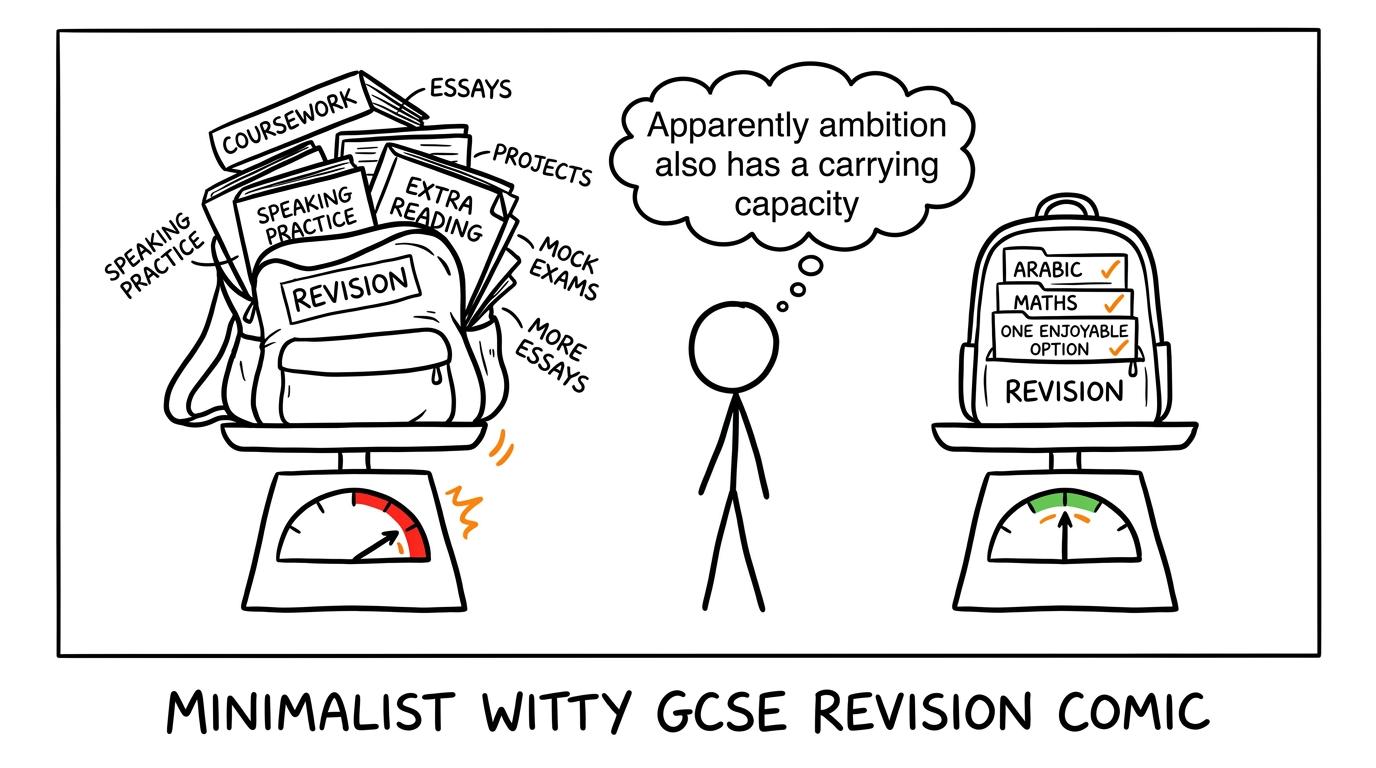 Revision backpacks reveal that ambition also has a carrying capacity
Protecting your GCSE maths revision time
Maths is normally a core GCSE, so your option choices should leave room to practise it throughout Years 10 and 11. Maths improves through questions, feedback and correction. It is difficult to replace that process with one large revision session immediately before an exam.
A balanced weekly pattern might include short Arabic retrieval sessions, planned option-subject work and two or three focused maths sessions. On busy days, the 20-minute GCSE maths revision routine provides a manageable structure.
Do not revise every subject equally by habit. Use evidence. Complete a mini test or paper section, mark it and identify where marks disappear. The guide to finding your weakest GCSE topics explains how to turn those mistakes into a useful revision list.
As exams approach, move from isolated topics towards mixed and timed practice. MathsGenie's Edexcel GCSE maths past papers include mark schemes and solutions where available. Students following AQA, OCR, Eduqas, WJEC or CCEA can select their board through the main revision hub.
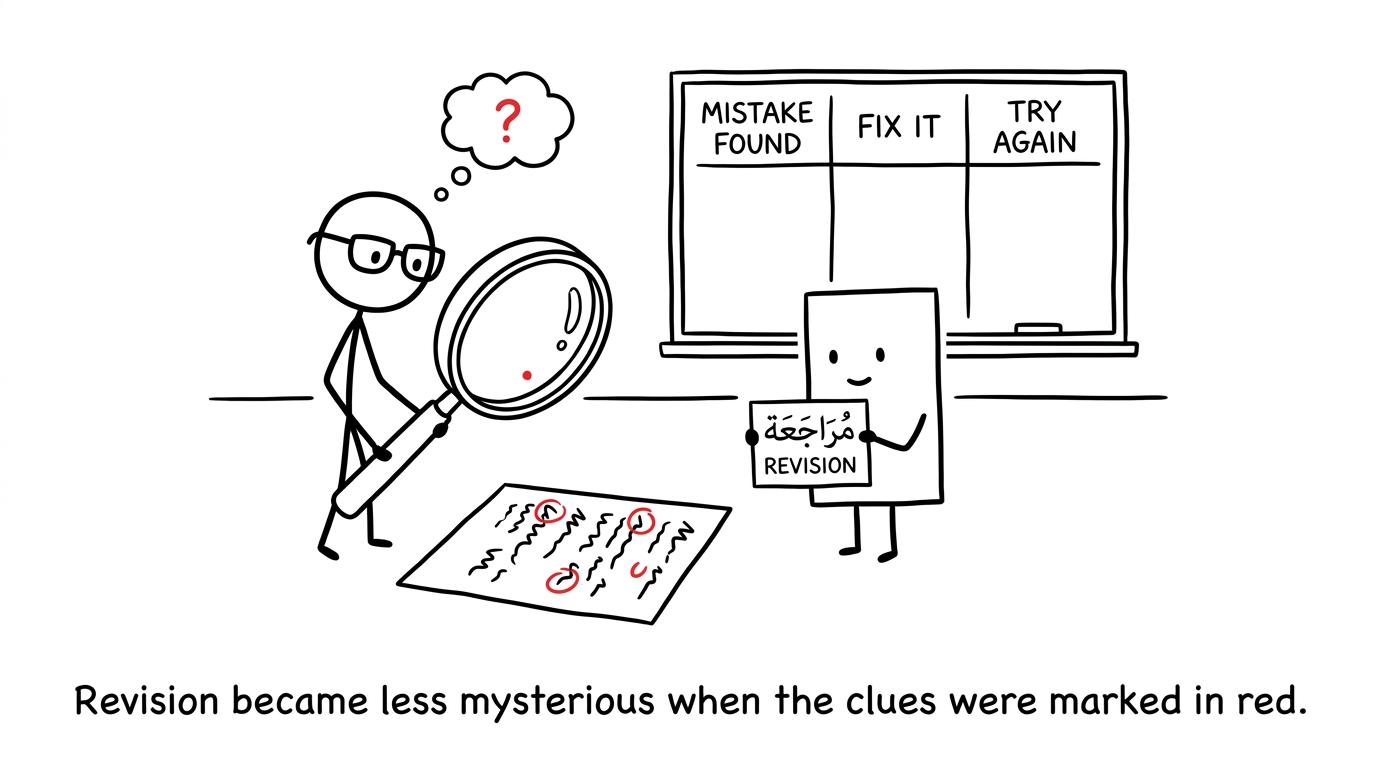 A revision detective investigates mistakes instead of guessing
How to make the final decision
Create a shortlist of realistic combinations, then compare each one using four questions:
- Interest: Would you still want to learn this subject during a difficult week?
- Attainment: What do classwork, assessments and teacher feedback actually show?
- Assessment fit: Does the course rely on exams, speaking, essays, performance or portfolio work?
- Capacity: Can you support its regular workload alongside Arabic and the core subjects?
Speak to the Arabic teacher about your readiness for standard Arabic and all four assessed skills. Ask option teachers about course content, homework and non-examined assessment. Then discuss timetable restrictions and entry requirements with your school.
Do not select a subject solely because a friend is taking it, because it is rumoured to be easy or because it sounds impressive. A balanced set of strong results is more useful than an overloaded programme chosen for appearance.
Common mistakes when pairing GCSE options with Arabic
Assuming home fluency guarantees an easy grade. Speaking confidently does not necessarily mean that formal reading, writing, translation and grammar are exam-ready.
Ignoring the exact specification. Assessment arrangements vary between qualifications. Confirm the board, tier structure and paper requirements with your school.
Choosing by career title alone. Most students do not need to design a complete career at fourteen. Preserve breadth while checking any specific sixth-form entry requirements that already matter to you.
Underestimating project deadlines. Several appealing practical subjects can become difficult when portfolios and performances peak together.
Letting options crowd out core revision. Maths, English and science still require consistent attention. A one-month GCSE maths revision plan can help you see how much regular practice needs to fit around your other subjects.
Choose a combination you can sustain
The best GCSE subjects to pair with Arabic are usually a humanity such as geography or history, followed by an option that matches your strengths and creates a manageable assessment mix. Computer science or business can add logical and applied thinking; a creative or practical subject can provide welcome variety. None is automatically best.
The quiet advantage belongs to the combination you can work on consistently. Once your choices are made, use MathsGenie's free GCSE revision resources to protect your core maths progress. Start with revision lessons and practice questions, check your understanding through mini tests, then build exam readiness with past papers, predicted papers, mark schemes and video solutions. Your options should expand what you can do and not consume all the time you need to do it well.