Best GCSE Media Studies Revision Guide: 8 Checks
Best GCSE Media Studies revision guide checks for exam-board accuracy, set products, theory, questions and mark-scheme support before you buy.
A revision guide can look reassuring before you open it. The cover promises complete preparation. The chapters are neatly colour-coded. Perhaps there is even a dramatic word such as “ultimate” in the title.
None of that tells you whether it will help in the exam.
The best GCSE Media Studies revision guide is the one that matches your exact exam board, assessment year and set products, explains the theoretical framework accurately, and makes you practise applying knowledge. Price and presentation matter, but only after those essentials are secure.
This is especially important when you are balancing Media Studies with subjects such as maths. Revision time is limited. A good guide reduces decisions; a poor one quietly creates more of them.
A quick revision guide checklist
Before buying or relying on a guide, check that it:
- names your exact exam board and specification;
- is valid for the year in which you will be assessed;
- covers your current Close Study Products or set media products;
- organises content around media language, representation, industries and audiences;
- explains relevant contexts rather than listing disconnected facts;
- distinguishes knowledge, analysis and production skills;
- includes exam-style questions with useful answers or marking guidance;
- supports active recall rather than endless rereading.
If a guide fails one of the first three checks, attractive design cannot rescue it.
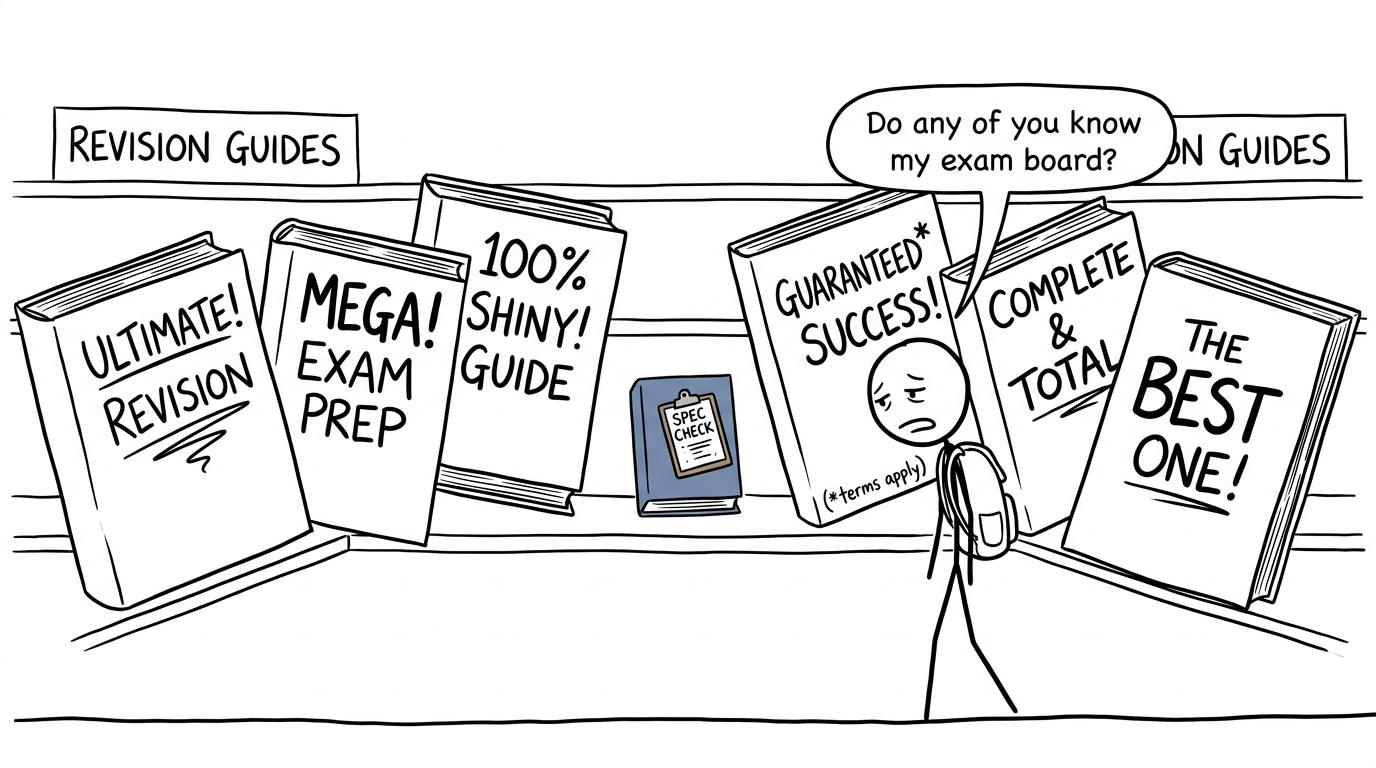 A student asks a shelf of shiny revision guides whether any knows their exam board
Start with the specification, not the cover
A revision guide is useful only when it maps onto the course you are actually taking. GCSE Media Studies is offered by boards including AQA, OCR and Eduqas, but their paper structures, terminology and set products are not interchangeable.
Do not assume that your Media Studies board is the same as your maths board. A student might sit Edexcel GCSE Maths while taking AQA Media Studies. Check the specification code on school documents, ask your teacher or look at a recent question paper used in class.
AQA structures the subject around four areas of the theoretical framework: media language, media representations, media industries and media audiences. It uses Close Study Products, commonly shortened to CSPs. OCR and Eduqas cover the same broad assessment objectives, but use their own components, set products and question structures.
A strong guide states exactly which specification it covers. “Suitable for all boards” can be helpful for general theory, but it is rarely enough as your only exam resource.
Check the assessment year and set products
Media Studies guides can age more quickly than revision books for subjects whose core content changes less frequently. Exam boards review or replace set products, and the correct material can depend on when your course began and when you will sit the exam.
This is not a minor publishing detail. Set products are the material through which you apply ideas about representation, audience, industry, context and media language. Revising a product that is no longer prescribed may improve general understanding, but it will not prepare you efficiently for your paper.
AQA states that its CSPs are reviewed, with newspapers updated regularly. OCR has published updates to its current GCSE specification and set product material. Eduqas has also confirmed different set products for different assessment years, including changes taking effect for later examination series.
Therefore, look for a clear edition date and an explicit assessment-year statement. Then compare the contents page with the current list supplied by your teacher. If the book is second-hand, perform this check before trusting any highlighted notes left by its previous owner.
Look for the four parts of the theoretical framework
A good guide does more than summarise television programmes, advertisements or magazine covers. It helps you analyse them through the theoretical framework.
Media language
The guide should explain how meaning is created through choices such as composition, editing, sound, typography, colour, narrative and genre conventions. It should help you move from identifying a feature to explaining its effect.
Representation
Look for coverage of how people, places, identities and social groups are constructed. Better guides address selection, omission, stereotyping and viewpoint rather than presenting representation as a list of character descriptions.
Media industries
You should find clear explanations of ownership, production, distribution, regulation, funding and technological change where these are relevant to your specification. These ideas should be connected to named products and contexts.
Media audiences
A useful guide considers how audiences are targeted, positioned and interpreted. It should distinguish intended audiences from actual audience responses and show that viewers are not necessarily passive.
The strongest guides connect all four areas. Media products do not place language, representation, industry and audience into separate boxes, even if a contents page does.
Make sure context is connected to analysis
Dates and background facts are easy to print. The harder and more valuable task is showing why they matter.
A guide might tell you when a product was released. A better guide explains how its social, cultural, political, economic or historical context influenced what was produced and how audiences may have understood it.
Ask whether each contextual section helps answer a question such as:
- Why was this representation constructed in this way?
- How did the industry shape the finished product?
- Why might contemporary and modern audiences respond differently?
- Which conventions reflect the period of production?
Context should strengthen an argument. It should not become a decorative paragraph attached to every response.
Test the quality of its questions
Reading creates familiarity, and familiarity can feel remarkably similar to knowledge. The difference appears when the book closes.
The best guide includes several forms of practice: short recall checks, analysis of unseen material, comparison tasks and extended-response questions. Those questions should use command words and mark totals that resemble your board’s assessment style.
Answers matter too. A single model paragraph is not enough if it gives no explanation of why it works. Look for indicative content, examiner-style commentary, planning guidance or references to assessment objectives.
Official past papers and mark schemes should remain part of your preparation because no commercial guide can perfectly reproduce an exam board’s phrasing. This principle works across subjects. MathsGenie’s guide to starting GCSE past papers at the right time explains why practice becomes valuable only when you review what went wrong.
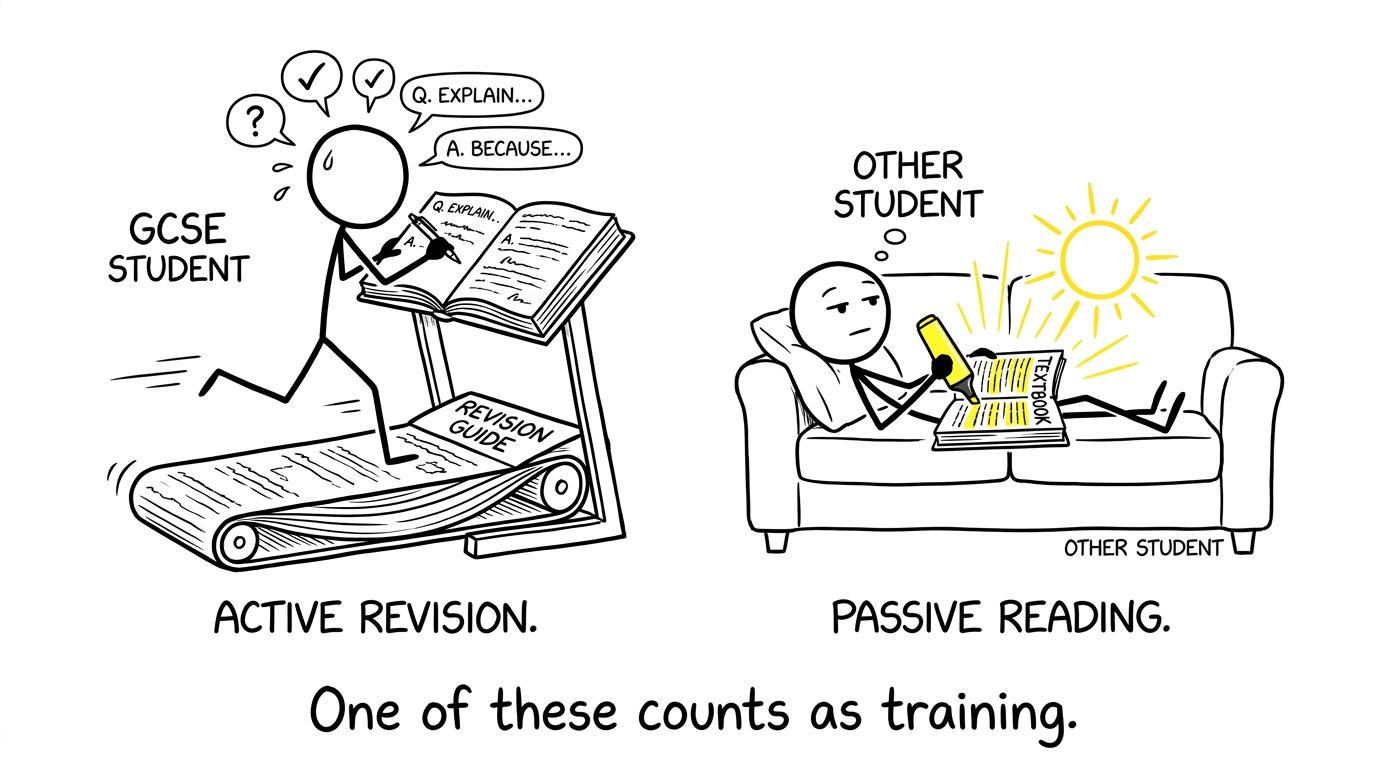 One student actively trains while another highlights an entire page
Check whether the guide makes you think
A revision guide should be a tool, not a script to memorise.
Useful features include retrieval questions, blank comparison grids, argument prompts, terminology checks and space to plan responses. Less useful features include pages of completed notes that invite no action beyond highlighting.
Try a simple test before buying. Read one section, close the guide and explain its central idea without looking. Then apply that idea to a media product. If the page helps you do both, it is probably teaching rather than merely compressing information.
For a manageable routine across your subjects, adapt the pattern in MathsGenie’s 20-minute GCSE revision routine: retrieve knowledge, complete a focused task, check it and record the next action. Media Studies requires written analysis rather than calculations, but the learning cycle is just as useful.
Judge explanations by precision, not simplicity
Clear language is valuable. Oversimplification is not.
A weak guide may turn a nuanced theory into a slogan or imply that every audience reacts identically. A strong guide introduces specialist terminology accurately, explains its limitations and shows how it supports analysis without replacing your own judgement.
Check a sample section on a topic you understand from class. Are key terms used consistently? Are claims supported by features from the product? Does the guide acknowledge that interpretations can differ when evidence supports them?
Also watch for pages that prescribe one “perfect” interpretation. Media analysis can allow different conclusions, but those conclusions must be reasoned and grounded in evidence.
Decide whether its format fits your revision
There is no universally perfect format. A concise guide may be ideal for refreshing secure knowledge but too thin for learning a missed unit. A detailed textbook may explain context beautifully but be difficult to use in the final weeks.
Consider what you need:
| Your need | Useful guide feature |
|---|---|
| You forget terminology | Retrieval prompts and precise definitions |
| You know facts but struggle to analyse | Annotated products and analytical questions |
| Extended answers feel unstructured | Planning frames and explained model responses |
| Set products blur together | Comparison grids organised by framework area |
| You are short of time | Clear specification mapping and concise summaries |
The price should be judged against this usefulness. A cheap guide that matches your course is better value than an expensive bundle containing outdated or irrelevant material.
Use a guide as one part of a revision system
No revision guide can provide the complete cycle by itself. You still need current specification information from your school, lesson materials, set products, official past papers and mark schemes.
A productive Media Studies session might involve retrieving one theory, applying it to a set product, answering a timed question and checking the response against marking guidance. Record the weakness you uncover, then return to it later.
The same structure can keep your maths revision moving alongside Media Studies. Use the GCSE Maths revision hub for lessons and topic practice, the revision planner to distribute subjects across the week, and board-specific papers such as the Edexcel GCSE Maths past papers when you are ready for timed practice.
If exams are approaching, the one-month GCSE maths revision plan provides a structure for balancing topic repair, mini tests and full papers. The point is not to turn every subject into maths. It is to stop each subject competing chaotically for whatever time remains.
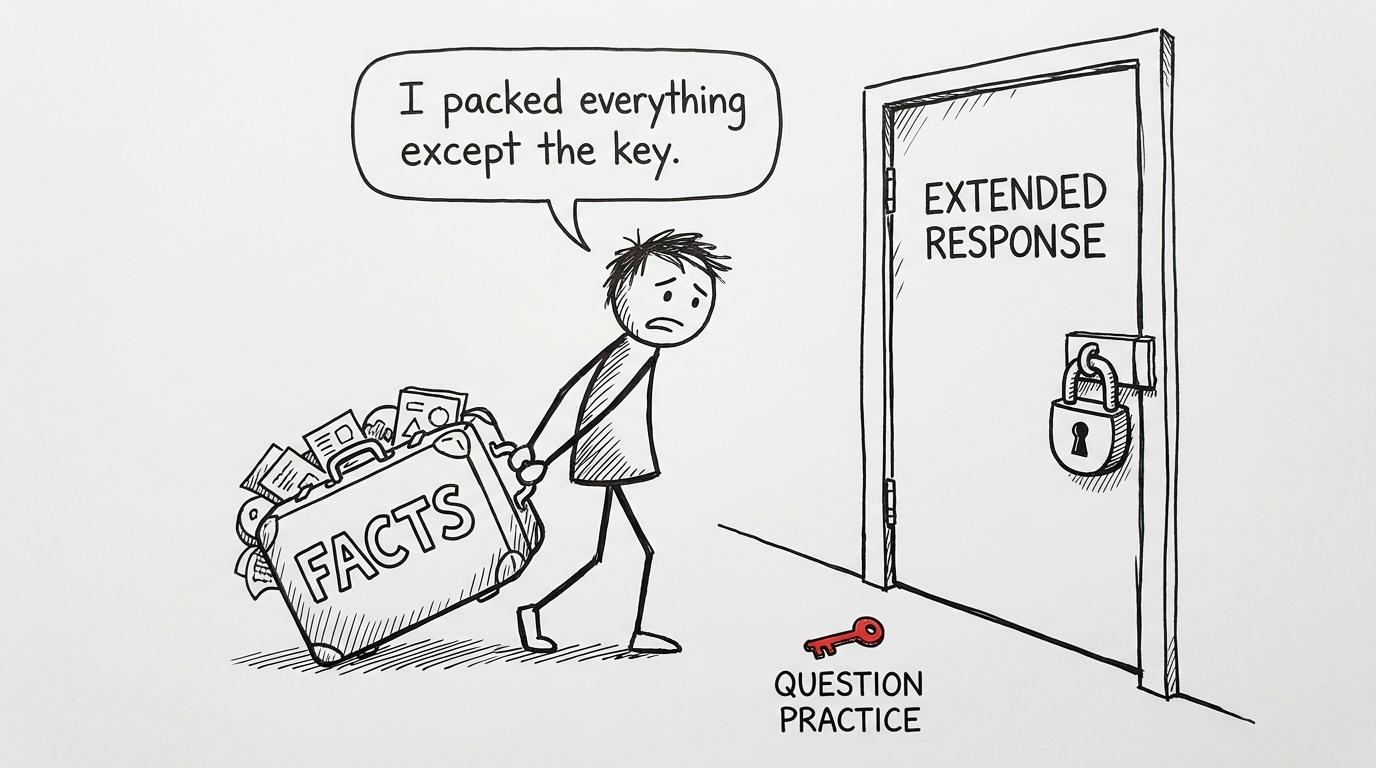 A student brings facts to an exam door but forgets the question-practice key
Common mistakes when choosing and using a guide
Buying for the wrong board
General Media Studies knowledge is transferable, but set products and assessments differ. Confirm the specification before paying.
Ignoring the publication and assessment dates
An older guide may explain theory well while covering obsolete products. Use it only as a supplementary resource after checking every topic.
Choosing the thickest book
More pages do not automatically mean better coverage. Relevance, accuracy and usable questions matter more than weight.
Treating model answers as scripts
Memorised paragraphs can fail when the question changes. Study how an answer selects evidence, develops analysis and reaches a judgement.
Highlighting instead of retrieving
Highlighting may organise a page, but it does not prove recall. Close the guide, write what you know, answer a question and check the gaps.
Never using real exam materials
A guide can prepare you for content, but past papers reveal timing, command words and question demands. Use both.
Choose evidence over promises
A good GCSE Media Studies guide is not defined by the brightest cover, the largest number of pages or the boldest claim. It is defined by alignment: with your board, your assessment year, your set products and the skills examiners assess.
Check those foundations first. Then look for accurate theory, connected contexts, active practice and meaningful answer support. The right guide should make your next revision action clearer.
As you balance Media Studies with maths, let MathsGenie remove the guesswork from the latter. Start with the free GCSE Maths revision resources, build understanding through revision lessons and practice questions, and test it with mini tests, past papers, predicted papers, mark schemes and video solutions. A guide may help you know more. A complete revision cycle helps you use what you know when the paper opens.