

Best GCSE Dance Revision Guide: How to Choose
Best GCSE Dance revision guide checks: specification coverage, accurate terminology, exam questions and feedback that genuinely improve your answers.
Revision guides make an easy promise: everything you need, neatly compressed between two covers. Yet the difficult question is not whether a book looks organised. It is whether using it will change what you can do.
The best GCSE Dance revision guide should match your current specification, cover both practical and written assessment, explain subject terminology precisely, and make you retrieve, apply and evaluate knowledge. It should also include questions, credible answers and guidance rooted in the mark scheme. A colourful summary book may help, but summaries alone rarely reveal whether you can produce an exam-ready response.
This matters particularly when Dance is competing with GCSE maths and other subjects for revision time. A useful guide reduces decisions. A weak one quietly consumes hours.
The quick revision guide checklist
Before buying or relying on any GCSE Dance guide, check whether it:
- names the correct exam board, specification and qualification code
- reflects the current assessment structure
- covers performance, choreography and dance appreciation
- uses terminology consistent with the specification
- includes all required professional works for your course
- distinguishes description, analysis, interpretation and evaluation
- provides exam-style questions with marks or answer guidance
- shows how extended responses are developed
- supports active recall rather than passive highlighting
- gives enough detail without replacing the official specification
If several of these are missing, the cover and price become irrelevant. The guide may be pleasant to read, but it is not a complete revision system.
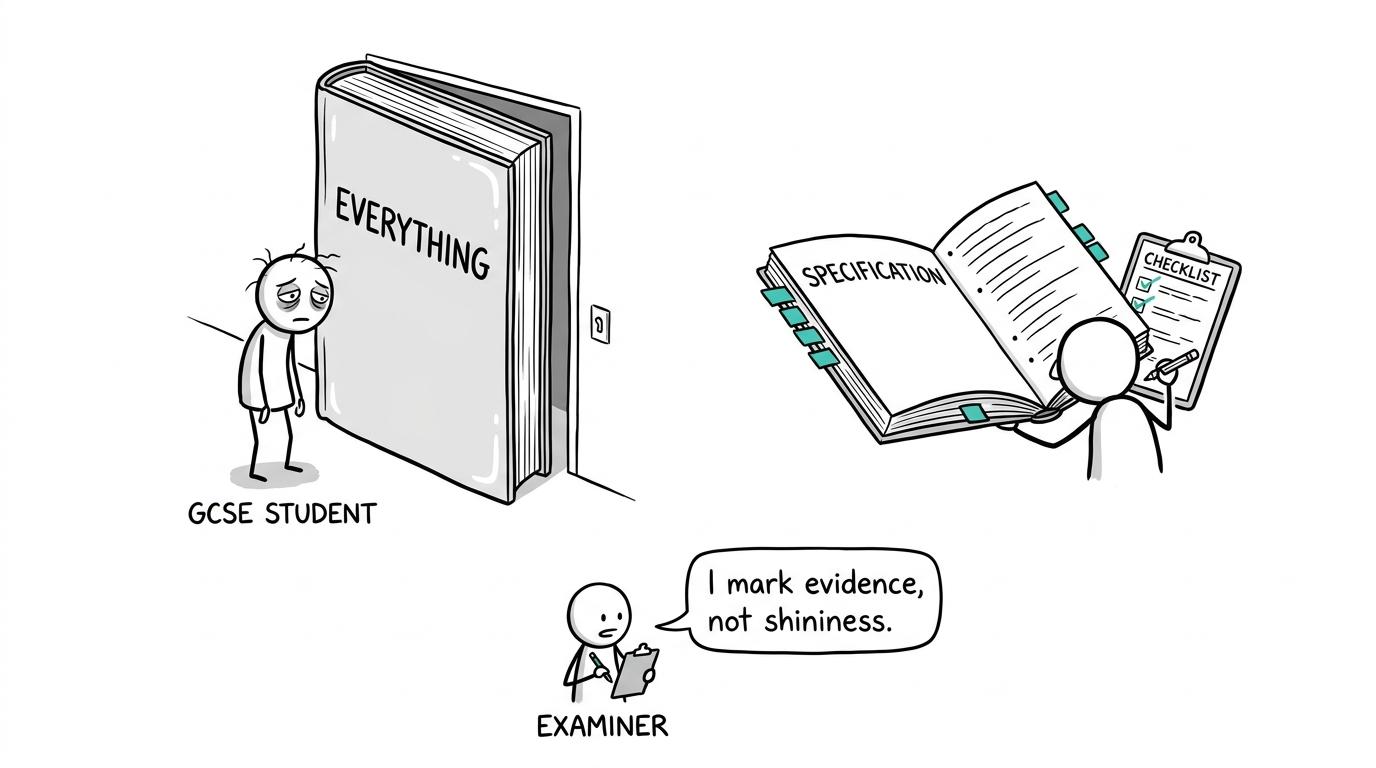 A glossy revision book competes with a specification-led guide
Start with the specification, not the sales page
A revision guide is an interpretation of a course. The specification is the course.
For AQA GCSE Dance, qualification code 823682368236, the current structure allocates 60%60\%60% to performance and choreography through non-exam assessment and 40%40\%40% to Dance appreciation through a written examination. The written paper lasts 111 hour 303030 minutes and is worth 808080 marks. GCSE Dance is untiered, unlike GCSE maths, where students sit foundation or higher tier papers.
A reliable AQA guide should accurately reflect the four assessment objectives:
- AO1: performance through physical, technical and expressive skills
- AO2: creating dance to communicate choreographic intention
- AO3: knowledge and understanding of choreographic processes and performing skills
- AO4: critical appreciation through analytical, interpretative and evaluative judgements
These are not decorative labels. They describe the abilities assessment is designed to reward. A guide that concentrates almost entirely on recalling facts about professional works may leave substantial gaps in your understanding of your own performance, choreography and critical appreciation.
Check the publication date, but do not treat a recent date as proof of accuracy. Compare the contents page with the latest specification and ask your teacher whether any assessment guidance has changed. If a guide describes the wrong anthology, outdated tasks or a different course structure, stop using it as your main source.
Look for complete coverage, not simply more pages
A thick book can create a comforting illusion: more pages must mean more protection. But volume and relevance are different things.
For AQA, students study all six works in the GCSE Dance Anthology: Artificial Things, A Linha Curva, Infra, Shadows, Within Her Eyes and Emancipation of Expressionism. A good guide should cover the defining characteristics of each work, including choreographic intention, movement content, performers, aural setting, costume, lighting, set or properties, staging and performance environment where relevant.
Coverage should extend beyond anthology facts. Look for clear treatment of:
- physical, technical, expressive and mental skills
- safe working practices
- action, dynamics, space and relationships
- choreographic processes and devices
- structuring devices
- stimuli and aural settings
- performance environments
- reflection on your own performance and choreography
- comparison, analysis and evaluation of professional works
The important question is not, “Does this term appear?” It is, “Does the guide help me use this term accurately in context?” A glossary can tell you what contrast means. A stronger resource helps you recognise contrast in movement material and explain its contribution to choreographic intention.
Check whether it teaches the demands of questions
Knowing Dance and answering a Dance examination question are connected, but they are not identical.
A useful guide explains the difference between command words. Describe asks for relevant characteristics. Analyse requires you to examine how features create effects or communicate meaning. Interpret involves drawing supported meaning from what is presented. Evaluate requires a reasoned judgement supported by evidence.
Weak guides often provide polished paragraphs without showing why they work. Stronger guides identify the claim, specific evidence, subject terminology and connection to the question. They also make clear that the depth required should respond to the mark allocation.
Look closely at the answers provided. Are they specific enough to distinguish one professional work from another? Do they explain relationships between movement, production features and choreographic intention? Do they model judgement rather than attaching “this is effective” to the end of a description?
The same principle applies in maths. Seeing a correct answer is less valuable than understanding how the method earns marks. Maths students can develop that habit through GCSE past-paper guidance, where attempting, marking, fixing and retesting form one continuous revision loop.
 A neglected practice paper asks to be answered
The best GCSE Dance revision guide makes you do something
Reading feels productive because the page becomes familiar. Unfortunately, recognition is not the same as recall.
A genuinely useful guide should regularly ask you to close the book and produce something: define a term, retrieve features of a work, compare two production choices, plan a response or evaluate how movement communicates intention. Questions should vary in length and demand rather than testing only short factual recall.
You should also be able to check your work. This may come through indicative content, answer frameworks, examiner commentary or a teacher-reviewed response. Be cautious when a guide presents a single model answer as the only acceptable wording. Extended Dance responses can take different valid routes when their claims are accurate, relevant and supported.
This is the same reason MathsGenie GCSE mini tests are useful for maths revision: they produce evidence. You find out what survives without notes. The guide to finding your weakest GCSE topics then shows how mistakes can direct the next revision session rather than merely lowering your confidence.
Test clarity without confusing simplicity with quality
A guide should make difficult ideas clearer, not remove the difficulty that the examination expects you to handle.
Good explanations use precise Dance vocabulary and then unpack it in ordinary language. Layout should make connections visible: between intention and movement, between production features and audience interpretation, and between practical experience and written appreciation.
Watch for two extremes. One guide may be so dense that every page feels like a specification pasted into a textbook. Another may reduce each professional work to a few memorable facts. The first is hard to use; the second may be dangerously incomplete.
Try a short usability test before committing:
- Choose one unfamiliar subtopic.
- Read the relevant section once.
- Close the guide and summarise it from memory.
- Answer one related question without notes.
- Check whether the guide helps you identify and correct what was missing.
If it supports that full process, it is useful. If it only helps with the first step, you will need substantial additional resources.
Compare value by feedback, not price per page
The cheapest guide is expensive if it wastes revision time. The largest guide is poor value if it never asks you to think.
Judge value by the complete package: accurate coverage, usable explanations, retrieval opportunities, exam-style application and feedback. A concise guide can be excellent when paired with the official specification, class materials, anthology resources and past questions. No commercial book should be expected to replace all of them.
This “whole system” test is useful when organising maths revision too. The free GCSE Maths revision hub brings together board-specific revision materials for Edexcel, AQA, OCR and Eduqas, while Edexcel GCSE Maths past papers provide timed practice, mark schemes and worked solutions where available.
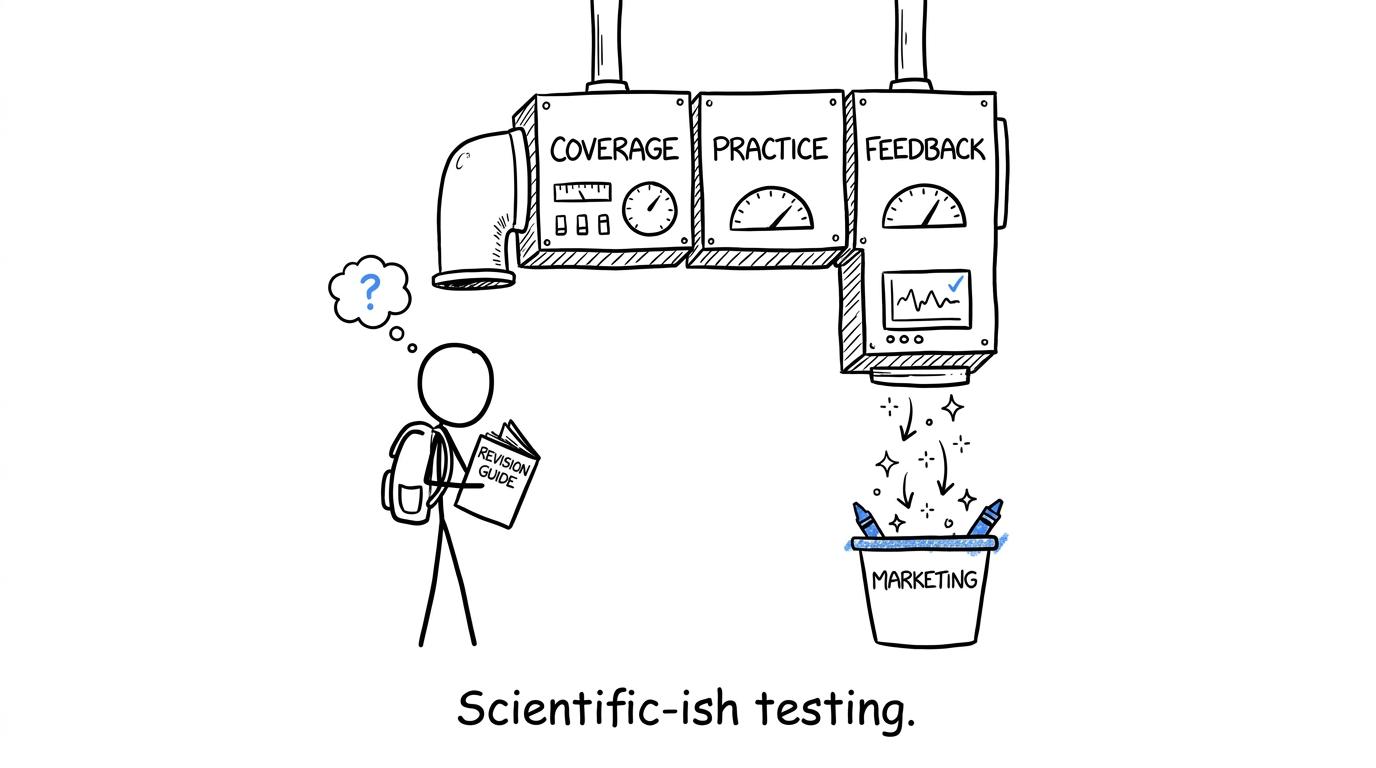 A quality detector scans coverage, practice and feedback
Common mistakes when choosing a GCSE Dance guide
Buying before checking the exam board
Do not assume that every GCSE-branded book matches your course. Confirm the awarding organisation and qualification details with your teacher or examination timetable. Exam-board names such as Edexcel, AQA, OCR and Eduqas are familiar from maths, but resources must still match the subject and specification you are actually taking.
Treating the anthology as a list of facts
Names, costumes and settings matter, but the written examination also rewards relationships and judgements. Revise how choices contribute to meaning, mood, intention and audience response.
Choosing attractive notes without questions
Clear design is helpful. It is not evidence of learning. A guide needs retrieval and application tasks, or it must be paired with them.
Ignoring your own practical work
Students can spend so long revising professional works that they neglect critical appreciation of their own performance and choreography. A complete guide should prompt specific reflection using appropriate terminology.
Trusting unofficial answers uncritically
Compare advice with the specification, official assessment materials, mark schemes and teacher guidance. Be especially cautious when an answer is vague, presents opinion without evidence or promises a rigid paragraph formula for every question.
Using one guide for every stage of revision
A guide is best for organising and clarifying knowledge. It cannot by itself provide enough timed practice or feedback. The broader revision principle is explained in MathsGenie’s short daily GCSE revision routine and GCSE catch-up plan: learn, practise, mark, fix and return.
Build a revision system, not a book collection
The best guide is not necessarily the one with the most content. It is the one that helps you move reliably from specification knowledge to independent performance: recall a concept, apply it to evidence, answer the question and improve after feedback.
Use that standard across your subjects. For Dance, verify your guide against the current specification, official assessment information and teacher guidance. Then combine it with active recall, exam-style questions and reflection on your practical work.
For maths, make MathsGenie’s GCSE revision area your free starting point. Use revision lessons and practice questions to repair individual topics, mini tests to check recall, and past papers, predicted papers, mark schemes and video solutions to prepare for exam conditions. A resource becomes valuable when it changes what you can produce without it. That is the test that matters.











