

Best GCSE Bengali Revision Apps and Resources 2026
Best GCSE Bengali revision apps for 2026, including flashcards, language tools, videos and official resources that genuinely support exam practice.
Revision apps are easy to collect and surprisingly hard to use well. One promises fluent vocabulary. Another sends daily reminders. A third makes revision feel productive while quietly avoiding the skills your exam will assess.
The best GCSE Bengali revision apps for most students are Quizlet or Anki for vocabulary, a Bengali language app such as Ling for listening and pronunciation, and your exam board's official resources for past-paper practice. No single app covers the whole qualification. The strongest approach combines one flashcard tool, one source of authentic Bengali and regular work with official papers and mark schemes.
This guide explains which resources are worth your time in 2026, what each one cannot do and how to fit Bengali revision around GCSE maths without letting either subject disappear.
Your GCSE Bengali revision checklist
Before downloading anything, check these five things:
- Confirm whether you take AQA GCSE Bengali or Pearson Edexcel International GCSE Bangla.
- Read the current specification for your exact qualification.
- Choose one main vocabulary app rather than maintaining several incomplete decks.
- Practise listening, speaking, reading and writing if your specification assesses all four skills.
- Use official past papers, mark schemes and examiner materials to test whether your revision transfers to exam questions.
That first point matters. AQA GCSE Bengali and Pearson Edexcel International GCSE Bangla are different qualifications with different assessment structures. AQA's specification has Foundation and Higher tiers, with students taking listening, speaking, reading and writing papers at the same tier. Pearson's current International GCSE Bangla specification follows its own content and assessment model. Never assume that a resource labelled simply “GCSE Bengali” matches your course.
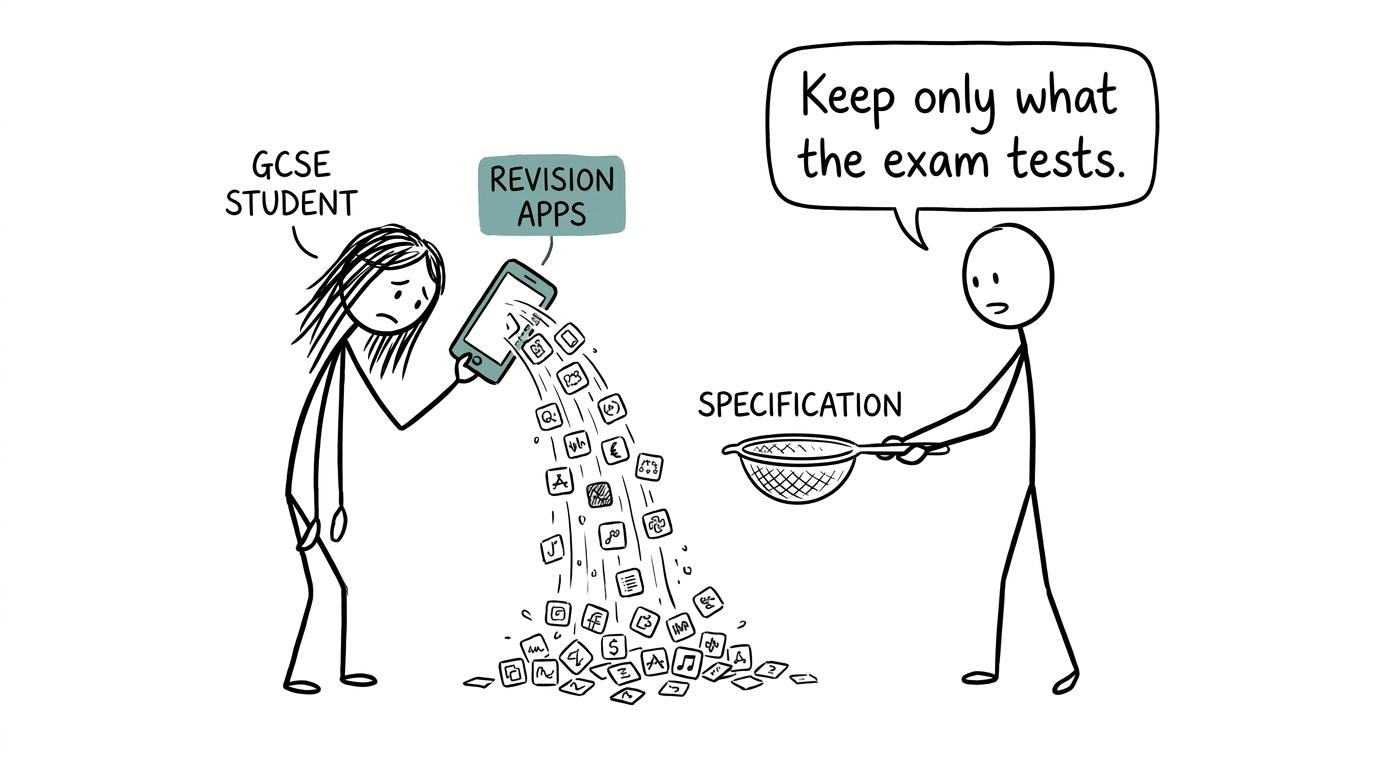 A student filters an overwhelming waterfall of revision apps through the exam specification
The best GCSE Bengali revision apps at a glance
| Resource | Best for | Main limitation | Verdict |
|---|---|---|---|
| Quizlet | Ready-made vocabulary sets and quick testing | Public sets may contain errors or miss specification content | Useful after checking every set |
| Anki | Personal flashcards and spaced review | Takes time to build and maintain well | Best for long-term vocabulary retention |
| Ling | Short Bengali lessons, listening and pronunciation | Not designed around a UK exam specification | Helpful as a supporting language app |
| Simply Learn Bengali | Common phrases and audio | Phrase lists are not a complete GCSE course | Useful for brief listening and recall practice |
| BBC Bitesize app | General GCSE organisation and revision habits | Dedicated Bengali coverage may be limited | Better for wider GCSE planning than Bengali content |
| YouTube | Hearing Bengali and finding explanations | Quality and syllabus relevance vary widely | Valuable when videos are carefully selected |
| Official exam-board resources | Specifications, sample materials, papers and mark schemes | Less game-like than an app | Essential for accurate exam preparation |
Features and free access can change, so check the current app listing before committing money or entering personal information.
Quizlet for quick GCSE Bengali vocabulary practice
Quizlet is the easiest starting point for many students because it offers flashcards, matching activities and self-testing. A dedicated uTalk AQA GCSE Bengali collection was available through Quizlet when this guide was reviewed, making it more relevant than a general beginner phrase list.
Its convenience is also its weakness. Anyone can publish a public deck, so spelling, translation and transliteration should not be trusted automatically. Compare vocabulary with your teacher's materials and the current specification. Delete doubtful cards rather than memorising them because they appeared in a popular set.
Quizlet works best for short daily retrieval sessions. Look at the English prompt and produce the Bengali word before revealing it. Recognition feels reassuring, but generating an answer is closer to what writing and speaking demand.
Anki for serious, long-term recall
Anki is the stronger choice if you are willing to create a careful personal deck. It schedules difficult material more frequently and material you remember less often. The official Anki website confirms that AnkiMobile is the official iOS app, while AnkiDroid is available for Android. Students should use official download links because similarly named apps are not necessarily part of the same system.
A useful Bengali card can include:
- the Bengali word or phrase;
- an accurate English meaning;
- an audio recording from a reliable speaker;
- one short, natural context sentence;
- a tag for its specification theme;
- a note identifying formal or informal register where relevant.
Keep cards small. One overloaded card containing vocabulary, grammar and a paragraph is difficult to retrieve and difficult to diagnose. Anki is excellent for memory, but it cannot judge whether an extended answer is relevant, developed or appropriately structured.
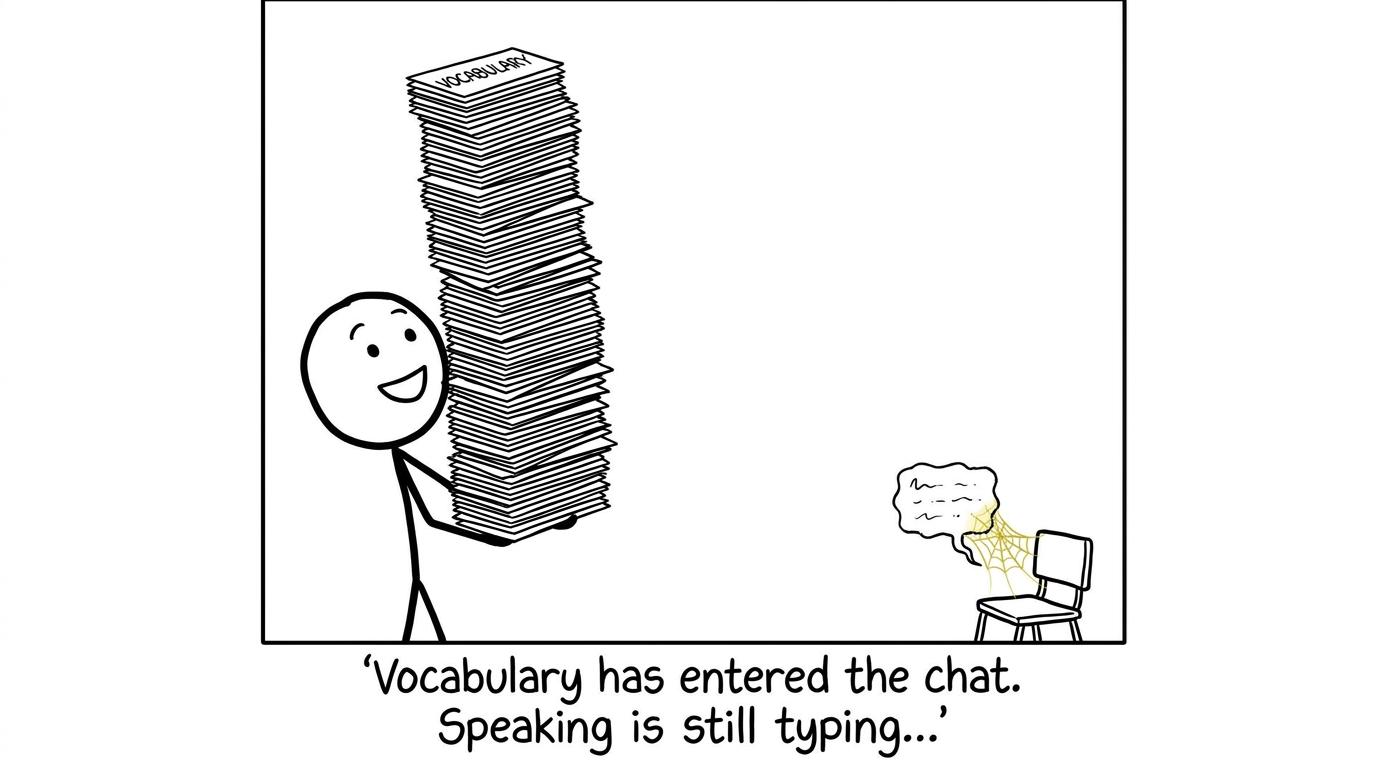 A huge vocabulary deck celebrates while speaking practice waits forgotten
Bengali language apps for listening and pronunciation
Ling
Ling offers Bengali lessons built around vocabulary, short dialogues and interactive activities. It can help students who need more regular contact with spoken Bengali, especially when classroom time is limited.
Use it as a language gym rather than an exam course. Listen without reading first, replay the audio, then repeat the phrase aloud. Afterwards, adapt useful language to an AQA theme such as identity and culture, local and global issues, or future study and employment.
The limitation is alignment. Completing an app pathway does not prove that you have covered your specification or can handle an exam task.
Simply Learn Bengali and beginner phrase apps
Simply Learn Bengali and similar phrase-based apps can support pronunciation and everyday vocabulary. They are most useful for brief practice during otherwise wasted time, such as a journey.
Their content often prioritises travel and basic conversation rather than GCSE assessment. Use them to strengthen foundations, not to decide what deserves revision. If an app cannot tell you which qualification it follows, assume it is supplementary.
Are Bengali YouTube channels worth using?
YouTube can be valuable because it lets you hear different speakers, replay explanations and observe how ideas are expressed naturally. Yet searching “learn Bengali” often produces beginner lessons, content for school systems outside the UK or literary material unrelated to your paper.
Search using your exact specification code and skill, such as “AQA Bengali 8638 speaking” or “Pearson International GCSE Bangla writing”. Before trusting a channel, check:
- whether it names the correct exam board and specification;
- whether recent videos match the current assessment structure;
- whether language is written accurately in Bengali script;
- whether advice agrees with official mark schemes;
- whether the teacher distinguishes language learning from exam technique.
Pearson has published recorded subject guidance and examiner-support material for International GCSE Bangla. Official recordings are safer for understanding assessment than an anonymous prediction video. For general listening, Bengali news, interviews and age-appropriate documentaries can expose you to authentic speed and phrasing, but they still need to be paired with exam tasks.
Free resources that matter more than another app
The least exciting resource is often the most useful: the specification. AQA's current Bengali specification identifies three broad themes that apply across its papers: identity and culture; local, national, international and global areas of interest; and current and future study and employment. It also sets out grammar expectations for Foundation and Higher tiers.
Use official resources in this order:
- Specification: turn each theme and grammar requirement into a checklist.
- Sample assessment materials: learn the task types before doing timed papers.
- Past papers: practise interpreting real instructions and managing time.
- Mark schemes: identify what earns credit rather than guessing what sounds impressive.
- Examiner reports and exemplars: notice recurring weaknesses and compare responses with examiner commentary.
AQA provides assessment resources for specification 863886388638. Pearson provides specification materials, sample assessments, past papers and marked exemplar responses for its International GCSE qualification. Some recent papers may be restricted temporarily, so use the material publicly available to students and ask your teacher or exams officer about school-controlled mock resources.
The same principle improves maths revision. MathsGenie's guide to using GCSE past papers properly explains the useful loop: attempt, mark, diagnose, repair and retest. In Bengali, the repair might be a tense, vocabulary gap or weak inference rather than an algebra method, but the logic is identical.
How to build a balanced Bengali revision system
A good system gives every resource one job.
Use Quizlet or Anki for vocabulary recall. Use a language app or carefully chosen audio for listening and pronunciation. Use a teacher, fluent adult or speaking partner for interaction and feedback. Use official papers for exam technique. Keep an error log linking mistakes to a precise next action.
A weekly pattern could include several short vocabulary reviews, one focused listening session, one written response and one speaking session. Add a timed paper section regularly rather than saving all exam practice until the final weeks.
If you are also preparing for maths, separate the subjects by task rather than vaguely promising to “revise both”. MathsGenie's guide to finding your weakest GCSE topics can help you use evidence instead of mood. The GCSE maths revision hub then gives you lessons, practice questions, mini tests and papers in one place.
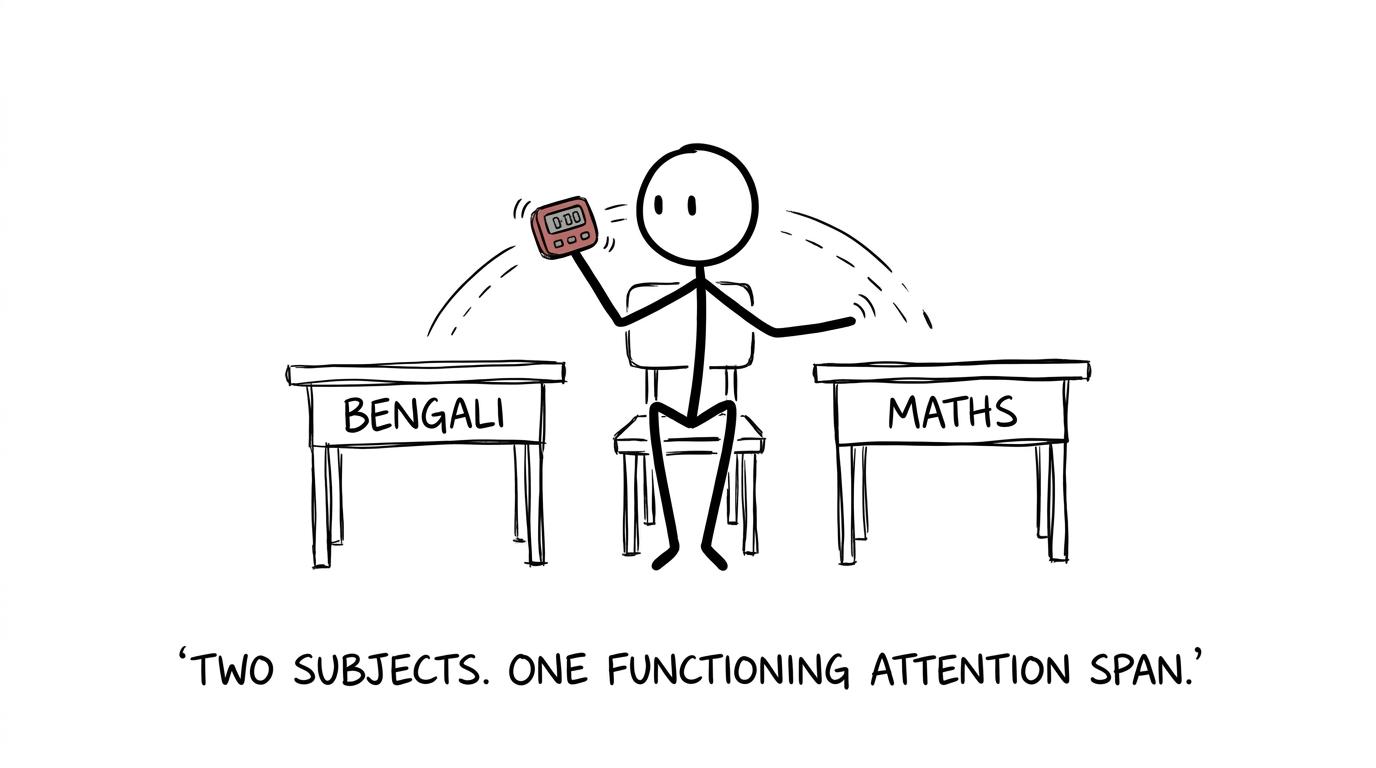 A student manages Bengali and maths revision with one overworked timer
Common mistakes when choosing Bengali revision resources
Downloading too many apps
Every new platform creates another deck, streak and set of notifications to maintain. Choose the smallest combination that covers your actual weaknesses.
Revising recognition instead of production
Tapping the correct translation from four options is easier than recalling, pronouncing or writing it independently. Regularly close the app and produce an answer without prompts.
Ignoring the exam board
A resource can teach accurate Bengali while still preparing you for the wrong tasks. Check the qualification title, specification code, tier and paper structure.
Treating speaking as memorisation
A polished script may help organise ideas, but AQA speaking also requires interaction and spontaneous language. Practise follow-up questions and adapting familiar language rather than relying entirely on a fixed speech.
Completing papers without reviewing them
A paper reveals a weakness only if you mark it and act on the result. The advice in MathsGenie's article on when to start GCSE past papers applies beyond maths: start early enough for the feedback to change what you do next.
Letting Bengali crowd out maths, or vice versa
Subjects with smaller resource libraries can consume revision time because finding material feels like work. Set a limit on searching, then begin the task. If maths also needs structure, use the GCSE one-week revision plan or the realistic advice on self-studying GCSE maths.
Choose tools by what they help you do
The best app is not the one with the longest feature list. It is the one that makes the right action easier. For GCSE Bengali, that means recalling precise vocabulary, understanding spoken and written language, communicating clearly and becoming familiar with your examination.
Begin with your specification. Add one flashcard system, one dependable source of audio and official assessment materials. Then practise producing Bengali, not merely recognising it.
For the maths side of your timetable, make MathsGenie your free revision base. Work through revision lessons and practice questions, check methods with video solutions, diagnose gaps using mini tests and build exam confidence with past papers, mark schemes and Edexcel GCSE predicted papers. Fewer scattered resources. More purposeful practice. That is usually where progress begins.










