

AI Quiz GCSE Economics: A Safe Revision Method
AI quiz GCSE economics guidance for productive self-testing, better prompts, reliable fact-checking and stronger quantitative skills for exam revision.
A quiz can feel productive without revealing very much. You answer a few multiple-choice questions, collect a reassuring score and close the tab. Yet the difficult part of GCSE Economics is rarely recognising a definition when four options are placed beneath it. It is recalling ideas independently, applying them to unfamiliar contexts and making justified judgements.
An AI quiz GCSE economics tool can help with that, if you control the questions, check the answers and resist asking the tool to do the thinking for you. The short answer is yes: an AI chatbot can generate quizzes, question you interactively and respond to your answers. But it should be treated as a flexible testing partner, not an examiner, teacher or guaranteed source of accurate information.
The quick checklist
For a productive AI economics quiz:
- name your qualification, exam board and exact topic;
- ask for one question at a time;
- include a mixture of recall, application, calculations and evaluation;
- answer before requesting feedback;
- make the AI explain which part of your answer needs improvement;
- verify disputed facts against your specification, teacher materials and trusted revision resources;
- keep a record of weak topics and revisit them later;
- never enter personal information or confidential school material.
That final point matters. Current Department for Education guidance warns that generative AI output can be inaccurate, biased, out of date, taken out of context or simply invented. It also advises schools to consider age restrictions, safeguarding and data protection. Follow your school's policy and use only an appropriate, approved tool.
What an AI economics quiz can do well
AI is useful because it can change the shape of a quiz quickly. A static set of flashcards asks the questions it was given. An AI tool can ask a follow-up question after a weak answer, increase the difficulty or return to an idea you confused earlier.
The strongest uses include:
- testing definitions such as scarcity, opportunity cost and inflation;
- asking you to distinguish similar concepts;
- creating short scenarios involving consumers, producers and government;
- questioning you about a table, chart or written data set;
- testing calculation methods;
- asking for an argument, counterargument and final judgement;
- turning your error list into a later retrieval quiz.
This fits the broad demands of GCSE Economics. Official assessment objectives distinguish knowledge and understanding, application, and analysis and evaluation. For regulated GCSE Economics qualifications in England, these are weighted at 35%35\%35%, 35%35\%35% and 30%30\%30% respectively. A quiz containing definitions alone therefore misses much of what the course is designed to assess.
Before creating questions, identify the content you actually need. The OCR GCSE Economics revision guides provide a clear topic map covering markets, government objectives, policies, international trade and quantitative skills.
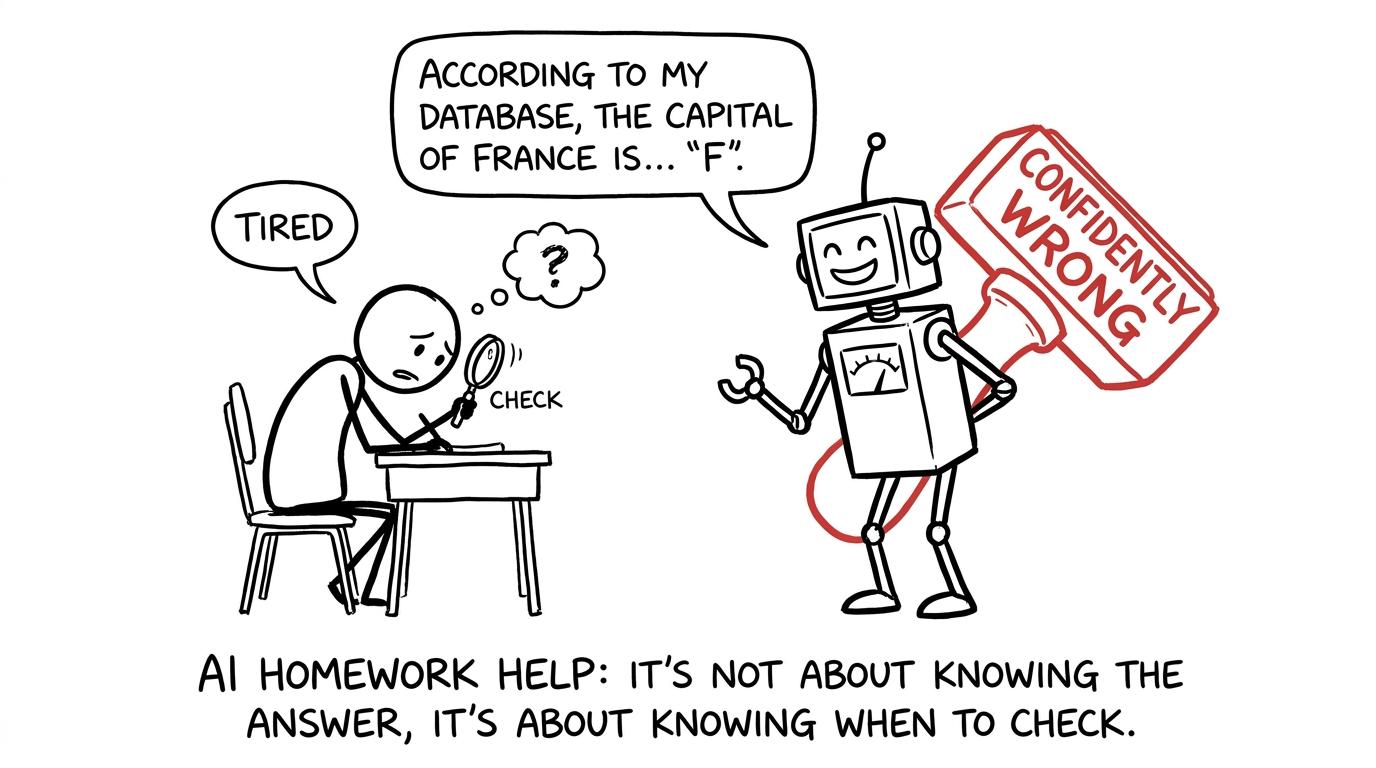 A student checks a confident robot quizmaster with a magnifying glass
How to prompt an AI quiz GCSE Economics tool
A vague request usually produces a vague quiz. “Test me on economics” gives the tool too much freedom: it may choose the wrong level, use material from another qualification or drift into A Level content.
A stronger starting prompt is:
Act as a GCSE Economics quiz partner. I am following the OCR J205 specification and revising demand. Ask one question at a time. Mix knowledge, application and analysis. Do not reveal the answer until I respond. After each response, identify what is correct, what is missing and whether any claim needs checking against the specification. Keep a list of my errors and retest them at the end.
Change the board and topic to match your course. AQA and OCR organise and assess their content differently, so never assume that a generic “GCSE” label guarantees a match. If you study another qualification, including International GCSE Economics, give the AI its precise title and specification code.
Set boundaries before the quiz begins
Tell the tool what not to do. Useful instructions include:
- do not introduce A Level terminology unless it is labelled as extension material;
- do not invent statistics, case studies or quotations;
- do not award a mark unless a clear marking reason is given;
- say when an answer is uncertain;
- do not rewrite my whole response before I attempt to improve it;
- use British economic terminology and pounds sterling where appropriate.
You can also paste a short topic checklist supplied by your teacher. Avoid uploading copyrighted textbooks, unpublished assessments, another student's work or anything containing names and personal details.
Make the AI wait for your thinking
The most important instruction is simple: one question at a time, with no answer shown in advance.
Write your answer from memory. If it is incomplete, ask for a hint rather than a model response. Then improve the answer yourself. The valuable moment is the struggle to retrieve and organise knowledge. If the AI supplies polished paragraphs immediately, revision becomes reading rather than testing.
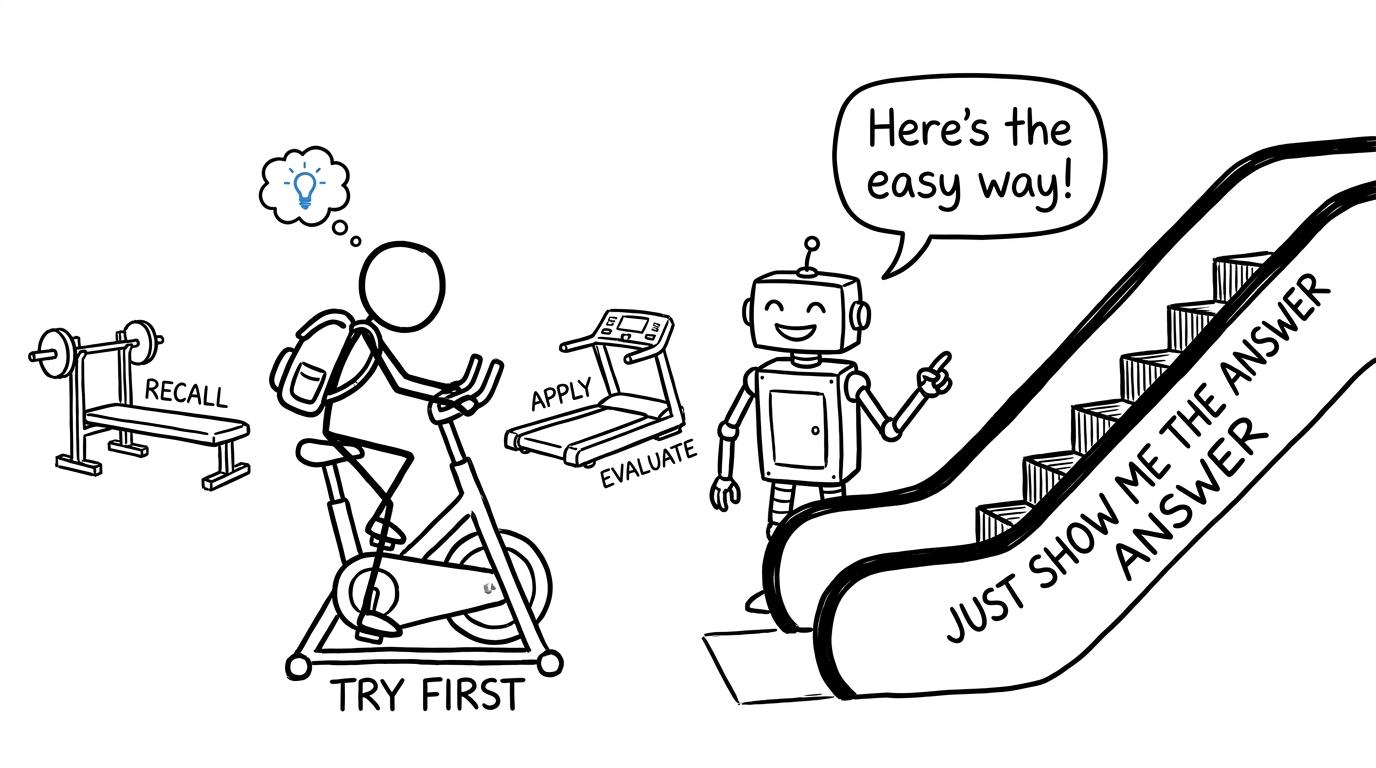 A student chooses the revision exercise bike instead of the answer escalator
Include the maths inside GCSE Economics
Economics is not only extended writing. Ofqual's GCSE Economics requirements include percentages, percentage changes, averages, revenue, costs, profit, income, graphs and the interpretation of quantitative data. At least 10%10\%10% of the total marks must reward quantitative skills at no lower than Key Stage 3 demand.
Ask the AI to test the method and the economic meaning of a result. Relevant relationships include:
Percentage change=new value−original valueoriginal value×100%\text{Percentage change}=\frac{\text{new value}-\text{original value}}{\text{original value}}\times 100\%Percentage change=original valuenew value−original value×100% Total revenue=price×quantity sold\text{Total revenue}=\text{price}\times\text{quantity sold}Total revenue=price×quantity sold Profit=total revenue−total cost\text{Profit}=\text{total revenue}-\text{total cost}Profit=total revenue−total cost Average cost=total costquantity produced\text{Average cost}=\frac{\text{total cost}}{\text{quantity produced}}Average cost=quantity producedtotal costThe AI should check units, the original value used in percentage change and whether the conclusion makes economic sense. But verify its arithmetic independently with a calculator. The OCR Economics calculations guide and AQA quantitative skills in economics guide give you specification-focused reference points.
If percentages remain the obstacle rather than the economics, return to the underlying method through the GCSE Maths percentages revision guide. For charts and data presentation, bar chart revision and practice can strengthen the mathematical foundation.
Where AI tends to give bad information
AI's most dangerous error is not an obviously absurd answer. It is a fluent answer containing one subtle mistake.
Specification drift
An AI tool may mix GCSE and A Level content, combine different exam boards or assume that every board uses the same paper structure. It may also confuse GCSE Economics with Business. Check every topic against your current specification rather than trusting the label attached to a generated question.
Invented marking language
A chatbot can create a plausible-looking mark scheme that is not an official mark scheme. It may reward terminology that sounds sophisticated while overlooking application to the context or a supported judgement. Treat AI feedback as coaching. Use genuine past-paper mark schemes to understand what examiners actually accepted.
Unreliable current examples
Economic figures change. Inflation, interest rates, unemployment and government policies are time-sensitive, while an AI tool may rely on old information or invent a source. Unless a question supplies data, avoid building an answer around an unverified statistic. GCSE analysis can often be strong without memorising a fragile number.
Oversimplified chains of reasoning
Economics contains conditional relationships. A change in interest rates may affect borrowing, saving, consumption, investment and inflation, but the size and timing of those effects depend on context. AI sometimes presents one possible chain as an automatic law. The role of money and financial markets guide can help you check the underlying concepts.
Faulty diagrams and calculations
Generated graph descriptions can reverse axes, confuse a movement along a curve with a shift, or label equilibrium inconsistently. Arithmetic can also be wrong even when the explanation sounds certain. Redraw diagrams yourself and check each calculation line by line.
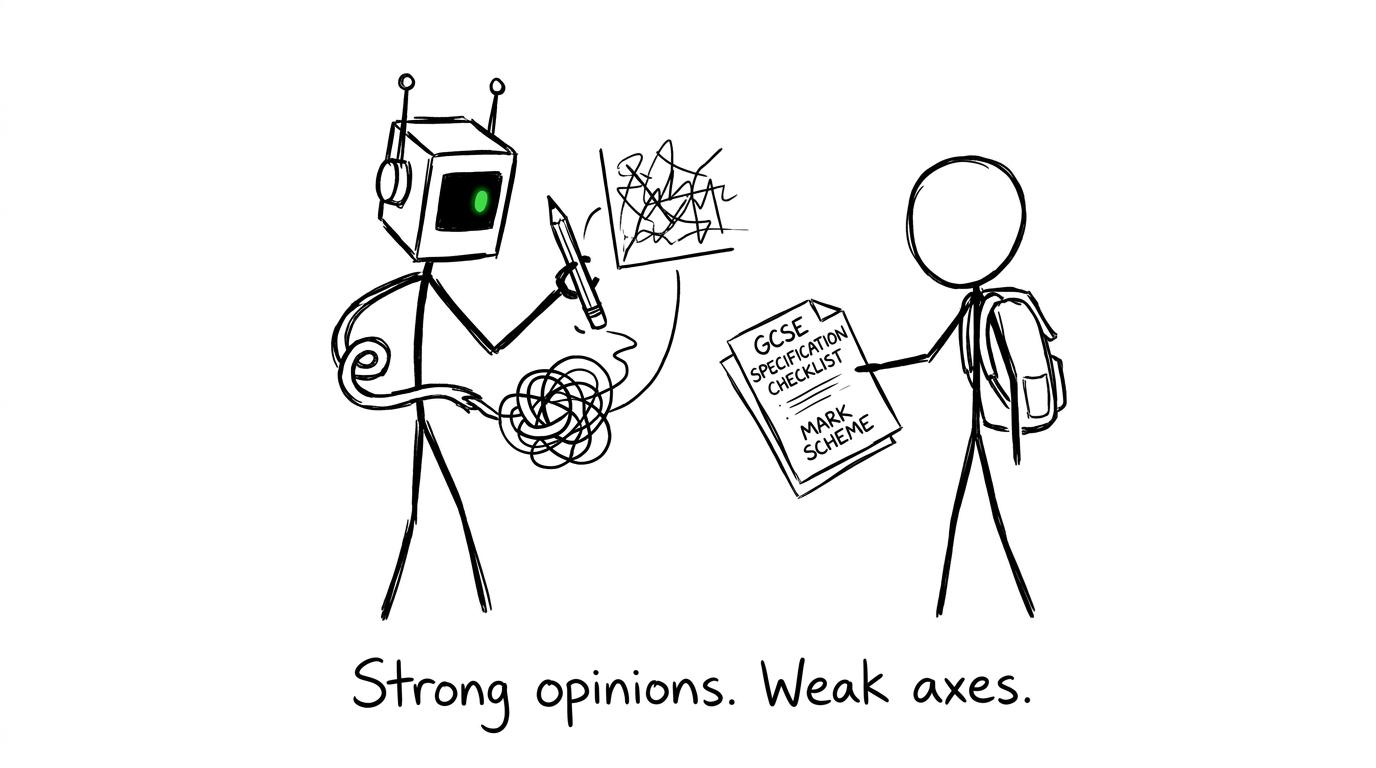 A robot with strong opinions struggles to draw a graph while a student offers a checklist
A reliable fact-checking routine
Use a simple hierarchy whenever an AI answer seems uncertain:
- First: check the current specification for whether the content is required.
- Second: check your teacher's materials and an established revision guide.
- Third: compare the wording with an official question and mark scheme.
- Fourth: ask the AI to identify its uncertainty, then verify rather than accepting its defence.
Do not ask the same chatbot, “Are you sure?” and treat “yes” as evidence. Confidence is a style of response, not proof of accuracy.
A useful error log has four entries: topic, your original error, the verified correction and the date for retesting. This turns a mistaken AI question into useful revision rather than letting it quietly reshape your knowledge.
Combine AI quizzes with real exam practice
AI questions are best used between established resources, not instead of them. A balanced session might begin with a revision guide, continue with an AI recall quiz and finish with genuine exam-style questions.
For the quantitative side, use the GCSE Maths revision hub to select your exam board and foundation or higher tier. Short Edexcel GCSE Maths mini tests can test whether percentage, graph and calculation skills remain secure under time pressure.
When you move to full papers, follow the discipline in MathsGenie's guide to using GCSE past papers properly: attempt, mark, diagnose, repair and retest. AI can help generate follow-up questions from your error categories, but the paper and its official mark scheme remain the stronger evidence of exam readiness.
Common mistakes when revising with AI
Accepting the first answer: A polished explanation can still be false. Check unfamiliar claims before learning them.
Requesting only multiple-choice questions: These can test recognition but give too little practice in application, analysis and judgement.
Giving the AI your answer before thinking: If you ask it to write a response and then read it, you have practised recognition rather than independent recall.
Using the wrong specification: Board, qualification and topic details should appear in the opening prompt.
Chasing a perfect AI score: The purpose is to uncover gaps. A difficult quiz that reveals three weaknesses is more valuable than an easy quiz producing full marks.
Ignoring the maths: Percentage change, averages, financial calculations and data interpretation are part of GCSE Economics. Practise them rather than hoping the written questions will compensate.
Submitting AI-written work: Revision use is different from presenting generated work as your own. JCQ guidance makes clear that misuse of AI in assessed work can constitute malpractice. Follow your teacher's instructions and ensure submitted work is genuinely yours.
Make AI the questioner, not the thinker
The best AI quiz does not make revision effortless. It makes your effort better directed. It asks, waits, challenges and returns to the gap. You still supply the knowledge, calculate the result and decide whether the evidence supports the conclusion.
Use an AI quiz to expose what you cannot yet recall, then repair the weakness with MathsGenie's free revision guides, lessons and practice questions. For your maths exams, build confidence through mini tests, past papers and predicted papers, checking your work with mark schemes and video solutions. Add each weakness to your revision planner and retest it after a gap.
Start with one precise topic today. Ask the AI one question. Answer without help. Then verify everything that matters.











