

Can Adults Retake GCSE Bengali? How It Works
Adults retake GCSE Bengali through evening courses or as private candidates. Learn how to find a centre, budget for fees and prepare with confidence.
A GCSE can feel strangely permanent when it appears on a certificate. It is not. When adults retake GCSE Bengali, they can enrol on a suitable course or study independently and enter through an approved exam centre as a private candidate. There is no standard school-age requirement for taking the qualification.
The most important detail is practical rather than academic: secure a centre that can enter you for the correct specification and conduct the speaking assessment. Do this before committing to a course or buying revision materials.
Your GCSE Bengali retake checklist
Before beginning, confirm each of these points:
- Decide whether you need GCSE Bengali or International GCSE Bangla.
- Check the awarding organisation and specification code required by an employer, college or university.
- Choose between an evening course, online tuition, a tutor or independent revision.
- Find an approved exam centre willing to accept private candidates.
- Confirm that the centre can arrange every assessment, including speaking.
- Ask for the complete price, internal entry deadline and cancellation terms.
- Check your statement of entry as soon as it arrives.
- Build revision around listening, speaking, reading and writing.
The order matters. Finding a course first and an exam centre later can leave you prepared for a qualification nobody nearby can host.
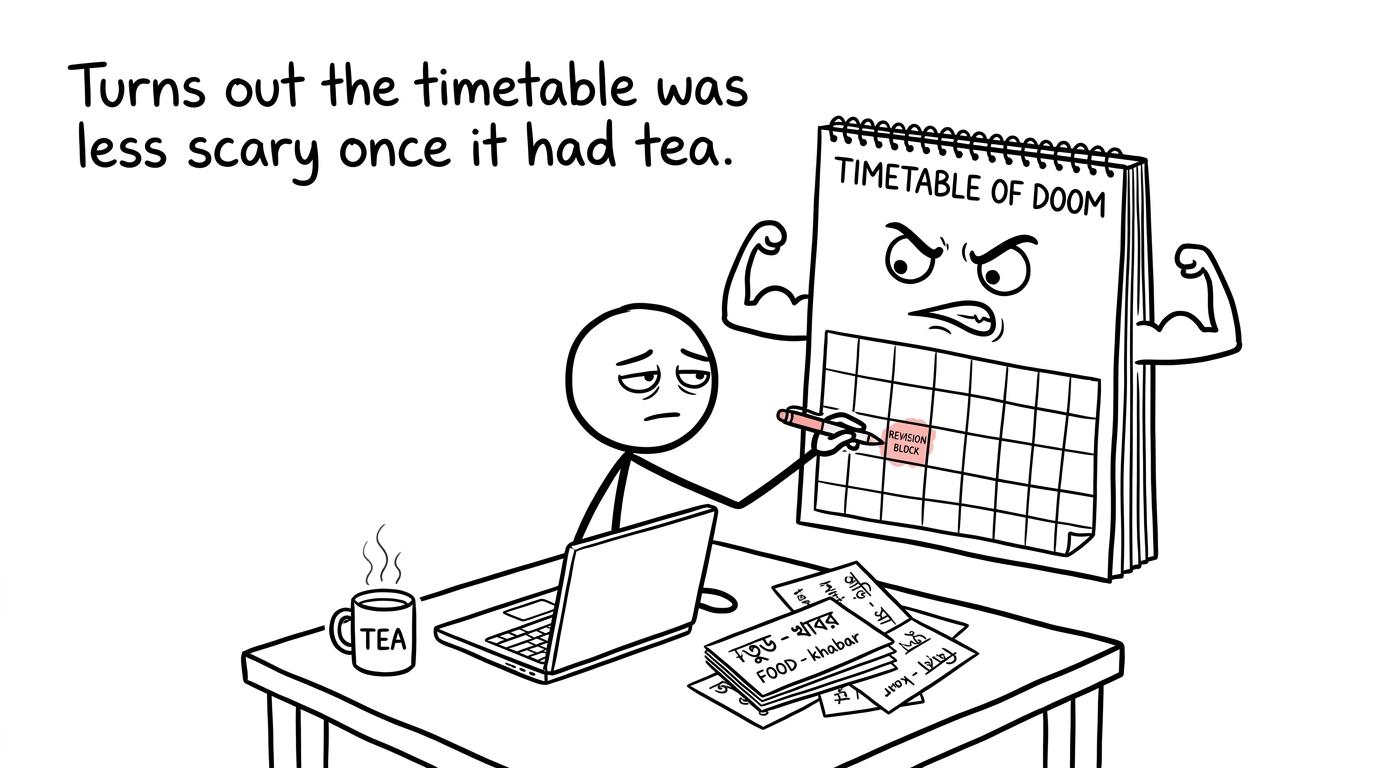 An adult learner calmly fitting GCSE revision around work
Can adults retake GCSE Bengali at any age?
Yes. An adult can take GCSE Bengali whether they are improving an earlier grade or entering the subject for the first time. If you are not enrolled at the school or college making your entry, you will normally be treated as a private candidate.
A private candidate does not enter directly with the exam board. An approved school, college or examination centre must submit the entry and supervise the assessments. Centres are not required to accept external candidates, so availability is often the real constraint.
GCSE Bengali is normally examined in the summer series. The additional November GCSE series is principally available for English language and maths, not Bengali. Always check the current awarding-body timetable before choosing your target year.
If you are also returning to GCSE maths, the free GCSE Maths revision hub lets you select your exam board and tier, then move between lessons, questions, papers and solutions.
Check which Bengali qualification you need
Names that sound similar can describe different qualifications. This is where a ten-minute check can prevent months of revision for the wrong assessment.
AQA GCSE Bengali
AQA GCSE Bengali has the specification code 8638 and uses the GCSE grades 999 to 111. Its assessment covers four language skills:
- listening;
- speaking;
- reading;
- writing.
Each skill contributes 25%25\%25% of the qualification. Foundation and higher tiers are available, and your centre must make the correct tier entry. Because it is a linear GCSE, a retake normally means completing the full qualification rather than repeating one weak skill in isolation.
Ask the centre to verify the current specification, tier and entry rules before you pay. This is particularly important if your original Bengali result came from an older specification.
Pearson Edexcel International GCSE Bangla
Pearson also offers an International GCSE in Bangla. It is not simply another name for AQA GCSE Bengali. Its content and assessment structure differ, so past papers and preparation materials are not automatically interchangeable.
Start with the requirement you are trying to meet. If a university, employer or training provider has asked for a language GCSE, ask whether it accepts the International GCSE route. Then choose the qualification deliberately rather than selecting whichever centre appears first.
The same principle applies in maths: specification details shape what appears in the papers. MathsGenie's GCSE maths topics by exam board and tier explains how shared national content can still be organised differently by Edexcel, AQA, OCR and Eduqas.
Evening classes and adult learning courses
An evening class offers structure. You have a timetable, a teacher and other learners expecting you to return next week. For adults balancing work or caring responsibilities, that accountability can be more valuable than an ambitious plan built around unlimited free time.
Search local further education colleges, council adult-learning services and community language providers. Bengali GCSE courses are less widely available than adult English or maths courses, so ask direct questions:
- Is this a complete GCSE Bengali course or a general language class?
- Which awarding organisation and specification does it teach?
- Is exam entry included?
- Where will the speaking assessment take place?
- Does the provider offer foundation, higher or both tiers?
- What happens if the class does not recruit enough learners?
Do not assume that GCSE Bengali will be publicly funded. Adult funding entitlements commonly associated with achieving a first grade 444 in English or maths do not automatically extend to optional language GCSEs. Eligibility varies by programme and personal circumstances, so obtain written confirmation from the provider.
A course may include the examination entry, or it may provide tuition while leaving you to book privately. That distinction affects both cost and administration.
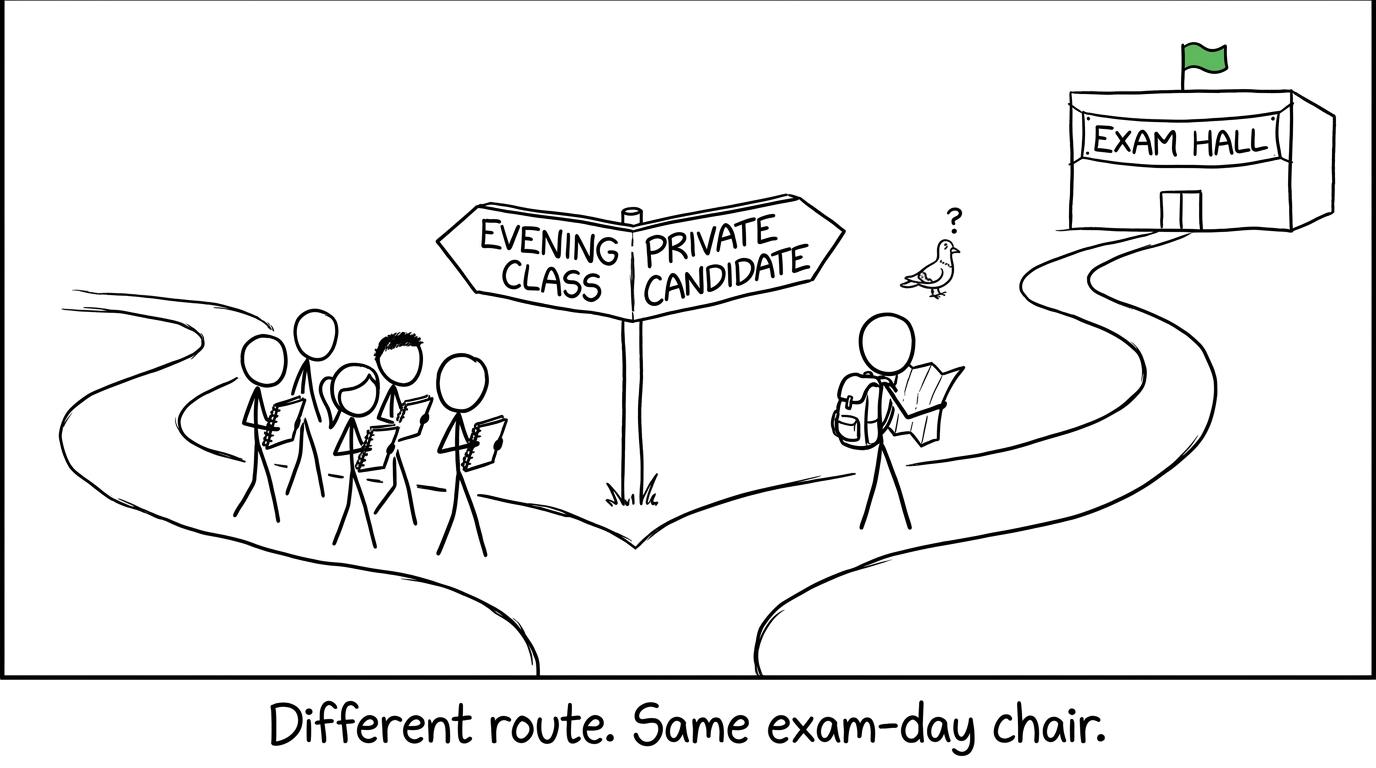 Two different adult-learning routes meeting at the same exam hall
Sitting GCSE Bengali as a private candidate
Independent entry gives you flexibility, but it also makes you the project manager. The process is manageable when handled in the right order.
Find an approved centre early
Use the JCQ private-candidate search service as a starting point, then contact centres directly. A listing does not guarantee that a centre currently has space or offers your exact subject.
When enquiring, say that you need AQA GCSE Bengali 8638, state your intended series and ask whether the centre can administer the speaking assessment. A centre accepting private GCSE maths candidates may not necessarily accept Bengali because language assessments require different arrangements.
Contact several centres. Ask about travel as well as availability: the speaking assessment and written papers may require separate visits.
Confirm the complete fee
Private-candidate charges vary because a centre may combine the awarding-body entry fee with administration, invigilation, speaking-assessment and late-entry charges. Request one written total and ask what it includes.
Centres often set internal deadlines earlier than the awarding organisation's final deadline. Applying late can increase the price or leave no available place, so begin enquiries well before the summer examination period.
Supply the correct candidate details
The centre may request identification, your date of birth, contact details and information from previous results. If you have a Unique Candidate Identifier from an earlier examination entry, provide it when requested.
Once entered, inspect your statement of entry. Check your name, subject, specification, tier and assessment details immediately. A small administrative error is much easier to correct before the examination period.
Discuss access arrangements promptly
If you may need extra time or another approved access arrangement, tell the centre at the beginning. Arrangements are based on evidence and applicable regulations; they cannot simply be requested on the day of an assessment. Private candidates should allow time for the centre to review their needs and complete any required process.
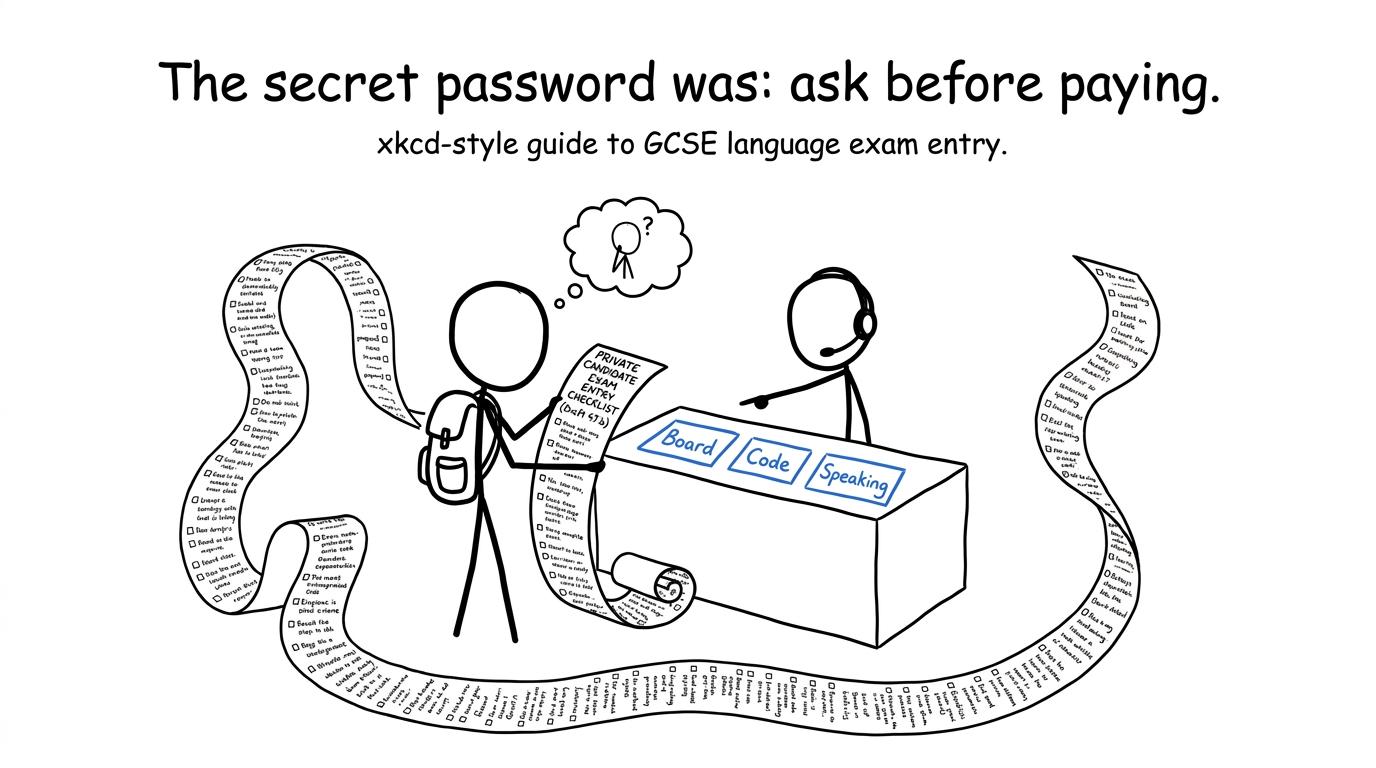 A private candidate discovering the three questions that matter before paying
How to prepare while balancing other GCSEs
Adult revision works best when it respects the life surrounding it. A plan that requires two uninterrupted hours every evening may look impressive and fail by Thursday. Short, repeatable sessions are more dependable.
Divide Bengali revision across all four assessed skills. Listening practice alone will not repair weak writing, while fluent family conversation does not guarantee accurate reading, spelling or formal responses. Use the current specification and official past materials to identify the language, themes and task types assessed.
A useful weekly structure is:
- one listening session with retrieval afterwards;
- one reading and vocabulary session;
- one planned writing task followed by correction;
- one speaking session recorded or completed with a teacher or partner;
- one mixed, timed assessment section.
Treat mistakes as information. Record whether each lost mark came from vocabulary, grammar, misunderstanding the instruction, weak time management or incomplete development. Then revise the cause rather than repeatedly rereading everything.
This is equally effective for maths. MathsGenie's guide to finding your weakest GCSE topics shows how to turn lost marks into a focused revision list. The best order for learning GCSE maths topics can then help you sequence the repair work.
As the examination approaches, move from isolated tasks to timed papers. The purpose is not merely to produce a score. It is to notice where time disappears, which instructions you misread and which knowledge remains unreliable. The guide to using GCSE past papers properly sets out a paper, mark, fix and retest cycle that works across subjects.
Common mistakes when arranging a Bengali retake
Confusing GCSE Bengali with International GCSE Bangla
Check the exact title, awarding organisation and specification code. Similar names do not guarantee the same papers or assessment structure.
Booking tuition before securing an exam centre
A tutor or online provider may teach the course without making your examination entry. Confirm where every assessment will take place before spending heavily on tuition.
Forgetting about speaking
Private language entries are more complicated than written-only subjects. Ask explicitly whether the centre can conduct the speaking component and whether its cost is included.
Assuming there will be a November retake
GCSE Bengali is normally a summer-series qualification. Do not base your plan on the November arrangements available for GCSE English language and maths.
Revising only the comfortable skill
A confident speaker may still need substantial reading and writing practice. Allocate time according to evidence from assessed tasks, not according to which activity feels easiest.
Leaving the entry until the official deadline
A centre's own deadline may be earlier, and places can fill. Early contact also gives more time to resolve identification, tier or access-arrangement questions.
Treating every mistake as a knowledge gap
Some marks are lost through timing, task interpretation or examination technique. Maths students can use the same distinction when following MathsGenie's advice on stopping GCSE content from being forgotten.
Take the next step calmly
Adults can retake GCSE Bengali, but the successful route begins with three confirmations: the right qualification, a centre that accepts private candidates and a firm plan for the speaking assessment. Evening classes can supply teaching and routine; independent study can supply flexibility. Neither route removes the need to verify the entry details.
Once the administration is settled, revision becomes a collection of small, visible actions. Practise each skill, use current assessment materials, mark honestly and return to weaknesses.
For the maths alongside your Bengali retake, make MathsGenie your free revision base. Start with revision lessons and practice questions, then progress to mini tests, past papers, predicted papers, mark schemes and video solutions. A clear revision plan does not make adult life less busy; it makes the next useful step easier to see.










