

A-Level Sociology Grade and University Entry
A-level sociology grade university guide: learn what each result means, compare typical UK degree offers and check the GCSE maths grades often required.
A university offer can look deceptively simple: three letters on a screen, perhaps ABBABBABB or BBCBBCBBC. Yet one important detail is easily missed. Your Sociology result is normally considered as part of your overall A-Level profile, not as an isolated grade.
That is the clearest answer to what an A-Level Sociology grade means for university. An AAA may help you meet a competitive offer, while a CCC can fit many standard or contextual offers. Lower grades may still lead to foundation-year routes. The exact outcome depends on your other subjects, GCSE requirements and the individual course.
For GCSE students, this matters earlier than it seems. Sociology degrees often expect evidence of numeracy, and some require GCSE Maths at grade 444 or above. The work you do now can keep that door open.
Your university entry checklist
Before comparing grades, check:
- the complete A-Level offer, not Sociology alone;
- whether the course requires an essay-based subject;
- the minimum GCSE English Language and Maths grades;
- whether contextual offers are available;
- whether the university uses grades or UCAS Tariff points;
- the requirements for the exact entry year in which you will apply.
Universities set their own conditions. Treat the examples below as a map, not a promise.
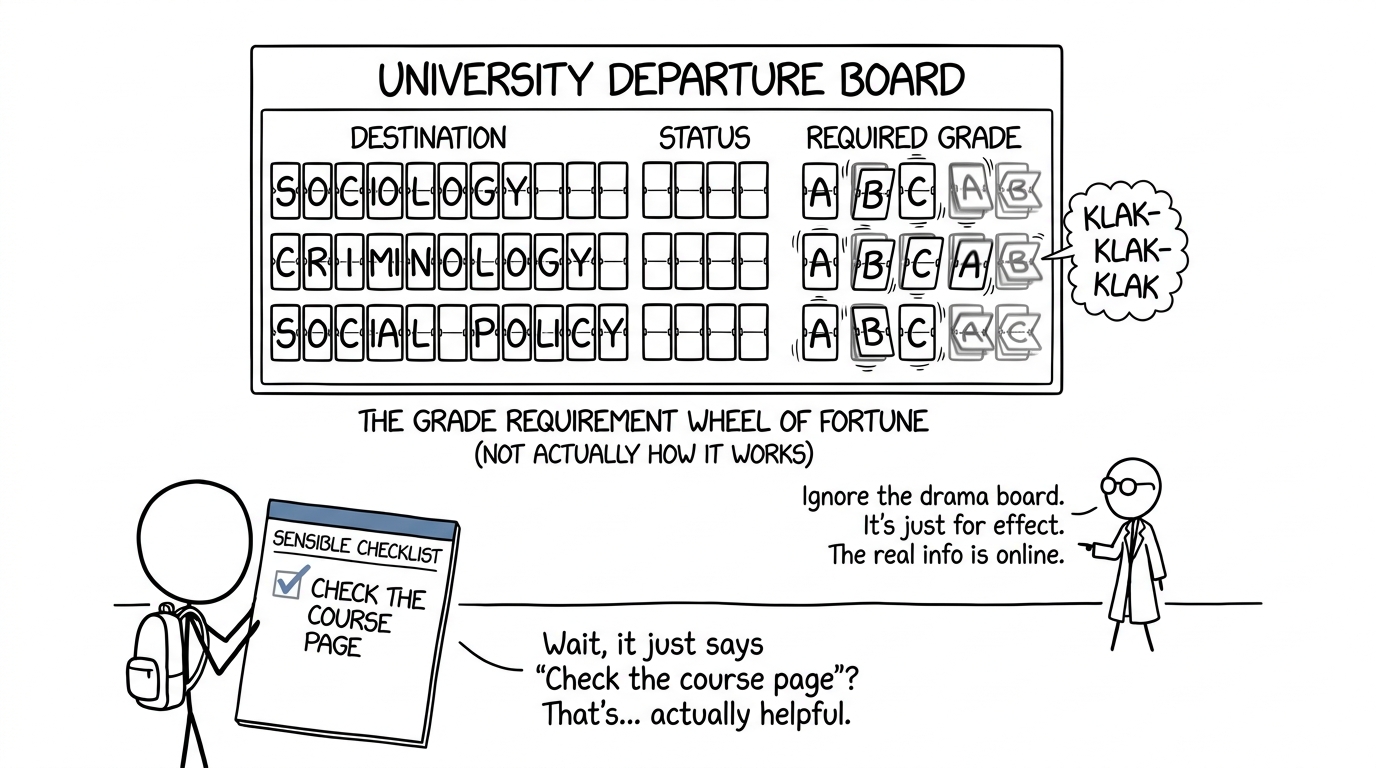 A student checks a changing university departure board
A-Level Sociology grades and UCAS Tariff points
A single A Level has the following UCAS Tariff value. GCSEs do not receive Tariff points.
| Sociology grade | UCAS Tariff points | Broad interpretation |
|---|---|---|
| A∗A^*A∗ | 565656 | Excellent result that strengthens a competitive application |
| AAA | 484848 | Strong result suitable for many demanding offers |
| BBB | 404040 | Solid result appearing in many typical Sociology offers |
| CCC | 323232 | Can support offers around BBCBBCBBC, BCCBCCBCC or Tariff-based routes |
| DDD | 242424 | May suit lower-tariff or foundation-year entry |
| EEE | 161616 | A pass, but direct-entry choices may be limited |
Tariff values do not mean every university will accept any combination producing the same total. A course asking for ABBABBABB may still require those grades rather than an equivalent points total.
Grade-by-grade Sociology degree entry requirements
Grade A∗A^*A∗ or AAA
An A∗A^*A∗ or AAA in Sociology demonstrates strong knowledge, analysis and extended writing. It can help with selective Sociology, social policy, criminology and combined humanities degrees.
Published offers for more competitive courses can sit around AABAABAAB or ABBABBABB. For example, Birmingham has published an ABBABBABB offer for its Sociology BA, while some combined degrees ask for AABAABAAB and specify an essay-based subject.
The important question is still your full profile. A Sociology grade of AAA alongside grades BBB and BBB creates ABBABBABB, whereas one high subject grade does not automatically compensate for every missed condition.
Grade BBB
A BBB is a strong and widely useful result. Several published Sociology offers sit around ABBABBABB, BBBBBBBBB or BBCBBCBBC.
Leicester, for example, has published a typical offer of BBBBBBBBB for Sociology. City St George's has listed BBCBBCBBC, alongside a minimum grade 444 in GCSE Maths and English Language. A student with Sociology at grade BBB could therefore be well placed if the other two A Levels complete the required combination.
If you are choosing subjects now, MathsGenie's guide to choosing three A-Level subjects can help you balance enjoyment, entry requirements and workload.
Grade CCC
A CCC does not close the door to university. It can fit offers such as BBCBBCBBC, BCCBCCBCC or CDDCDDCDD, depending on the course and your other grades.
Some universities also make contextual offers that are lower than their standard offers for eligible applicants. Eligibility is determined by each institution and can involve factors such as school background or personal circumstances. Never assume that you qualify without checking.
A CCC may also contribute 323232 Tariff points where a course uses points. For instance, three grades of BCCBCCBCC produce:
40+32+32=104 40 + 32 + 32 = 104 40+32+32=104That calculation is useful only when the provider accepts Tariff-based entry and does not impose separate subject or grade conditions.
Grade DDD
A grade DDD is worth 242424 Tariff points. Direct entry choices become narrower, but foundation years and courses with flexible Tariff requirements may remain realistic.
Published foundation-year Sociology requirements can begin around DDDDDDDDD, equivalent to 727272 points from three A Levels. Foundation years add an introductory year before the main degree and can provide a structured route into university-level work.
Compare the course content and total duration, not simply the entry grade. A lower offer is useful only if the degree itself suits your goals.
Grade EEE or below
An EEE is an A-Level pass worth 161616 Tariff points, but it is unlikely to satisfy the Sociology component of most standard three-grade offers. Options may include a foundation year, an alternative course, resitting, or applying with other accepted Level 3 qualifications.
If results differ from your offer, contact the university rather than rejecting yourself. Admissions decisions can depend on the full application and available places, although flexibility is never guaranteed.
Why GCSE Maths still matters for Sociology
Sociology is essay-rich, but university study also involves research methods, interpreting evidence, sampling and evaluating data. More immediately, universities may set a GCSE Maths minimum.
Published examples vary. Birmingham and City St George's have required grade 444 in GCSE Maths, while other courses may accept Maths or a science, or specify only English. Always read the GCSE conditions separately from the A-Level offer.
 GCSE Maths and Sociology textbooks pass an evidence baton
If Maths is the qualification that could limit your options, start with the GCSE Maths revision hub. Edexcel students can use the Edexcel GCSE Maths course page, then work through topic-by-topic lessons.
For skills connected with social research, the Edexcel GCSE Statistics resources and probability revision provide useful foundations.
Common mistakes when reading university offers
Looking at Sociology in isolation
Universities usually make an offer across three A Levels. Record the complete requirement and any named subjects.
Confusing grades with Tariff points
An offer of ABBABBABB is not automatically interchangeable with any qualifications totalling the same points. Check how the course states its requirement.
Ignoring GCSE conditions
You could meet the A-Level offer but miss a required GCSE Maths or English grade. Check both levels before applying.
Using an old course page
Offers, accepted qualifications and contextual policies can change. Verify the university's page for your intended entry year.
Treating predicted grades as final results
Predicted grades support applications, but any conditional offer states what you must actually achieve. MathsGenie's OCR A-Level Sociology grade calculator can help OCR students estimate performance, while the Eduqas A-Level Sociology revision hub provides board-specific resources.
Turn requirements into a practical plan
Choose several realistic courses and create three groups: aspirational, well-matched and safer choices. For each one, record the standard offer, contextual offer, GCSE conditions and required subjects.
Then work backwards. Strengthen GCSE Maths now with lessons and practice questions. Later, use mark schemes and past papers to identify where Sociology marks are being lost. Nearer the exams, GCSE predicted papers can help maths students rehearse under timed conditions.
Your grade is not a verdict on your future. It is one part of a route. Use MathsGenie to make that route clearer: review free revision lessons, practise targeted questions, complete past and predicted papers, and learn from mark schemes and video solutions. Start with the course-planning guide, check current university requirements, then revise for the grades that keep your preferred options open.











