

A-Level Results: Didn't Get the Grades?
A-level results didn't get grades you needed? Explore missed-offer options: Clearing, marking reviews, gap years, resits and practical next steps.

Results day can shrink your world to a few letters on a screen. Months of revision, one university offer and one carefully imagined future suddenly seem to depend on whether an A became a B.
If your A-level results didn't bring the grades you needed, pause before assuming that everything has gone wrong. Missing an offer does not automatically mean losing the place, and losing the place does not mean running out of worthwhile routes. Your main A-level missed-offer options are to check whether your firm or insurance choice accepted you, contact admissions, explore Clearing, consider a review of marking and decide whether a gap year or resit would serve you better.
The important thing is to act calmly, in the right order.
Your results-day checklist
Before making any irreversible decision:
- Collect your grades and check your status in the UCAS Hub.
- Read the exact course and university details shown in your application.
- Contact a university if your decision is still pending.
- Speak to a teacher or exams officer if a grade looks unexpected.
- Search Clearing while any marking review is being considered.
- Do not decline a confirmed place until you understand what you are giving up.
- Write down names, telephone numbers and details of every conversation.
For 2026 entry, A-level results are released on Thursday 13 August. UCAS advises students to check their application status and collect their actual results, because universities and Clearing teams will need to know the grades achieved.
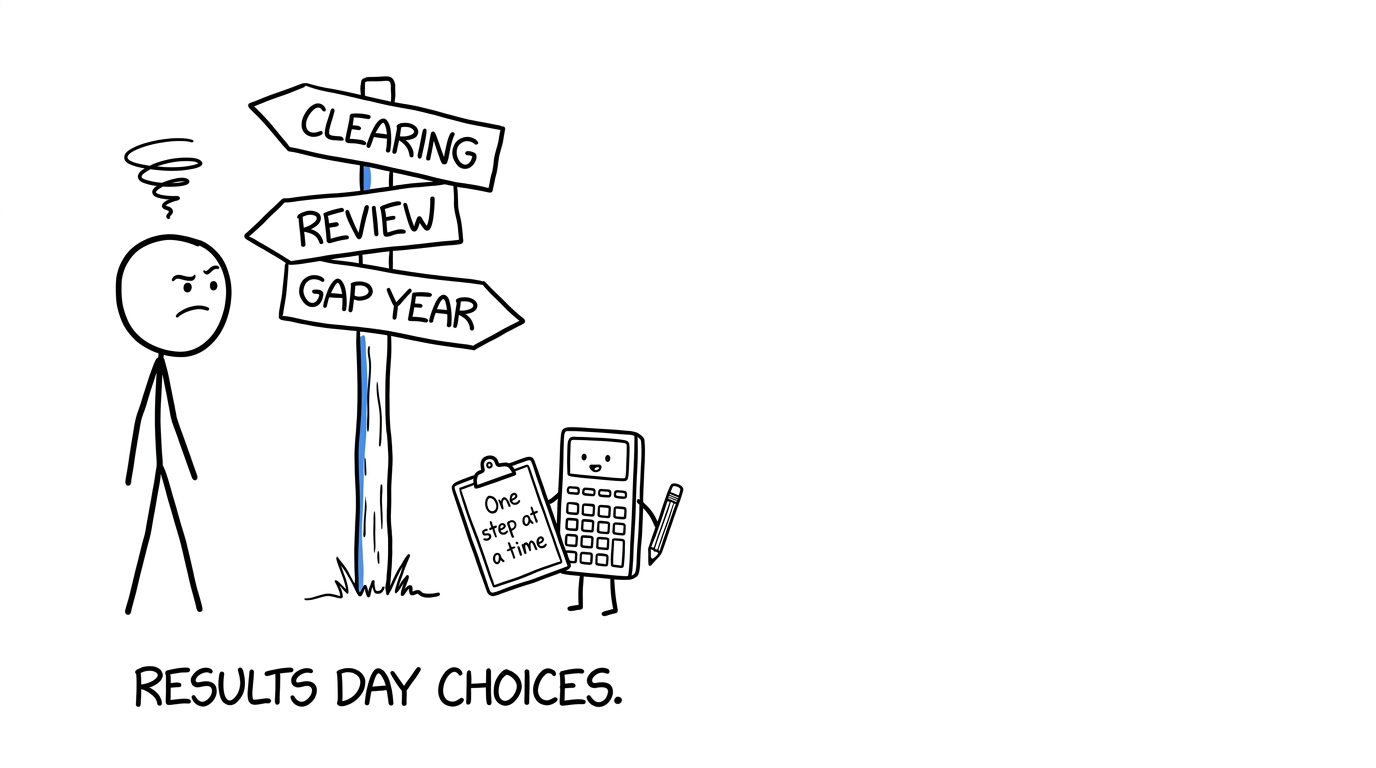 A student choosing between Clearing, a review and a gap year
Check what UCAS actually says
A lower grade does not tell you, by itself, whether you have a university place. The decision shown in your UCAS application matters more.
Your firm choice is confirmed
The university has accepted you. This can happen even if you narrowly missed the published offer, because universities consider their available places and the complete application.
You do not need to telephone admissions to persuade them again. Check the course details, accommodation messages and instructions from the university.
Your insurance choice is confirmed
If your firm choice is unsuccessful but your insurance choice is confirmed, you have a place at your insurance university. That is precisely what the insurance choice was designed to provide.
Think carefully before rejecting it. UCAS does not let you simply swap your firm and insurance choices. If you decline a confirmed place, you normally enter Clearing, and there is no guarantee that the same place will remain available.
Your application is pending
A pending decision is not a rejection. The university may still be reviewing your results or waiting for information. Read any messages and contact admissions for clarification rather than making assumptions.
Neither choice accepted you
This is the moment to explore Clearing. It may feel like a door closing, but Clearing is better understood as a live list of different doors that are still open.
Contact the university after a near miss
If the UCAS Hub shows that your application is pending, telephone the relevant admissions team. Have these details ready:
- your UCAS personal ID;
- your achieved grades;
- the course title and code;
- any information the university requested;
- a pen and paper for recording the response.
Be concise and polite. Ask whether your application is still under consideration and whether a related course or foundation year is available. Avoid repeatedly calling if you have already received a clear decision.
Universities control their own admissions decisions. Your school cannot overturn a rejection, but a teacher or careers adviser can help you understand the alternatives before you commit to one.
Use Clearing without treating it as a panic sale
Clearing allows eligible applicants to apply for courses with vacancies. If you missed both your firm and insurance offers, your UCAS application should indicate that you can use it.
Search by subject rather than chasing the first familiar university name. Compare:
- course modules and assessment methods;
- entry requirements;
- location, travel and accommodation;
- professional accreditation where relevant;
- foundation-year options;
- whether you would genuinely be willing to study there.
Contact the university before adding a Clearing choice. Prepare a short explanation of why the course interests you, and keep your results and UCAS ID nearby. An informal or verbal offer is not the final application step: follow the university's instructions and add the choice through UCAS when permitted.
Clearing rewards preparation, not blind speed. Acting promptly helps, but accepting an unsuitable course merely to make the uncertainty disappear can create a larger problem later.
 A remarkably organised results-day backup plan
Request a review if a mark appears wrong
What students often call a remark is officially a review of marking. It is not a request for extra marks because you were close to a boundary. The exam board checks whether the original marking applied the mark scheme correctly.
Speak to your school's exams officer immediately if:
- the result is significantly different from your consistent performance;
- a teacher believes the marking may contain an error;
- one component is unexpectedly low;
- a university place depends on the outcome.
Your school or college can request access to a script to help decide whether a review is sensible. For most candidates, the centre submits the request and needs your consent. A fee may apply.
Crucially, a reviewed mark can rise, remain unchanged or fall. Your resulting grade can therefore also go up, stay the same or go down. Discuss that risk with a teacher who understands the subject and mark scheme.
For the June 2026 series, the JCQ deadline for a priority A-level review of marking is 20 August 2026. This faster service is intended for cases involving a higher education place. Tell the university immediately that a priority review is being requested and ask how long it can keep the place open. Continue researching Clearing because a review does not guarantee a changed grade.
Exam boards including Edexcel, AQA, OCR and Eduqas follow regulated post-results processes, although fees and submission arrangements can differ. A formal appeal normally follows a review and concerns a remaining marking or procedural error. It is not the first step, and grade boundaries themselves cannot be appealed.
Consider a gap year, resits or a different route
A gap year is not automatically lost time. It becomes valuable when it has a purpose: improving grades, gaining relevant experience, earning money or reconsidering the course itself.
If you resit A-level Maths, begin with evidence rather than a vague promise to work harder. Use the Edexcel A-level Maths revision hub or the OCR A-level Maths revision resources, identify weak topics and build a routine around practice and feedback.
Use Edexcel A-level Maths past papers to diagnose where marks were lost. Then return to topic questions, mark schemes and video solutions before attempting another paper. Near the next examination series, Edexcel A-level predicted papers can add focused timed practice.
Also investigate foundation years, apprenticeships, employment and deferred entry. The best alternative is not necessarily the one closest to your original plan. It is the one that still leads somewhere you want to go.
What GCSE students can learn now
If you are currently preparing for GCSEs, UCAS Clearing is not your immediate process. However, results-day habits begin earlier: know the requirements for your sixth form or college, keep contact details ready and speak to the institution if you miss a condition.
More importantly, use feedback before results become final. Start with the GCSE Maths revision hub, choose the correct exam board and foundation or higher tier, and turn dropped marks into specific topics to repair. GCSE predicted papers and a realistic one-month GCSE maths revision plan can make that process measurable.
Common mistakes after missing an offer
Assuming a missed grade means automatic rejection
Always check UCAS. A university may have accepted you despite the lower grade or offered an alternative course.
Declining a confirmed place too quickly
Once surrendered, a place may not be recoverable. Discuss the decision and investigate alternatives first.
Waiting for a marking review before exploring Clearing
Run both options in parallel. A review can remain unchanged, while suitable vacancies may fill.
Treating every near-boundary result as an error
Being close to the next grade is not evidence of incorrect marking. Ask a teacher to assess the script and the realistic risk.
Choosing any available course to end the anxiety
Course content, location and long-term fit still matter. Clearing changes the timetable, not the importance of the decision.
Your next step is smaller than it feels
Results day is a decision point, not a verdict on your ability. Check your status, gather reliable information and take one action at a time. A firm place, insurance place, Clearing course, review of marking, foundation year or planned resit can each become a credible route forward.
If another examination attempt is part of that route, return to MathsGenie's free GCSE and A-level revision resources. Use revision lessons to rebuild understanding, practice questions and mini tests to develop accuracy, then past papers, predicted papers, mark schemes and video solutions to prepare for the real examination. The plan may have changed. Your ability to make progress has not.











