A-Level Results Day Myths: What Really Happens
A-level results day myths, clearly debunked. Learn the facts about grade boundaries, Clearing, reviews of marking and appeals before results day 2026.
Results day has a strange ability to turn uncertainty into certainty. A rumour heard in a corridor becomes a rule; one disappointing mock becomes a prediction of the future. Yet many A-level results day myths confuse what feels possible with what actually happens.
The short answer is reassuring: grade boundaries are not fixed in advance, missing an offer does not automatically mean losing your place, Clearing is not a mark of failure, and an appeal is not an instant second opinion. For GCSE students and parents looking ahead, understanding these facts now makes future results days far less mysterious.
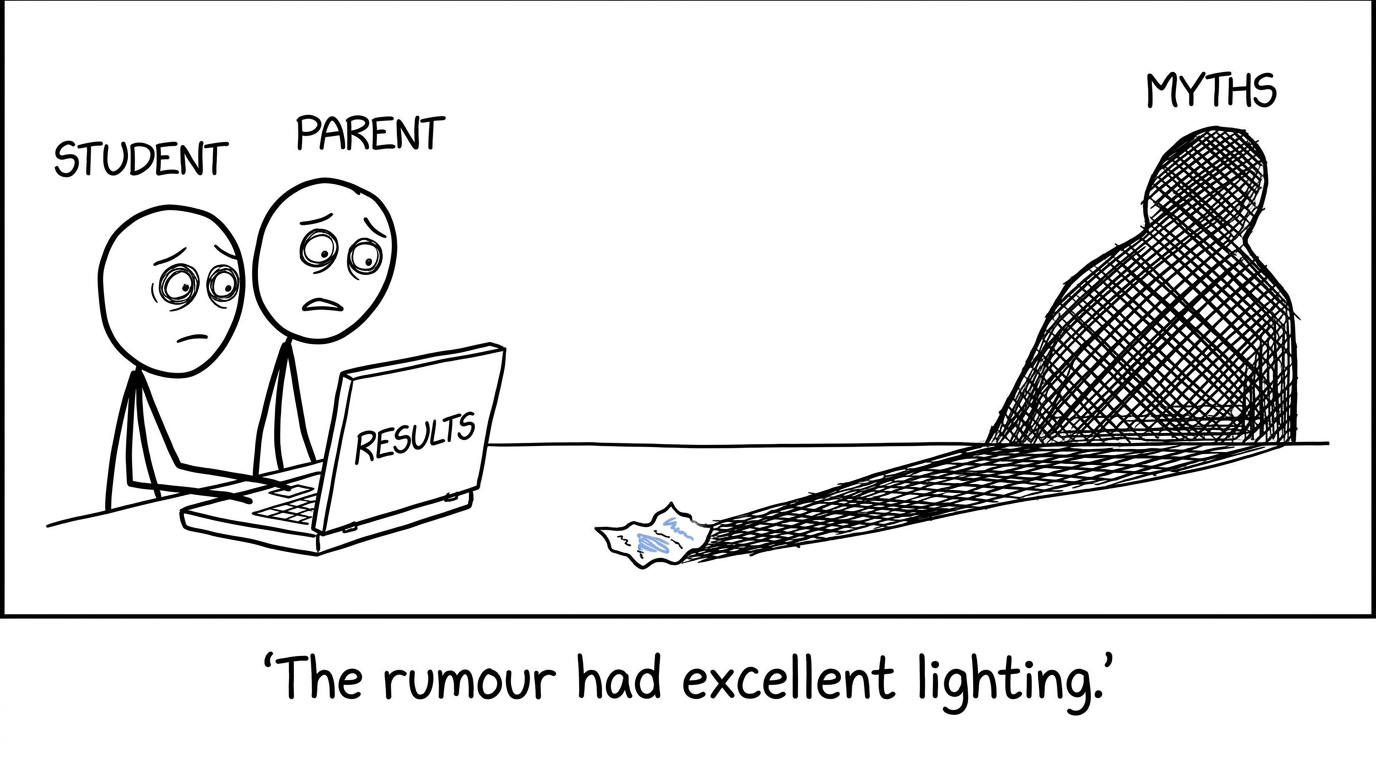 A student discovers that results-day rumours look larger than they are
Results day facts at a glance
For students receiving A-level results in England, Wales and Northern Ireland in 2026:
- Results day is Thursday 13 August 2026.
- Schools and colleges can release results from 8.00am, although local arrangements vary.
- UCAS Hub shows the status of a university application, not the individual exam grades.
- Clearing runs from 2 July to 19 October 2026.
- A Clearing choice can be added from 1.00pm on A-level results day.
- Questions about marking normally begin with the school or college, not with a direct appeal.
Keep your school’s contact details, UCAS login and offer information together. Calm preparation is more useful than repeatedly refreshing a screen.
Myth: Grade boundaries are decided before the exams
Fact: Boundaries are set after the papers have been taken
Exam boards including AQA, Edexcel, OCR and Eduqas set boundaries once marking is nearly complete. Senior examiners consider the difficulty of the assessment and evidence from students’ work. This allows standards to remain comparable when one paper is easier or harder than another.
A boundary is simply the minimum mark needed for a particular grade. It is not a target secretly chosen months earlier, and it can change between exam series. Previous boundaries may help with revision planning, but they cannot predict the next set exactly.
This principle also matters at GCSE, across foundation and higher tier. MathsGenie’s grade boundaries explainer lets students compare verified boundaries by qualification, board and year. The guide to GCSE maths marks per grade explains why historical thresholds should be treated as context rather than promises.
Myth: Missing an offer by one grade means automatic rejection
Fact: Check UCAS Hub before assuming anything
Universities receive results and decide whether to confirm conditional places. An applicant who narrowly misses the published conditions may still be accepted, but this is never guaranteed. Course capacity, the full application and the university’s decision all matter.
UCAS Hub may therefore show a confirmed place even when the grades do not exactly match the original offer. Equally, meeting the headline grades does not replace any other conditions attached to an offer.
The sensible sequence is simple: collect the actual grades, check UCAS Hub, read any messages, and then speak to the school or university if the position is unclear. The loudest A-level results misconception is often the belief that you already know the decision before checking.
Myth: Clearing only contains unwanted courses
Fact: Clearing lists courses that still have vacancies
Clearing is an official UCAS route for applicants who do not hold a place and for some students reconsidering their choices. A vacancy may exist for many reasons. Its presence does not reveal the quality of the course or the students applying to it.
Students should research course content, location, accommodation, costs and entry requirements rather than accepting the first available option. Contact the university, discuss the course and obtain permission before adding a Clearing choice in UCAS Hub. On 13 August 2026, choices can be added from 1.00pm, so the morning offers time to compare rather than panic.
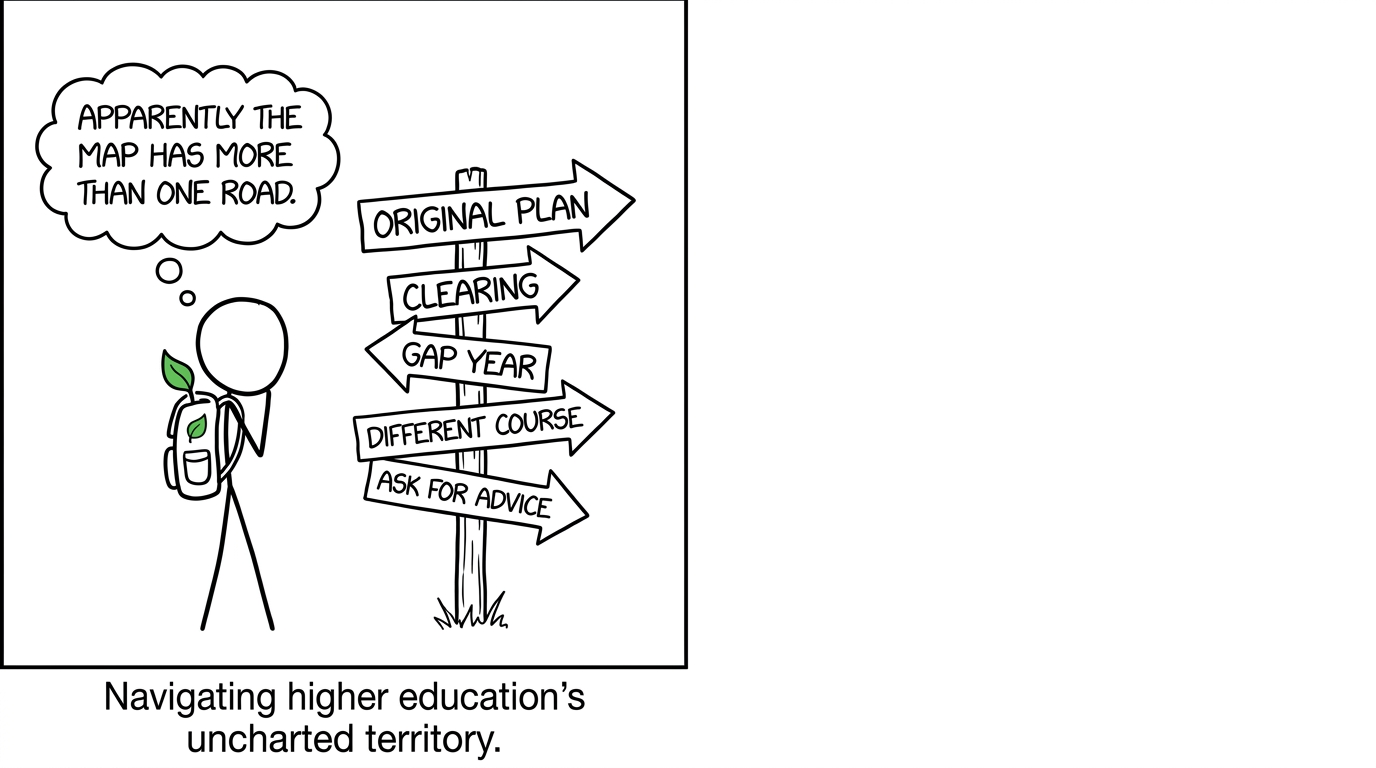 A student notices that the route after results day has several possible roads
Clearing is a route, not a judgement. A different course, a different institution, an apprenticeship, resits or a planned gap year may each be sensible depending on the student.
Myth: A remark gives the paper a fresh mark from scratch
Fact: The usual first step is a review of marking
Students normally speak to their school or college, which can request access to a script or a post-results service from the exam board. A clerical re-check looks for administrative issues such as missed questions or incorrect totals. A review of marking checks whether the mark scheme was applied correctly.
The mark can rise, stay the same or fall, so informed consent is required. Being close to a boundary does not itself earn extra marks, and a predicted grade does not create entitlement to a higher result.
For 2026, the JCQ deadline for a priority review of marking where a higher education place depends on the outcome is 20 August. Schools should check the current board rules, fees and deadlines immediately because circumstances vary.
Myth: An appeal is the same as requesting a remark
Fact: An appeal usually follows the review process
An appeal is a later challenge where eligible concerns remain after a review, such as an unresolved marking error or a procedural problem. It is not a way to argue that a boundary feels unfair. Ofqual states that the setting of a grade boundary cannot itself be appealed.
Private candidates may have different routes for making requests, so they should contact their exam board or the centre that entered them. In every case, prompt advice matters more than guesswork.
Common mistakes on results day
- Looking only at UCAS Hub and expecting it to display individual grades.
- Assuming a missed offer means rejection before checking the application status.
- Treating last year’s grade boundaries as this year’s thresholds.
- Calling a review of marking an appeal and missing the correct first step.
- Requesting a review without understanding that marks can decrease.
- Adding a Clearing choice before researching the course and receiving permission.
- Waiting several days before telling a university that a priority review is being considered.
Parents can help by slowing the sequence down: read first, confirm facts, write down names and deadlines, then decide.
Prepare for the result by improving the process
Results day is important, but it is the final line of a much longer page. GCSE students can make that future morning easier by building reliable habits now. Start with the GCSE maths revision hub, identify weak topics, and use GCSE past papers with their mark schemes rather than judging progress by feeling alone.
Nearer the exams, MathsGenie’s predicted papers and mini tests can reveal small gaps while there is still time to correct them. Students progressing to A-level maths can later use the A-level maths revision resources and A-level past papers with mark schemes to develop the same disciplined routine.
The best response to results-day mythology is not blind optimism. It is accurate information and a plan. Begin with MathsGenie’s grade boundaries explainer, then turn today’s uncertainty into useful revision through free lessons, practice questions, video solutions, past papers and predicted papers.