

A-Level Results Day for Parents: How to Help
A-level results day for parents explained: prepare for UCAS, Clearing and results collection while supporting your child calmly through every outcome in 2026.
A-Level results morning can make an entire household feel as though it is waiting for one envelope or one screen to decide the future. It does not. For anyone searching for guidance on A-level results day for parents, the useful answer is simple: prepare the practical details, let your child lead, and remember that every possible result has a next step.
In 2026, A-Level, AS and T Level results day in England, Wales and Northern Ireland is Thursday 13 August. Collection arrangements vary between schools and colleges, so check the centre's instructions rather than assuming a time or method. Supporting your child through A-Level results is less about finding perfect words and more about bringing calm to a morning full of uncertainty.
A quick results day checklist
Before the day, help your child confirm:
- how and when their school or college will release results
- that they can sign in to their UCAS Hub account
- their UCAS Personal ID and relevant university contact details
- the conditions of their firm and insurance offers
- whether they want you nearby when they open their results
- a charged phone, charger, pen, paper and somewhere quiet to make calls
- one or two realistic alternative courses or routes
Preparation should feel like a safety net, not a prediction that something will go wrong. The same principle helps younger students approaching GCSEs: a clear Maths Genie revision planner turns an uncertain goal into manageable next actions.
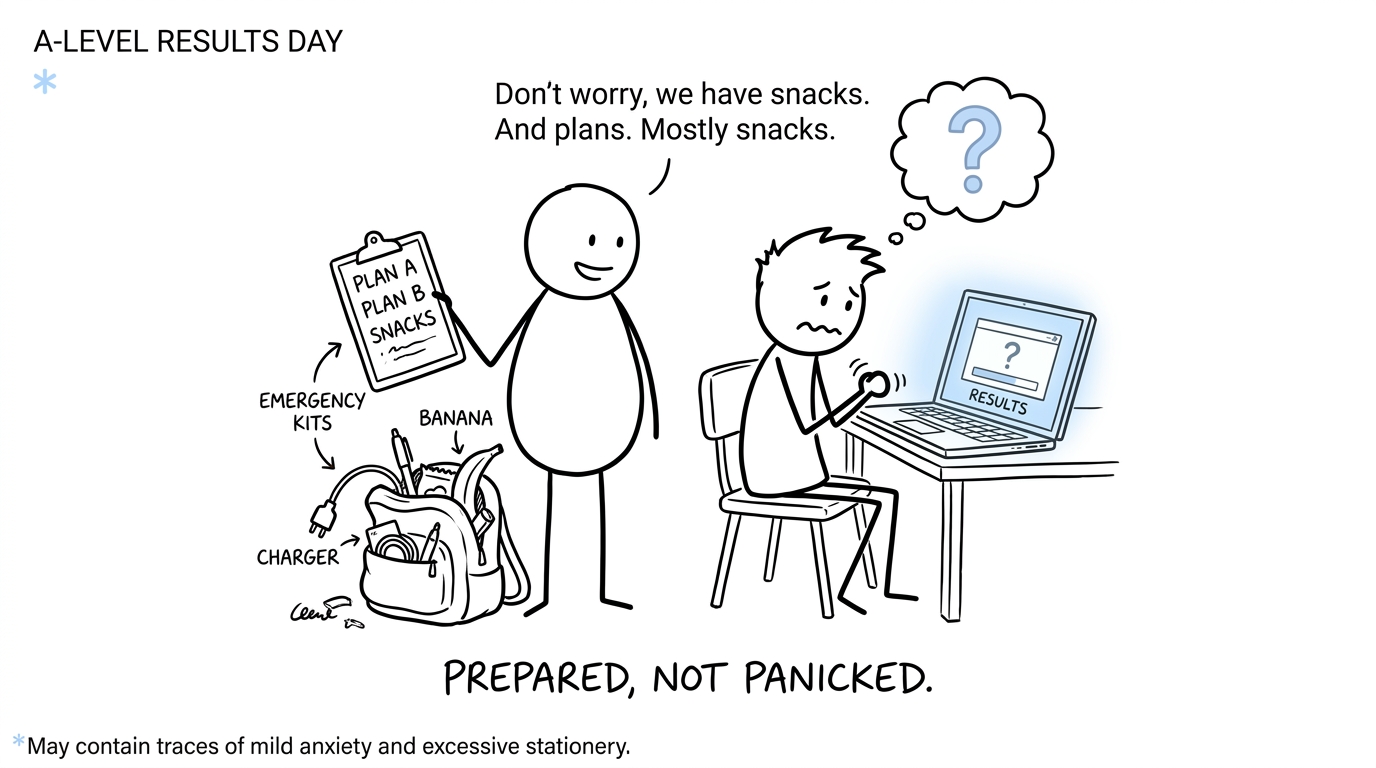 A parent prepared for results day with plans, snacks and an emergency banana
What happens on A-Level results day?
Two processes happen alongside each other. The school or college gives your child their grades, while UCAS Hub shows what has happened to their university application. UCAS does not act as the student's results slip: it normally shows whether a place has been confirmed, not the grades themselves.
The main outcomes are:
- Firm place confirmed: the university has accepted the student.
- Insurance place confirmed: the firm choice has not been confirmed, but the insurance choice has.
- Decision pending: the university may still be considering the application or need more information.
- No place confirmed: the student can investigate Clearing, alternative study, apprenticeships, employment or a planned resit.
A student who narrowly misses an offer should not assume the answer is no before checking UCAS and contacting the university if advised to do so. Universities make their own admissions decisions and may sometimes confirm places despite missed offer conditions.
Students who have completed A-Level Maths revision with Maths Genie's A-Level Maths resources can also return to their school for subject-specific advice if a result seems unexpected.
Understanding UCAS and Clearing
Clearing is the UCAS process through which applicants can look for courses that still have places. For the 2026 cycle, it runs from 2 July to 19 October, although students receiving summer A-Level results commonly begin using it on results day if they are eligible.
Before adding a Clearing choice, the applicant should contact the university or college and receive permission to add that course. Only one Clearing choice can be added at a time. This is why a shortlist and careful notes are more useful than calling institutions at random.
Universities normally need to speak to the applicant. UCAS also cannot discuss application details with a parent unless the student has arranged nominated access. Even then, the best role for a parent is usually supportive rather than directive.
How parents can help with Clearing
- Keep a record of course names, codes, telephone numbers and offer deadlines.
- Help compare course content, location, accommodation and costs.
- Encourage your child to ask how long any offer remains available.
- Provide food, water and a quiet place between calls.
- Let your child speak and make the final decision.
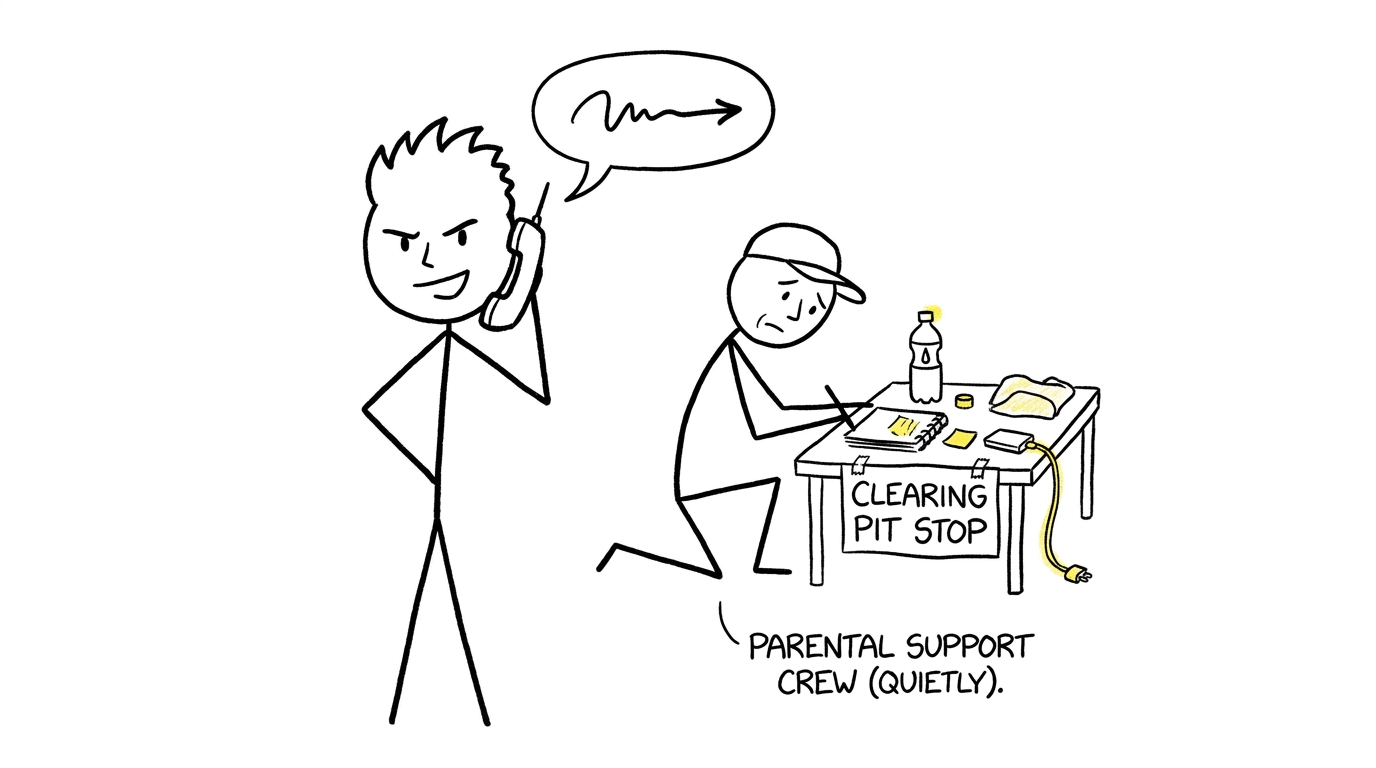 A student leads a Clearing call while a parent works as the calm pit crew
Supporting your child emotionally
Results can arrive in seconds, but feelings rarely organise themselves so quickly. A child may be delighted, disappointed, numb or uncertain about a result that appears excellent to everyone else.
Listen before solving. A useful opening is: “Would you like me to listen, help you explore options, or give you some space?” That returns a little control to the person whose future is being discussed.
Avoid immediate comparisons with classmates, siblings or the grades you achieved. Results are information about examinations taken at a particular time. They are not a complete judgement of ability, effort or future potential.
If your child becomes overwhelmed, pause before making major decisions. Encourage them to eat, drink and speak with a trusted teacher, careers adviser or pastoral lead. Where distress is serious or persistent, seek appropriate professional support rather than treating it as an ordinary results-day wobble.
Results day dos and don'ts for parents
Do
- agree beforehand how involved your child wants you to be
- stay calm even when the UCAS page is slow or unclear
- recognise the work behind the grades, not just the outcome
- use teachers and careers staff who understand the available routes
- write down information during calls so your child can concentrate
- celebrate effort and progress whatever happens next
Don't
- open results or share them without permission
- call universities pretending to be the applicant
- pressure your child into accepting the first available course
- assume a missed offer means university is no longer possible
- demand an immediate post-mortem on every examination
- turn another student's grades into a benchmark
If a grade looks wrong
Start with the school or college. Staff can explain marks, grade boundaries and the available post-results services. Depending on the circumstances and exam board, options may include an administrative check, access to a script or a review of marking.
These processes have deadlines and may involve fees. Marks and grades can potentially stay the same, rise or fall, so the centre should explain the implications and obtain the required consent. If a university place depends on the outcome, tell the school and university promptly because priority arrangements may apply.
Students considering another attempt can rebuild method and confidence with A-Level Maths past papers, A-Level predicted papers and topic-by-topic revision. Younger students can prepare earlier through the GCSE Maths revision hub, GCSE revision resources and mini tests and a realistic one-month maths revision plan.
A calm plan for whatever comes next
Results day matters, but it is a junction rather than a verdict. A confirmed place creates one route. Clearing, an apprenticeship, employment, a different course, a gap year or resits create others. The parent's task is not to choose the road from the passenger seat. It is to help the young person read the signs clearly.
Begin that support before results day. Use the free Maths Genie revision planner to organise revision lessons, practice questions, mini tests, mark schemes, video solutions, past papers and predicted papers. Good preparation cannot control every result, but it can make both examinations and the decisions afterwards feel far more manageable.











