

A-Level Results Day Checklist for 2026
A-level results day checklist for 2026: prepare UCAS details, Clearing options, result reviews and a calm plan for every outcome with confidence.
Results day compresses two years of work into a few letters on a screen or sheet of paper. That is why the waiting can feel harder than the exams themselves. Yet the most useful truth is simple: you do not need to predict your results. You need a plan for each possible outcome.
This A-level results day checklist covers the practical details, UCAS decisions, Clearing, post-results services and emotional preparation. For students receiving results in England, Wales and Northern Ireland, A-level results day in 2026 is Thursday 13 August. Your school or college will confirm when and how you can collect your grades.
Your results day checklist at a glance
Before results day, make sure you can tick off the following:
- Confirm how and when your school or college releases results.
- Test your UCAS sign-in details and update your contact information.
- Save your UCAS Personal ID and relevant university telephone numbers.
- Write down your firm and insurance offer conditions.
- Research a small number of realistic Clearing alternatives.
- Keep identification, a charged phone, charger, pen and notes ready.
- Decide who you want nearby for support.
- Keep the full morning free so you can make decisions without rushing.
- Know how to contact your school’s exams officer or sixth-form team.
- Plan something quiet for afterwards, whatever the outcome.
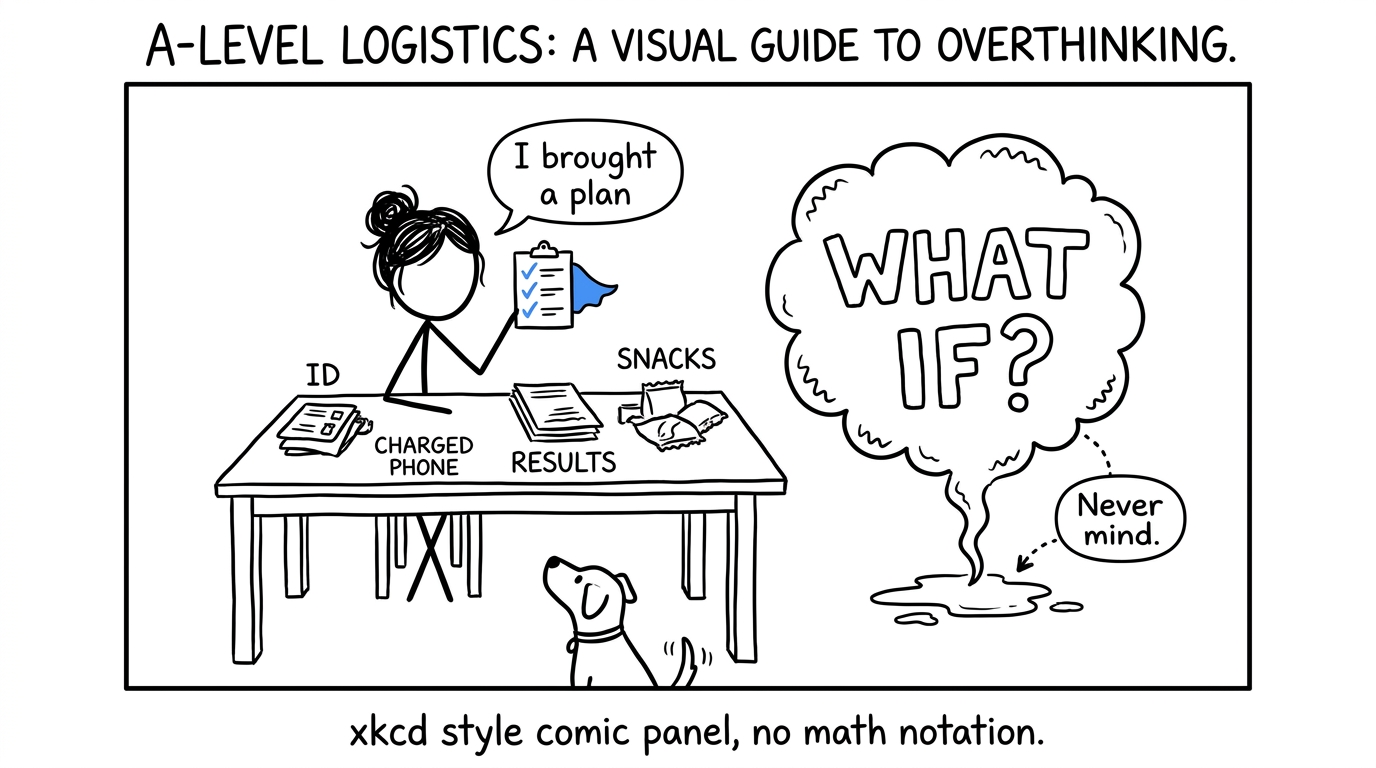 A prepared student watches a giant what-if cloud deflate beside an organised results day checklist
A-level results day preparation before the morning
Check the collection arrangements
Schools and colleges do not all release results in the same way. Some ask students to collect an envelope in person; others use a secure online portal. Confirm the opening time, location and identification requirements directly with your centre.
Do not assume that a friend’s arrangements apply to you. If you cannot attend, ask in advance whether someone may collect results for you or whether they can be released electronically.
Prepare your UCAS information
Sign in to your UCAS application before results day to make sure your password works. Check that your email address and telephone number are current, then save these details somewhere secure:
- UCAS Personal ID
- firm and insurance university choices
- course names and codes
- offer conditions
- university admissions telephone numbers
- GCSE and A-level qualification details
Most relevant results are sent to UCAS by awarding organisations and matched to applications, but not every qualification is transmitted automatically. Check whether you may need to send evidence directly to a university.
UCAS normally needs to speak to you about your application. If you want a parent, carer or another trusted person to act for you, arrange nominated access beforehand.
Research without assuming the worst
Preparing for Clearing does not mean you expect to miss your grades. It means you are protecting your ability to think clearly.
Create a shortlist of courses you would genuinely consider. Look beyond the course title: compare modules, location, accommodation, travel costs and professional accreditation where relevant. Clearing for 2026 runs from July into October, but vacancies change quickly and availability is never guaranteed.
The same principle that helps with maths revision helps here: preparation reduces the number of decisions you must make under pressure. MathsGenie’s free revision planner is useful throughout Year 13 because it turns a large, uncertain goal into manageable actions.
What to do on A-level results day
Check UCAS and collect your grades
Your UCAS application may show whether your place has been confirmed, but it does not replace your official results. Collect or download your grades as instructed by your school or college.
Then compare your UCAS status with your results:
- Firm place confirmed: follow the university’s instructions and check your email carefully.
- Insurance place confirmed: review the course, accommodation and next steps before acting.
- Decision pending: contact the university if it requests information, then give it time to make its decision.
- In Clearing: search for suitable vacancies and contact universities before adding a choice.
- Grades higher than expected: you can keep your confirmed place or explore alternatives, but do not surrender a place impulsively.
A result below the published offer does not always mean rejection. A university may still accept you, offer an alternative course or keep the decision pending. Read the actual status rather than guessing from the grades alone.
Make Clearing calls calmly
If you enter Clearing, prepare to speak for yourself. Have your Personal ID, Clearing number, grades, course code and a few brief reasons for choosing the course in front of you.
Take notes during every conversation, including the name of the person you spoke to and any deadline given. Contact the university before adding a Clearing choice, and only add it after receiving permission. You can add only one Clearing choice at a time, so make sure you understand what is being offered.
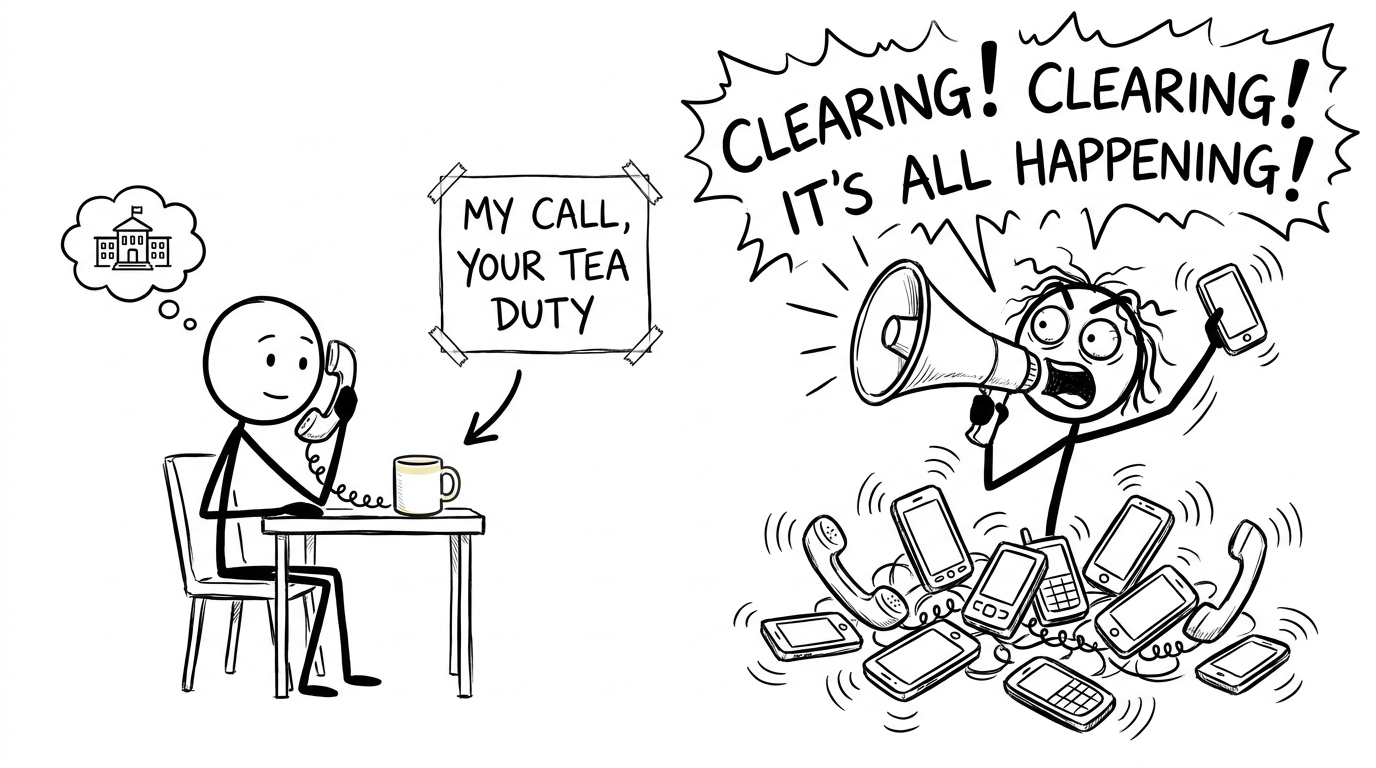 A student makes a calm Clearing call while an enthusiastic parent is assigned tea duty
If you think a result may be wrong
Speak to your teacher or exams officer as soon as possible. They can discuss the grade boundary, review your marks and explain whether accessing the script or requesting a review of marking is sensible.
For the June 2026 series, requests for priority reviews of marking must reach the awarding body by 20 August 2026 when progression to higher education is at stake. The standard deadline for reviews of results is 24 September 2026. Your centre may impose an earlier internal deadline so that it has time to process the request.
A review is not simply a request for extra marks. The marking is checked against the mark scheme, and the mark can increase, decrease or remain unchanged. Your written consent is normally required, and fees may apply. If a university place depends on the outcome, tell both your school and university promptly.
Prepare emotionally as well as practically
Results can produce relief, disappointment and uncertainty in the same morning. Try not to compare envelopes or screenshots immediately. Someone else’s result does not explain your options, and their next step does not determine yours.
Choose one trusted person who can help you slow the moment down. Eat breakfast, charge your phone and avoid making permanent decisions in the first emotional rush. A different university, a gap year, an apprenticeship or a resit can still be a thoughtful route forward rather than a consolation prize.
Preparation during Year 13 also matters. Students taking A-level maths can use the A-level maths revision hub, while Edexcel students can work through the Edexcel A-level revision resources. Timed Edexcel A-level past papers, topic practice, mark schemes and video solutions make the final grade feel less mysterious.
Common results day mistakes
- Forgetting passwords: test UCAS and school portal access before the morning.
- Treating UCAS as a results slip: collect your official grades as well as checking your application status.
- Calling without notes: keep course codes, grades and questions in front of you.
- Letting someone else make the call: universities generally need to speak to the applicant.
- Adding a Clearing choice too early: speak to the university and obtain permission first.
- Declining a confirmed place impulsively: this can cancel the place, so take advice before acting.
- Waiting to discuss a questionable mark: priority post-results deadlines are short.
- Assuming one disappointing grade closes every route: ask your school, university and careers adviser about the full range of options.
Turn uncertainty into a plan
A good checklist cannot control the grades. It can control what happens next: the passwords you remember, the calls you are ready to make and the pause you take before a major decision.
Until results day arrives, keep your attention on the part you can still influence. Use MathsGenie’s A-level predicted papers, free revision lessons, practice questions, mini tests, past papers, mark schemes and video solutions. If you are moving up from GCSE, the GCSE to A-level curriculum guide can help you understand the transition.
Start with the MathsGenie revision planner, schedule your next focused session and let preparation do what worry cannot: give you a clear next step.











