

A-Level Resits Explained: When and How to Resit
A-level resits explained clearly: learn when exams run, how to register, where private candidates sit, what to check and how to revise with confidence.
A disappointing result can make the future feel suddenly smaller. Yet an A Level grade is not a locked door. It is one assessment outcome, and you can take the qualification again.
This guide has A-level resits explained clearly: most current A Levels are linear, so you normally resit all written papers for the subject during the main summer exam series. Your school or college may enter you, or you can register through an approved exam centre as a private candidate. Start early because centres set their own deadlines, fees and acceptance rules.
If you are currently preparing for GCSEs, understanding the process now is useful. The same habits that help with grades 999-111, checking the specification, practising questions and learning from mark schemes, become even more important at A Level.
A-Level resit checklist
Before committing to a resit, confirm:
- the subject and exam board, such as Edexcel, AQA, OCR or Eduqas
- whether your former school or college will enter you
- which approved exam centres accept private candidates
- the qualification and entry codes
- whether the subject includes non-exam assessment or a practical endorsement
- the centre's registration deadline and full fee
- whether you need access arrangements
- how the resit will affect a university, apprenticeship or employment application
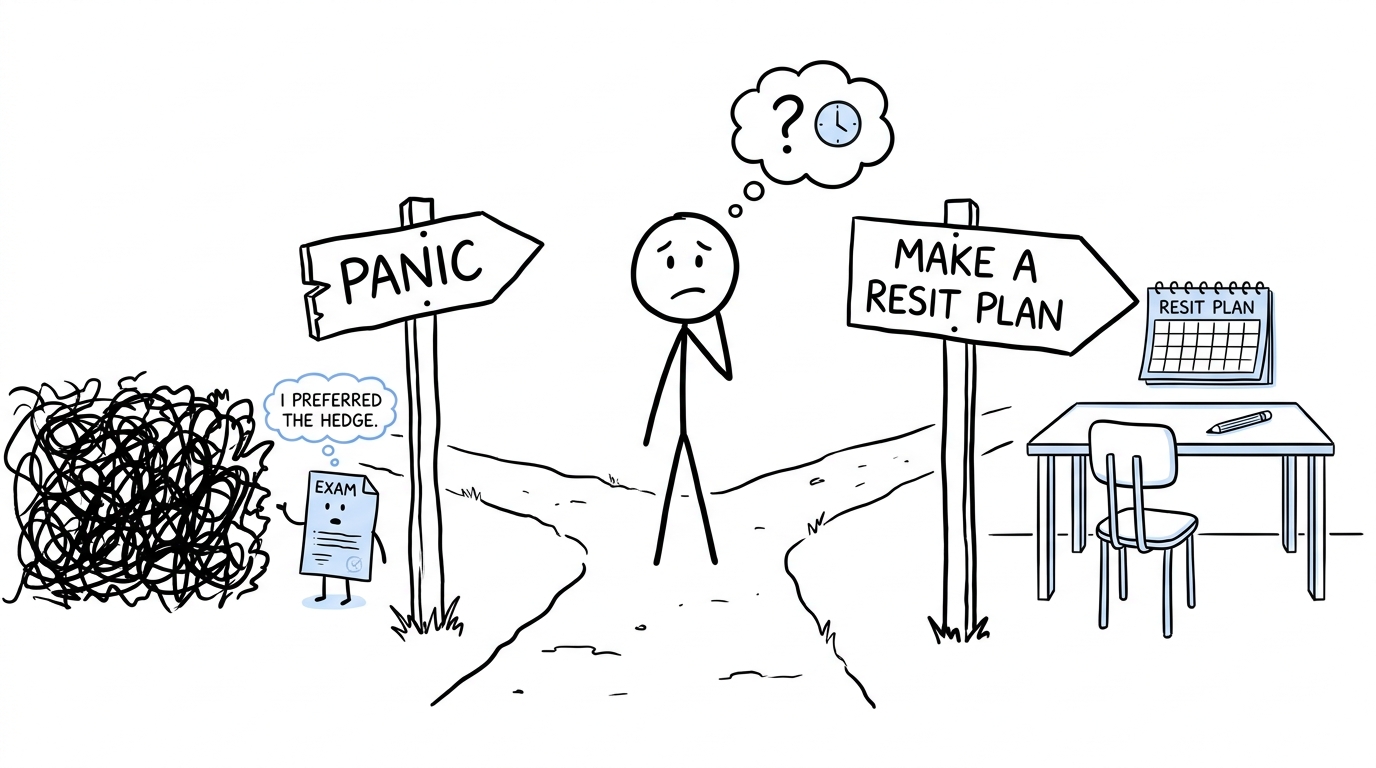 A student chooses between panic and making a calm resit plan
When can you resit A-Level exams?
For the reformed A Levels used in England, written examinations are generally available in the main May and June summer series. Unlike GCSE English language and maths, A Levels do not normally have a November resit window. In many subjects, missing the summer series means waiting until the following year.
Exact dates change annually and vary by subject and exam board. Check the current official timetable through your centre and remain available for the full examination period, including the published contingency day.
Registration happens much earlier than the examinations. Awarding organisations publish entry deadlines, but schools and private centres usually impose earlier internal deadlines so that they can check documents and process entries. Contact centres during the autumn if possible rather than assuming you can book shortly before the exam.
If you have only just received your result, first discuss whether a clerical check, access to the script or review of marking is appropriate. These services have strict deadlines and are different from resitting the qualification.
How to resit A-Level exams
Ask your former school or college
Your simplest option may be to return to the centre where you originally sat the qualification. It already holds information such as your Unique Candidate Identifier and may know your access arrangements or non-exam assessment history.
However, a school is not required to accept former students. Ask whether it accepts resit candidates, offers your subject and exam board, and can manage any coursework or practical requirements.
Find an approved private-candidate centre
If your previous centre cannot help, you need an approved school, college or examination centre that accepts private candidates. The current JCQ private-candidate search service can help you identify possibilities, but you must contact each centre directly.
Ask the centre to confirm:
- that it offers your exact specification
- whether it handles non-exam assessment
- what identification and previous results it needs
- the complete cost, including administration and late fees
- how results and certificates will be provided
Fees are not nationally fixed. They depend on the subject, awarding organisation and centre, so obtain a written quotation rather than relying on an online average.
Complete and check your entry
A centre may ask for photographic identification, contact details, previous certificates, your Unique Candidate Identifier and your Unique Learner Number if one has been issued. It will make the formal entry on your behalf.
When you receive your statement of entry, check your name, subject, specification, exam board and component details immediately. A small administrative error can become a large problem if it is noticed too late.
 An exam candidate remembers the pens but forgets the correct entry code
Do you resit every paper?
Current A Levels are linear qualifications. To improve the overall grade, you normally retake all examined components in the same series, not only the paper on which you performed least well.
The position can differ for non-exam assessment. In many subjects, an eligible NEA mark can be carried forward from the previous certificated attempt. Alternatively, you may be able to complete new work under the required supervision. The correct entry option matters, and a newly submitted mark may replace the previous one even if it is lower.
For A Level biology, chemistry, physics and geology, the practical skills endorsement is reported separately. A previous endorsement result can generally be carried forward, including between awarding organisations, but the centre must make the appropriate arrangements. Confirm the rules for your exact specification before paying.
Planning revision for a resit
A resit is most valuable when it changes the method, not merely the date. Begin by comparing your previous performance with the specification. Sort topics into secure, uncertain and weak areas, then give the weakest examinable skills the most attention.
For A Level maths, the Edexcel A Level Maths revision hub brings together lessons, question banks, worksheets, mini tests and revision tools. You can rebuild difficult areas with focused resources such as the Integration revision lesson and the Trigonometry and Modelling revision guide. OCR candidates can also use the specification-matched OCR Integration revision guide.
Move gradually from topic practice to complete papers. The Edexcel A Level Maths past papers include mark schemes and solutions, allowing you to identify whether lost marks came from knowledge, method, notation, accuracy or time management. Record those causes after every paper.
Resits and university applications
Check the published policy for each university and course before registering. Requirements can vary, particularly for competitive courses, and you should not assume that every admissions team treats resits identically.
When applying through UCAS, a previously completed qualification must be declared. If you are taking it again, the resit is also entered with the result pending. Arrange an academic reference and predicted grade where required, especially if you are revising independently.
Common A-Level resit mistakes
- Registering too late: centres may close entries before the awarding organisation's deadline.
- Choosing the wrong specification: the subject title alone does not confirm the exam board or entry code.
- Expecting to retake one paper: linear A Levels normally require every examined component.
- Ignoring NEA or practical arrangements: not every private centre can supervise or assess them.
- Repeating the old revision routine: more hours will not fix an approach that never diagnoses lost marks.
- Forgetting access arrangements: discuss support with the centre when registering, not just before the examination.
Turn the second attempt into a better process
A resit does not promise a higher grade. It offers something more useful: another attempt supported by better information. Register early, verify every detail and build revision around the marks you previously lost.
Start at MathsGenie and use the free revision lessons, practice questions, revision guides, past papers, predicted papers, mark schemes, video solutions and mini tests. A calm plan cannot change the first result, but it can make the next one far less dependent on hope.











