

A-Level Politics Grade: University Entry Guide
A-level politics grade university guide: compare typical UK entry offers, UCAS points and what each result may mean for politics degree choices in 2026.

A university offer can look like a verdict before it is properly understood. You see AAAAAAAAA, compare it with your predicted Politics grade, and assume the door is either open or closed. The reality is less dramatic and more useful. Your A-level politics grade university meaning depends on your complete grade combination, the course, contextual eligibility and any GCSE requirements. Politics is not normally assessed in isolation.
For 2026 entry, published examples range from A∗AAA^*AAA∗AA for highly selective Politics courses to tariff-based offers around 104104104 to 112112112 UCAS points. A strong Politics grade helps, but universities usually make an offer across three A Levels rather than demanding one particular Politics result.
Your quick university entry checklist
Before comparing courses, check:
- the complete A-level offer, such as AAAAAAAAA, AABAABAAB or BBBBBBBBB;
- whether Politics is required, preferred or simply accepted;
- GCSE English Language and maths requirements;
- contextual offer eligibility;
- whether the course uses grades or UCAS Tariff points;
- requirements for joint degrees such as Politics and Economics;
- the official course page for your intended entry year.
Requirements change, so treat the examples below as a map rather than a guarantee.
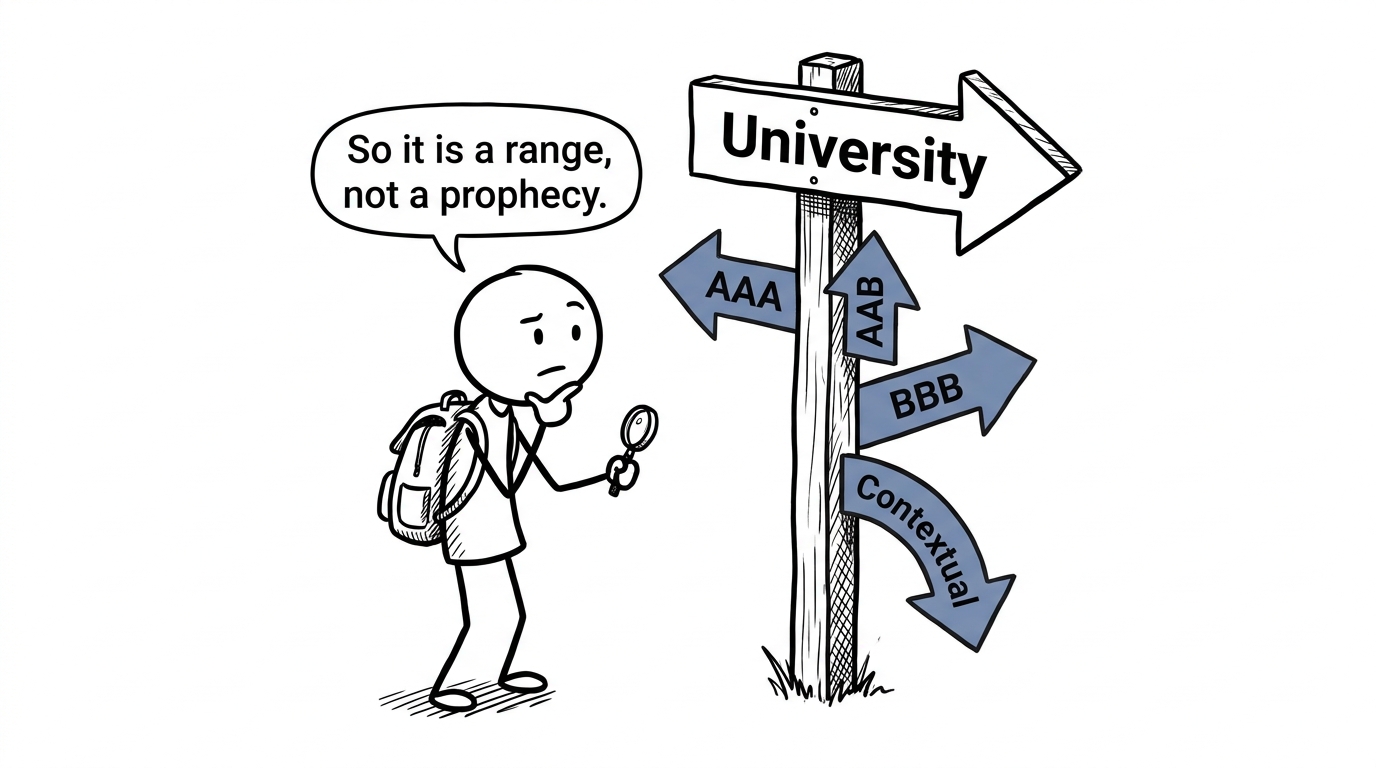 A student discovers that university grade requirements are a range rather than a prophecy
What does an A-Level Politics grade mean?
An A-level grade summarises your performance across the assessments specified by your exam board, whether you take AQA, Edexcel or another recognised specification. Universities then consider that grade alongside your other qualifications.
Politics develops relevant skills: constructing arguments, evaluating evidence, comparing institutions and writing clear conclusions. However, several universities offering Politics degrees do not require A-Level Politics. For 2026 entry, Leeds explicitly states that it does not require the subject, while courses at Exeter, Leicester, Warwick and York publish offers without making Politics compulsory.
That means the question is rarely, “Is my Politics grade high enough?” It is usually, “Does my complete profile meet the politics degree entry requirements?”
Grade-by-grade breakdown
UCAS assigns the following Tariff values to full A Levels. Not every university uses the Tariff, and a points total does not override a named subject or grade requirement.
| Politics grade | UCAS Tariff points | What it may mean |
|---|---|---|
| A∗A^*A∗ | 565656 | Strong preparation for highly selective offers |
| AAA | 484848 | Suitable for many courses asking for AAAAAAAAA to AABAABAAB, depending on other grades |
| BBB | 404040 | Compatible with many AABAABAAB, ABBABBABB and BBBBBBBBB combinations |
| CCC | 323232 | Can contribute to tariff offers and combinations such as BBCBBCBBC or BCCBCCBCC |
| DDD | 242424 | May suit lower-tariff courses, foundation years or alternative routes |
| EEE | 161616 | A passing grade, but direct-entry choices are likely to be more limited |
Grade A∗A^*A∗
An A∗A^*A∗ in Politics is an excellent result, but it does not automatically satisfy an A∗AAA^*AAA∗AA offer. The other two grades still matter. King’s College London, for example, publishes an A∗AAA^*AAA∗AA standard requirement for its Politics course for 2026 entry, with a lower contextual pathway for eligible applicants.
Use an A∗A^*A∗ to build a balanced list rather than applying only to the most selective courses.
Grade AAA
A grade AAA places you within range of many demanding courses. Published 2026 examples include AAAAAAAAA at Manchester and Warwick, while Exeter, Leeds and York list typical offers of AABAABAAB.
Your subject combination can matter. Manchester’s Politics and International Relations course includes Politics among a broad list of accepted subjects and also publishes GCSE English Language and maths requirements.
Grade BBB
A grade BBB keeps a wide range of options open. Loughborough lists ABBABBABB for Politics, Leicester lists BBBBBBBBB, and some universities publish contextual offers below their standard requirement.
A Politics grade of BBB could therefore sit comfortably inside ABBABBABB or BBBBBBBBB. It could also form part of an AABAABAAB application if your remaining grades are stronger. This is why one letter never tells the whole story.
Grade CCC
A grade CCC does not end the route to a Politics degree. Some providers use UCAS points rather than a fixed three-grade offer. Manchester Metropolitan University, for example, publishes a range of 104104104 to 112112112 points for its Politics degree, broadly corresponding to combinations such as BCCBCCBCC to BBCBBCBBC when all three qualifications are A Levels.
Check whether the university accepts your precise combination. Tariff totals are useful, but course-specific conditions come first.
Grades DDD and EEE
With a DDD or EEE, direct entry choices are narrower, particularly if your other results are similar. Your options may include a foundation year, a related course with lower requirements, Clearing, an alternative Level 3 route or retaking an A Level.
None of these routes should be chosen by panic. Compare course content, progression rules, costs and long-term fit before deciding.
Why GCSE maths can still matter
Politics is essay-based, but universities may retain baseline GCSE requirements. Some ask for grade 444 or above in maths, English Language, or either maths or a science. Joint courses involving Economics, data analysis or research methods may place more emphasis on numeracy.
If you are currently preparing for GCSEs, this is the quiet value of securing core grades now: they remove avoidable restrictions later. Use the GCSE Maths Revision hub to choose your board, including Edexcel, AQA, OCR or Eduqas, then organise weak topics with the MathsGenie revision planner.
 A university admissions machine considers grades, course fit and the wider application
Building a sensible university shortlist
Divide possible choices into three groups:
- Aspirational: your predicted grades are close to the standard offer.
- Realistic: your predictions meet or slightly exceed the requirement.
- Safer: the offer is below your predictions, while the course still suits you.
Also investigate contextual admissions. Exeter publishes a standard AABAABAAB offer and a contextual BBBBBBBBB offer for eligible applicants; Warwick publishes AAAAAAAAA and a contextual ABBABBABB. Eligibility rules differ, so never assume that attending a particular school or living in a particular postcode automatically qualifies you.
Common mistakes when interpreting entry requirements
Looking only at the Politics grade
Universities normally assess the full combination. A grade AAA in Politics cannot compensate automatically for every other result.
Treating UCAS points as universal
Some courses accept a tariff total; others insist on named grades. Always read the wording beside the offer.
Ignoring GCSE conditions
An applicant may meet the A-level offer but miss a required GCSE English Language or maths grade. Check these conditions early.
Assuming A-Level Politics is compulsory
Many Politics degrees welcome applicants from different academic backgrounds. History, English, Economics, Geography, Sociology, languages, maths and sciences can all contribute useful skills.
Using outdated requirements
Course requirements can change between application cycles. Confirm details directly for the year in which you intend to enrol.
Turn future choices into present action
A Politics grade is not a label for your potential. It is one part of a larger application and, more importantly, information you can act upon. Compare complete offers, ask about contextual admissions and keep a range of thoughtful choices.
For students still building their academic foundations, start with MathsGenie’s GCSE revision resources and mini tests, GCSE predicted papers and mark schemes. If A-Level Maths is part of your future combination, explore the GCSE-to-A-Level progression guide and A-Level Maths revision hub.
Use revision lessons to repair gaps, practice questions to build accuracy, and A-Level past papers with mark schemes to develop exam judgement. University plans become less intimidating when today’s next step is clear.











