

A-Level Physics Grade Boundaries: Results Day 2026
A-level physics grade boundaries explained for 2026 results day: when they appear, how marks become grades, and what to do if your result looks wrong.
Results day has a peculiar kind of tension. You can know how every paper felt, remember every calculation you questioned and still not know the number that matters. That is because A-level physics grade boundaries are not fixed before the exams. They are set after the papers have been marked, then published on A-level results day.
For summer 2026, A-level results are released from 8:00 am8{:}00\text{ am}8:00 am on Thursday 13 August. The official physics A-level grade boundaries 2026 will become public on results day, not reliably before it. Any earlier figures you see are predictions rather than confirmed boundaries.
 A student uses an imaginary boundary detector outside the results room
A-level physics results day checklist
When you receive your result:
- Check the qualification and exam board: AQA, Edexcel, OCR, Eduqas or WJEC.
- Find your overall grade and, if available, your total raw mark.
- Use the boundary table for the correct specification and exam series.
- Compare your total with the overall qualification boundary, not an isolated paper boundary.
- Check whether your Practical Endorsement is recorded separately.
- Speak to your school or college before requesting a review of marking.
- If a university place is involved, check your application status and contact the university promptly if necessary.
A boundary is simply the minimum mark required for a grade. If the A boundary is 153153153, then 153153153 earns an A; 152152152 does not.
How A-level physics grade boundaries are set
Exam boards cannot make every paper exactly equal in difficulty. A question involving an unfamiliar experimental arrangement may prove harder than expected. Another may give students a clearer route into the calculation than its writers anticipated.
Boundaries adjust for those differences. When a paper is harder, the relevant boundaries may be lower. When it is easier, they may be higher. A changing boundary does not mean the value of the grade has changed.
Once marking is nearly complete, exam boards consider statistical evidence and the quality of students' work around possible boundary marks. Senior examiners use that evidence to recommend the final boundaries. Ofqual oversees grading standards in England.
There is no fixed quota requiring a particular number of students to receive each grade. Boundaries are intended to maintain comparable standards, not to rank students until an allocated supply of A grades runs out.
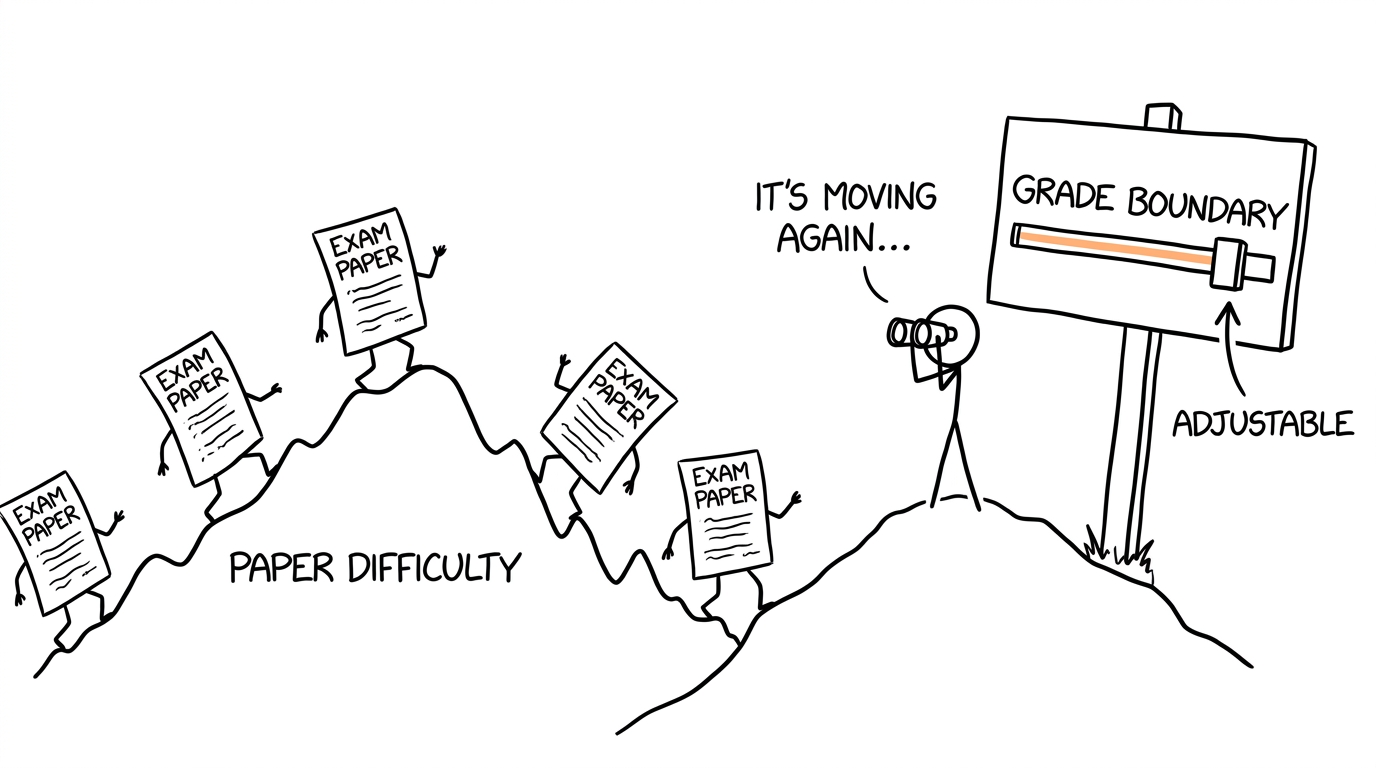 Exam papers cross a difficulty hill while the grade-boundary sign moves
Why physics boundaries vary by exam board
AQA, Edexcel and OCR do not use identical papers or total marks. Their specifications divide assessment differently:
| Example specification | Written papers | Maximum examined mark |
|---|---|---|
| AQA Physics 7408 | 85+85+8085+85+8085+85+80 | 250250250 |
| Edexcel Physics 9PH0 | 90+90+12090+90+12090+90+120 | 300300300 |
| OCR A Physics H556 | 100+100+70100+100+70100+100+70 | 270270270 |
This is why comparing raw marks across boards is misleading. A mark of 180180180 represents different proportions of each qualification:
180250=72%,180300=60%,180270≈66.7%.\frac{180}{250}=72\%,\qquad \frac{180}{300}=60\%,\qquad \frac{180}{270}\approx66.7\%.250180=72%,300180=60%,270180≈66.7%.Even percentages do not create a universal grade boundary. You must use the official table for your board, specification and year.
Physics is also highly mathematical. For example, AQA and Edexcel specifications require at least 40%40\%40% of the assessment to involve mathematical skills at Level 222 or above. Students moving towards A Level can strengthen that foundation through GCSE maths revision, while current A-level students can revisit mechanics through Edexcel A Level Maths revision.
Worked grade-boundary example
Suppose an AQA Physics student receives these hypothetical paper marks:
61+54+48=163.61+54+48=163.61+54+48=163.Imagine that the fictional overall boundaries are:
| Grade | Minimum total mark |
|---|---|
| A* | 190190190 |
| A | 158158158 |
| B | 132132132 |
| C | 106106106 |
The student's total of 163163163 is above the A boundary of 158158158 but below the A* boundary of 190190190. The awarded grade would therefore be an A.
The distance above the boundary is:
163−158=5 marks.163-158=5\text{ marks}.163−158=5 marks.These figures are deliberately illustrative. They are not predictions for 2026. The lesson is the method: add the relevant marks, locate the highest boundary reached and avoid judging the grade from one paper alone.
Does the Practical Endorsement affect the grade?
For the main reformed A-level physics specifications, the Practical Endorsement is reported separately from the A* to E qualification grade. Your written examinations test practical knowledge, data analysis and experimental understanding, but the separate endorsement itself does not add marks to the overall grade boundary.
That distinction matters on results day. You could receive an A-level grade alongside a separately reported pass in practical skills. If the endorsement result is missing or unexpected, ask your school or college to check the entry and reporting details.
What to do if you are close to a boundary
Being one mark below a grade can feel enormous. Administratively, however, it is still one mark below. A school should not request a review merely because the result is close.
First, ask for your component marks and discuss the scripts with a teacher. They can consider whether the marking appears consistent with the mark scheme. A review can leave the mark unchanged, raise it or lower it, so the decision should be based on evidence. Your exams officer can explain the available post-results services, deadlines and any fees.
If progression depends on the grade, tell your school immediately. Contact your chosen university as well rather than assuming the application outcome from the boundary alone.
Common mistakes when reading physics boundaries
Using last year's figures as a promise
Past boundaries provide context, not certainty. The 2026 boundaries reflect the 2026 assessments and are confirmed only on results day.
Looking at the wrong specification
OCR Physics A and OCR Physics B are different qualifications. Likewise, AS and A Level have separate totals and boundaries. Match the exact code on your results documents.
Averaging paper grades
Individual papers do not each produce one third of an overall letter grade in every specification. Use the total subject mark and the official qualification-level boundary.
Treating a percentage as universal
There is no permanent rule that a particular percentage always earns an A or A*. The raw-mark threshold can move between exam series.
Forgetting that marks can move both ways
A review of marking is not a guaranteed upgrade. Get informed advice before submitting one.
Turn results-day clarity into your next step
A boundary explains where a grade was drawn. It does not explain every mark you gained or lost, and it certainly does not measure the full value of two years' work.
If you are continuing with physics, rebuild from the evidence. Use the AQA A Level Physics revision hub or the OCR A Physics revision guides, then focus on specific areas such as work, energy and power, electricity, moments or Edexcel density and viscous drag.
MathsGenie brings together free revision guides, lessons, practice questions, past papers, predicted papers, mini tests, mark schemes and video solutions. Start with the topic that cost you marks, practise it deliberately, then return to a timed paper. Results day gives you a grade; the next revision decision gives you direction.











