

A-Level Maths Results Day: Edexcel vs AQA
A-level maths Edexcel vs AQA grade boundaries compared using 2025 marks, with clear advice for 2026 results day and interpreting your final grade.
Results day can make a single mark feel enormous. Yet the first thing to know about A-level maths Edexcel vs AQA grade boundaries is reassuring: a higher boundary does not mean that an exam board is harsher. Boundaries reflect the demand of that board's papers in that particular exam series.
The latest confirmed comparison is from June 2025. Edexcel required 258258258 marks for an A*, while AQA required 260260260. For an A, the boundaries were 214214214 and 221221221 respectively. The figures are close, but they should be interpreted carefully rather than used to declare one board easier.
Grade boundary comparison at a glance
Here is the essential checklist for A-level maths results day:
- Both qualifications are marked out of 300300300.
- Your final grade is based on your combined subject mark, not a separate grade for each paper.
- The latest confirmed boundaries are from June 2025.
- June 2026 boundaries will not be known before results day.
- A lower boundary usually reflects a more demanding assessment, not easier grading.
- Always check the correct exam board, qualification and exam series.
You can see the complete historical figures on MathsGenie's Edexcel A Level Maths grade boundaries and AQA A Level Maths grade boundaries pages.
Edexcel vs AQA grade boundaries for 2025
| Grade | Edexcel 9MA0 | AQA 7357 | AQA minus Edexcel |
|---|---|---|---|
| A* | 258258258 | 260260260 | 222 |
| A | 214214214 | 221221221 | 777 |
| B | 178178178 | 183183183 | 555 |
| C | 142142142 | 145145145 | 333 |
| D | 106106106 | 108108108 | 222 |
| E | 717171 | 717171 | 000 |
All figures are raw marks out of 300300300. In percentage terms, the A* boundaries were:
258300×100=86%\frac{258}{300}\times 100=86\%300258×100=86%for Edexcel and
260300×100≈86.7%\frac{260}{300}\times 100\approx86.7\%300260×100≈86.7%for AQA.
The widest difference was at grade A, where the AQA boundary was 777 marks higher. That describes the 2025 assessments only. It does not establish a permanent advantage for Edexcel candidates.
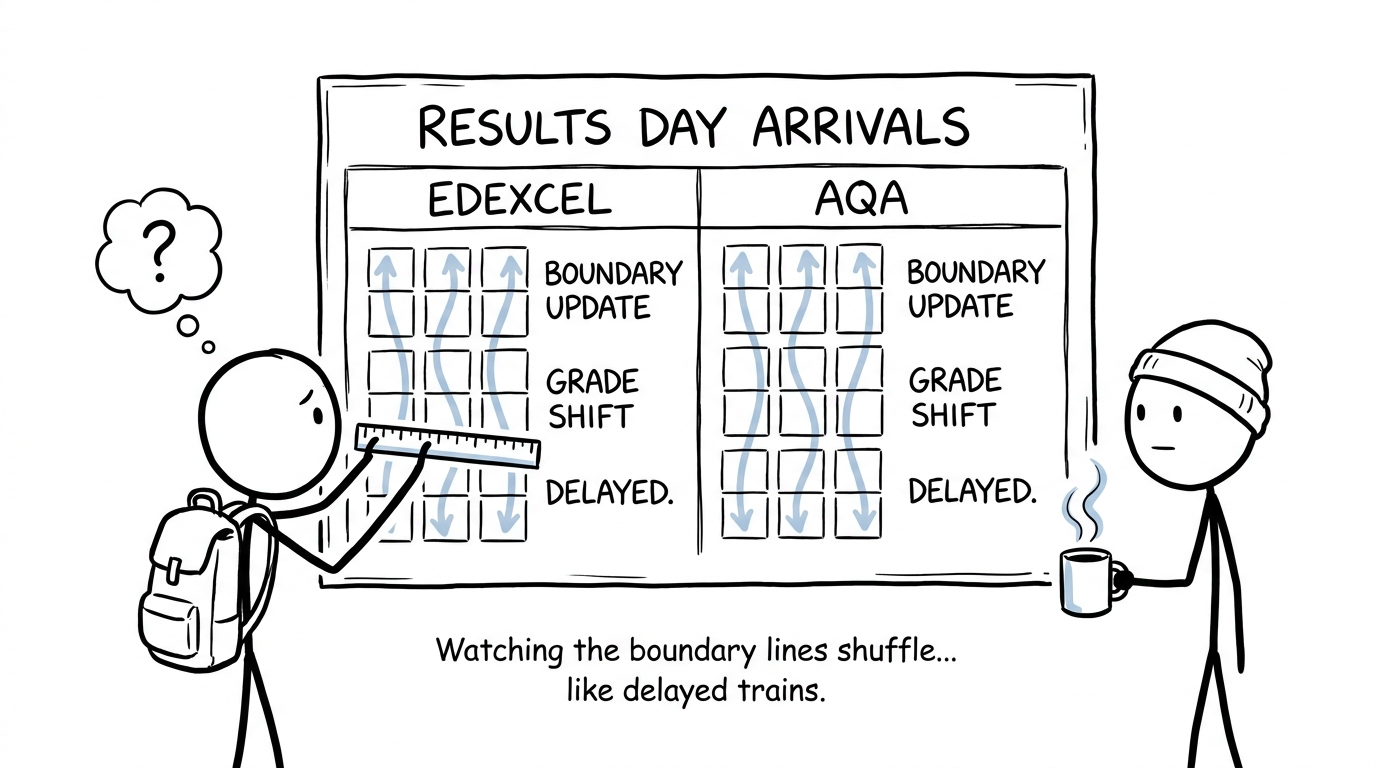 Students waiting for Edexcel and AQA grade boundaries on a results-day arrivals board
Why Edexcel and AQA boundaries differ
Grade boundaries are set after papers have been sat and marked. Awarding organisations consider statistical evidence and the quality of students' work, while Ofqual oversees comparability between boards.
If candidates generally found an assessment more accessible, its boundaries may rise. If the paper proved more demanding, they may fall. Therefore, the raw mark needed for an A can differ without changing the standard represented by that grade.
The paper structures also package shared A-level content differently. Edexcel has two Pure Mathematics papers followed by a Statistics and Mechanics paper. AQA has one Pure Mathematics paper, one combining Pure Mathematics and Mechanics, and one combining Pure Mathematics and Statistics. Each board awards the qualification from the combined total across its three papers.
That distinction matters when using past papers. Students should practise the format they will actually sit through the Edexcel A Level Maths revision hub or AQA A Level Maths revision hub, rather than choosing papers according to whichever historical boundary looks friendlier.
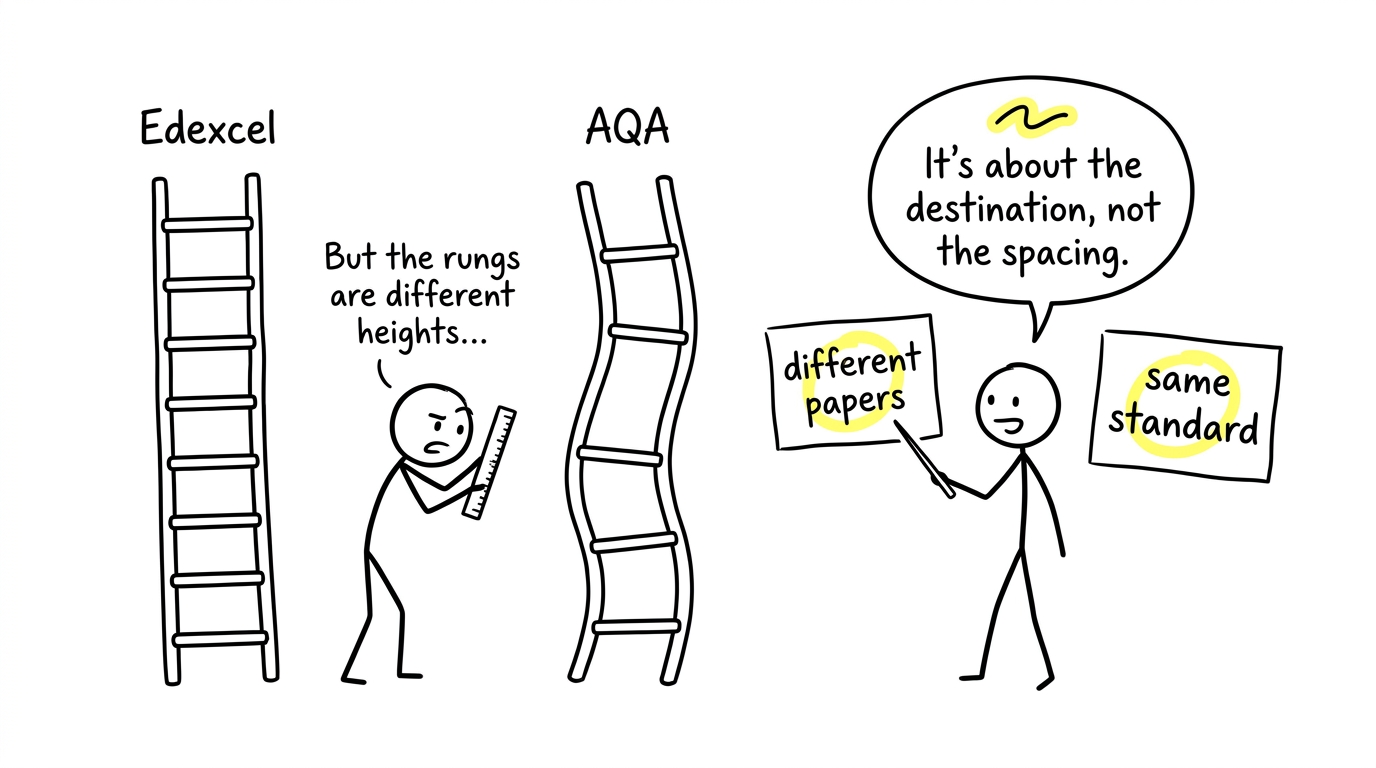 A student comparing two different ladders labelled Edexcel and AQA
What happens on A-level maths results day 2026?
A-level results may be released to candidates from 08:0008{:}0008:00 on Thursday 13 August 2026. Schools and colleges can have different collection arrangements, so students should confirm the practical details with their centre.
The crucial point is that 2026 Edexcel grade boundaries and AQA grade boundaries cannot be confirmed from past trends. They are published on results day after the awarding process. Any boundary shared beforehand is an estimate, not an official threshold.
When you receive your result:
- check your exam board and specification;
- find your total raw mark where your centre provides it;
- compare it with the official subject boundary;
- note how far the result is from the next grade;
- speak to your school or college before considering a review of marking.
A review is not an automatic grade increase. Marks can remain unchanged, rise or fall, so the marked script and mark scheme should be considered first.
What GCSE students should take from the comparison
If you are currently preparing for GCSE maths, do not choose an A-level course because one board had a lower boundary in one summer. Your school usually chooses the specification, and historical differences can reverse as paper demand changes.
A better preparation strategy is to strengthen the algebra, graphs, trigonometry and problem-solving skills that continue into A Level. Start with the GCSE Maths revision hub, then use the GCSE to A Level curriculum guide to understand the step up.
For current A-level students, past-paper marks are best treated as diagnostic evidence. Complete the correct Edexcel A Level past papers or AQA A Level past papers, mark them carefully, and repair the topics responsible for lost marks. A historical boundary can provide context, but it should never become a predicted result.
Common mistakes when comparing grade boundaries
Treating a lower boundary as an easier route
Lower boundaries normally indicate that students found the assessment more demanding. They do not prove that the board awards grades more generously.
Comparing individual-paper thresholds with the final grade
Published notional paper boundaries can help teachers judge mocks, but the qualification grade comes from the combined subject total. Individual papers are not awarded separate A-level grades.
Mixing years or specifications
A 2024 Edexcel boundary should not be compared with a 2025 AQA result as though both came from the same assessment conditions. Check the year, board, subject and specification code.
Predicting the next boundary from a trend
Past boundaries offer context, not certainty. Paper demand and cohort evidence change each year.
Ignoring the mark scheme
A raw score is useful only if it has been marked accurately. Method marks can change the total, so use official-style mark schemes and video solutions rather than relying on remembered answers.
The takeaway for results day
In June 2025, AQA's A-level maths boundaries were between 000 and 777 marks higher than Edexcel's, depending on the grade. That difference does not make AQA harder to succeed with. It reflects the evidence from two different sets of assessments.
On results day, compare your mark only with the confirmed boundary for your board and series. Until then, focus on what you can influence: accurate methods, timed practice and careful review.
MathsGenie brings those steps together for free. Use the A Level Maths revision centre for revision lessons, board-specific practice questions, mini tests, past papers, predicted papers, mark schemes and video solutions. You can also organise the work with the MathsGenie revision planner. When the confirmed figures arrive, return to the dedicated Edexcel or AQA grade boundary page for the clearest board-specific answer.











