

A-Level Maths Career Paths After Results Day
A-level maths career paths explained: explore realistic degrees, apprenticeships and jobs your grade can support, with clear next steps after results day in the UK.
Results day can make one envelope feel as though it contains your entire future. It does not. Your grade matters, but A-level maths career paths are broader than a single university offer or job title. A strong result can support routes into mathematics, engineering, computing, finance, economics and data. A lower-than-expected grade may change the route, but foundation years, apprenticeships, Clearing and resits can keep the destination within reach.
For GCSE students, that is the useful lesson now: choosing A-level Maths can preserve options, while building strong algebra, graphs, probability and problem-solving skills gives you a better start.
Your results-day route at a glance
Use this checklist before making any decisions:
- Check whether your university or apprenticeship place has been confirmed.
- Read the exact conditions rather than judging the outcome from one grade.
- Speak to your school, college or admissions team before assuming an option is closed.
- Compare courses by content, entry requirements and career relevance.
- Consider degree apprenticeships and foundation years alongside conventional degrees.
- Choose a route because it suits your interests, not simply because it sounds prestigious.
For 2026 applicants, A-level results day in England, Wales and Northern Ireland is Thursday 13 August. UCAS advises students to have their Hub details ready, while the National Careers Service provides results-day guidance. Dates and arrangements can change each year, so always check official information and your school’s collection process.
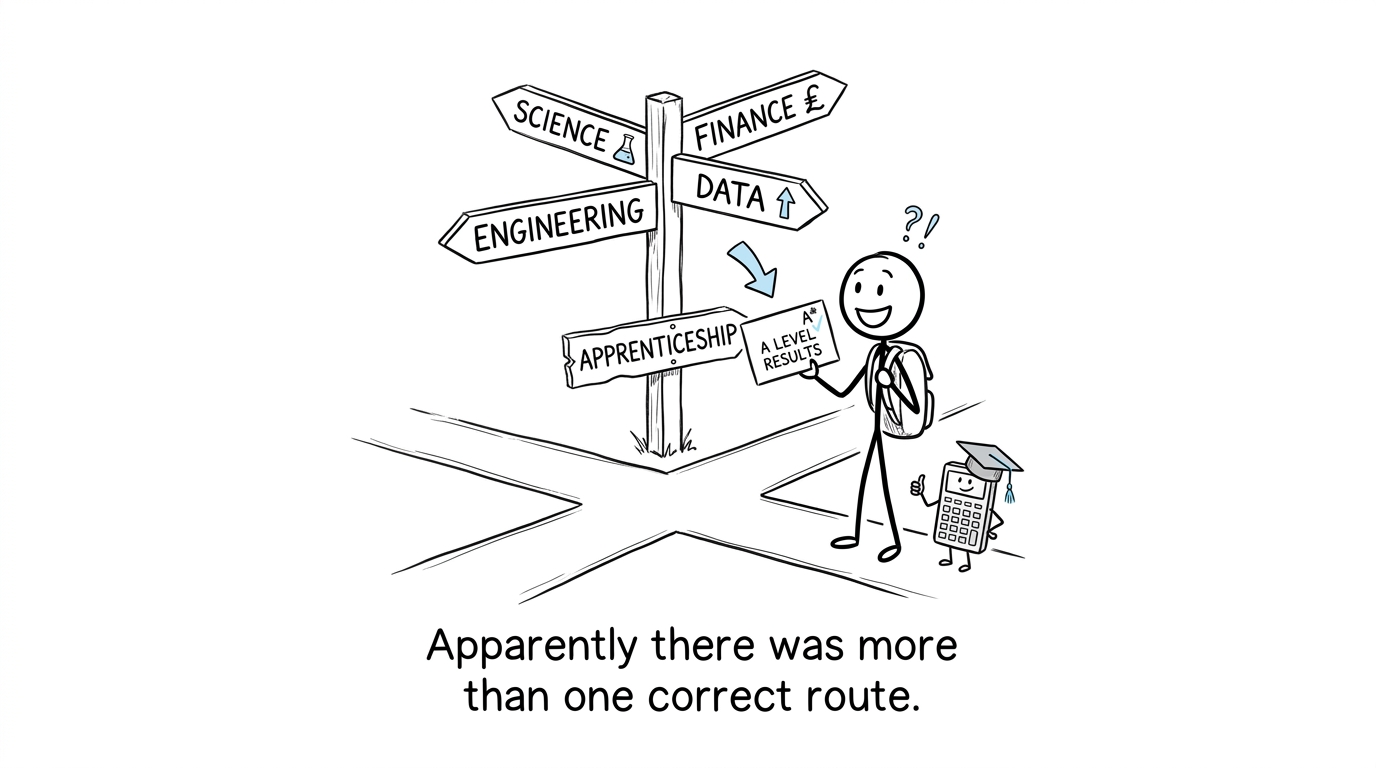 Student discovering several possible career routes after opening an A-level results envelope
Which careers can A-level Maths lead to?
A-level Maths is not training for one occupation. It develops mathematical modelling, logical argument, data interpretation and the ability to break an unfamiliar problem into manageable parts. Those skills appear across many sectors.
| Interest | Possible course or training route | Example careers |
|---|---|---|
| Pure maths and probability | Mathematics, statistics or actuarial science | Statistician, actuary, operational researcher |
| Designing and building | Civil, mechanical, electrical or aerospace engineering | Engineer, systems analyst, quantity surveyor |
| Technology and algorithms | Computer science, data science or a digital degree apprenticeship | Software developer, data analyst, AI engineer |
| Markets and decisions | Economics, finance, accounting or an apprenticeship | Economist, accountant, investment analyst |
| Physical systems | Physics, mathematics or engineering | Meteorologist, research scientist, medical physicist |
These are pairings, not guarantees. A-level Maths may support entry, but professional careers can also require a relevant degree, accredited training, workplace experience or professional examinations.
Mathematics, statistics and actuarial work
A mathematics or statistics degree is the most direct academic route. It can lead towards data analysis, statistical modelling, research, teaching and operational research.
Actuarial careers combine probability, statistics and finance to evaluate long-term risk. The National Careers Service identifies degrees such as mathematics, statistics, actuarial science, economics, engineering and accounting as relevant routes. Higher and degree apprenticeships may also be available, although entry requirements differ by employer.
Engineering and physical sciences
Engineering is among the clearest A-level maths careers routes because many engineering degrees require Mathematics and may also ask for Physics or another science. Mechanics, vectors and calculus become tools for describing motion, forces and changing systems.
Course requirements vary considerably. Before selecting A levels, check several universities rather than relying on one example. Highly selective courses may expect especially strong grades or additional subjects.
Computing, data and artificial intelligence
Computer science entry requirements depend on the course. More theoretical programmes often require A-level Maths, while some practical computing courses do not. Data science usually draws more heavily on statistics, probability and mathematical modelling.
The link between maths and computing is not just calculation. Both reward precise instructions, structured reasoning and persistence when the first approach fails.
Economics, finance and accountancy
Economics degrees with substantial quantitative content often require or strongly prefer A-level Maths. Finance, accountancy and banking routes may accept several subject combinations, but mathematical confidence helps with forecasting, risk and interpreting data.
There are also school-leaver and degree apprenticeships in accountancy, financial services and actuarial work. They allow students to earn while training, although each vacancy has its own grade and subject requirements.
What different grades may mean
There is no national rule matching each A-level Maths grade to a fixed career. Universities and employers set their own criteria, and offers may consider your complete subject combination or personal circumstances.
A top grade can make you competitive for demanding mathematics, economics, computing, physics and engineering courses. Some highly selective mathematics degrees also expect Further Maths when it is available and may use an admissions test.
A middle grade can still support many university courses, higher apprenticeships and foundation-year routes. If you miss an offer, check whether the provider has accepted you before entering Clearing. Universities sometimes confirm applicants who narrowly miss a condition.
A lower result does not erase your mathematical skills. You might change course, take a foundation year, apply for an apprenticeship, resit or build experience through another qualification. The important distinction is between a changed route and a closed future.
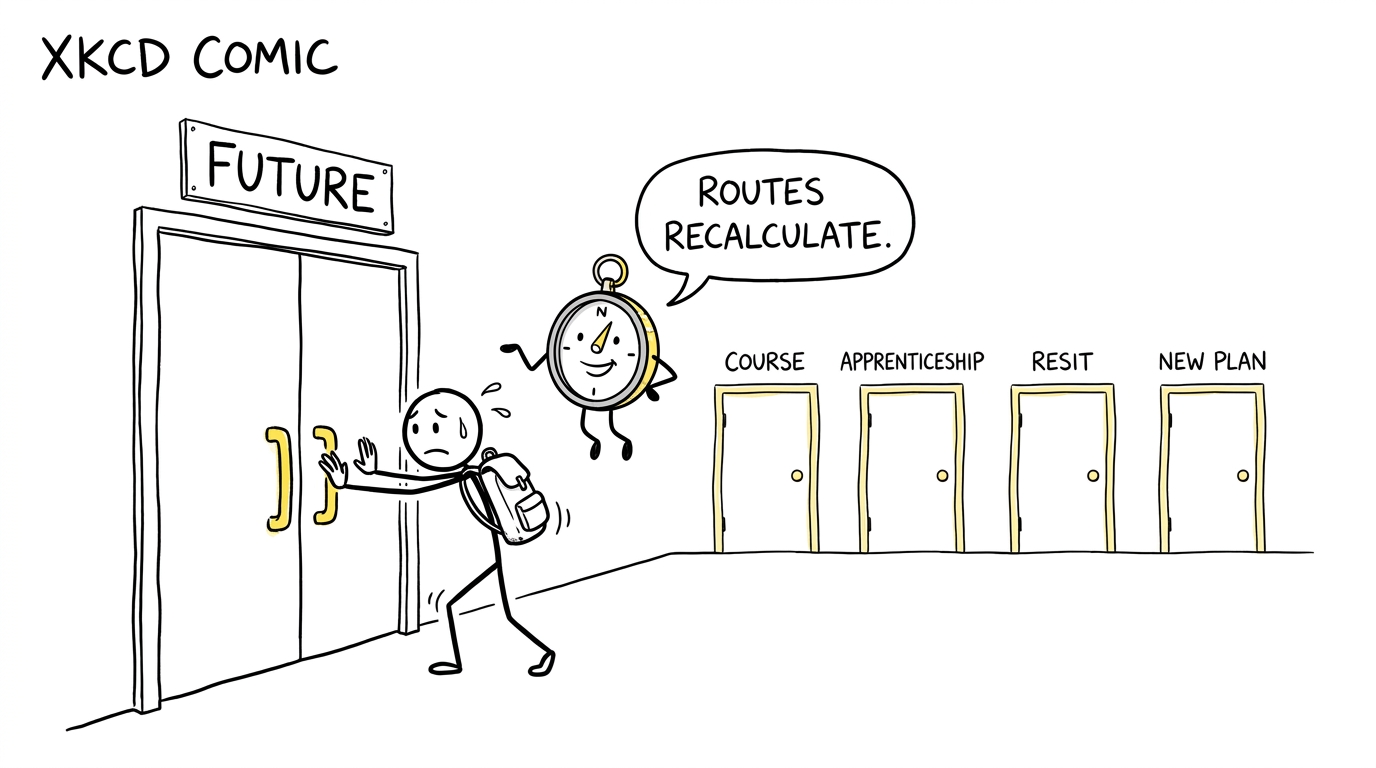 Student noticing that the future has several doors rather than one impossible entrance
What GCSE students should do now
If these jobs after A-level maths sound interesting, your immediate task is simpler: create a strong GCSE foundation.
Start with the GCSE Maths revision hub, selecting Edexcel, AQA, OCR, Eduqas or your relevant exam board. Learn one method, complete practice questions, check the solutions and record the exact reason for each lost mark.
Students taking AQA can use the dedicated AQA GCSE Maths revision resources. Nearer the exams, combine past-paper practice with GCSE predicted papers and the short tests available in MathsGenie’s revision resources.
If you are considering the subject at sixth form, read the GCSE to A Level Maths guide. A-level Maths builds quickly on algebra, indices, surds, graphs, trigonometry and rearranging formulae. Confidence in those areas matters more than trying to learn calculus early.
Common mistakes when choosing a route
Treating one grade as a career verdict
A result affects your next step, not your lifetime potential. Investigate Clearing, foundation years, apprenticeships and resits before abandoning a suitable goal.
Assuming every course has identical requirements
A course title can hide major differences. One computer science degree may require Mathematics; another may not. Check each provider’s current requirements directly.
Choosing a career only because it uses maths
Enjoying maths does not mean you must become a mathematician. Ask whether you prefer coding, designing, explaining, researching, working with money or analysing uncertainty.
Ignoring communication skills
Engineers, analysts and actuaries must explain conclusions to people who may not share their technical background. Clear writing and discussion matter alongside numerical accuracy.
Build the result before results day
Career choices feel enormous because they are made before you can see every consequence. The calmer approach is to improve the option directly in front of you.
GCSE students can strengthen the foundations now. A-level students can turn weak topics into marks through focused practice. Start with the free A Level Maths revision hub, or use the board-specific Edexcel A Level Maths resources for lessons, revision guides, exam-style questions, videos, worksheets and papers.
Use MathsGenie’s revision lessons to learn, practice questions and mini tests to check understanding, then past papers, predicted papers, mark schemes and video solutions to prepare under exam conditions. Results day opens routes, but the work that creates those routes begins much earlier.











