

A-Level History Career Paths After Results Day
A-level history career paths explained: match your results to realistic university, apprenticeship and career routes in law, heritage, media and more.

Results day can make one letter feel like a verdict on your future. It is not. A-level history career paths extend well beyond becoming a historian, and your result usually changes the route available rather than deciding your eventual destination. History can lead towards law, heritage, teaching, journalism, publishing, government, marketing and business. Some routes require a degree or professional training; others begin with an apprenticeship, employment or volunteering.
The useful question is not simply, “What job matches my grade?” It is, “Which realistic next step connects this result to the work I may enjoy?”
Your results-day checklist
Before changing plans in the emotion of the morning:
- compare your confirmed result with every condition in your offer;
- check whether your university or apprenticeship place has been confirmed;
- speak to your school or college before rejecting an offer;
- investigate alternative courses, foundation years and apprenticeships;
- compare course content, costs, location and career support;
- remember that employers eventually consider skills, experience and later qualifications, not one A-level grade alone.
University requirements vary considerably. Some history courses require A-level History, while others accept a wider range of subjects. Many also expect GCSE English and maths, commonly at grade 444 or above, although each provider sets its own conditions. Always check the current course page rather than relying on an old prospectus.
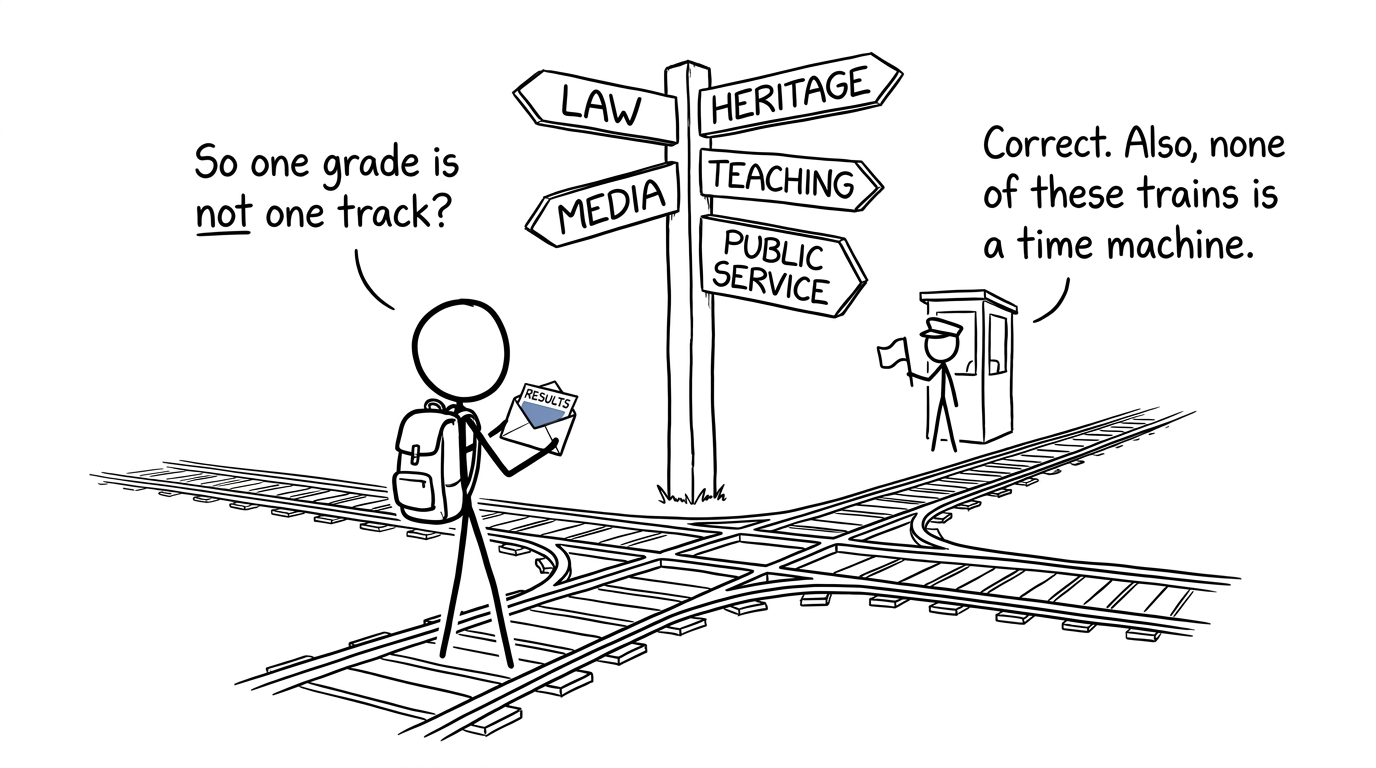 A student discovers that a History result leads to several career tracks
What does A-level History prepare you to do?
A-level History is partly about knowledge, but its wider value lies in what you learn to do with evidence. You investigate sources, distinguish assertion from proof, compare interpretations and build a defensible judgement under time pressure.
Those abilities transfer naturally to work involving:
- research and information management;
- persuasive written communication;
- policy or legal arguments;
- identifying bias and unreliable claims;
- presenting complicated ideas clearly;
- planning substantial independent projects.
This is why A-level history careers are found in sectors that may not have “history” in the job title. The subject teaches a way of thinking: patiently enough to examine evidence, but decisively enough to reach a conclusion.
Career and course pairings to consider
History degree to heritage or archives
A history, archaeology, heritage or museum studies course can support careers in museums, historic properties, conservation and cultural organisations. Archivists preserve records and make collections available to researchers and the public. This route commonly involves a first degree followed by recognised postgraduate training in archives and records management, although relevant higher apprenticeships also exist.
Practical experience matters. Volunteering with a museum, archive, local history project or heritage site can help you test whether you enjoy collections work before committing to further training.
Law course to solicitor or legal services
History’s emphasis on evidence, interpretation and structured argument fits legal work well. You might take a law degree, choose history or another subject before completing professional legal training, or investigate legal apprenticeships.
A strong History grade supports an application, but it does not qualify someone to practise law by itself. Compare the complete training route, professional requirements and cost before choosing a course.
History or politics to government and policy
History pairs naturally with politics, international relations, economics and public policy. Possible destinations include local government, parliamentary support, policy research, the Civil Service and charities.
Many Civil Service graduate schemes accept a degree in any subject, although specialist schemes can demand particular degrees or stronger classifications. There are also non-graduate administrative and apprenticeship routes. This makes public service one of the broader options among jobs after A-level History.
Journalism, media or publishing
Source evaluation is not confined to an exam paper. Journalists, researchers, editors and publishing teams must check information, understand context and communicate accurately.
Relevant next steps include journalism, history, English, media or publishing courses, as well as apprenticeships and entry-level roles. A portfolio can be valuable: school publications, responsible online writing, volunteering and community projects provide evidence that you can research and communicate for a real audience.
History degree to teaching
To teach in most maintained primary and secondary schools in England, you normally need qualified teacher status. Routes include an undergraduate degree with qualified teacher status, a degree followed by postgraduate teacher training, and teacher apprenticeships.
GCSE English and maths requirements remain important for teacher training. If that possibility interests you while you are still preparing for GCSEs, protect those foundations through the GCSE Maths revision hub and board-specific practice such as Edexcel GCSE Maths revision.
History to business, marketing or communications
A History qualification can also lead into recruitment, marketing, public relations, project support, customer research and general graduate schemes. These routes value concise writing, audience awareness and the ability to absorb unfamiliar information.
Business-related experience can strengthen the connection. That might mean an apprenticeship, a part-time role, supporting an event or taking responsibility for communications in a school or community organisation.
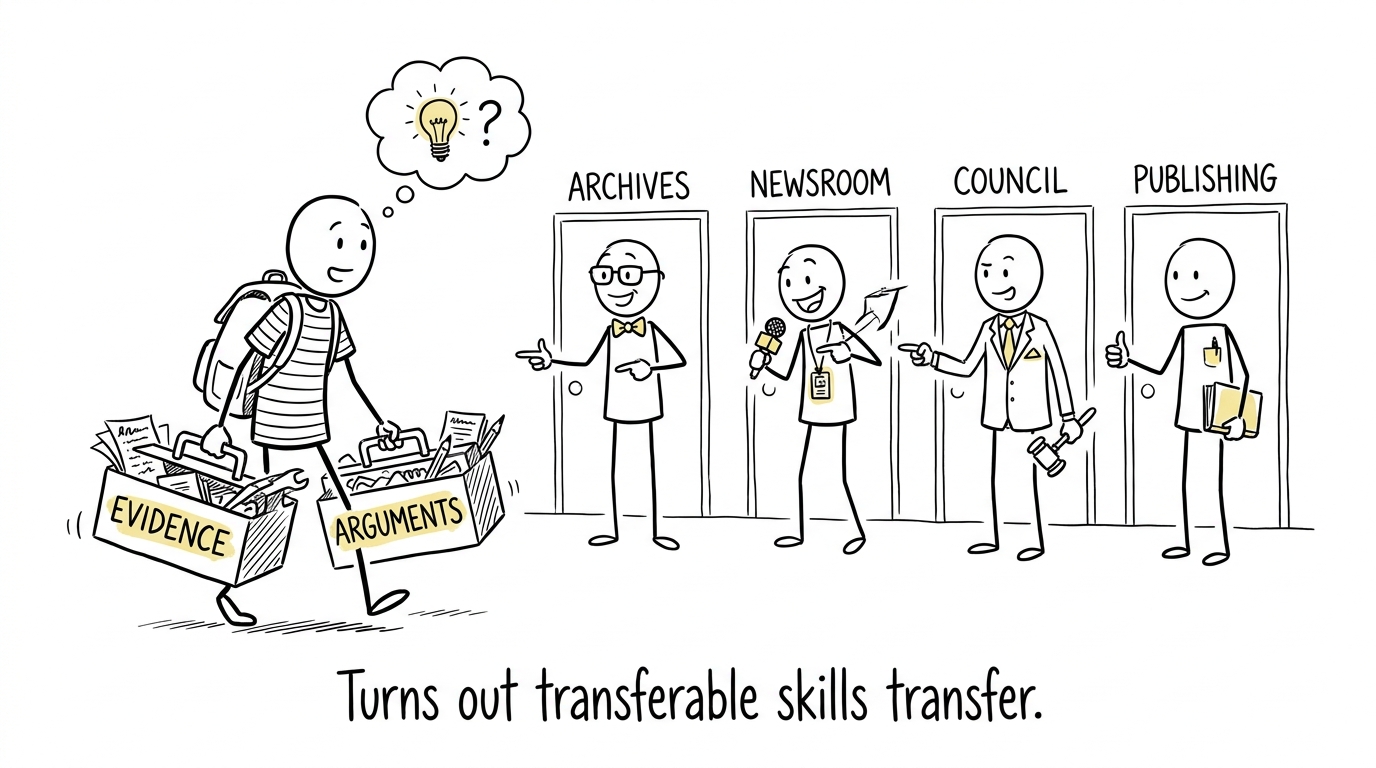 Transferable History skills arrive at several different workplaces
How your grade changes the route
A higher grade can make you eligible for more competitive courses, but there is no universal grade that unlocks every history degree. Current requirements differ widely between universities, and contextual offers may also apply.
If you meet your offer, confirm the place and review the course carefully. If you narrowly miss it, check your application status and contact the provider rather than assuming the answer is no. If you need a different plan, Clearing, a foundation year, an apprenticeship, employment followed by later study, or a carefully considered resit may still lead towards the same sector.
For students continuing with History, start by choosing the correct specification in the A-level History revision hub. You can use AQA A-level History revision, explore Edexcel History lessons, or review performance with the OCR History grade calculator.
Why GCSE maths still matters
It is easy to treat maths as unrelated to a humanities career. In practice, GCSE maths is often an entry requirement for degrees, apprenticeships and teacher training. Numeracy also appears in budgets, polling, timelines, data interpretation and research.
You do not need to choose A-level Maths for most history routes. However, keeping the option open can support combinations such as history and economics or politics with quantitative analysis. If that interests you, compare the transition through GCSE to A Level curriculum guidance and the A-level Maths revision hub.
Common mistakes when choosing a route
Treating one grade as a career forecast. It affects immediate choices, not your entire working life.
Choosing a course only for its title. Compare modules, assessment, placements and graduate destinations.
Assuming every history-related job requires a history degree. Apprenticeships and broader degrees are available for several sectors.
Ignoring professional training. Teaching, archives, conservation and law may require qualifications beyond an undergraduate course.
Neglecting GCSE maths. A missing required grade can restrict otherwise suitable applications. Use GCSE predicted papers alongside topic revision to strengthen your exam preparation.
Turn the result into a next step
A History result is evidence of what you achieved in one course. Your next decision should combine that evidence with your interests, finances, preferred way of learning and the entry requirements for the route ahead.
Use MathsGenie as your free revision base. Visit the A-level History resources for specification-matched revision guides, lessons, past papers, mark schemes and grade tools. For GCSE maths, build confidence through practice questions, mini tests, predicted papers and video solutions. A career is rarely opened by one dramatic moment; it is built through a series of sensible next steps.










