A-Level Economics Lower Grade Than Expected?
A-level economics lower grade than expected? Follow a calm results-day plan for reviews, Clearing, resits and stronger quantitative skills.
An A-level Economics lower grade than expected can make results day feel as though every plan has narrowed at once. It has not. Your immediate job is not to judge your ability or redesign your future before breakfast. It is to check your university status, speak to your school or college, and compare three practical routes: a review of marking, Clearing, or a resit.
A disappointing grade is information. Painful information, perhaps, but still something you can investigate and act on.
Your results-day action checklist
Work through these steps in order:
- Check your complete results and your UCAS application status.
- Do not assume a missed offer means rejection; the university may still accept you.
- Contact the university if its decision is pending.
- Ask your Economics teacher or exams officer for your component marks and grade boundaries.
- Discuss access to your scripts or a review of marking.
- Search Clearing while any review is being considered.
- Consider a resit only after comparing it with your available university, apprenticeship and employment options.
For 2026 entry, A-level results day is Thursday 13 August. Exact post-results arrangements vary by centre and exam board, so obtain your own school or college deadlines immediately.
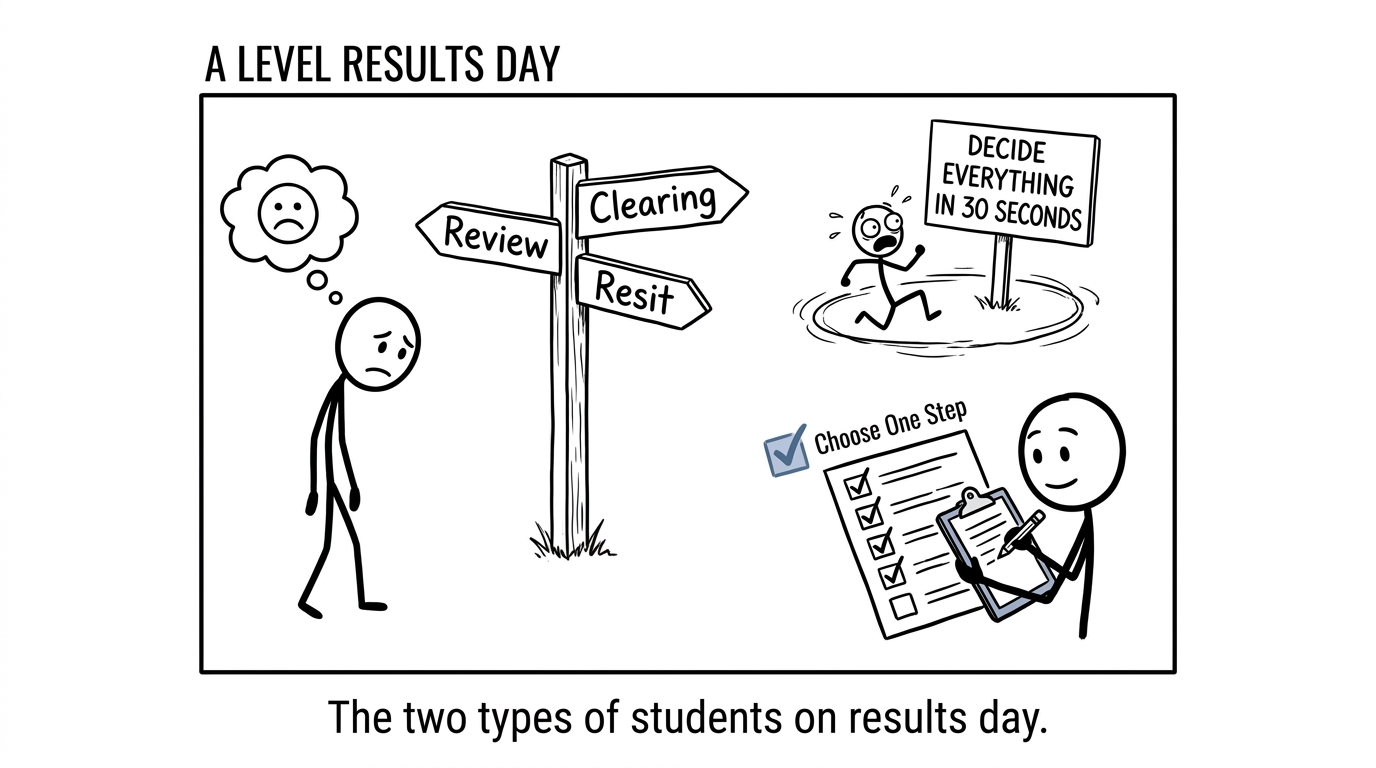 A student calmly choosing between review, Clearing and resitting while panic runs in circles
Check what the result actually changes
The grade on your results sheet and the status of your university application are related, but they are not identical.
First, check whether your firm or insurance university has confirmed your place. Universities sometimes accept applicants who narrowly miss an offer, while a pending decision may mean the admissions team is still considering your results. Contact the university rather than guessing what silence means.
If your place is confirmed, pause before giving it up simply because the Economics grade feels disappointing. Ask whether the course still suits your interests, finances and longer-term plans. A lower result does not automatically make an accepted course the wrong choice.
If neither choice has accepted you, prepare for Clearing. Keep your UCAS details, results, course preferences and questions together so that you can make informed calls rather than rushed ones.
Should you request an A-level Economics remark?
Students often call this a remark, but the formal service is usually a review of marking. A reviewer checks whether the agreed mark scheme was applied correctly; the script is not simply marked again from the beginning.
Your mark can rise, remain unchanged or fall. Written consent is therefore required, and requests normally go through your school, college or examination centre rather than directly from you to AQA, Pearson Edexcel, OCR or Eduqas.
Ask for evidence before deciding
Speak to your teacher and exams officer about:
- your mark in each paper or component;
- the distance between your mark and the next grade boundary;
- whether your performance is sharply different from other papers;
- whether a teacher can inspect an available copy of the script;
- the fee, deadline and possible outcomes;
- whether your university place depends on a rapid decision.
A review is most defensible when there is evidence that the mark scheme may not have been applied correctly. Being one mark below a boundary does not itself prove an error.
For the June 2026 series, the published deadline for an A-level priority review of marking is 20 August 2026. This service is intended for cases where access to further or higher education depends on the outcome. Ofqual states that awarding organisations aim to complete priority reviews by 3 September 2026, but you should still ask the university whether it will hold your place. Do not assume the exam board will manage that conversation for you.
Use Clearing without treating it as defeat
Clearing is the system universities and colleges use to fill remaining course places. For 2026, it runs from 2 July to 19 October, although availability changes throughout that period.
Search for courses that you would genuinely be willing to take. Compare modules, assessment methods, placement opportunities, location, accommodation and entry requirements. A course title alone tells you surprisingly little.
Before adding a Clearing choice, contact the university and obtain permission or an informal offer. You can only add one Clearing choice at a time, so do not enter a course merely to make the uncertainty disappear.
If your original application remains pending, ask that university for a clear update. It may still accept you with lower grades or suggest a related course. Meanwhile, keep researching Clearing options so that waiting does not become inactivity.
When an Economics resit may be sensible
A resit deserves consideration when the grade blocks an important route and you have a credible plan for improving it. It should not be an automatic response to embarrassment.
Ask yourself:
- Does the university or course I want accept resit applicants?
- Would a higher Economics grade materially change my options?
- Can I arrange teaching, examination-centre entry and funding?
- Am I willing to revise consistently for the next summer examination series?
- What will I do alongside the resit?
Confirm dates, fees and entry requirements with your former centre or a suitable private-candidate centre. Check the current specification for your original exam board before committing. Changing boards may mean different content and paper structures.
A strong resit plan begins with diagnosis, not with rereading the entire textbook. Use your scripts, mark schemes and examiner feedback to identify whether marks were lost through economic knowledge, application to the context, analysis, evaluation, timing or quantitative work.
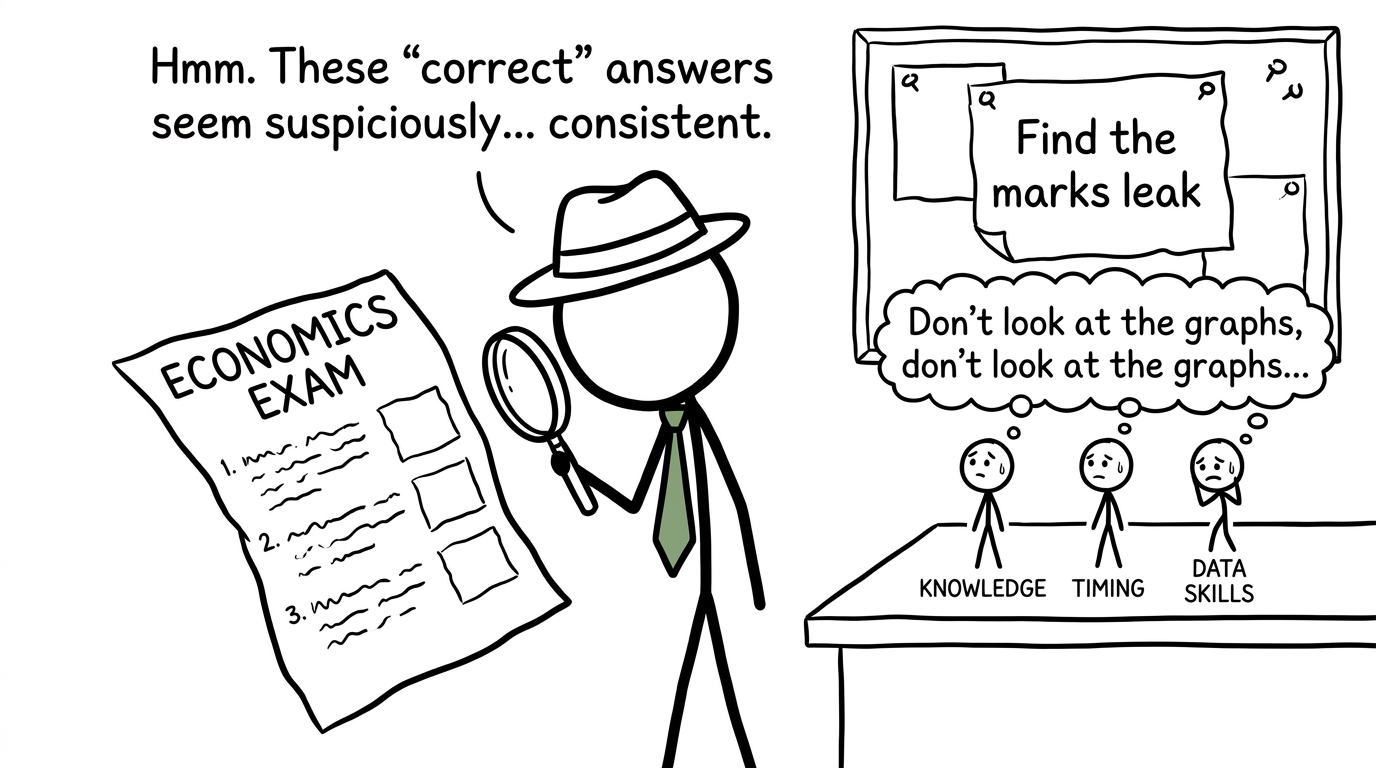 A student detective investigating knowledge, timing and data skills as possible marks leaks
Rebuild the quantitative side of Economics
Economics is not Maths A Level, but national subject requirements specify that quantitative skills account for at least 20%20\%20% of A-level Economics marks. These skills include percentages, ratios, index numbers, real values, elasticity, cost and revenue calculations, and the interpretation of graphs and numerical evidence.
If data questions contributed to your A-level Economics disappointing result, return to the underlying skills systematically. The GCSE Maths revision hub is useful for repairing foundations such as percentages, ratios and graph interpretation. Edexcel students can use short GCSE Maths mini tests to test one area without sitting a full paper.
For more advanced numerical confidence, explore the free A Level Maths revision hub. Choose only the topics that support your Economics work rather than trying to learn an unrelated Maths specification. The Edexcel A Level Maths revision page brings together lessons, topic questions, videos and worksheets, while Edexcel A Level Maths past papers can develop disciplined interpretation under time pressure.
Students still deciding whether Economics suits them can also read A Level after GCSE Economics, which explains the balance between written reasoning and quantitative skills.
Common mistakes after a disappointing result
Requesting a review without teacher advice
A review can lower a mark as well as raise it. Examine the component marks, boundaries and script evidence first whenever time permits.
Waiting for a review before exploring Clearing
Run both processes in parallel. Tell the university about the priority review and ask how long it will hold the place, but continue researching alternatives.
Declining a confirmed place too quickly
Releasing yourself from an accepted place is consequential. Contact any alternative university first and make sure you understand the process.
Resitting with the same revision method
More hours spent on the same passive routine may reproduce the same outcome. Use timed papers, mark schemes, targeted corrections and repeated practice. MathsGenie's A Level predicted papers demonstrate how structured paper practice can be built into a wider revision plan, although your Economics practice must match your Economics exam board.
Treating one grade as a verdict
An exam result records performance across particular papers under particular conditions. It matters, but it does not measure every useful ability or decide every future route.
Turn the result into a practical next step
The best A-level Economics next steps are rarely dramatic. They are administrative first, strategic second: check UCAS, contact the university, speak to your exams officer, inspect the evidence, research Clearing and then decide whether a resit serves a clear goal.
If quantitative skills were part of the problem, start repairing them now with MathsGenie's free revision lessons, practice questions, mini tests, past papers, predicted papers, mark schemes and video solutions. Use the MathsGenie revision resources to build a routine in which every mistake leads to a specific correction. One grade may have changed today's plan. It has not removed your next move.