A-Level After GCSE Economics: What Should You Choose?
A-level after GCSE Economics: compare Economics, Maths and related subjects, check typical grade thresholds, and choose a combination that fits your goals.
Results day has a strange way of turning one envelope into several decisions. If you are considering an A-level after GCSE Economics, the direct answer is this: choose A-Level Economics if you enjoyed analysing markets, policies and real-world evidence, but select your wider combination according to your strengths and future plans.
You do not normally need GCSE Economics to start the A Level, although having it gives you useful foundations. Your school or college sets its own entry requirements, so check those before treating any general guidance as a guarantee.
Your results-day decision checklist
Before confirming your choices, ask:
- Did I enjoy explaining why economic events happen, not merely learning definitions?
- Am I comfortable interpreting data, percentages and graphs?
- Can I write structured arguments using evidence?
- Do I meet my sixth form's subject-specific requirements?
- Will my combination support any university courses I may consider?
- Would I still choose Economics if my friends chose something else?
That final question matters. A subject combination has to survive long after the group chat moves on.
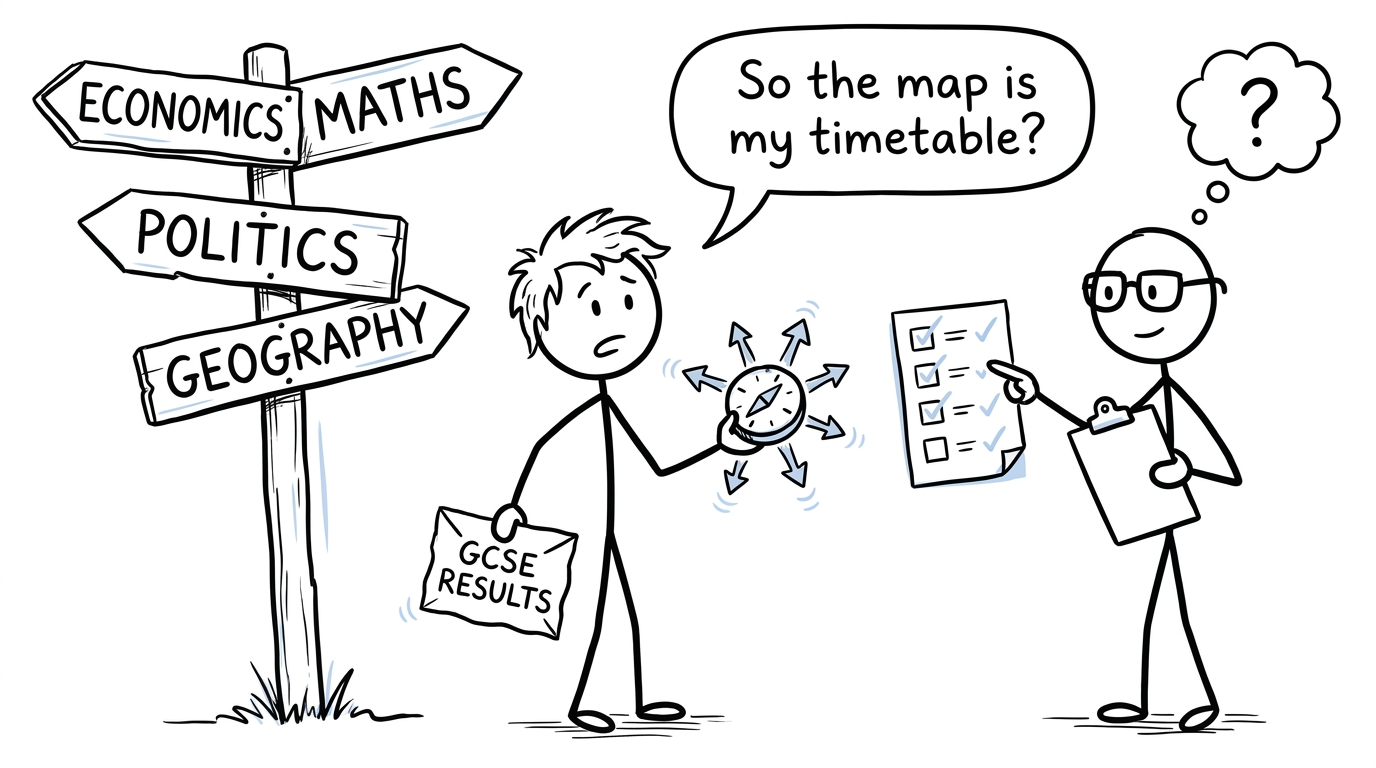 A student using a questionable compass at an oversized A-Level signpost
Is A-Level Economics the natural next step?
For many students moving from GCSE Economics to A-Level, yes. The A Level revisits familiar territory such as markets, government intervention, economic performance and international trade, but expects deeper analysis and more careful evaluation.
You will need to move beyond stating that a policy has an effect. You must explain the chain of reasoning, apply it to the context, consider competing arguments and reach a supported judgement.
The subject is also more quantitative than some students expect. National subject requirements state that quantitative skills must account for at least 20%20\%20% of A-Level Economics marks. These skills include:
- ratios, fractions and percentage changes;
- averages and relevant statistical measures;
- index numbers and real values;
- costs, revenue and profit;
- elasticity calculations;
- constructing and interpreting graphs;
- analysing written, graphical and numerical evidence.
That does not make Economics a disguised Maths A Level. It means numerical confidence supports the economic reasoning. If these foundations need attention, revise them through the GCSE Maths revision hub and targeted percentage change resources.
Grade thresholds to check before choosing A-Level Economics
There is no single national entry grade for A-Level Economics. Published sixth-form requirements vary: some ask for grade 555 in GCSE Maths, many use grade 666, and more selective providers may ask for grade 777. English requirements commonly matter because extended writing and evaluation are central to the course.
Use these bands as decision support, not universal entry rules:
| GCSE profile | What it may mean |
|---|---|
| Economics grade 777-999, Maths grade 666 or above, strong English | You are likely to have a secure starting point, subject to local requirements. |
| Economics grade 666, Maths grade 555-666 | Economics may be realistic, but check the exact entry threshold and strengthen quantitative skills. |
| Economics grade 444-555 | Ask which assessment areas reduced your grade and discuss readiness with the department. |
| No GCSE Economics | This is not normally a barrier; specifications do not require prior Economics study. |
| Maths below the stated threshold | Contact the sixth form rather than assuming admission or rejection. Its published policy is decisive. |
A disappointing result does not automatically settle the question. Look at your paper performance, teacher feedback and the entry policy together. Students still completing GCSE revision can use the GCSE Economics revision hub, including board-specific AQA GCSE Economics resources and OCR GCSE Economics resources.
Which A Levels pair well with Economics?
Economics and Maths
This is a strong combination if you enjoy quantitative reasoning and may apply for an Economics degree. Some university Economics courses require A-Level Maths, while others prefer it or accept applicants without it. Requirements differ substantially, so investigate possible courses before finalising Year 121212 choices.
Do not select Maths only because it appears impressive. A-Level Maths requires confident algebra and sustained practice. Explore the A-Level Maths revision overview to see the level of progression involved.
Economics and Politics, History or Geography
These subjects complement Economics through institutions, policy, development and extended argument. They suit students who enjoy connecting models to social and political contexts. Geography can also add data interpretation, while History develops evidence-based judgement.
Economics and Business
There is genuine overlap, particularly around firms, markets and finance. That can be useful, but some schools or future courses may have views about overlapping subject combinations. Ask your sixth form and check likely university requirements rather than relying on rumours.
Economics and sciences
Economics can sit successfully beside Physics, Chemistry or Biology. This may suit a student who wants analytical breadth without committing to three closely related humanities subjects. The best combination is not the one that looks neatest on paper. It is the one in which you can remain interested and perform consistently.
 A student persuading an escaped economics graph to return to a revision folder
How to decide whether choosing A-Level Economics is right
Use evidence from your GCSE experience. Separate your overall grade into three questions:
- Knowledge: Could you recall and explain economic concepts accurately?
- Application: Could you connect ideas to the case study or data provided?
- Analysis and evaluation: Could you develop logical chains and reach justified conclusions?
Then inspect the quantitative side. The OCR Economics calculations guide covers percentages, averages, revenue, costs, profit and income. If those methods become secure with focused practice, a temporary weakness need not define your choice.
Finally, read the actual specification used by your sixth form. AQA, Edexcel, OCR and Eduqas do not package every topic and paper in exactly the same way, even though they follow shared national subject content.
Common mistakes when selecting your A Levels
Treating one grade as the whole decision. A grade matters, particularly where it controls entry, but it does not show which assessment skills were strongest or weakest.
Assuming GCSE Economics is compulsory. A-Level specifications are designed without a national prior-learning requirement. Local entry rules can still apply if you took the GCSE.
Underestimating the writing. Economics combines diagrams and calculations with substantial explanation, analysis and evaluation.
Ignoring Maths because Economics is a social science. Quantitative skills form at least 20%20\%20% of A-Level assessment, and some Economics degrees require A-Level Maths.
Choosing subjects only for a distant career. Future options matter, but so do motivation, workload and the likelihood of achieving strong grades.
Make the next choice using evidence
Moving from GCSE Economics to A-Level is less like stepping onto an escalator and more like choosing a road. Your result shows where you are starting. It does not choose the destination for you.
Check your sixth form's thresholds, compare specifications and think honestly about both writing and numerical work. Then explore MathsGenie's Edexcel A A-Level Economics overview. Use its revision lessons, practice questions, mark schemes, past papers, predicted papers and mini tests to understand what the course demands and, if you choose it, to begin Year 121212 with a clear plan.