

A-Level Economics Grade Boundaries 2026 Explained
A-level economics grade boundaries explained for 2026: learn when they appear, how raw marks become grades, and what to check calmly on results day morning.
There is a peculiar kind of uncertainty after your final Economics paper. The writing is finished, but the meaning of your marks is not yet known. That is because A-level economics grade boundaries are not fixed before the exams.
For students awaiting A-level Economics results day, the essential facts are simple: the 2026 boundaries will be set after marking, published on results day, and used to convert your overall raw mark into a grade from A* to E. A result below the E boundary is recorded as U. The exact Economics A-level grade boundaries 2026 cannot be known or predicted reliably in advance.
A-level Economics results day checklist
A-level results will be released to students on Thursday 13 August 2026. Before interpreting your result, check:
- your exam board and specification
- your final Economics grade
- your overall raw mark, if available
- the correct 2026 subject-level boundary table
- whether you met any university or apprenticeship conditions
- who to contact at your school or college if something appears wrong
You can use the MathsGenie grade boundaries hub to understand how boundary tables are organised. Although boundaries differ between subjects, the principle remains the same: a boundary is the minimum mark required for a particular grade.
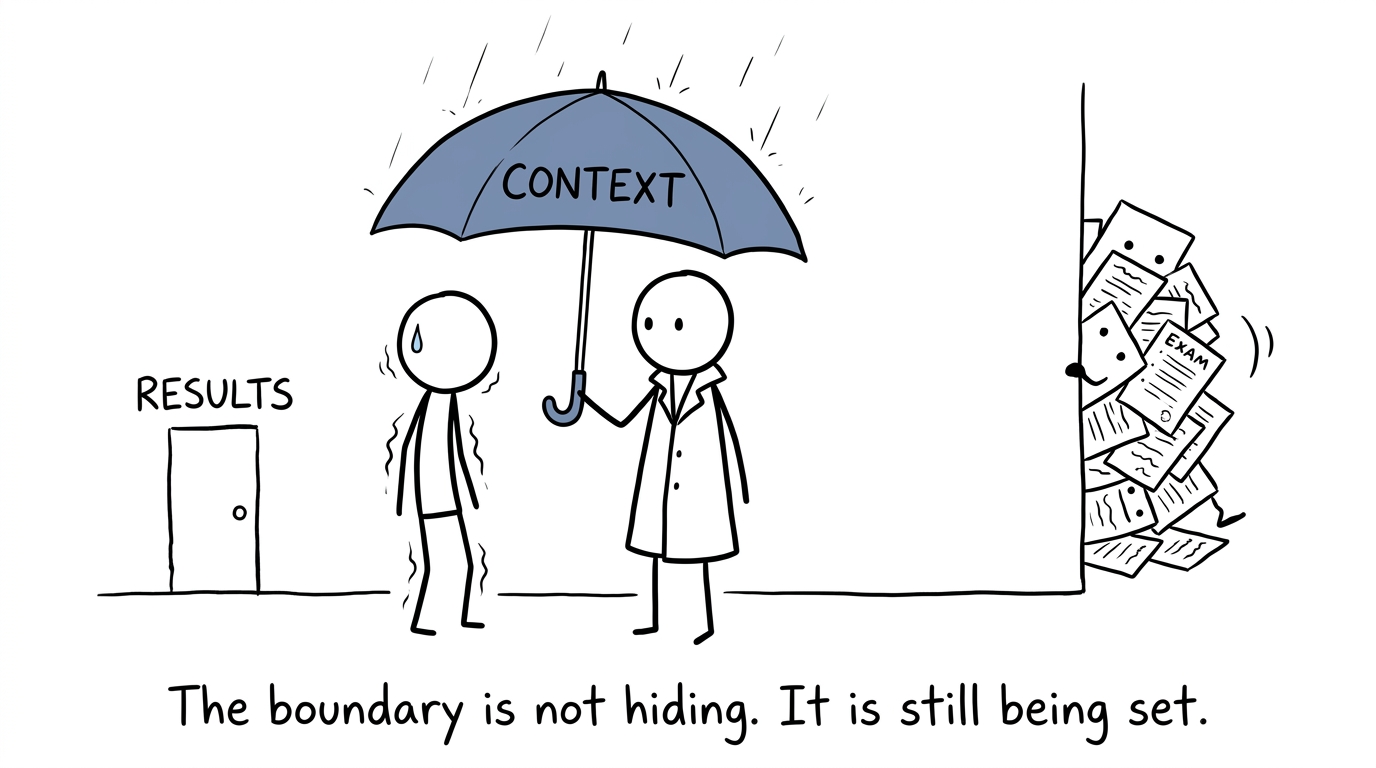 A student waiting while the grade boundary is still being set
How A-level Economics grade boundaries work
Exam boards such as AQA, Edexcel, OCR and Eduqas set boundaries only after papers have been completed and marked. Senior examiners and awarding experts consider evidence including the demands of the assessments and how students performed.
This adjustment is important. If an examination proves more demanding than a comparable paper from the previous year, its boundaries may be lower. If it proves less demanding, they may be higher. The aim is to keep the standard represented by each grade comparable over time.
There is no predetermined quota requiring a particular number of Economics students to pass or fail. Nor is there a cap on how many students may receive an A*. Your grade depends on the quality of your assessed work against the final standard.
Raw marks and subject grades
A raw mark is the number of marks awarded for your answers. Depending on the specification, marks from different papers or components are combined according to the exam board's published assessment structure.
In a simple unweighted structure, the total would be:
Overall raw mark=Paper 1 mark+Paper 2 mark+Paper 3 mark\text{Overall raw mark}=\text{Paper 1 mark}+\text{Paper 2 mark}+\text{Paper 3 mark}Overall raw mark=Paper 1 mark+Paper 2 mark+Paper 3 markYour overall total is then compared with the subject-level boundaries. You do not normally receive separate final A-level grades for microeconomics and macroeconomics. The components contribute to one overall Economics grade.
Specifications and maximum marks vary, so never compare an AQA mark directly with an Edexcel, OCR or Eduqas boundary. This is the same lesson GCSE students encounter when comparing Edexcel GCSE grade boundaries with OCR GCSE Maths boundaries: the correct board, qualification, tier where relevant, and exam series all matter.
A worked boundary example
Consider a hypothetical Economics qualification worth 240240240 raw marks. These are illustrative boundaries, not official 2026 figures:
| Grade | Minimum overall mark |
|---|---|
| A* | 185185185 |
| A | 165165165 |
| B | 145145145 |
| C | 125125125 |
| D | 105105105 |
| E | 858585 |
Suppose a student receives these paper marks:
58+51+57=16658+51+57=16658+51+57=166Because 166≥165166\geq165166≥165 but 166<185166<185166<185, the student receives an A. The student is one mark above the A boundary, not one mark below an A*. Boundaries mark the bottom of each grade interval.
If another student earns 144144144, the result is a C in this hypothetical table because the B boundary is 145145145 and the C boundary is 125125125.
A percentage can provide context:
166240×100≈69.2%\frac{166}{240}\times100\approx69.2\%240166×100≈69.2%However, exam boards award the grade using the relevant raw-mark boundary, not a universal rule that a certain percentage always equals a particular grade.
Why 2025 boundaries cannot predict 2026 exactly
Previous boundaries are useful for reviewing past papers, but they are historical records rather than forecasts. The questions, assessment demand and cohort evidence change each year.
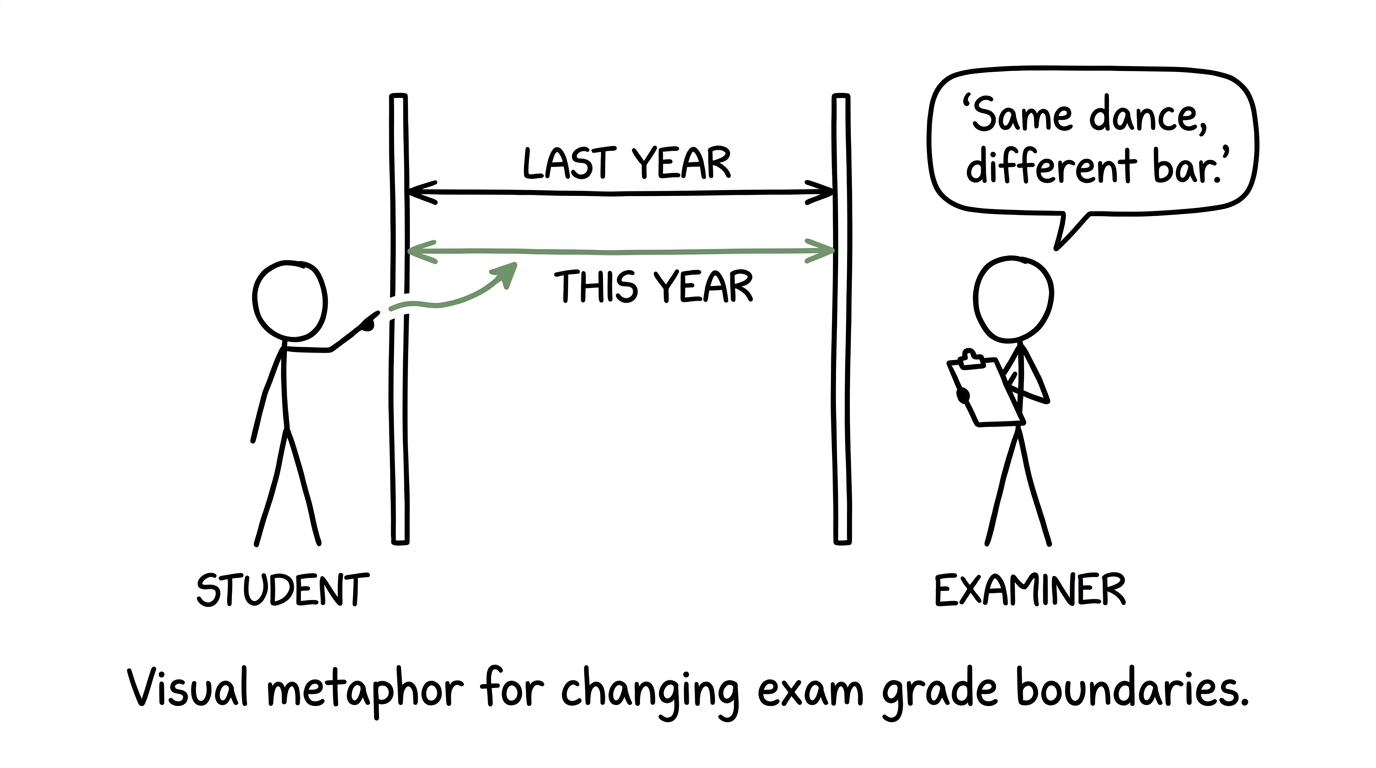 Two changing grade-boundary limbo bars
A boundary moving does not automatically mean standards have fallen or risen. Often, it means the threshold has responded to a different paper while preserving a comparable grade standard. The GCSE maths marks per grade guide explains the same distinction for grades 999 to 111.
This is also why unofficial predicted boundaries should be treated cautiously. Before results day, nobody outside the awarding process has the completed marking and awarding evidence needed to calculate the final thresholds.
What to do when you receive your Economics result
First, read the grade rather than immediately searching for online reactions. Then confirm your board and locate its official 2026 boundary document. If your overall mark is close to a boundary and the result affects your next step, speak to your school or college examinations officer.
They can explain your available post-results options, including access to scripts or a review of marking where appropriate. A review is not a free extra attempt at a higher grade: marks can remain unchanged, rise or fall. Check the current deadline, fee and possible consequences before requesting one.
If you are progressing to a numerate course, keep your mathematical skills active. The Edexcel A Level Maths revision hub brings together lessons, exam-style questions and past papers. The A Level Maths predicted papers are also useful for students preparing for future exam series rather than trying to forecast boundaries.
Common mistakes on Economics results day
Comparing different exam boards
A mark only makes sense beside the boundary for your exact board, specification and series. Different maximum marks make direct comparisons misleading.
Treating a boundary as a target percentage
There is no permanent percentage for an A, B or C. Practise producing the strongest answers you can rather than revising towards last year's minimum.
Reading component boundaries as the final result
Check whether a table shows component information or the overall subject boundary. Your certificate reports the overall qualification grade.
Assuming one mark guarantees a successful review
Being close to a boundary tells you the possible significance of a mark change. It does not prove that marking was incorrect.
Approach results day with evidence, not rumours
A grade boundary can feel personal, but it is simply a threshold applied after the assessment has been marked. On 13 August 2026, use the correct board's published table, compare it with your overall mark, and ask your school or college for advice before making a post-results decision.
For free preparation beyond results day, visit MathsGenie and use its revision lessons, practice questions, mark schemes, video solutions, mini tests, past papers and predicted papers. Start with the grade-boundary guides, then turn what you learn into a calmer, better-informed next step.











