

A-Level Economics Career Paths After Results Day
A-level economics career paths after results day: compare university, apprenticeship and work routes, plus the maths skills that keep options open.
Results day can make one grade feel like a verdict on your whole future. It is not. A-level economics career paths stretch across finance, government, data, accountancy, consulting and business, but your result does not automatically assign you to one of them. It affects which next steps are immediately available.
A strong grade may secure a university offer or strengthen an apprenticeship application. A lower grade may mean exploring Clearing, a foundation year, a different degree or a school-leaver role. The destination can remain similar even when the route changes.
For GCSE students looking further ahead, there is another useful lesson: your maths foundations matter. Economics uses percentages, ratios, graphs, averages and data interpretation, while many economics degrees place particular importance on A Level Maths.
Your results-day checklist
Before making a rushed decision, work through this order:
- Check whether you met every condition of your university or apprenticeship offer.
- Read the exact status shown by UCAS or contact the employer directly.
- Compare alternative courses by content, not title alone.
- Check whether an economics degree requires A Level Maths.
- Consider degree apprenticeships and school-leaver programmes alongside university.
- Ask what professional qualifications a career requires after your next course.
- Speak to your school or college careers adviser before declining an offer.
A result is information. The best response is to use it calmly.
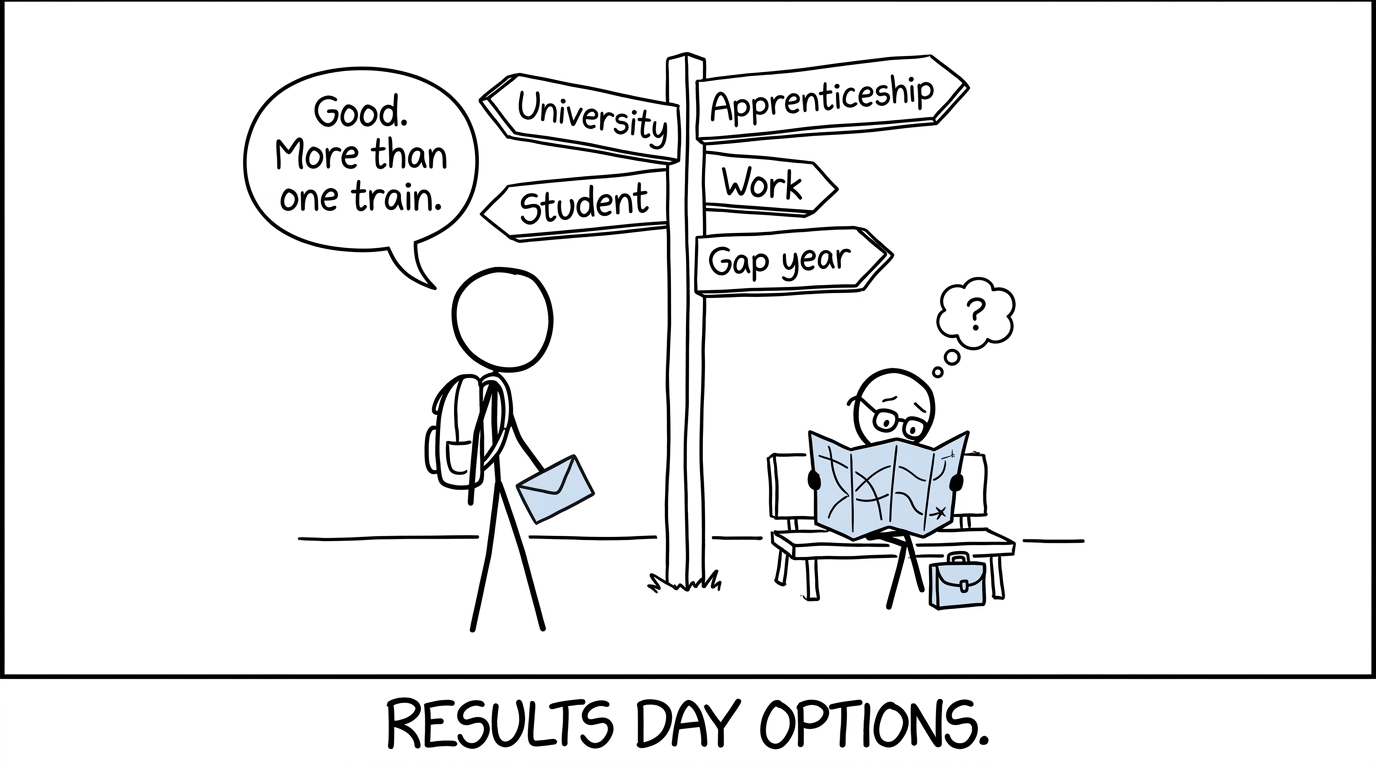 A student sees several possible trains after opening a results envelope
What does an A Level Economics grade open up?
Economics develops a combination employers value: analysing evidence, understanding incentives, interpreting data, building arguments and judging trade-offs. It can support several routes, although A Level Economics alone is not normally a professional qualification.
Some of the most realistic career and course pairings are:
| Career direction | Possible next course or route |
|---|---|
| Economist or policy analyst | Economics degree, joint economics degree or professional economist degree apprenticeship |
| Accountancy or audit | Accounting and finance degree, school-leaver apprenticeship or professional training contract |
| Data analyst | Economics, statistics, data science or maths degree; data-focused apprenticeship |
| Banking or investment | Economics, finance or maths degree; banking apprenticeship or school-leaver programme |
| Actuarial work | Actuarial science, maths, statistics or economics degree followed by professional examinations |
| Business or management consulting | Economics, management or another analytical degree; higher or degree apprenticeship |
| Public policy and the Civil Service | Economics, politics, public policy or a joint degree; relevant apprenticeship |
| Marketing and commercial analysis | Economics, marketing, business or data analytics course; commercial apprenticeship |
These are pairings, not promises. Employers set their own criteria, and competitive roles may require a degree, relevant experience, professional examinations or postgraduate training.
University routes after A Level Economics
Economics graduates move into areas including financial analysis, risk, consulting, policy, accountancy and data analysis. Yet university course titles can hide important differences.
A BSc Economics course is often more mathematical than a BA or a joint course, although labels vary between universities. Modules may include statistics, econometrics, microeconomics and macroeconomics. Some selective courses require a high grade in A Level Maths even when A Level Economics itself is not compulsory.
That distinction matters. Economics at university is not simply writing essays about inflation. It increasingly asks you to test claims using models and data.
If you are still choosing sixth-form subjects, compare entry requirements before finalising your combination. The guide to choosing three A Level subjects can help you keep realistic options open.
If your grade is higher than expected
You can accept your confirmed place, reconsider available alternatives or take time to compare course modules carefully. A more selective course is not automatically the better course. Placement years, optional modules, teaching style, location and cost all matter.
If your grade is lower than expected
First, check your actual application status. A university may still confirm your place. If it does not, possible routes include Clearing, a foundation year, another institution, resitting or applying later.
Entry requirements change by course and year, so use current university and UCAS information rather than an old screenshot or a friend’s offer.
Apprenticeships and jobs after A Level Economics
Students searching for jobs after A-level economics often expect a single list of job titles. The more useful answer is to separate immediate school-leaver opportunities from careers requiring further qualifications.
Higher and degree apprenticeships can lead into accountancy, banking, data, government, insurance and commercial analysis. The Government Economic Service also operates a professional economist degree-apprenticeship route, while entry to many graduate economist positions normally requires an economics degree or qualifying joint degree.
Apprenticeships combine paid work with formal learning, but they are not the easy version of university. Applications can involve tests, interviews and assessment centres. Look for evidence of numerical confidence, communication, curiosity and careful decision-making.
 An economics skills toolbox attracts recruiters from several sectors
Why maths keeps economics careers open
Economic arguments often begin with words but become clearer through numbers. You may need to interpret percentage change, index numbers, averages, elasticity and graphs. For example, the AQA A Level Economics specification requires quantitative skills to account for at least 20%20\%20% of the overall marks.
GCSE students can therefore prepare now. Strengthen your skills through the GCSE Maths revision hub, then focus on areas with direct economic relevance such as percentages for Edexcel GCSE Maths.
If A Level Maths is part of your plan, explore the A Level Maths revision hub. Topics such as representations of data are particularly useful preparation for evidence-based subjects.
Common mistakes when choosing an economics route
Assuming the grade guarantees a career
A grade can unlock the next application stage. It cannot replace a degree, apprenticeship, experience or professional qualification where these are required.
Checking only the overall offer
A course may require a particular grade in Maths or another named subject. Read every subject condition.
Choosing by salary alone
Pay varies by sector, location, qualifications and experience. Also consider the daily work: analysing data, writing reports, advising clients or explaining policy.
Treating apprenticeships as a backup
Good programmes can be highly competitive. Research and apply early rather than waiting for university results.
Neglecting quantitative skills
Confidence with data makes economics courses and analytical careers more accessible. Use GCSE predicted papers to test your maths under time pressure, then repair the topics costing you marks.
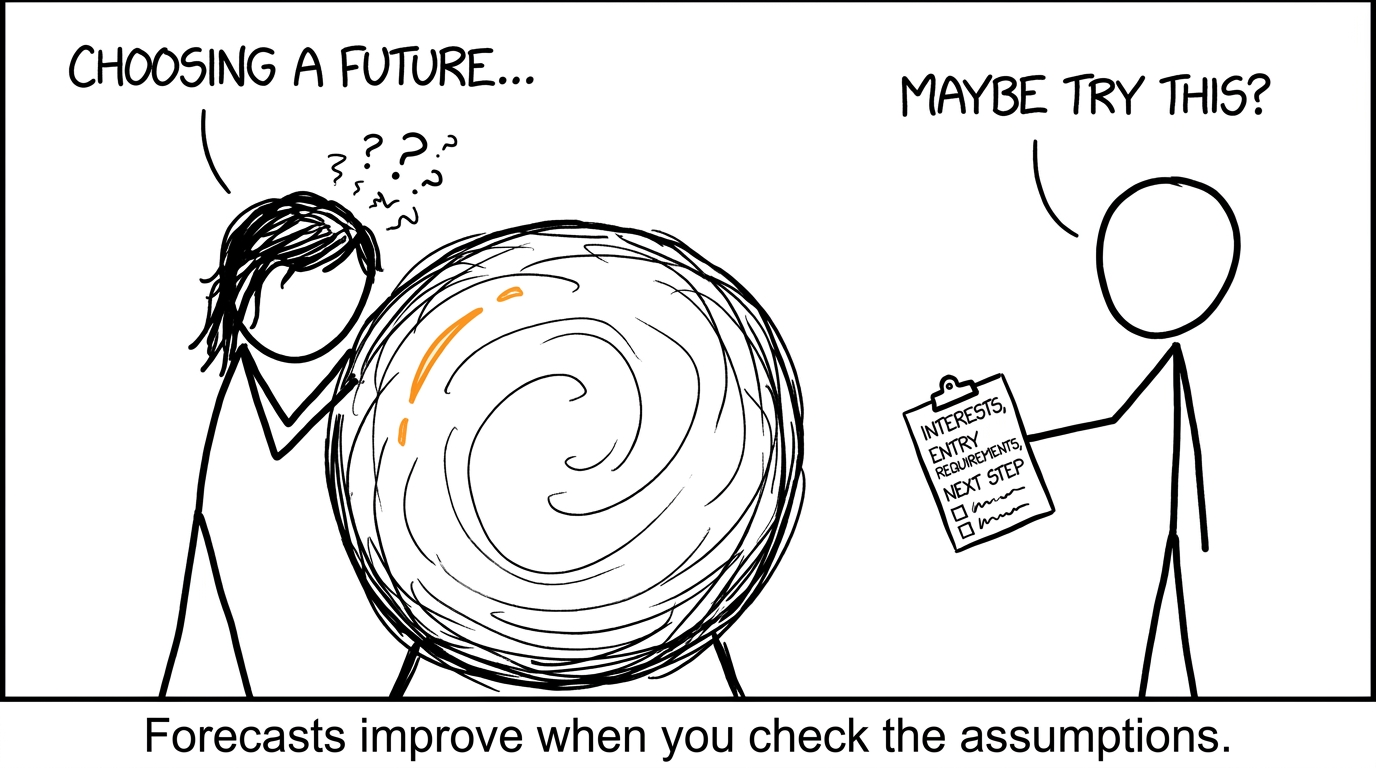 A sensible checklist defeats an oversized career crystal ball
Turn one result into a practical next step
The best A-level economics careers are not opened by a grade alone. They are built through a sequence: choose the right route, develop quantitative skills, gain experience and learn to explain evidence clearly.
If you are preparing for Economics, start with MathsGenie’s AQA A Level Economics resources or Edexcel A A Level Economics revision. Use revision lessons to understand each model, practice questions to apply it, and past papers, predicted papers, mini tests and mark schemes to discover what earns marks.
Results day may close one specific door. It rarely closes the whole corridor. Your next well-researched decision matters more.










