

A-Level Chemistry Lower Grade Than Expected: Next Steps
A-level chemistry lower grade than expected? Follow calm next steps on reviews, Clearing and resits, with advice for protecting university plans.
Opening a results envelope can compress two years of work into one uncomfortable moment. If you received an A-level chemistry lower grade than expected, the immediate answer is simple: check your university status, speak to your school or college, and compare three possible routes: a review of marking, Clearing or a resit.
Do not make the largest decision while experiencing the strongest emotion. A disappointing grade matters, but it does not decide your ability, your future course or what happens next. It is information. Your task now is to use it carefully.
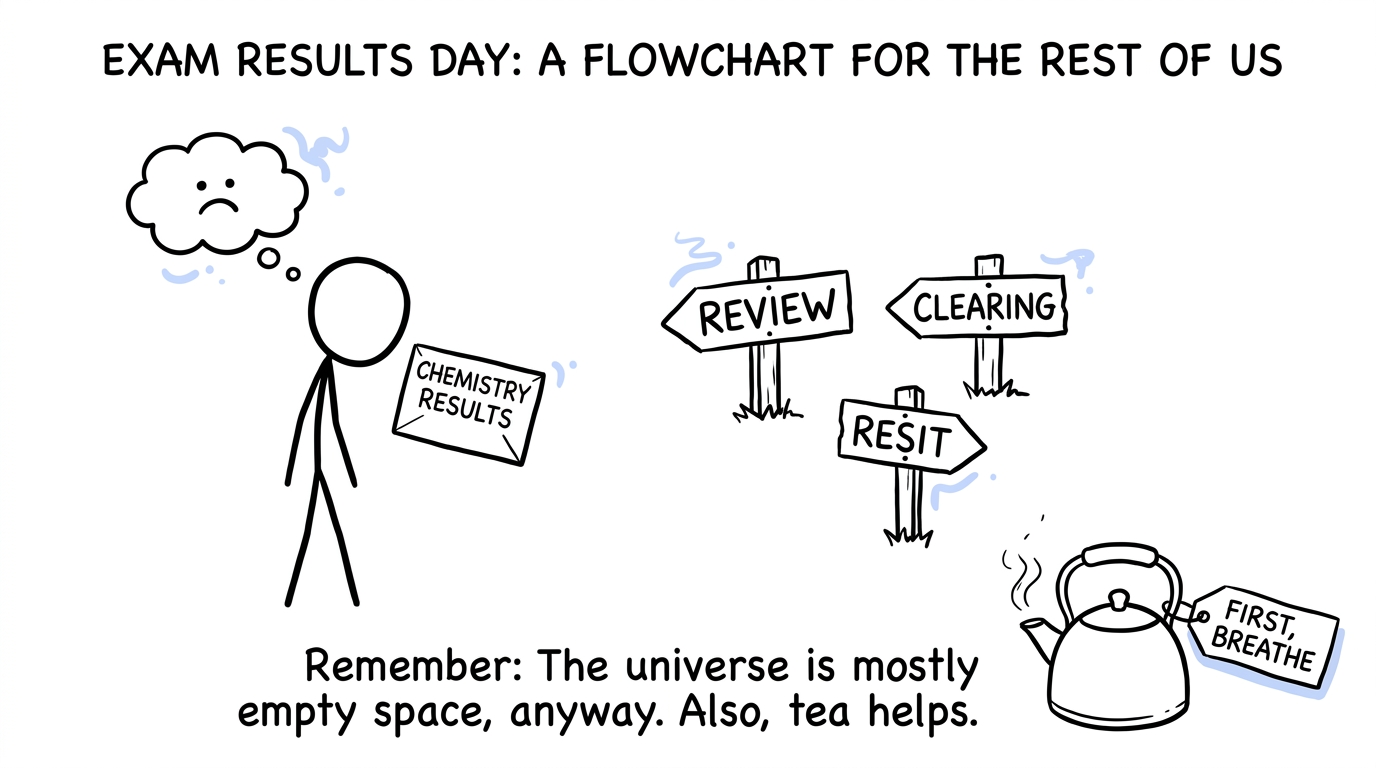 A student pauses before choosing between a review, Clearing and a resit
Your immediate results-day checklist
Work through these actions in order:
- Check your UCAS application status before assuming that you have lost your place.
- Read your complete results slip, including your other subjects and practical endorsement.
- Speak to your chemistry teacher, exams officer or sixth-form adviser.
- Contact your firm or insurance university if your application is unresolved.
- Ask how far your mark was from the next grade boundary.
- Consider a priority review if a university place depends on the result.
- Research Clearing courses without committing immediately.
- Discuss the cost, timing and practical arrangements of a chemistry resit.
For the June 2026 examination series, A-level results are released on Thursday 13 August. The deadline for a priority review of marking is Thursday 20 August 2026, while the standard reviews-of-results deadline is Thursday 24 September 2026. Your school needs time to submit a request, so speak to its exams officer promptly. Dates can change between examination series.
Check what your university has decided
A grade below your offer does not automatically mean rejection. Universities receive results and may still confirm a place, particularly when an applicant has narrowly missed an offer or performed strongly elsewhere.
Check UCAS first. Your status may show that:
- your firm choice has confirmed your place;
- your insurance choice has accepted you;
- a decision is still pending;
- you have been offered a changed course;
- you are eligible for Clearing.
If the status is unclear, contact the university admissions team yourself. Have your UCAS Personal ID, course details and results ready. Ask whether it can reconsider your application, offer an alternative course or wait for a priority review outcome. Do not assume that silence means rejection.
Decide whether to request a review of marking
Students often call this a “remark”, but the formal process is normally a review of marking. An examiner checks whether the mark scheme was applied correctly; the paper is not simply marked again from the beginning because you hoped for a different outcome.
When a review may be sensible
A review deserves serious consideration when:
- you are close to the next grade boundary;
- the result differs sharply from consistent performance in mocks and assessed work;
- your teacher believes particular responses may not have been credited correctly;
- a higher grade could protect a university place.
Ask whether your centre can obtain your marked script and let an experienced chemistry teacher examine it. A teacher can compare your answers with the mark scheme and identify whether there is a credible marking issue rather than ordinary lost marks.
Your mark can rise, remain unchanged or fall. Written consent is therefore required. Fees and centre arrangements vary, so ask your exams officer what you may need to pay and whether the fee is refunded following a grade change.
For the June 2026 series, priority reviews must reach the awarding body by 20 August and are intended for urgent A-level cases, commonly where progression to higher education is involved. Contact the university as well as your school because requesting a review does not by itself guarantee that a place will be held.
Use Clearing as an active choice
Clearing is not a waiting room for courses nobody wanted. It is the system universities and colleges use to fill available places, and it can reveal routes that were not visible when you made your original choices.
For 2026 entry, UCAS Clearing runs from 2 July to 19 October. If you are eligible, search for suitable courses and contact providers directly. Before calling, prepare:
- your UCAS Personal ID and Clearing number;
- your complete A-level and GCSE results;
- the exact course title;
- questions about modules, accreditation, laboratories, accommodation and entry requirements;
- a short explanation of why the course interests you.
Speak to more than one provider where possible. An informal offer gives you something concrete to compare, but you should only add a Clearing choice in UCAS after that university or college has given you permission. You can add only one choice at a time.
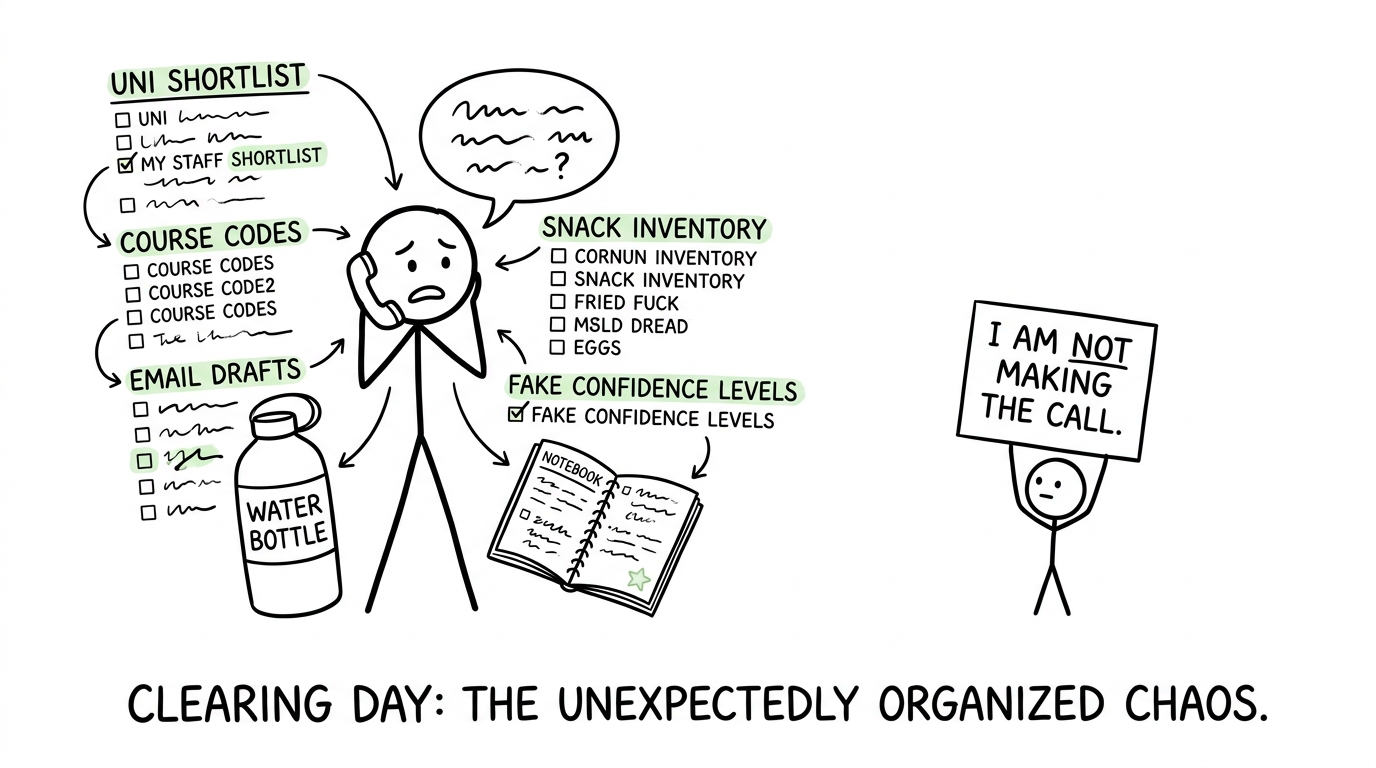 A student makes an organised Clearing call while a parent wisely steps back
A different university, foundation year or related course may still lead towards your intended career. Look beyond the title and inspect the actual content. Chemistry, medicinal chemistry, pharmacology, materials science and environmental science can overlap, but they are not interchangeable.
Consider an A-level Chemistry resit
If a particular grade is essential for your chosen route, a resit may be the clearest of your A-level chemistry next steps. It is not starting from nothing. You already know the course, the examination structure and many of the places where marks escaped.
For a linear A-level Chemistry resit, candidates generally retake all written examination components rather than selecting one paper. Discuss entry arrangements with your former school, a college or an approved private-candidate centre. Confirm the exam board, AQA, Pearson Edexcel, OCR or Eduqas, because specifications and paper structures differ.
Also ask about:
- entry and tuition fees;
- teaching or independent-revision support;
- examination dates and centre deadlines;
- whether universities accept resit applicants for your chosen course;
- how predicted grades and a new UCAS application will be handled.
A previous A-level science practical endorsement can normally be carried forward, including between JCQ awarding bodies, provided the correct entry process and candidate details are used. The most recent endorsement result is generally the one carried forward. Confirm this with the new centre before registering rather than assuming it will happen automatically.
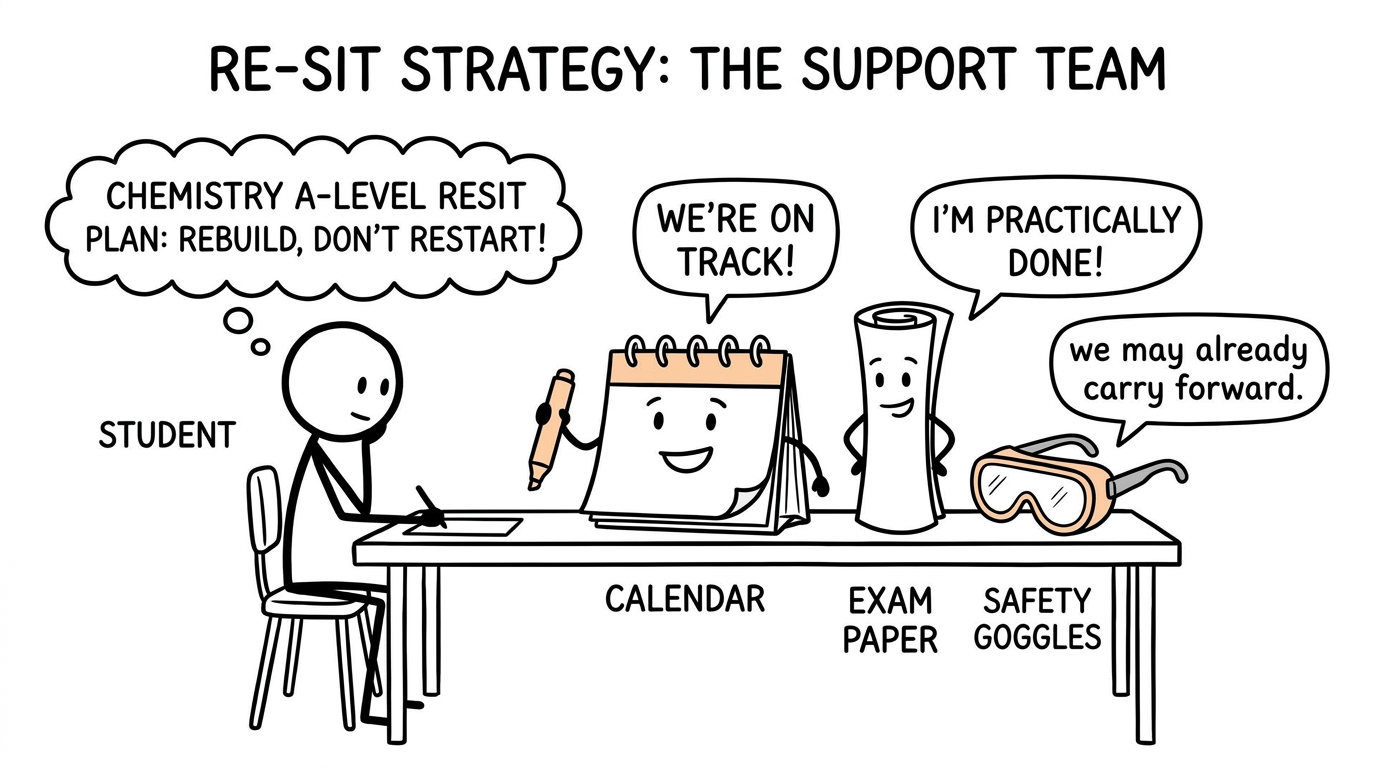 A student plans a chemistry resit with encouragement from a calendar and practical goggles
Build a better resit plan from evidence
An A-level chemistry disappointing result becomes useful only when you diagnose it honestly. Separate weaknesses into knowledge, application, practical understanding, calculations, timing and examination language.
Chemistry also depends heavily on quantitative confidence. Rearranging formulae, interpreting graphs, handling ratios and working accurately with standard form can quietly decide several marks across a paper. Use the free A Level Maths revision hub to strengthen those transferable skills.
Choose resources that match your course where possible. MathsGenie provides dedicated support through Edexcel A Level Maths revision, OCR A Level Maths revision and AQA A Level Maths past papers. These are maths resources rather than Chemistry resit materials, but they can repair the mathematical fluency needed for moles, rates, equilibria, logarithmic relationships and data analysis.
Use a repeatable revision cycle: learn one area, answer questions without notes, mark strictly, record the reason for each lost mark and return to that weakness later. MathsGenie’s approach of combining revision lessons, practice questions, mark schemes and video solutions provides a useful model for organising Chemistry revision too.
Common mistakes after a disappointing result
Acting before checking UCAS
A missed offer grade does not necessarily mean that the place has disappeared. Read your application status and contact admissions before declining anything.
Requesting a review based only on hope
Being close to a boundary matters, but teacher analysis of the script is more useful than disappointment alone. Remember that marks can decrease.
Adding a Clearing choice too soon
Research the course and obtain permission from the provider before adding it. Check course content, accommodation and financial implications rather than choosing under pressure.
Resitting without changing the method
Repeating the same notes and expecting a different grade is not a plan. Use timed papers, mark schemes and an error log. Short diagnostic tools such as GCSE Maths mini tests show how focused testing can expose a precise gap quickly.
Neglecting your other qualifications
If you are still preparing for GCSEs, treat this article as a lesson in protecting future options. Build strong foundations now through the GCSE Maths revision hub, Edexcel GCSE Maths past papers and a realistic one-month maths revision plan.
Your result is a decision point, not a verdict
The best next step depends on evidence. Request a review when there is a plausible marking issue. Use Clearing when the destination matters more than following the original route. Resit when the required grade remains essential and you can commit to a substantially better plan.
Once the immediate decisions are made, rebuild the quantitative side of your preparation with MathsGenie. Use its free revision lessons, practice questions, past papers, predicted papers, mini tests, mark schemes and video solutions to make progress visible. One grade may close a particular door today. A calm, informed plan usually reveals that it was never the only door available.











