

A-Level Chemistry Grade and University Entry
A-level chemistry grade university guide: understand grade meanings, typical chemistry degree entry requirements, contextual offers and practical next steps.
A university offer can make one letter feel enormous. An A may appear to open the future; a C can feel as though it closes it. The reality is more useful and less dramatic. Your A-level chemistry grade university options depend on your overall grades, required subjects, the course, contextual eligibility and sometimes your practical endorsement.
For chemistry degrees, an A or B in Chemistry provides the widest choice. A grade C or below may still lead to university through selected courses, an integrated foundation year, resits or another science pathway. Requirements change, however, so always check the official course page for your intended year of entry.
Your university entry checklist
Before judging any grade, check:
- the overall offer, such as AAA, AAB or BBC;
- the required grade specifically in Chemistry;
- whether Maths, Biology or Physics is also required;
- GCSE Maths and English requirements;
- whether you must pass the Chemistry practical endorsement;
- standard and contextual offers separately;
- foundation-year and alternative-entry routes.
Universities set their own requirements. A conditional offer may specify both an overall profile and a subject condition, so AAB including grade A in Chemistry is not the same as any combination of AAB.
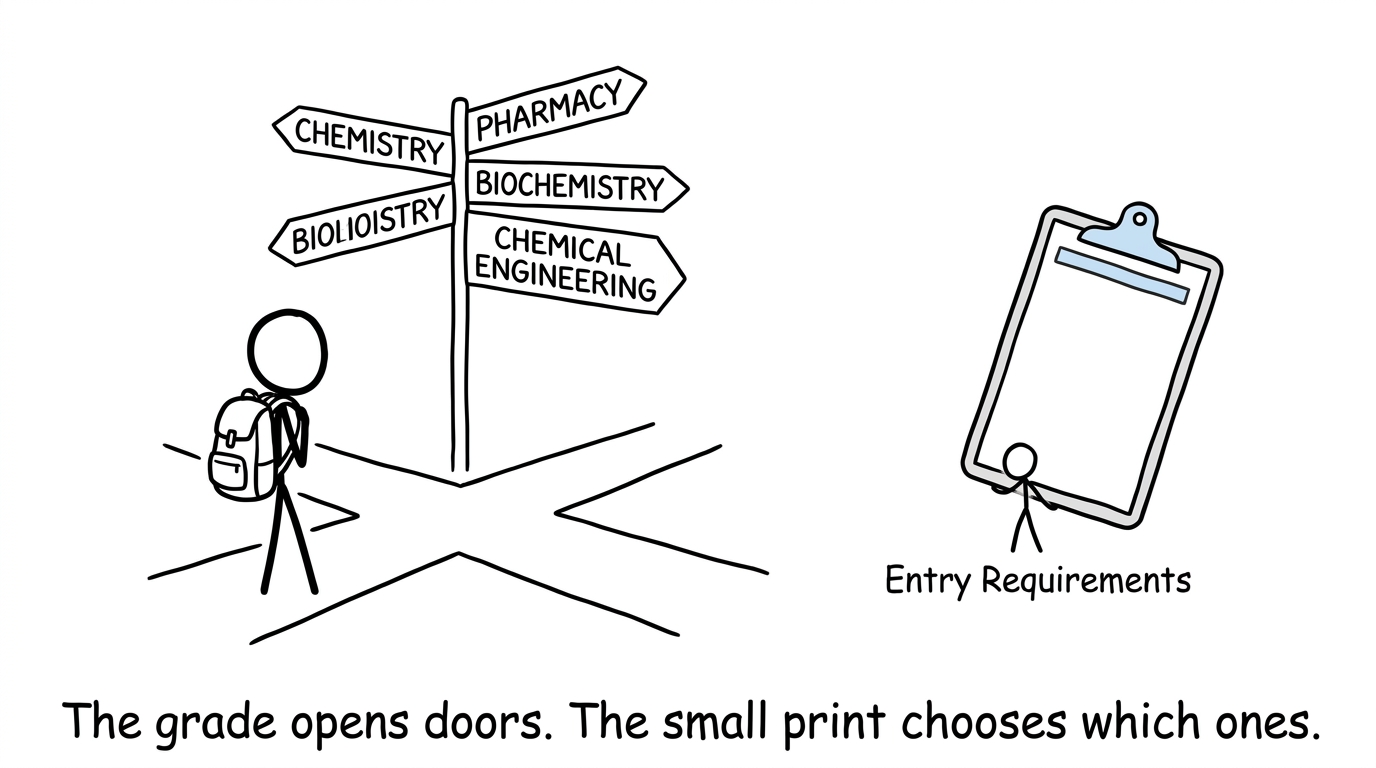 A student examines university routes while entry requirements carry a large clipboard
A-level chemistry grade meaning, grade by grade
A-level grades run from A* to E, while U means unclassified. Every grade from A* to E is a pass, but passing the qualification does not automatically satisfy chemistry degree entry requirements.
A*: the strongest academic signal
An A* in Chemistry places you in a strong position for highly selective chemistry, biochemistry, medicine and chemical engineering applications. It can also help satisfy an overall offer containing one or more A* grades.
Yet an A* is not a universal ticket. A chemical engineering course might also require A-level Maths, while medicine may require Biology, an admissions test and other selection stages. Read every condition rather than focusing on your best letter.
A: access to many demanding courses
An A in Chemistry meets the subject requirement for many competitive programmes. For 2026 entry, published examples included Bristol Chemistry at AAA including Chemistry and Manchester Chemistry at AAA including Chemistry plus another science or Maths. Their contextual offers were lower overall but still required an A in Chemistry.
This illustrates an important distinction: universities may reduce the overall grade profile without reducing the required Chemistry grade. Contextual offers depend on an institution's eligibility rules, not simply on requesting one.
B: a broad and realistic range
A B in Chemistry can support applications to numerous chemistry and related degrees. Published examples for recent entry cycles have included Cardiff Chemistry at ABB-BBC with Chemistry, while some universities specify a B in Chemistry alongside an overall offer or UCAS Tariff range.
At this level, subject combinations matter greatly. Pharmacy commonly asks for Chemistry plus another science or Maths. Chemical physics and chemical engineering are more likely to require Mathematics or Physics as well.
If B is your target, compare several courses rather than treating one university's requirement as a national rule.
C: fewer direct routes, but several alternatives
A C is a valid A-level pass, although it falls below the Chemistry requirement for many direct-entry BSc and MChem courses. Your options may include:
- universities with more flexible subject conditions;
- chemistry or applied science with an integrated foundation year;
- a related degree with different requirements;
- resitting Chemistry and reapplying;
- beginning with another recognised qualification.
Foundation years are not automatic back doors. They have their own grades, subjects and eligibility conditions, so check precisely whom each programme is designed for.
D or E: a pass that may require a different route
Grades D and E confirm that you passed A-level Chemistry, but they are unlikely to meet the subject-specific requirement for direct entry to most chemistry degrees. A foundation course, resit, Access to HE route or different science programme may be more realistic.
The sensible response is diagnosis, not panic. Ask whether Chemistry is compulsory for your intended career and whether improving the grade is preferable to changing route.
U: the qualification has not been passed
A U does not satisfy a university condition requiring an A-level pass. Speak promptly to your school or college about a resit and contact universities if you already hold offers. Their decisions are individual, particularly during Confirmation and Clearing.
Example requirements for chemistry-related degrees
Chemistry degree entry requirements vary by institution and year, but current examples reveal a pattern:
| Degree area | Typical pattern to investigate |
|---|---|
| Chemistry | Chemistry is normally required, often at A or B; another science or Maths may be requested |
| Biochemistry | Chemistry is frequently essential, with Biology, Maths or another science often required |
| Pharmacy | Chemistry plus a second science or Maths is common; practical conditions may apply |
| Chemical engineering | Maths and Chemistry are commonly central requirements |
| Medicine | Chemistry is required by many medical schools, often alongside Biology or another science; additional selection requirements apply |
These are patterns, not guaranteed offers. Universities also consider the complete application, and meeting minimum grades does not necessarily guarantee admission to a competitive course.
Why GCSE Maths still matters
For a GCSE student, university may feel distant. But chemistry already rests on mathematical habits: ratio, percentages, units, graphs, standard form and rearranging formulae. Some chemistry courses also state minimum GCSE Maths grades.
Build those foundations through Edexcel GCSE Maths revision, especially standard form practice, then test your progress with GCSE past papers. The exam board may be Edexcel, AQA, OCR or Eduqas, but accurate working and units travel well between subjects.
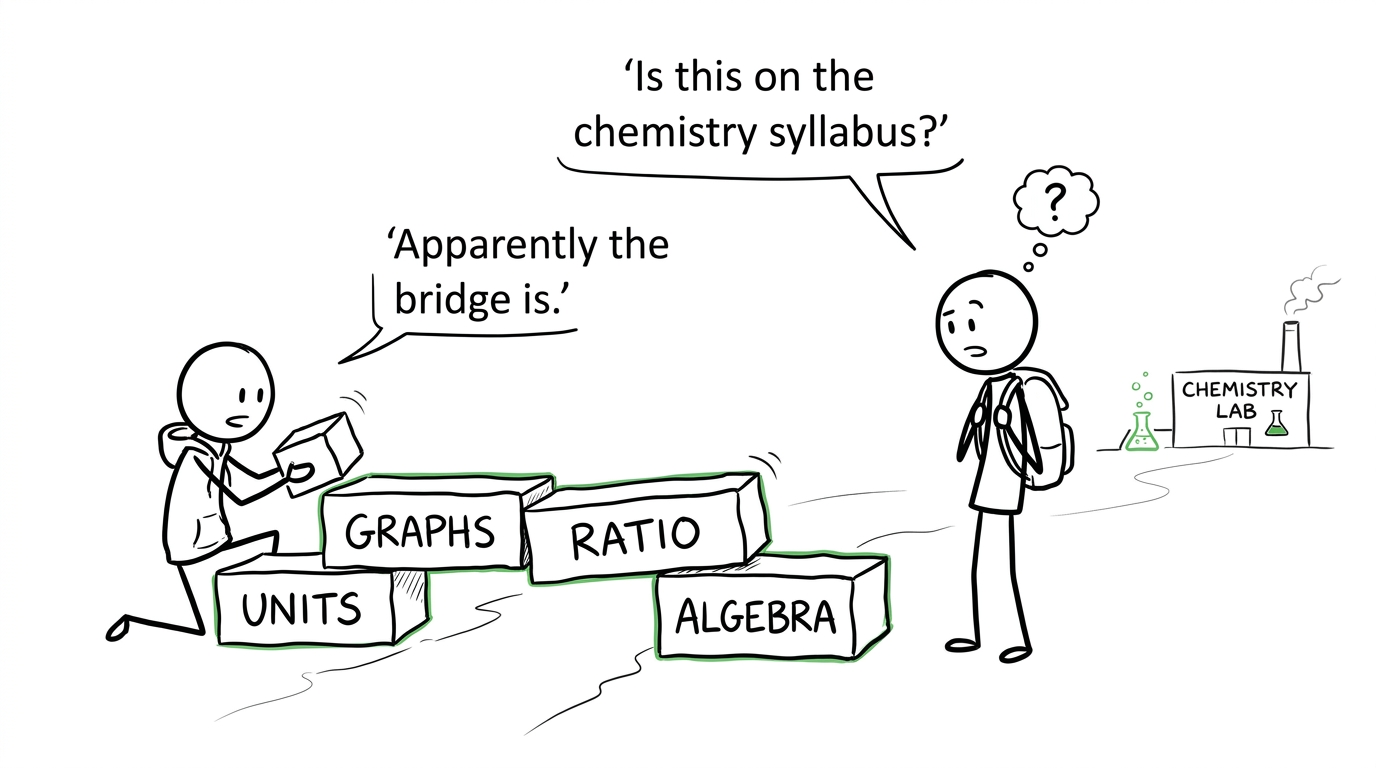 A student builds a bridge from GCSE Maths skills towards a chemistry laboratory
If you later take A-level Maths, the Edexcel A Level Maths revision hub and A Level Maths past papers can support science-heavy degree plans.
Common mistakes when interpreting entry requirements
- Looking only at the overall offer. AAA may also require A in Chemistry.
- Assuming typical means guaranteed. Competitive selection can involve more than grades.
- Ignoring the second required subject. Maths, Biology or Physics may be compulsory.
- Confusing a pass with university eligibility. An E passes A level but may not meet a course condition.
- Using an old course page. Requirements can change between admissions cycles.
- Forgetting GCSE and practical conditions. These can remain part of an offer.
Turn the grade into a plan
A grade is best treated as information. Compare ambitious, realistic and safer choices; record every subject condition; and investigate contextual or foundation routes where appropriate. If you are still choosing sixth-form subjects, use MathsGenie's guide to choosing three A-level subjects as a practical degree and careers resource.
Then work backwards. Use Edexcel A Level Chemistry revision or the OCR A Chemistry revision hub for lessons, exam-style questions, past papers, predicted papers, mini tests and mark schemes. Combine them with MathsGenie's maths practice and video solutions so calculation mistakes do not limit a strong scientific answer.
Your Chemistry grade matters, but it is not your whole future. Understand the condition, strengthen the skills beneath it and choose the next route deliberately.











