

A-Level Business Resit: Your Results Day Plan
A-level business resit guide for results day: confirm your entry, diagnose lost marks and follow a practical weekly revision plan using papers and feedback.

Results Day can make two years of work feel as though they have been compressed into one letter. If that letter was not what you expected, an A-level Business resit gives you another opportunity, but only if the second attempt is organised differently from the first.
The immediate plan is simple: check whether a review of marking is appropriate, confirm where and when you can retake the qualification, then use your previous papers to identify whether you lost marks through knowledge, application, analysis, evaluation, quantitative skills or timing. Revision should begin with that diagnosis, not with rereading the entire textbook.
 A student calmly choosing a plan after an unexpected result
Your A-level Business resit checklist
Before building a revision timetable, complete these practical steps:
- Speak to your school or college about your marks and any post-results options.
- Confirm your exam board: AQA, Pearson Edexcel, OCR or Eduqas.
- Obtain your component marks and, where available, access to your scripts.
- Check whether your former school will enter you for the resit.
- If necessary, find an approved centre accepting private candidates.
- Ask the centre about its fees, internal deadline and access arrangements.
- Check the current specification and paper structure for your exam board.
- Record the retake correctly on any university application.
Standard A-level Business examinations are normally available in the summer series rather than autumn. Private candidates must enter through an approved exam centre, and each centre controls its own availability, charges and internal deadlines. Start arranging the entry early rather than waiting until revision feels urgent.
UCAS currently requires applicants to declare completed qualifications, previous results and pending resits. If university entry is part of your plan, speak to your school, referee and intended universities about their individual policies rather than assuming every course treats resits identically.
Milestone one: understand what happened
A disappointing grade is a result, not a diagnosis. Two students with the same grade may need completely different revision plans.
Request your component marks and discuss whether access to scripts would be useful. Then sort each lost mark into one of these categories:
- AO1 knowledge: inaccurate definitions, missing models or weak understanding.
- AO2 application: answers that could have been written about any business.
- AO3 analysis: undeveloped chains of reasoning or unexplained consequences.
- AO4 evaluation: unsupported judgements or conclusions that ignore the context.
- Quantitative skills: errors involving percentages, ratios, finance or data.
- Exam management: unfinished questions, poor timing or misread command words.
These four assessment objectives are used across A-level Business specifications, although their weighting and paper structure vary. That is why your own specification and mark schemes matter more than generic essay advice.
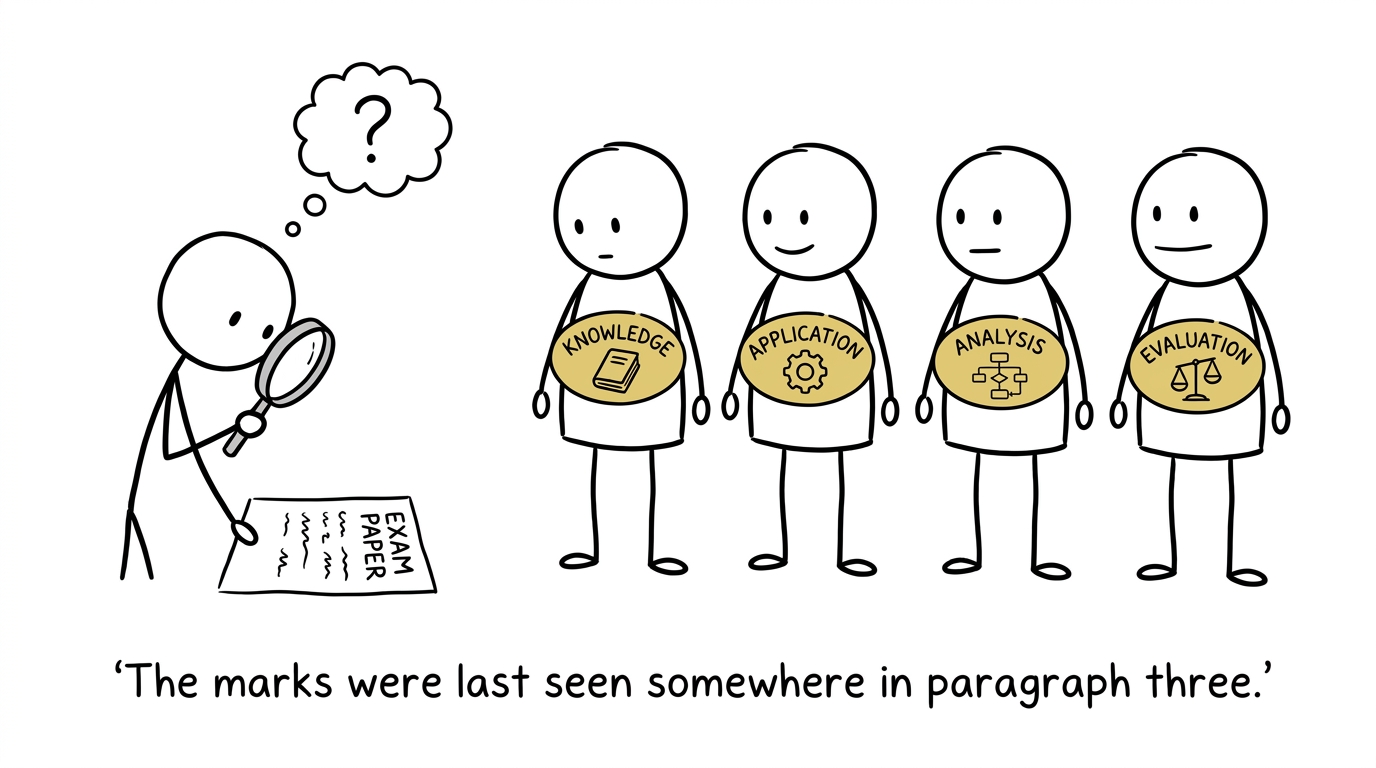 A student detective investigating where the marks disappeared
Milestone two: secure the entry and specification
Resitting A-level Business usually means taking the required written papers for the full qualification again, not simply repeating the paper with the lowest mark. Confirm the exact arrangement with your exam board and centre before planning around it.
Begin at the A-Level Business revision hub, where resources are organised for AQA, Edexcel, OCR, Eduqas and WJEC. Students following OCR can use the dedicated OCR A-Level Business revision page, while Eduqas candidates should work from the Eduqas A-Level Business resources.
Do not change exam boards casually. Topics overlap, but paper structures, command words and specification details can differ. If a centre offers a different board, compare both specifications before agreeing to the switch.
Milestone three: rebuild knowledge through retrieval
For the first phase of A-level Business retake revision, divide the specification into manageable areas such as marketing, operations, finance, human resources, strategy and external influences.
Use a weekly rhythm:
- Monday: retrieve definitions, models and formulae without notes.
- Tuesday: answer short contextual questions.
- Wednesday: practise quantitative skills and data interpretation.
- Thursday: plan analytical and evaluative responses.
- Friday: complete a timed mixed set and mark it.
- Weekend: revisit mistakes and one older topic.
Reading has a place, but recognition is not recall. Close the notes, explain a concept from memory, then check what was missing. A short retrieval session followed by focused questions is usually more revealing than another hour of highlighting.
Business specifications also assess quantitative skills. If percentages, ratios, averages or graphs are costing marks, repair those foundations through the Edexcel GCSE Maths lessons and GCSE Statistics revision resources. The aim is not to restart GCSE Maths. It is to remove small numerical weaknesses that interrupt stronger Business answers.
Milestone four: turn knowledge into contextual answers
Once the core content is secure, spend more time writing than reading. Use the A-Level Business question bank to practise specific topics before moving to complete papers.
For every longer response, ask:
- Have I used evidence from the case or data?
- Have I explained how one effect leads to another?
- Have I considered a limitation, alternative or dependency?
- Does my judgement answer the precise question?
Keep an error log with four columns: topic, lost mark, reason and next action. “Revise finance” is too vague. “Practise interpreting profitability data and linking it to business objectives” gives you something concrete to do.
Milestone five: make past papers the centre of revision
In the final phase, complete papers under realistic conditions. Use the A-Level Business past-paper collection, mark every response and compare your wording with the mark scheme.
The most valuable step comes afterwards: rewrite weak sections without looking at the model answer. Later, attempt a similar question to check that the improvement transferred. A mark scheme should become a feedback tool, not a document you glance at before filing the paper away.
MathsGenie's broader one-month revision planning guide also provides a useful pattern: diagnose, practise, mark, correct and revisit. The subject may differ, but the feedback loop remains powerful.
Common mistakes when resitting A-level Business
Repeating the old revision method
More hours will not solve a weak method. If passive notes dominated the first attempt, the resit plan needs retrieval, timed writing and marked questions.
Ignoring administration
A strong revision plan cannot compensate for a missed centre deadline. Confirm the entry, qualification code, exam board, papers and access arrangements in writing.
Memorising generic essays
Business questions reward application to the context. Prepared paragraphs can become irrelevant when the business, objective or constraint changes.
Avoiding quantitative questions
Calculations and data interpretation are part of the qualification. Use the Edexcel GCSE Maths revision hub to strengthen percentages, ratio and graphs where necessary.
Completing papers without reviewing them
A paper identifies the problem; correction creates the improvement. Track repeated errors and revisit them after a delay.
Make the second attempt evidence-led
An A-level Business resit is not about proving that the original result was unfair or unrepresentative. It is about producing better evidence next time: clearer knowledge, sharper application, deeper analysis and judgements grounded in the case.
Start with the MathsGenie A-Level Business hub. Choose your exam board, diagnose weaknesses through the question bank, learn from mark schemes and build towards timed past papers, predicted papers and mini tests. A resit becomes manageable when each week has a purpose, and each mistake has a planned response.











