

A-Level Business Grade University Entry Guide
A-level business grade university guide: learn what each grade means, compare business degree entry requirements and choose your next steps confidently.

University offers can look like a code written for somebody else: AABAABAAB, ABBABBABB, tariff points, contextual offers and GCSE conditions. The clearest a-level business grade university answer is this: your Business grade matters as part of your overall offer, but it rarely decides your future alone.
For Business and Management degrees, universities commonly set requirements across three A Levels. Some also specify GCSE Maths or English grades. A strong Business grade can support your application, but you must compare your complete grade profile with the exact course conditions.
Your quick university entry checklist
Before judging what your predicted Business grade means, check:
- the university's standard A Level offer;
- whether Business is required, preferred or simply accepted;
- GCSE Maths and English requirements;
- contextual offer eligibility;
- foundation-year routes;
- whether the course uses grades or UCAS Tariff points;
- requirements for more mathematical courses such as finance or economics.
Entry requirements change between courses and admissions cycles. The examples below reflect published 2026 requirements checked during research, but always confirm the current course page before applying.
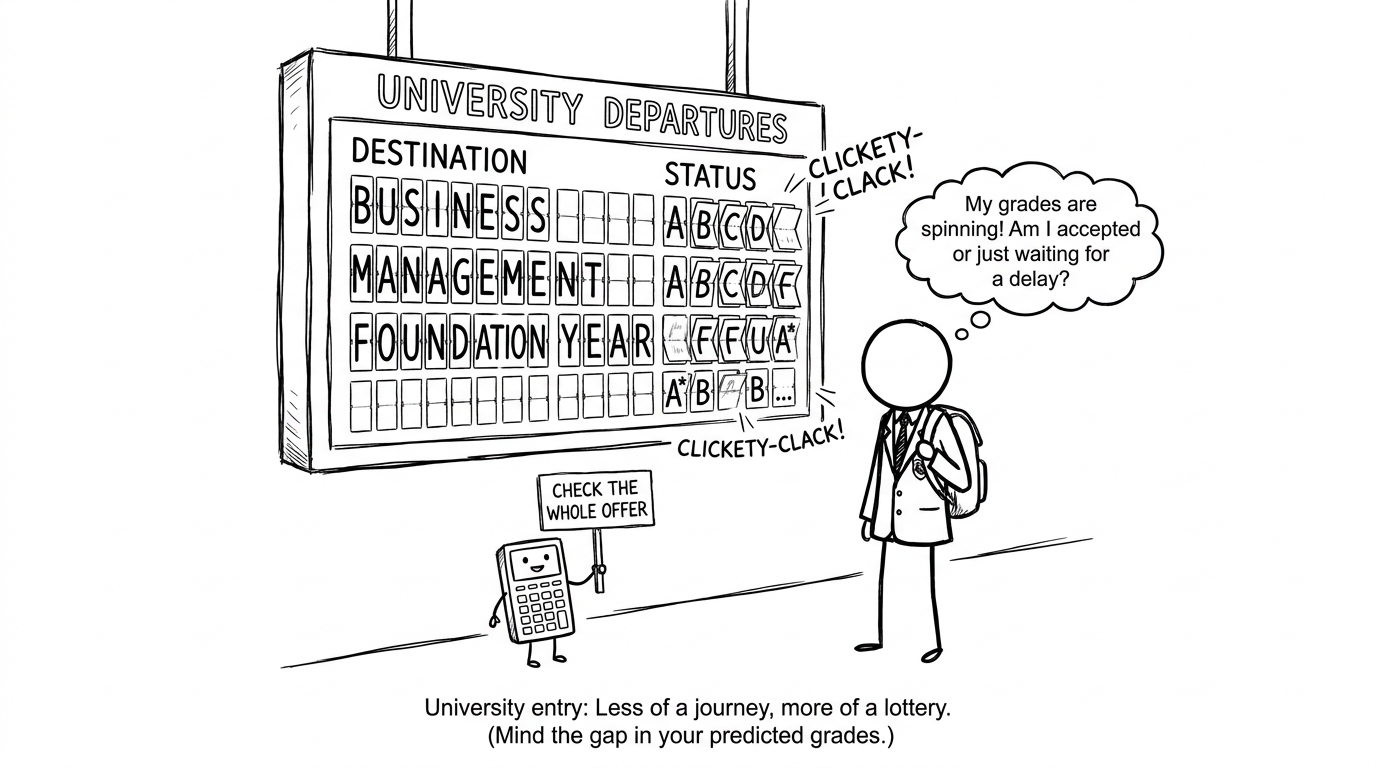 A student watches university destinations and changing grades on a departures board
What your A-Level Business grade may mean
A grade is evidence of performance in one subject, not a complete admissions decision. Universities may consider your other subjects, predicted grades, GCSE results, school context and the information in your UCAS application.
| Business grade | UCAS Tariff value | What it may mean for related degrees |
|---|---|---|
| A∗A^*A∗ | 565656 | A very strong result that supports applications to highly selective courses, provided the rest of your offer is met. |
| AAA | 484848 | Fits comfortably within many offers ranging from AAAAAAAAA to ABBABBABB when combined with suitable grades elsewhere. |
| BBB | 404040 | A solid result accepted within many combinations such as AABAABAAB, ABBABBABB and BBBBBBBBB. |
| CCC | 323232 | Can contribute to tariff-based offers, less selective courses and some foundation-year routes. |
| DDD | 242424 | May suit lower-tariff or foundation-year options, but is below many standard direct-entry offers. |
| EEE | 161616 | A pass carrying tariff credit, although direct entry to many Business degrees will require a stronger overall profile. |
UCAS Tariff points apply to Level 3 qualifications, not GCSEs. Universities do not all use the Tariff, so never convert an offer into points unless the course itself permits this.
Grade A∗A^*A∗ or AAA: strong, but not automatic
An A∗A^*A∗ or AAA in Business shows excellent subject performance. However, a course asking for AAAAAAAAA will not normally be satisfied by one top grade alongside results below the remaining conditions.
Published 2026 Business and Management offers illustrate the range. Warwick listed A∗AAA^*AAA∗AA, while Manchester listed a typical offer of AAAAAAAAA. Other universities, including Southampton, Birmingham and Exeter, published typical offers around AABAABAAB.
This is why the a-level business grade meaning depends on the full combination. An AAA in Business is valuable, but the offer is the finish line you must read carefully.
Grade BBB: compatible with many typical offers
A BBB keeps a broad range of Business and Management options open. Published requirements included ABBABBABB at Surrey and UEA, with Leicester also listing ABBABBABB for Business and Management.
A student predicted BBB in Business should build a balanced shortlist: courses close to the predicted profile, some more ambitious choices and options with slightly lower requirements. Contextual offers can also be lower than standard offers for eligible applicants. They are not automatic discounts, so check each university's criteria.
Grade CCC: broaden the route, not abandon the goal
A CCC may not fit a standard AABAABAAB or ABBABBABB offer, but it does not close the door on university. Look for courses using tariff points, lower grade combinations, contextual admissions or an integrated foundation year.
The important distinction is between the subject grade and the overall application. A CCC in Business combined with stronger grades elsewhere may produce a different outcome from three CCC grades. Course requirements, rather than assumptions about prestige, should guide the shortlist.
Grades DDD and EEE: investigate alternative entry routes
These grades are A Level passes and carry UCAS Tariff points. Nevertheless, they sit below the standard requirements of many direct-entry Business degrees researched for this guide.
Useful alternatives may include a foundation year, a different institution, further improvement or another Level 3 route. Foundation years add time and usually involve additional tuition costs, so compare the curriculum, progression rules and total cost rather than treating them as an easy fallback.
Business degree entry requirements beyond Business
The surprising part of many business degree entry requirements is that A-Level Business may not be compulsory. Several published courses accept a wide range of A Level subjects. More quantitative degrees, however, may impose stronger mathematics conditions.
GCSE Maths remains particularly important. Examples for 2026 ranged from grade 444 at some universities to grade 666 or 777 at more selective courses. Published requirements included grade 555 at Exeter, grade 666 at Southampton and grade 777 at Warwick. English requirements also varied.
That matters now if you are still preparing for GCSEs. Improving Maths is not merely about passing the next exam; it may preserve choices you have not made yet. Use the GCSE Maths revision hub to select Edexcel, AQA, OCR or Eduqas resources. Edexcel students can work directly from the Edexcel GCSE Maths revision area, while GCSE predicted papers can help build timed practice nearer the exams.
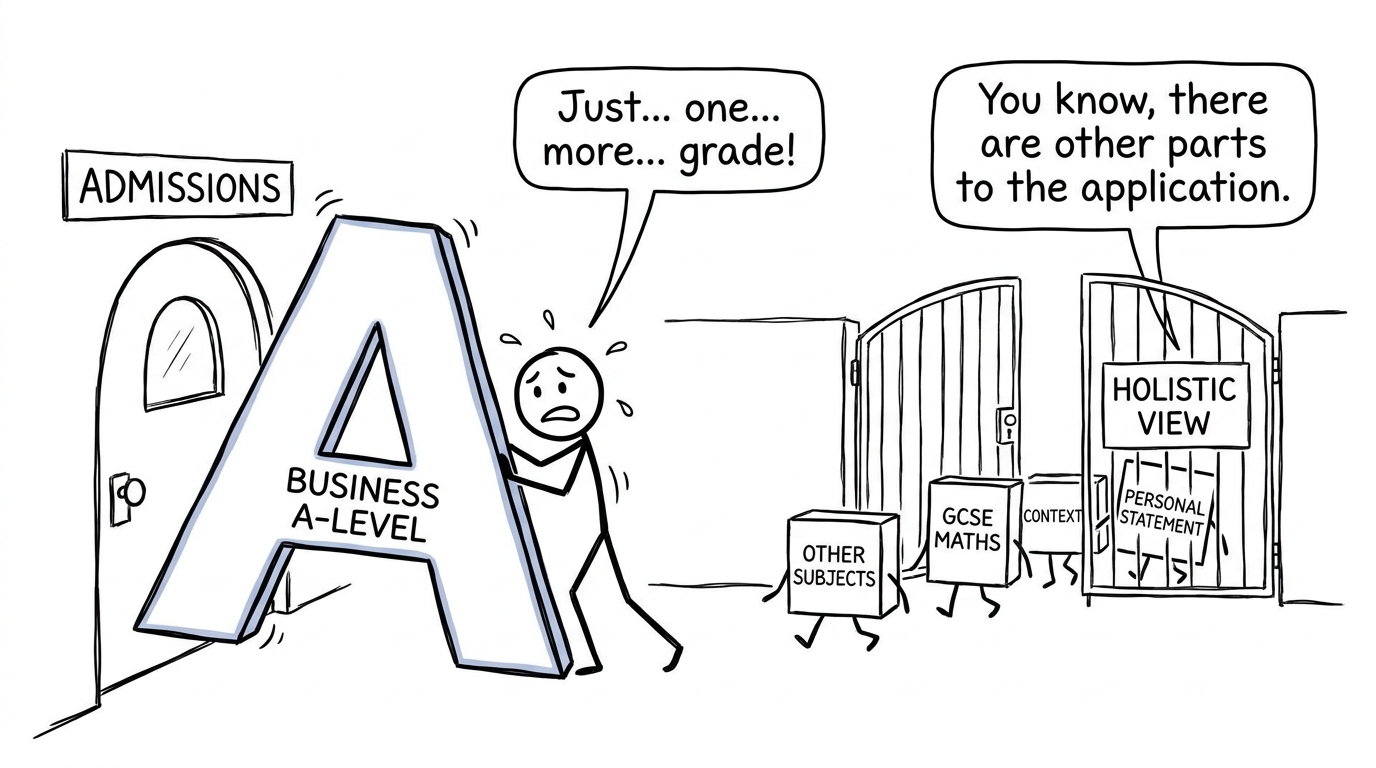 One giant grade struggles at a university door while the rest of an application enters easily
How to strengthen your position
Choose A Levels by checking real degree requirements before enrolment. MathsGenie's guide to choosing three A Level subjects is a useful degree-planning resource for comparing interests, ability and future requirements.
If you take Business, revise against your specification rather than collecting disconnected notes. The Edexcel A Level Business revision guides organise content by examinable topic. Students considering a quantitative Business, Finance or Economics pathway can also explore the A Level Maths revision hub and Edexcel A Level Maths resources.
Common mistakes when comparing university offers
Looking only at the Business grade
An offer such as AABAABAAB normally describes the whole grade combination. Check whether any subject-specific grade is required.
Ignoring GCSE conditions
Meeting the A Level offer may not override a stated GCSE Maths or English requirement. Read every section of the entry page.
Treating tariff points and grades as interchangeable
Some courses accept a tariff total; others insist on named grades. Follow the wording used by the university.
Assuming every foundation year has the same rules
Entry grades, fees, modules and progression conditions differ. Compare the complete route.
Using old requirements
Universities can revise offers and subject conditions. Check the admissions cycle in which you intend to begin the course.
Turn the requirement into a revision target
Your Business grade is not a label attached to your ability. It is one piece of evidence, sitting beside other grades and course conditions. Start with several real degree pages, record their standard and contextual offers, and identify every GCSE requirement.
Then work backwards. MathsGenie gives you free revision lessons, practice questions, mark schemes, video solutions, mini tests, past papers and predicted papers. Begin with the relevant GCSE Maths resources, repair the topics costing you marks, and keep the university doors you may want later as open as possible.











