

A-Level Biology Grade: University Entry Guide
A-Level biology grade university guide: see what A* to E can mean, compare Biology degree entry requirements, and plan realistic UK application choices.

A university offer can look deceptively simple: three letters, perhaps AAB or BBB. Yet those letters hide subject rules, GCSE conditions and practical requirements. Your A-Level Biology grade and university options are connected, but one grade never tells the whole story.
The short answer is this: an A or A* can support applications to highly selective biological sciences courses; a B opens many strong options; a C can meet some direct-entry requirements; and lower grades may lead towards foundation years or alternative routes. Always check the complete offer, including required subjects, before deciding whether a course is realistic.
Your quick university entry checklist
Before comparing courses, record:
- your predicted Biology grade and overall predicted grades;
- the exact A Level subjects required by each course;
- any minimum grade specified for Biology or another science;
- GCSE English, maths and science requirements;
- whether a pass in the practical endorsement is required;
- the standard and contextual offers;
- whether a foundation year is available.
Requirements vary by university, course and entry year. The examples below were checked against official course information available in July 2026, but you must recheck the relevant university page when applying.
A-Level Biology grade meaning, grade by grade
A Biology grade is evidence of attainment within your exam board's specification. It is not a fixed percentage: grade boundaries are set for each examination series and differ between AQA, Edexcel, OCR and Eduqas. You can compare recent results through MathsGenie's AQA A Level grade boundaries and OCR Biology grade boundaries.
More importantly, universities normally consider a grade profile rather than Biology in isolation.
| Biology grade | What it may mean for university choices |
|---|---|
| A* | You are academically well placed for demanding Biology-related courses, provided your other grades and subjects meet the offer. |
| A | Many selective biological sciences courses become realistic, although some also require another science at a high grade. |
| B | A wide range of direct-entry courses may remain available, including courses asking for profiles around AAB, ABB or BBB. |
| C | Some direct-entry courses may be possible, especially where offers include BCC or CCC and Biology is an accepted required subject. |
| D or E | Direct entry is more limited, but foundation years, further education and later progression can provide alternative routes. |
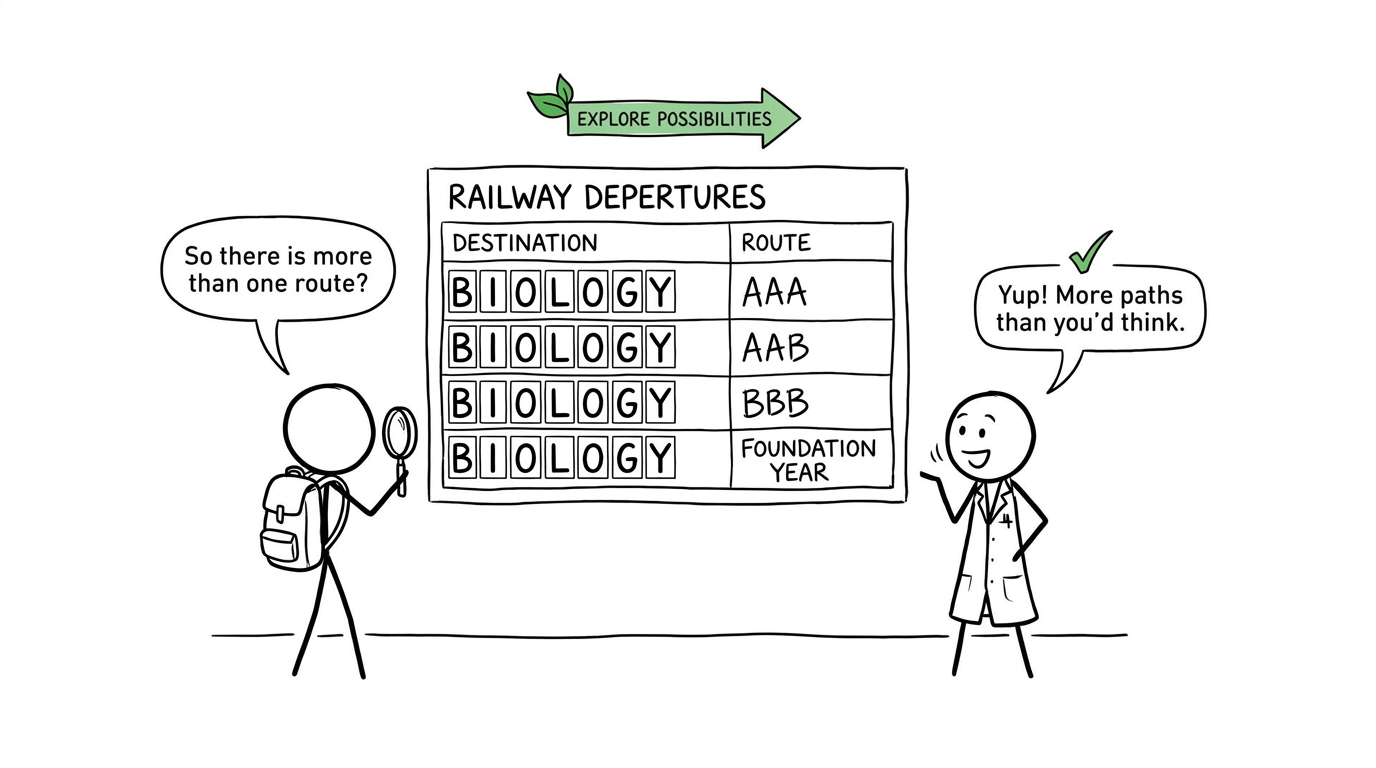 A student discovers that several university routes can lead towards Biology
Grade A* in Biology
An A* demonstrates excellent performance, but it does not replace the other conditions in an offer. A course asking for AAA may still expect three A grades and a particular second science. The A* does not automatically compensate for a missing required subject.
For example, UCL's Biological Sciences BSc requirements for 2026 entry listed AAA, with Biology and another named science, alongside GCSE English Language and Mathematics at grade 6. The important lesson is not simply “get an A*”. It is “build the correct subject and grade combination”.
Grade A in Biology
An A makes many selective Biology degrees academically plausible. Warwick's published Biological Sciences offer for 2027 entry, for example, included AAB with Biology and a second science, or AAA including Biology. Its contextual offers were lower, but still contained subject conditions.
A grade A can therefore be powerful, but read every word after “including”. Chemistry, Mathematics, Physics, Psychology or another named science may be essential or accepted as the second subject, depending on the course.
Grade B in Biology
A B is a strong result and appears within many published biology degree entry requirements. Current examples across UK universities include offers around AAB, ABB and BBB, often with Biology plus another science.
This is where course research becomes especially valuable. Two degrees with similar names can ask for different combinations. One may insist on Chemistry; another may accept Maths, Physics, Psychology, Geography or Environmental Science.
If you also take A Level Maths, use the free A Level Maths revision hub or the Edexcel A Level Maths resources to strengthen the data, probability and algebra skills that support scientific study.
Grade C in Biology
A C does not end the possibility of a Biology-related degree. Brighton's Biological Sciences BSc for 2026 entry published a range of BBB to BCC including Biology. A Dundee biological sciences course listed on UCAS for 2026 showed a standard offer of CCC including Biology or Chemistry, with additional GCSE science and maths conditions.
These examples are not promises of admission. They show why searching widely matters. Consider course content, laboratory provision, placement opportunities and location alongside the headline grades.
Grades D and E in Biology
With a D or E, direct entry to a standard Biology degree is less common. A foundation year may offer a more suitable route by adding an initial year that develops scientific knowledge and academic skills. Brighton, for example, publishes an integrated foundation-year option for applicants who do not meet its direct-entry requirements.
You could also explore retakes, an Access to Higher Education course when appropriate, or another recognised qualification. Check eligibility directly with each provider rather than assuming that every alternative route is accepted.
Why your GCSE maths grade still matters
Biology at university is not free from maths. Students work with experimental data, rates, graphs, uncertainty and statistical analysis. Some universities also specify a GCSE maths threshold: published examples range from grade 4 to grade 6 depending on the institution and course.
That makes your present GCSE preparation part of a longer story. A secure result can protect future choices even if you do not plan to take A Level Maths. Start with the GCSE Maths revision hub, select Edexcel, AQA, OCR or Eduqas, and match your practice to the correct foundation or higher tier.
MathsGenie's GCSE Biology practical skills guide also shows how variables, rates, sampling and percentage change connect scientific thinking with numeracy.
 A calculator in a lab coat explains that data belongs in Biology too
Predicted grades, offers and contextual admissions
Predicted grades help universities assess an application, but institutions use them in different ways. A conditional offer states what you must achieve, usually through a combination of grades and named subjects.
Some applicants may qualify for contextual consideration because universities assess achievement in light of educational or personal circumstances. A contextual offer can reduce the standard grade requirement, but it remains conditional. Check each institution's eligibility rules rather than assuming that a lower published offer applies automatically.
If you are still choosing sixth-form subjects, read how to choose your three A Level subjects. Work backwards from several possible degrees so that one missing subject does not close an otherwise suitable route.
Common mistakes when comparing Biology entry requirements
Reading only the headline grades
AAB may also mean Biology plus Chemistry, a pass in the practical endorsement and a particular GCSE maths grade. Copy the whole requirement into your shortlist.
Treating a predicted grade as a guaranteed result
Predicted grades support an application; achieved grades determine whether most conditional offers are confirmed. Keep revising after receiving an offer.
Assuming every Biology degree requires the same subjects
Biological sciences, biochemistry, biomedical science, ecology and neuroscience can have very different requirements. Chemistry may be compulsory for one course but not another.
Ignoring contextual and foundation routes
A standard offer is not always the only route. Check contextual eligibility and foundation-year requirements separately.
Revising by rereading alone
Active practice reveals gaps more honestly. Use the AQA A Level Biology question bank, then mark carefully and revisit weak topics.
Turn a grade into a plan
An A-Level Biology grade meaning is not a verdict on your future. It is one piece of evidence that helps you build an informed university shortlist. Compare ambitious, realistic and safer choices; check subject and GCSE conditions; and confirm every requirement for your actual entry year.
Then improve what is still within your control. MathsGenie brings together free revision lessons, practice questions, past papers, predicted papers, mini tests, mark schemes and video solutions. Start with the resource matching your exam board, practise under timed conditions and turn each lost mark into a clear next step. A university offer may be written in three letters, but reaching it is usually built one corrected question at a time.











