

A-Level Biology Career Paths After Results Day
A-level biology career paths explained: explore realistic UK degrees, apprenticeships and jobs, plus clear next steps for results day and Clearing.

Results day can make one letter feel heavier than it is. Yet your Biology result does not decide your whole future. A-level biology career paths include healthcare, laboratory science, biotechnology, conservation, data-led research and education. Some require a particular degree; others offer apprenticeships or technician routes.
The important question is not simply, “What job can I get with this grade?” It is, “Which routes remain realistic when I consider my complete results, interests and course requirements?”
For students planning ahead, A-level results day in England, Wales and Northern Ireland is Thursday 13 August 2026. Course requirements and available Clearing places can change, so always check the current information from universities, employers and professional bodies.
Your results-day checklist
Before making a decision:
- Check whether your firm or insurance university place has been confirmed.
- Read your actual subject grades rather than relying only on your application status.
- Compare your complete results with each course’s subject requirements.
- Ask whether the degree has professional accreditation where this matters.
- Consider foundation years, apprenticeships and related courses alongside traditional degrees.
- Speak to your school or college before requesting a review of marking or committing to a resit.
A Biology grade opens possibilities, but it works alongside your other subjects, GCSE results, practical experience and personal interests.
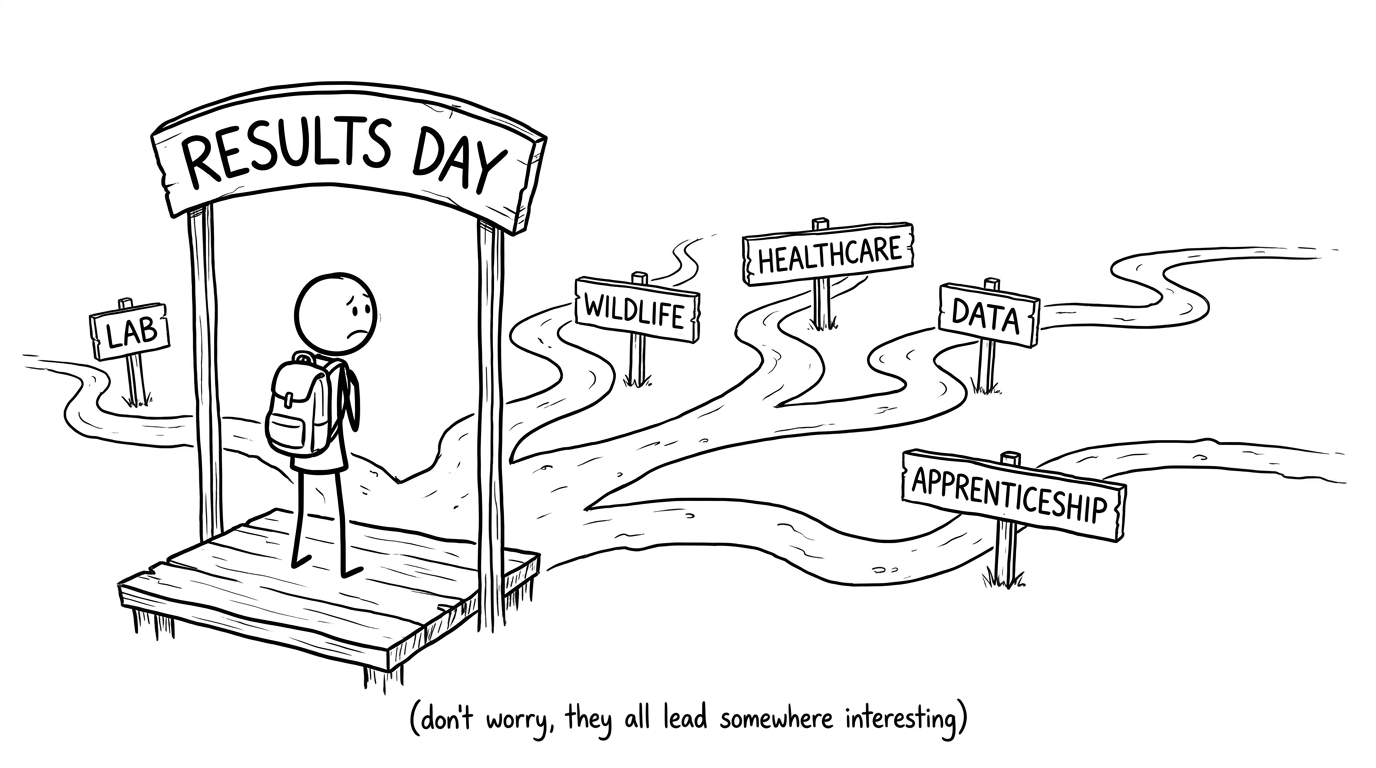 A student discovers that results day has several possible routes
A-level biology career paths by area
Healthcare and patient science
Biology supports applications to medicine, dentistry, nursing, physiotherapy, radiography, dietetics and several healthcare science courses. It is not, however, a universal entry ticket.
Medical schools set their own conditions. Most expect very high A-level grades, while many specify Chemistry and another science, sometimes Biology. Admissions tests, interviews and evidence that you understand the profession may also form part of selection.
A realistic pairing might be:
- Course: medicine
- Possible career: doctor
- Check carefully: required science subjects, admissions test, GCSE profile and interview arrangements
Biomedical science is another important route. If your aim is to become a registered biomedical scientist working with patient samples, check that the degree meets the relevant professional requirements and supports the necessary laboratory training. A broadly named biomedical sciences degree does not automatically provide the same professional route.
- Course: accredited biomedical science
- Possible career: biomedical scientist or laboratory-based healthcare role
- Alternative route: healthcare science or laboratory degree apprenticeship
Research, biotechnology and pharmaceuticals
Students who enjoy cells, genetics and experimental work might consider biological sciences, biochemistry, microbiology, genetics, pharmacology or biotechnology.
These can lead towards laboratory technician work, quality assurance, clinical research, scientific communication, manufacturing or further research training. Some research posts later require a master’s degree or PhD, so look beyond the course title and examine its modules, placements and graduate routes.
- Course: biotechnology or biochemistry
- Possible career: biotechnologist, laboratory scientist or quality-control specialist
- Useful preparation: accurate data handling, practical competence and confident maths
The AQA A-level Biology question bank is useful here because application questions develop the habit that scientific work demands: interpreting evidence rather than recalling isolated facts. You can also revisit DNA replication revision if genetics and molecular biology appeal to you.
Ecology, conservation and animal science
Biology also leads outside the laboratory. Ecology, environmental biology, zoology, marine biology and conservation courses can support careers involving habitats, wildlife, environmental consultancy or field research.
- Course: ecology, zoology or conservation biology
- Possible career: ecologist, zoologist or conservation officer
- Check carefully: fieldwork, placement opportunities and whether postgraduate training is common in your preferred specialism
Relevant experience can matter because these fields combine scientific knowledge with observation, recording, teamwork and communication. Maths remains present too: ecologists analyse samples, variation and population data rather than simply identifying species.
Students interested in this direction can explore the ideas behind the subject through the OCR A ecosystems revision guide.
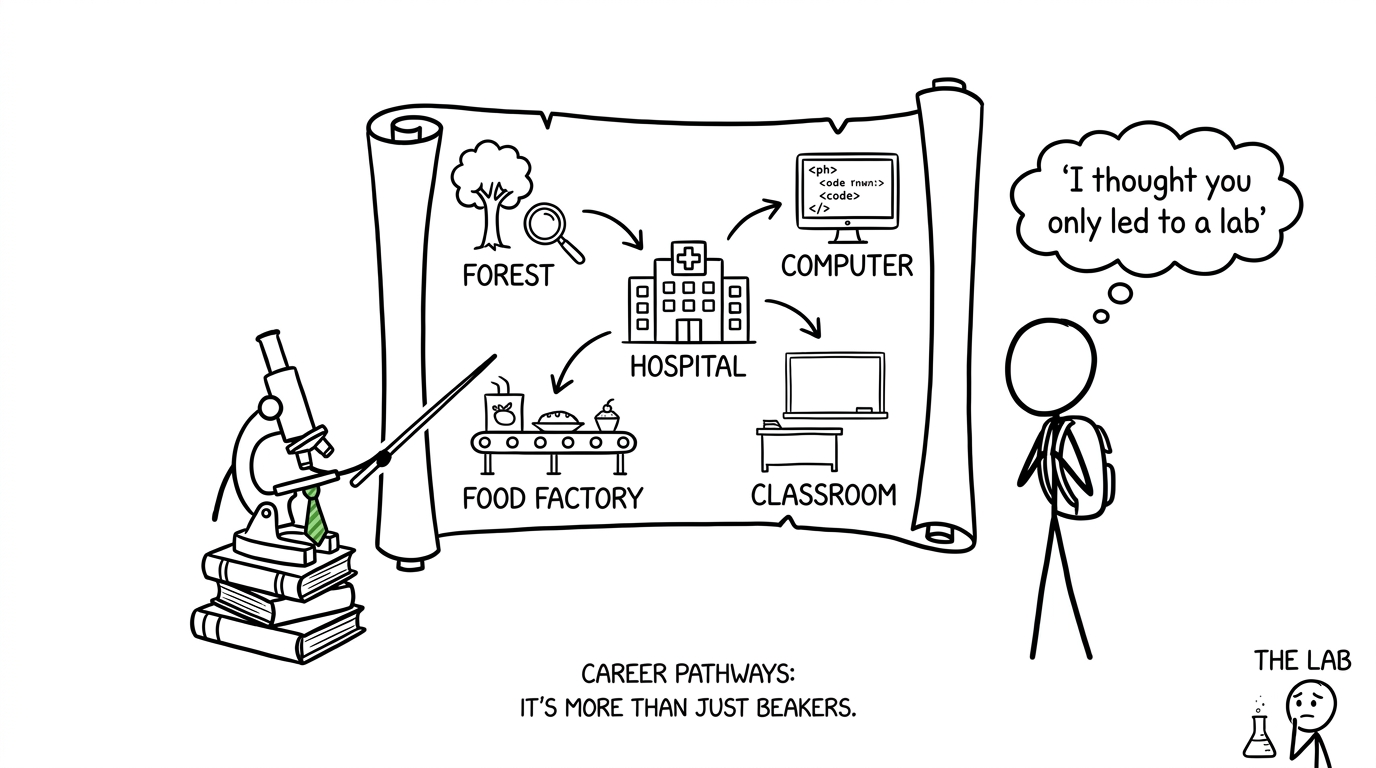 A microscope reveals that Biology leads far beyond the laboratory
Biology combined with maths and data
Modern biology is increasingly quantitative. Genetics, epidemiology, ecology, neuroscience and drug research all involve data interpretation. Course titles such as bioinformatics, computational biology and biostatistics sit where biological questions meet computing and maths.
A simple percentage change may begin with
percentage change=new value−original valueoriginal value×100.\text{percentage change}=\frac{\text{new value}-\text{original value}}{\text{original value}}\times 100.percentage change=original valuenew value−original value×100.But the larger skill is deciding what the result means, whether the evidence is reliable and how uncertainty affects a conclusion.
If you are still completing GCSEs, protecting your maths foundations now keeps more science routes available later. Use the GCSE Maths revision hub for your exam board, then move to A-level Maths revision if you choose the subject at sixth form.
What if your Biology grade is lower than expected?
A missed offer is not the same as a closed career. You may still have several options:
- contact the university and wait for its formal decision;
- compare related courses through Clearing;
- investigate a foundation year;
- consider a laboratory or healthcare apprenticeship;
- study a broader bioscience degree before specialising;
- resit if a specific career genuinely requires a stronger grade.
Do not assume that similarly named courses have identical requirements. One biomedical science course might ask for Biology plus another science, while another may accept a different combination. Requirements also vary by university and year.
Common mistakes when choosing a route
Treating one grade as the whole decision. Universities and employers may consider subject combinations, GCSEs, interviews, practical experience and other evidence.
Choosing a course only because its title sounds right. Read the modules, placement details, professional accreditation and progression routes.
Assuming Biology alone is enough for medicine. Chemistry and another science are frequently specified, but every medical school sets its own requirements.
Ignoring apprenticeships. Technician, healthcare science and degree-apprenticeship routes can combine employment with recognised training.
Underestimating maths. Graphs, rates, sampling and statistical reasoning run through both A-level Biology and many biological careers.
Turn the next decision into a useful one
A result is information, not an identity. Strong grades may confirm your original plan. Different grades may reveal a foundation course, apprenticeship or neighbouring discipline that suits you better.
Start with the free A-level Biology revision hub, choose your exam board and use revision lessons, practice questions, mini tests, past papers and mark schemes to identify what needs work. AQA students can go directly to the AQA A-level Biology revision page, while students strengthening genetics can use the inheritance lessons.
MathsGenie gives you a calm revision loop: learn the content, answer questions, study the mark scheme and return to the mistakes. Whether you are choosing A levels at GCSE or preparing for results day, that loop turns uncertainty into a practical next step.










