1.8 E: Trigonometry
123456789101112131415161718192021222324252627282930313233343536373839404142434445464748495051525354555657585960616263646566676869707172737475767778798081828384858687888990919293949596979899100101102103104105106107108109110111112113114115116117118119120121122123124125126127128129130131132133134135136137138139140141142143144145146147148149150151152153154155156157158159160161162163164165166167168169
Question 88
A design for a decorative stained-glass window panel is shown below. The design consists of a sector OBC OBC\,OBC of a circle with centre OOO, flanked by two congruent triangles OAB OAB\,OAB and ODCODCODC. The point O O\,O lies on the straight base ADADAD. The points B B\,B and C C\,C lie on the arc of the circle. The side lengths AB AB\,AB and DC DC\,DC are equal, and the angles ∠AOB \angle AOB\,∠AOB and ∠DOC \angle DOC\,∠DOC are equal and acute.
Given that:
- angle BOC=1.8BOC = 1.8BOC=1.8 radians
- area of sector OBC=24.3 cm2OBC = 24.3 \text{ cm}^2OBC=24.3 cm2
- AOD AOD\,AOD is a straight line of length 15.0 cm
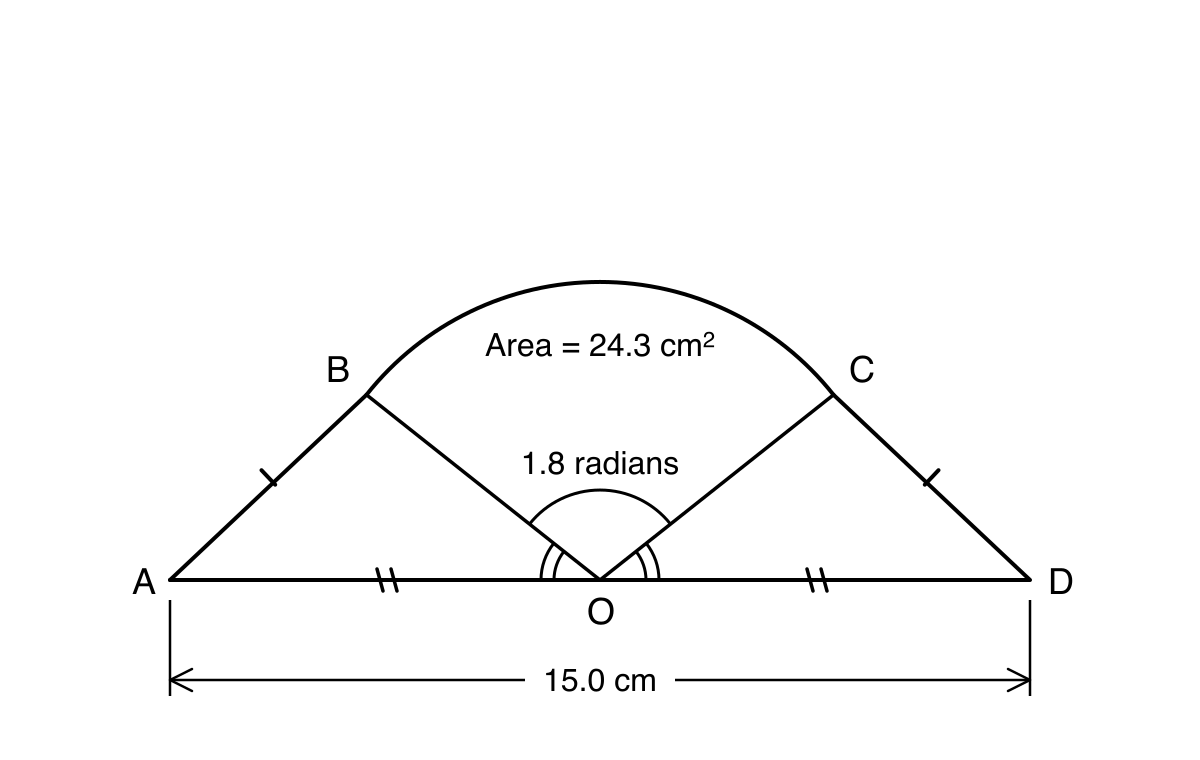
a.[2]
Find the radius of the sector, giving your answer in cm\text{cm}cm to 2 decimal places.
b.[2]
Find the size of angle AOBAOBAOB, in radians, to 2 decimal places.
c.[3]
Hence find: the total area of the window panel, giving your answer in cm2\text{cm}^2cm2 to one decimal place.
d.[3]
the total perimeter of the panel, giving your answer in cm\text{cm}cm to one decimal place.
1.8 E: Trigonometry Questions
317 exam-style questions on AQA A Level Maths 1.8 E: Trigonometry, covering 1.8.1 Trigonometric definitions, rules and radians, 1.8.2 Small angle approximations (A-level only), 1.8.3 Trigonometric functions and exact values, 1.8.4 Reciprocal and inverse trigonometric functions (A-level only), 1.8.5 Trigonometric identities, 1.8.6 Compound and double angle formulae (A-level only), 1.8.7 Solving trigonometric equations, 1.8.8 Proofs with trigonometric identities, and 1.8.9 Trigonometry in context. Each one has a worked solution and a mark scheme showing where the marks go.