A patient presents with extreme thirst and the persistent excretion of large volumes of very dilute urine. Blood tests reveal that the patient has a low blood plasma water potential, yet their circulating concentration of antidiuretic hormone (ADH) is abnormally high.
The diagram below shows a collecting duct epithelial cell from a healthy individual.
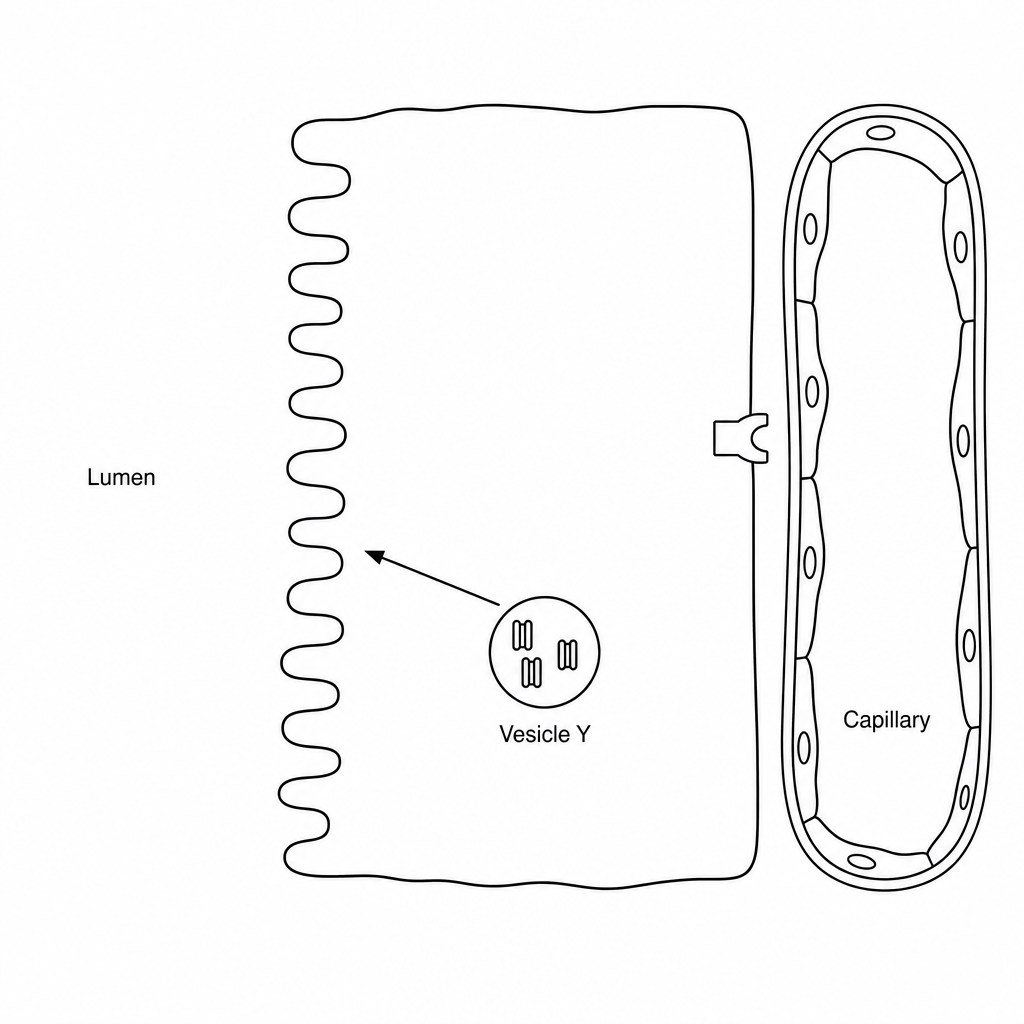
Which of the following cellular-level malfunctions explains the patient's symptoms?
A loss-of-function mutation in Receptor X on the basolateral membrane, which prevents ADH binding and stops Vesicle Y from fusing with the apical membrane.
An over-activation mutation in Receptor X, causing it to continuously trigger the fusion of Vesicle Y with the apical membrane in the absence of ADH.
Inhibition of the active transport of sodium and chloride ions out of the ascending limb of the loop of Henle, preventing the fusion of Vesicle Y.
A decrease in the transcription of the gene encoding Receptor X, leading to increased exocytosis of Vesicle Y to compensate.