High-precision automated manufacturing systems often use advanced sensor technology to monitor and control processes.
Describe the differences between analogue and digital signals. You may draw a diagram to support your answer.
An industrial LIDAR sensor is positioned above a high-precision silicon wafer to measure its thickness.
A laser pulse is emitted from the transmitter on the sensor. It is then reflected from the reflective surface of the wafer and received at the detector.
The equation linking average speed, distance moved and time taken is:
average speed=distance movedtime taken \text{average speed} = \frac{\text{distance moved}}{\text{time taken}} average speed=time takendistance movedThe distance between the reflective surface of the wafer and the sensor is 4.8 mm4.8\text{ mm}4.8 mm.
The laser light travels at an average speed of 3.0×10⁸ m/s3.0 \times 10^8\text{ m/s}3.0×108 m/s between the sensor and the wafer.
Calculate the time taken for the laser light to be received at the detector after it is emitted from the sensor.
A geophone is a highly sensitive seismic sensor used to record ground vibrations so that they can be processed and stored on a digital medium.
The diagram shows the construction of a geophone.
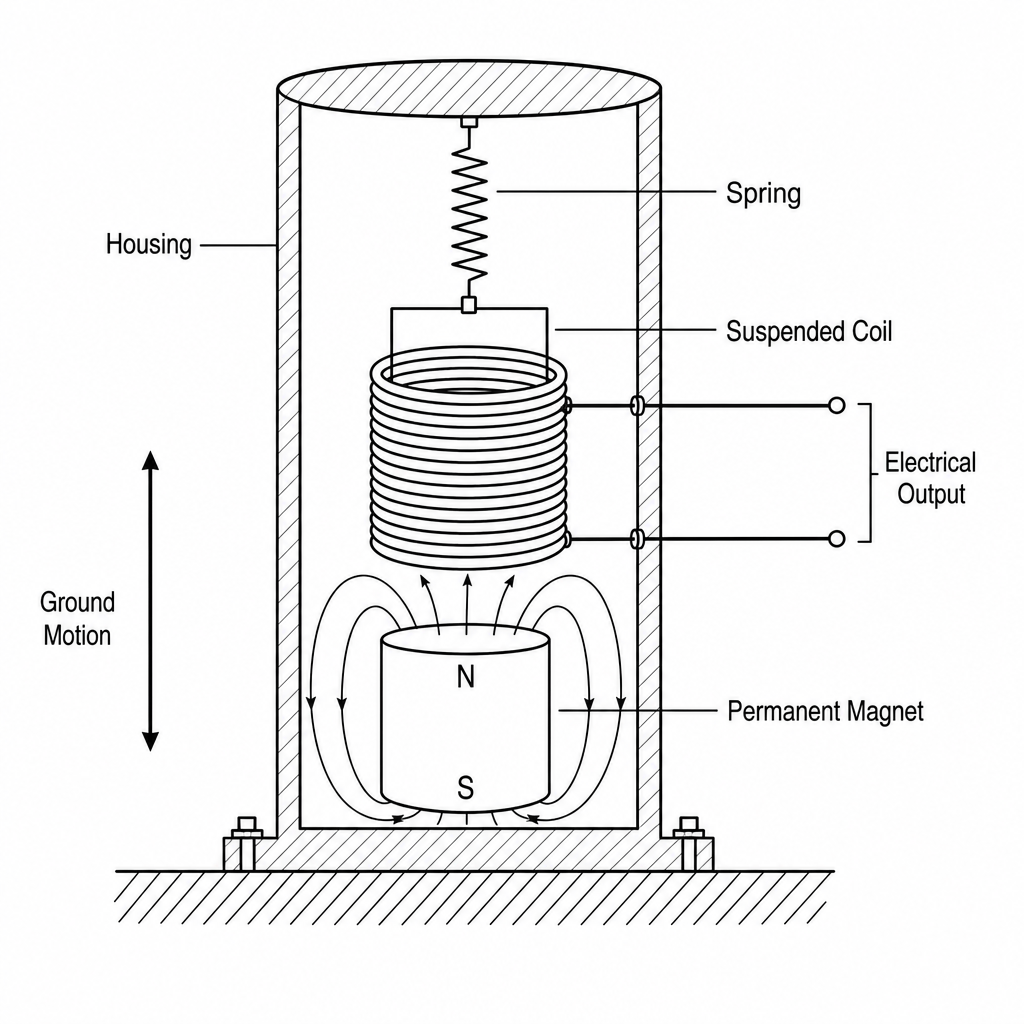
Explain how the geophone produces an electrical signal from ground vibrations.

