Skip to content
MathsGenie logo
Quick links
Open app

Course home

  1. IGCSE
  2. Physics Edexcel
  3. Question bank

Electromagnetic induction

MediumHard
1234567891011121314151617181920212223242526272829
Question 21

A student is investigating the transmission and recording of sound.

a.

The recording equipment is connected to a power supply providing an alternating current (a.c.).

What is alternating current?

[1]
b.

Signals can be sent as infrared waves through glass optical fibers.

Suggest a property of infrared waves that makes them suitable for transmission in optical fibers.

[1]
c.

Complete the table to show uses and possible harmful effects of some other parts of the electromagnetic spectrum.

Part of electromagnetic spectrumUsePossible harmful effect on people
gamma rays
infrared
[4]
d.

Sound is detected using a moving-coil microphone.

The diagram shows the construction of a moving-coil microphone.
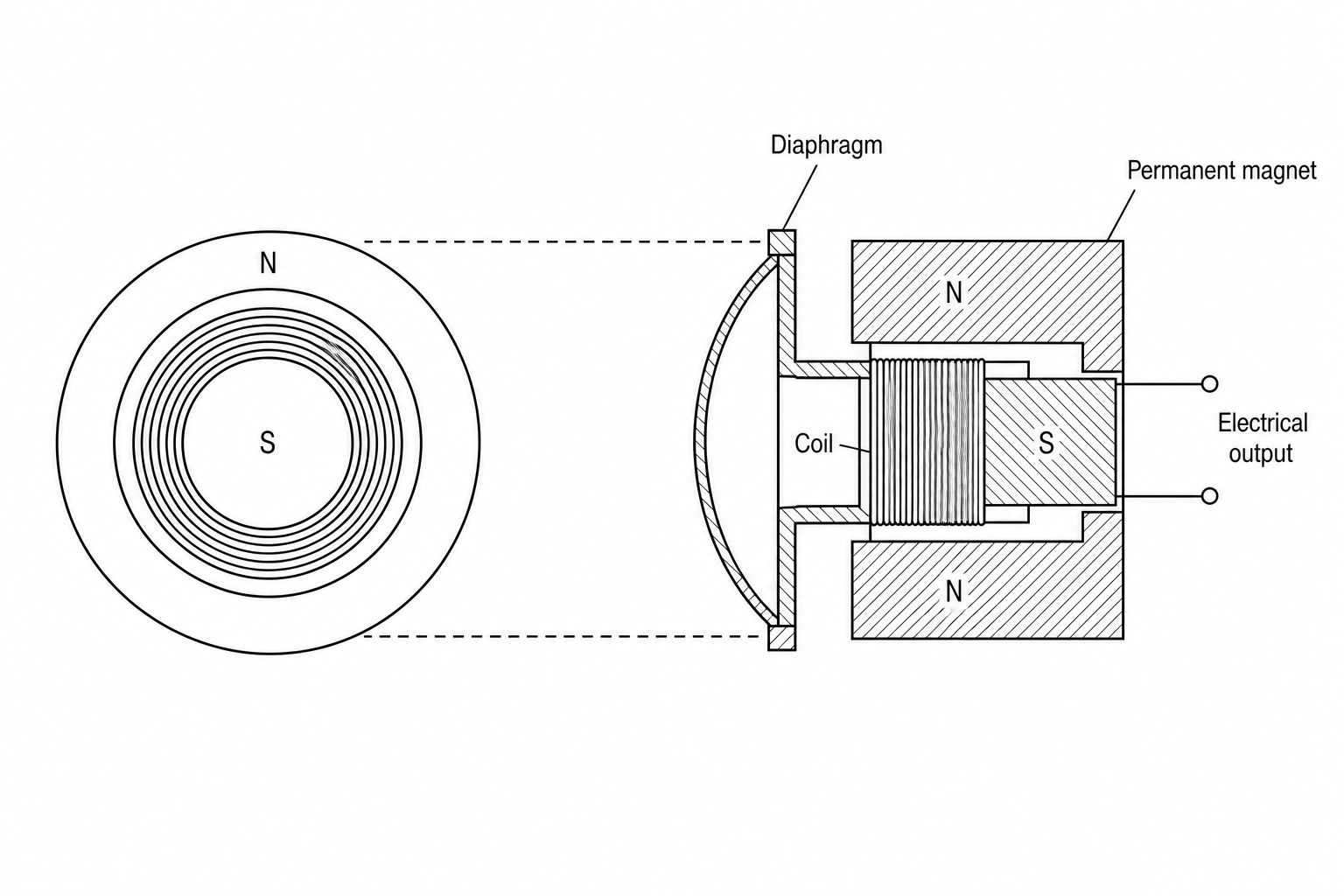
A cross-sectional diagram of a moving-coil microphone. On the left, a front-on circular view shows an outer ring of north poles (labeled N) and a central south pole (labeled S), with concentric circles representing the coil positioned in the gap. Dashed alignment lines project to the right-hand side, which shows the side cross-section. The side profile shows a flexible dome-shaped diaphragm labelled 'diaphragm' connected to a cylinder labelled 'coil on tube'. The coil of wire is wound around a central magnetic pole labelled 'S' in the middle, surrounded by outer magnetic poles labelled 'N' of a permanent magnet. Electrical output wires extend from the coil. When sound waves hit the dynamic diaphragm, it vibrates back and forth along the axis of the magnetic poles.

Describe how a moving-coil microphone uses sound waves to produce an electrical signal.

[6]

Electromagnetic induction Questions

  1. IGCSE
  2. /Physics
  3. /Electromagnetic induction
