The alkanes are a homologous series of saturated hydrocarbons obtained from fractions of crude oil.
Describe how crude oil is separated into fractions in an industrial fractionating column.
State the general formula of the alkanes.
State two characteristics, other than having the same general formula, of members of any homologous series.
Hexane is an alkane used as an industrial solvent. Balance the equation for the complete combustion of hexane:
C6H14+…O2→…CO2+…H2O \text{C}_6\text{H}_{14} + \dots \text{O}_2 \rightarrow \dots \text{CO}_2 + \dots \text{H}_2\text{O} C6H14+…O2→…CO2+…H2OIncomplete combustion of hexane leads to the formation of a poisonous gas. Identify this gas.
Explain why this gas is poisonous to humans.
During the combustion of fuels at high temperatures inside a car engine, nitrogen oxides represented by the formula NOx\text{NO}_xNOx can form. Describe how these gases are formed in the engine.
The alkane C5H12\text{C}_5\text{H}_{12}C5H12 has three structural isomers. The fully displayed formula of one of these isomers (2-methylbutane) is shown below:
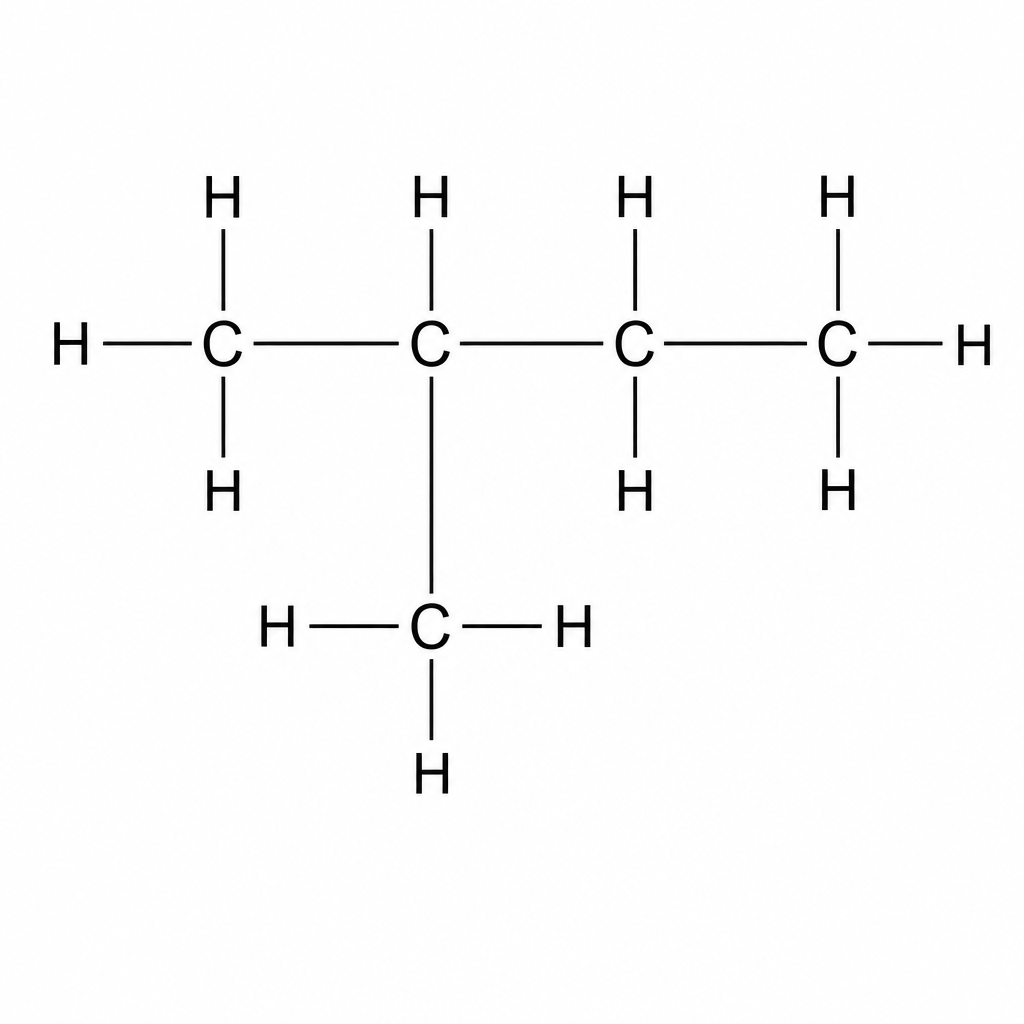
Draw the fully displayed formulae of the other two structural isomers.
Propylene glycol is a compound used in eco-friendly antifreeze formulations. A sample of compound Y has this composition by mass:
C=47.4%,H=10.5%,O=42.1% \text{C} = 47.4\%, \quad \text{H} = 10.5\%, \quad \text{O} = 42.1\% C=47.4%,H=10.5%,O=42.1%Use this information to calculate the empirical formula of Y.
The relative formula mass of Y is 76. Determine the molecular formula of Y.

