The production of polymers from crude oil involves several industrial processes, including fractional distillation, cracking, purification, and polymerisation.
Three of the fractions obtained from fractional distillation of crude oil are refinery gases, kerosene, and heavy fuel oil.
Identify which of these fractions has the highest viscosity.
Identify which of these fractions has the lowest boiling point.
Identify which of these fractions contains molecules with the smallest number of carbon atoms.
Cracking in industry is carried out at high temperatures in the presence of a catalyst.
Name a catalyst used in industrial cracking.
One reaction that occurs in cracking involves the conversion of one molecule of hexadecane (C16H34\text{C}_{16}\text{H}_{34}C16H34) into one molecule of octane (C8H18\text{C}_8\text{H}_{18}C8H18) and two molecules of an alkene. Complete the equation for this reaction.
C16H34→C8H18+‾ \text{C}_{16}\text{H}_{34} \rightarrow \text{C}_8\text{H}_{18} + \mathord{\underline{\quad\quad\quad\quad\quad}} C16H34→C8H18+Give three reasons why cracking is carried out in the oil industry.
One of the compounds sometimes present as an impurity in crude oil is methanethiol, CH4S\text{CH}_4\text{S}CH4S. Explain why it is important to remove this compound from a fuel before it is burned.
One compound obtained from crude oil is fluoroethene, which is used as a monomer in polymerisation.
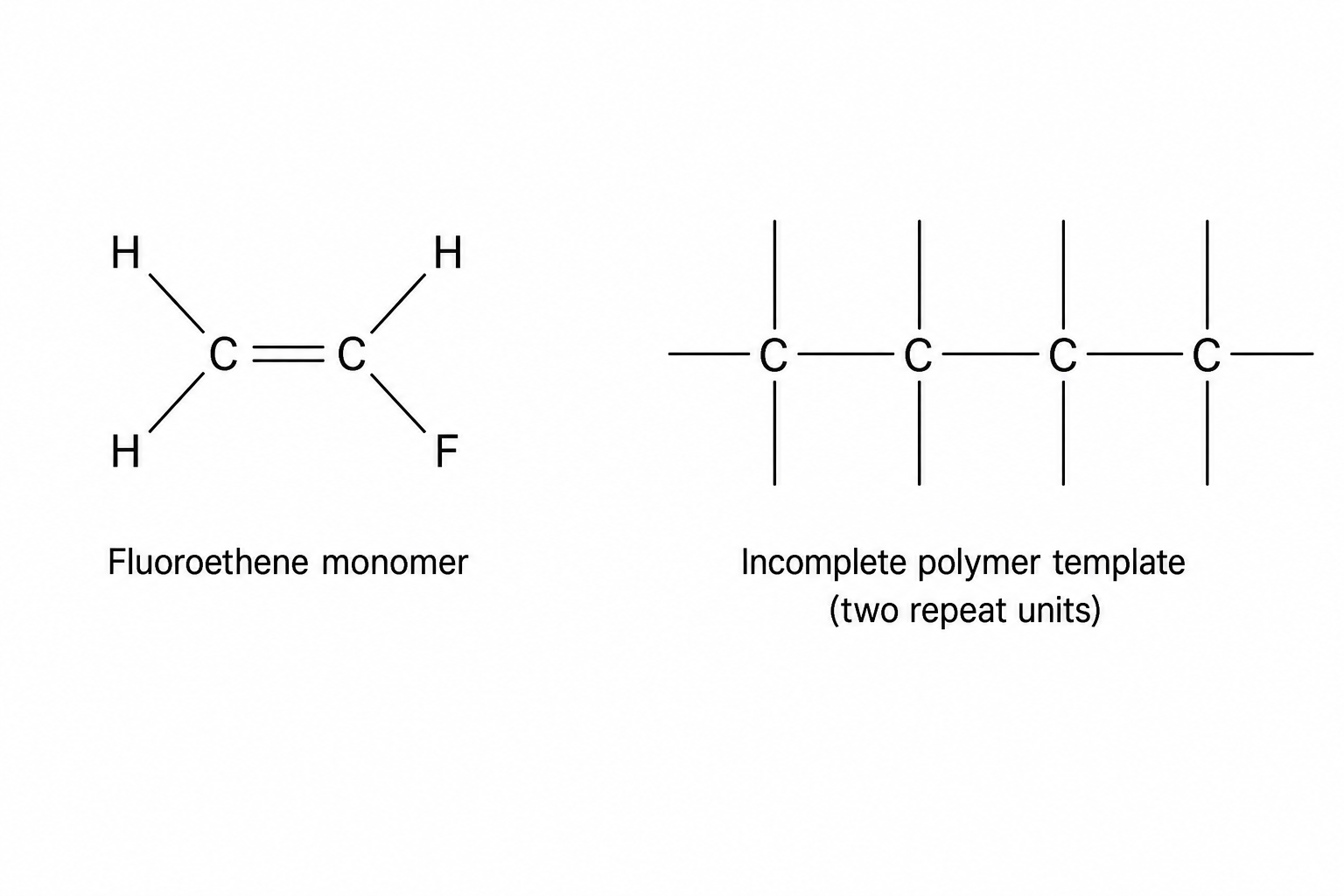
Complete the structure of the polymer template to show two repeat units of the polymer formed from fluoroethene.

