Fig. 22.1 shows a ray of red light from a laser entering a rectangular plastic block from the air.
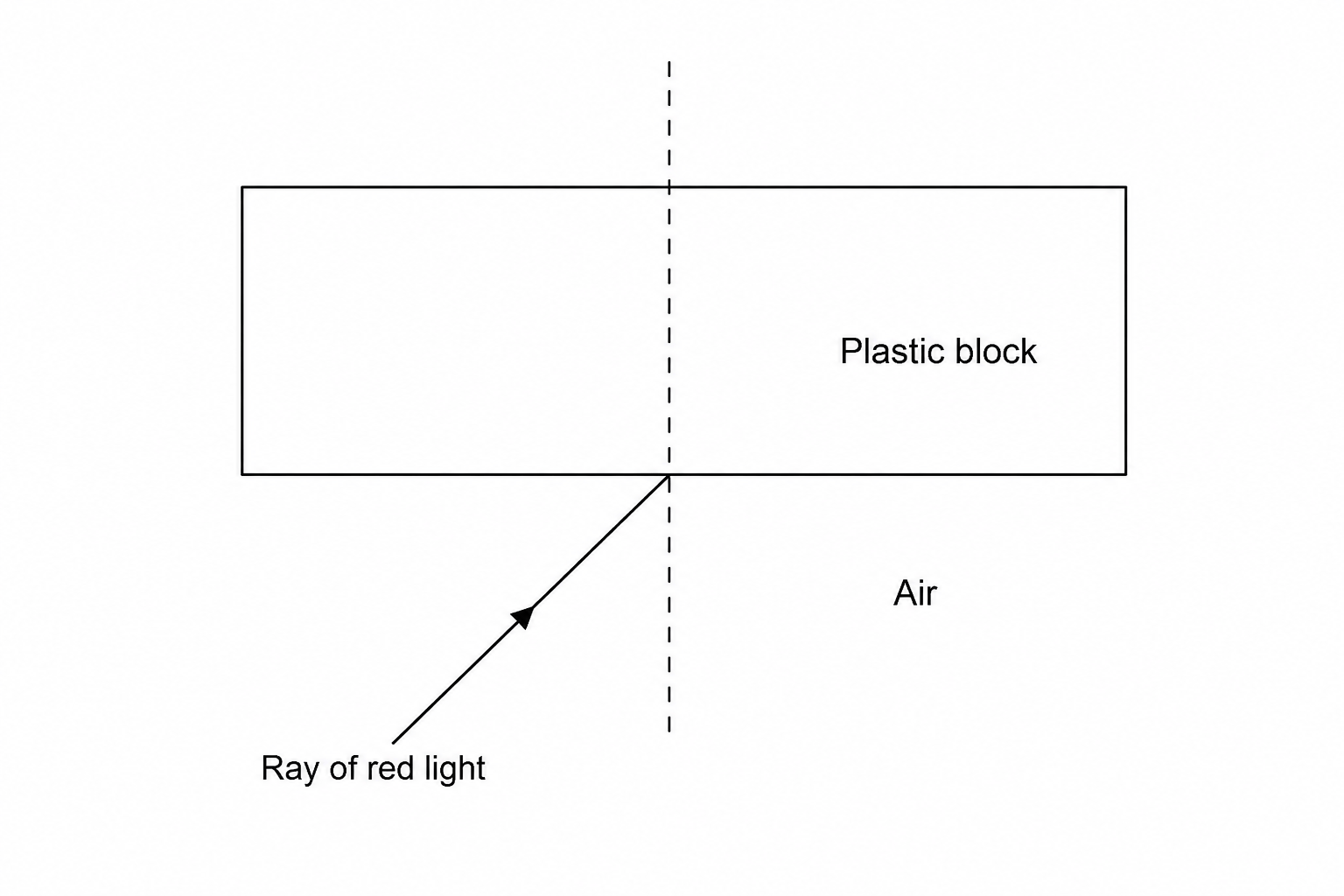
When the red light enters the plastic block from the air it will refract.
Draw the path of the refracted ray inside the plastic block in Fig. 22.1.
Explain why red light refracts as it enters the plastic block.
A student uses the red laser and plastic block to investigate the relationship between the angle of incidence and angle of refraction for the plastic.
The table shows the student's results.
| Angle of incidence (∘^{\circ}∘) | Angle of refraction (∘^{\circ}∘) |
|---|---|
| 20 | 13 |
| 35 | 23 |
| 50 | 31 |
| 65 | 37 |
Describe a method the student could have used to investigate this relationship.
The student concludes that the angle of incidence is directly proportional to the angle of refraction. Show that the student is incorrect. Use data from the table.
The student replaces the red laser with a blue laser and repeats the experiment for the same angles of incidence.
The student notices that the angles of refraction for the blue light are all different from the angles of refraction for the red light.
Explain why the angles of refraction are different when light of a different colour is used.
The student replaces the plastic block with a glass lens and directs both the red and blue lasers into the lens at the same time as shown in Fig. 22.2.
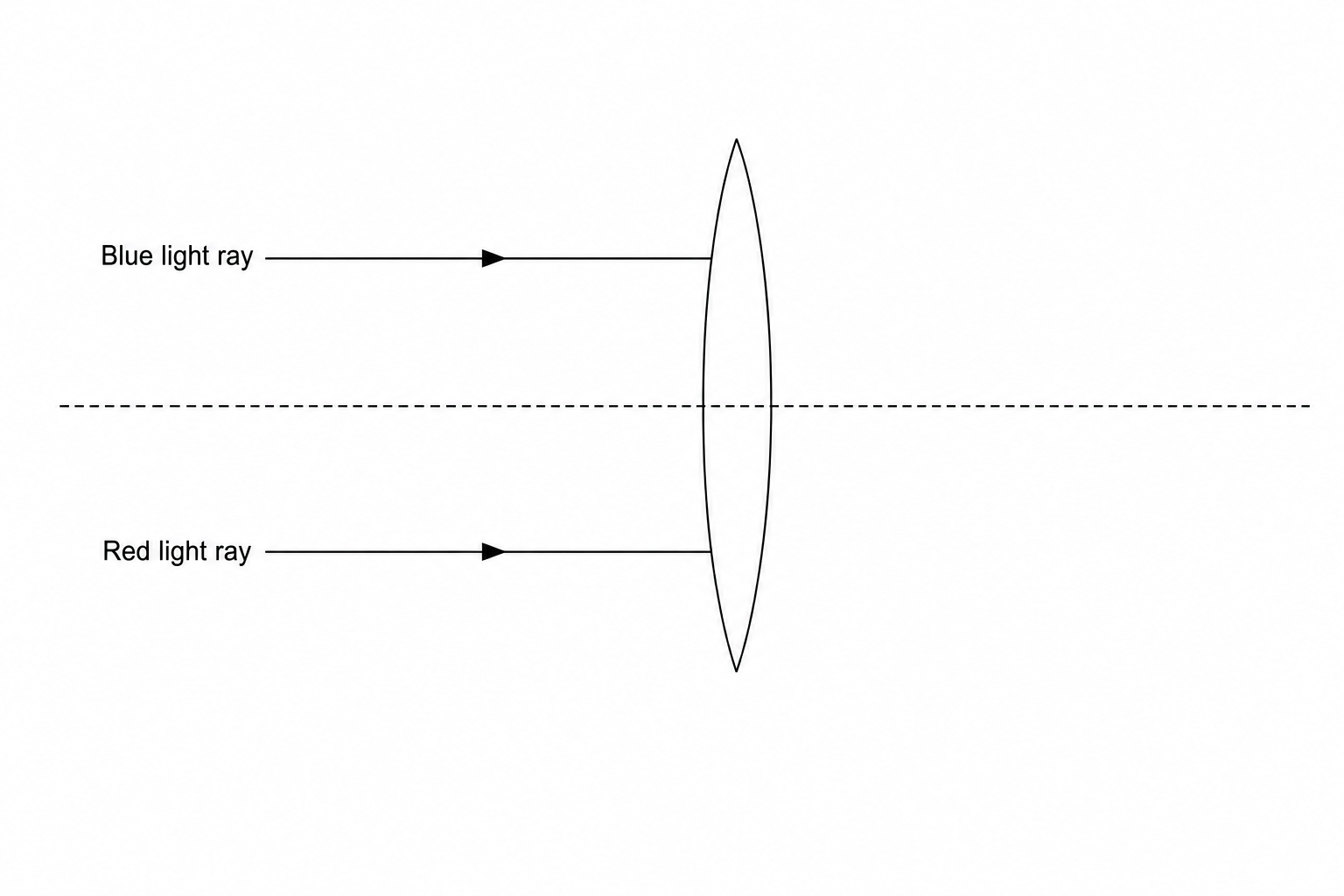
Complete Fig. 22.2 by continuing the paths of the red and blue light rays.