Wave behaviour

EasyMediumHard
123456789101112131415161718192021222324252627282930313233343536373839404142434445464748
Question 33
Medium

(a) Lenses can be used to help people see clearly.
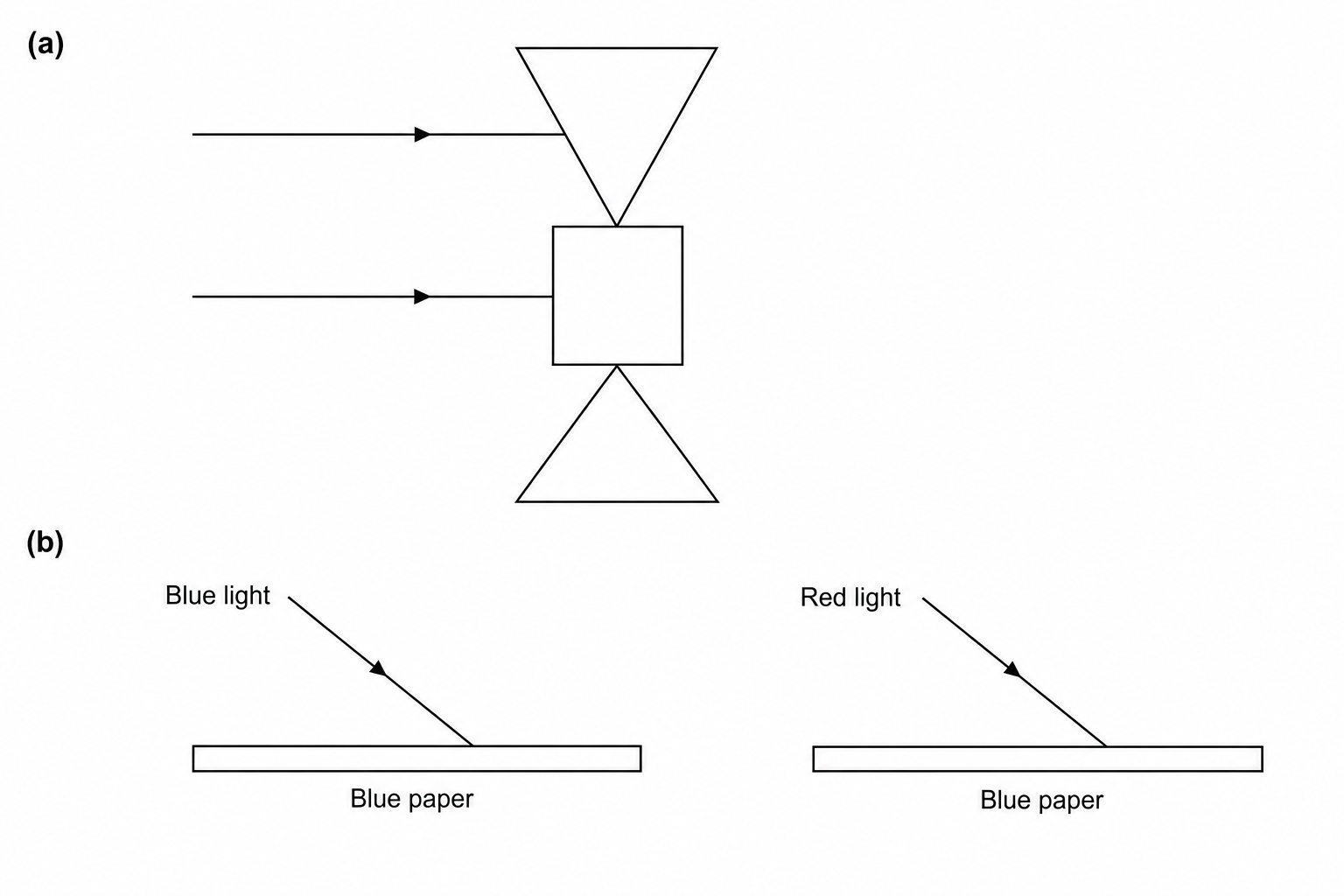
A schematic diagram showing two parts, (a) and (b). Part (a) shows a model of a concave lens made of three glass shapes stacked vertically: at the top is a triangular prism with its flat base on top and its sharp vertex pointing downwards; in the middle is a square glass block; below that is a triangular prism with its base at the bottom and its vertex pointing upwards. Two horizontal incoming light rays, represented by straight lines with arrows pointing to the right, are shown: the upper ray is aligned with the middle of the top prism, and the lower ray is aligned with the middle of the square block. Part (b) shows two diagrams: on the left, an incoming ray labeled 'Blue light' points down and right towards a flat parallelogram labeled 'Blue paper'; on the right, an incoming ray labeled 'Red light' points down and right towards an identical flat parallelogram labeled 'Blue paper'.

a.

Complete the ray diagram for part (a) to show how the light rays travel through and emerge from this model concave lens (glass prisms and glass block).

[2]
b.

Explain how a concave lens can correct short-sighted vision. Use the model to help you.

[3]
c.

A student looks at blue paper in different coloured light. She looks at the blue paper with blue light. The paper appears blue. What colour does the blue paper appear in red light? Explain your answer.

[3]

Wave behaviour Questions

  1. GCSE
  2. /Physics
  3. /Wave behaviour