a.[2]
A student draws a diagram to show the reflection of a light ray from a plane mirror.
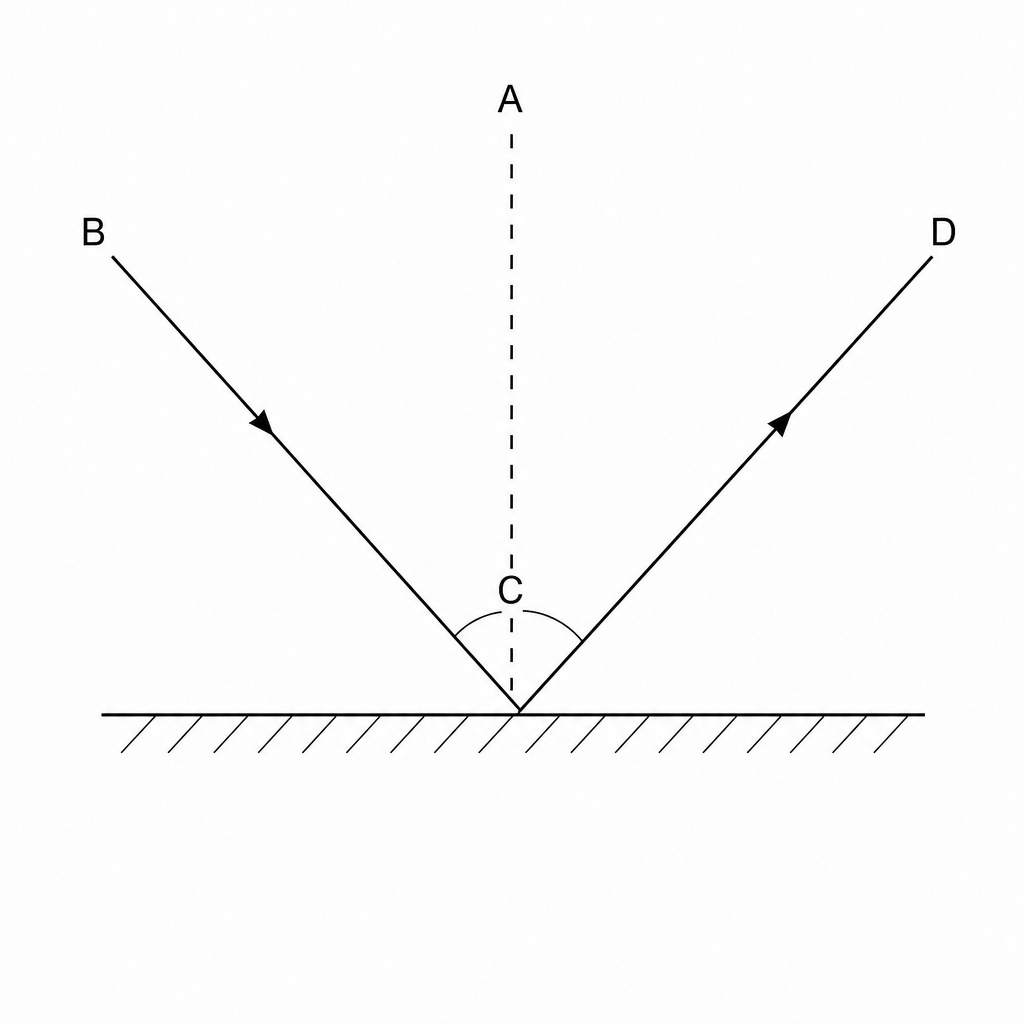
Line B is the incident ray. What are the names of line A and angle C?
Line A: _________________________________________\text{\_\_\_\_\_\_\_\_\_\_\_\_\_\_\_\_\_\_\_\_\_\_\_\_\_\_\_\_\_\_\_\_\_\_\_\_\_\_\_\_\_}_________________________________________
Angle C: _________________________________________\text{\_\_\_\_\_\_\_\_\_\_\_\_\_\_\_\_\_\_\_\_\_\_\_\_\_\_\_\_\_\_\_\_\_\_\_\_\_\_\_\_\_}_________________________________________
b.[9]
The student does an experiment to investigate how light refracts when it enters a rectangular glass block from air.
The equipment available is:
- Ray box with one slit
- Rectangular glass block
- Pencil, ruler, and paper
- Protractor
Describe how the student does the experiment.
In your answer include:
- how the student sets up the equipment and marks the paths of the rays
- what measurements the student needs to take
- a prediction of what the student will find out from their results, comparing the angle of incidence and the angle of refraction.