Forces and motion

EasyMediumHard
12345678910111213141516171819202122232425262728293031323334353637383940414243444546474849505152535455565758596061626364
Question 59
Medium

A cyclist goes for a ride along a track.
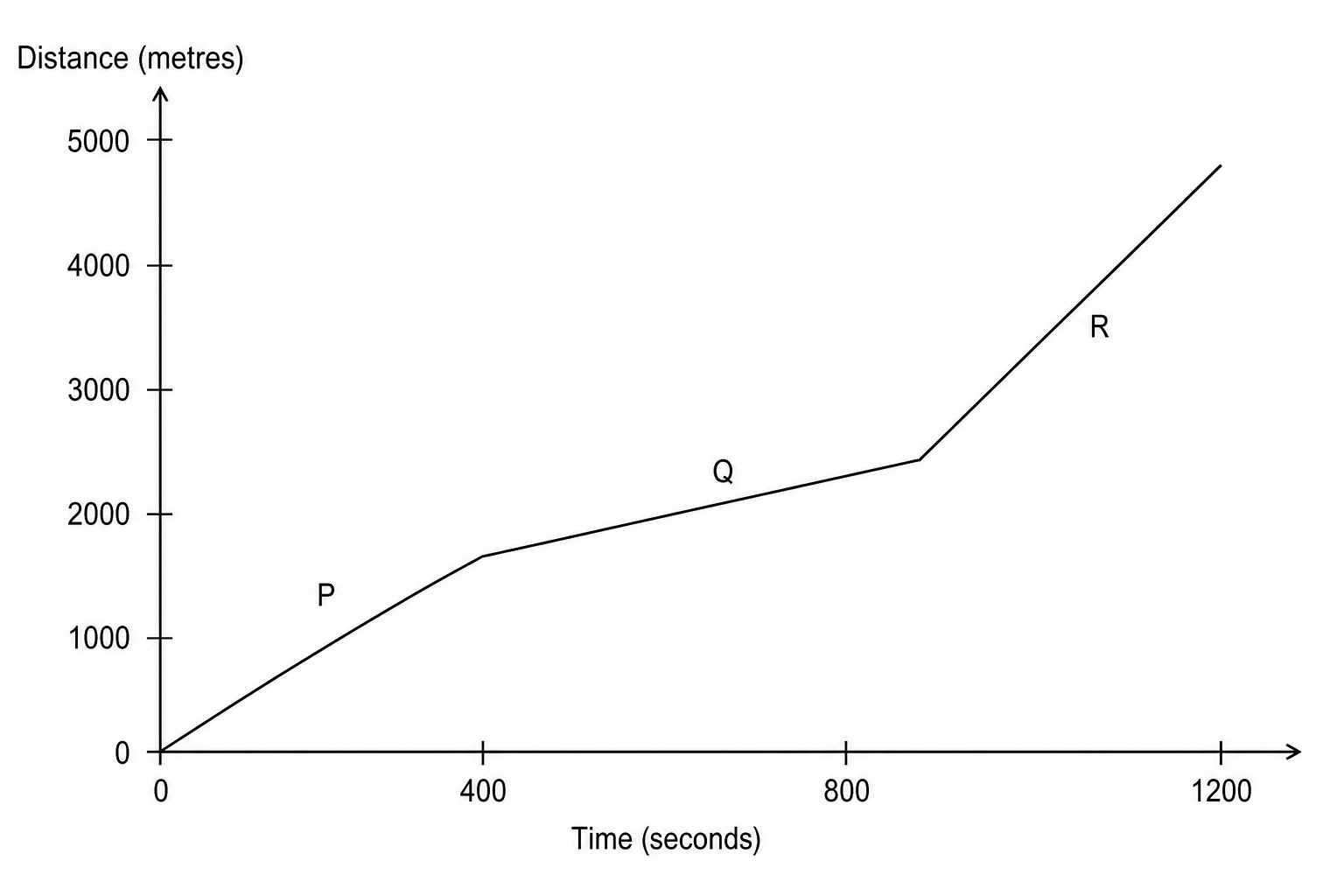
A distance-time graph showing three linear sections for a cyclist's journey. The horizontal axis represents 'Time in seconds' from 0 to 1200 with coordinates marked. The vertical axis represents 'Distance in metres' from 0 to 5000. Section P starts at (0, 0) and goes linearly to (400, 1600). Section Q starts at (400, 1600) and goes linearly to (800, 2400). Section R starts at (800, 2400) and goes linearly to (1200, 4800).

a.

Some physical quantities are scalars and others are vectors.

Which of the following are vector quantities? Select two:

  • Displacement
  • Distance
  • Mass
  • Speed
  • Acceleration
[2]
b.

What was the total distance traveled by the cyclist in 1200 seconds1200\text{ seconds}1200 seconds?

[1]
c.

Calculate the average speed of the cyclist during the entire 1200 seconds1200\text{ seconds}1200 seconds.

[2]
d.

Which section of the graph (P, Q, or R) represents the cyclist riding the slowest? Give a reason for your answer.

[2]
e.

Complete the following sentence:

When riding up a hill, the cyclist did more work against the force of ____________.

[1]

Forces and motion Questions

  1. GCSE
  2. /Physics
  3. /Forces and motion